This article contains affiliate links to booking sites. If you book through them, LOCAL SIDE JAPAN earns a small commission at no extra cost to you. The cheapest way to try Edo Kiriko is described first, and it is not an affiliate link. How this site is made →
TOKYO / SUMIDA CITY / KINSHICHO
Edo Kiriko is cut glass: a clear or colored glass with a pattern ground into it on a spinning wheel, one line at a time, by someone who has been doing it for decades. It started in 1834 in a glass shop near Nihonbashi, survived the move east across the river when the city’s workshops did, and is still made almost entirely in Sumida and Koto, in small buildings that look like nothing from the street.
You can spend ¥4,400 to try it, or ¥21,000. Both are 90 minutes, both end with a glass you cut yourself. Here is the difference, and where the workshops actually are.
On this page
What you are actually looking at
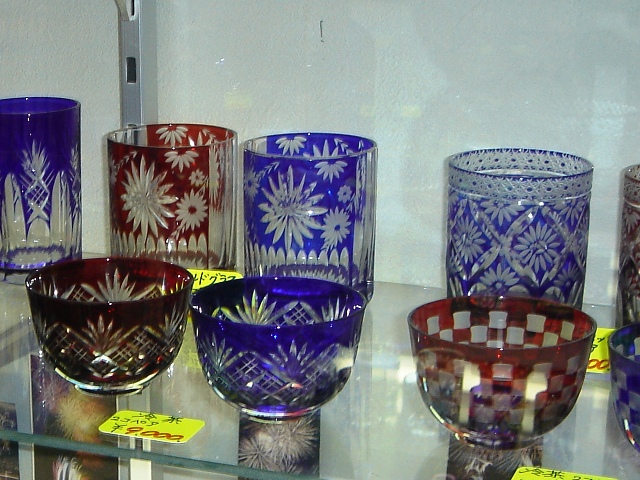
Pick up a piece and turn it. The pattern is not on the surface; it is cut into it, and the cuts catch light from inside the glass. The classic motifs have names: nanako (fish roe, a field of tiny squares), kiku (chrysanthemum), asa-no-ha (hemp leaf), yarai (bamboo fence). A colored piece is two layers, a thin skin of blue or red over clear glass, and every cut exposes the clear beneath, which is why the lines glow white.
Real Edo Kiriko carries the mark of the Tokyo Cut Glass Industrial Cooperative, and the craft is nationally designated. A rocks glass from a good workshop is ¥10,000 to ¥30,000. The ¥1,500 “kiriko-style” tumblers in Asakusa souvenir shops are pressed in a mold; there is nothing wrong with them, but they are not this.
What Edo Kiriko is, in five minutes
Edo Kiriko is cut glass made in Tokyo: a clear glass blank with a thin skin of colored glass on the outside, usually ruby red or lapis blue, into which a craftsman cuts patterns on a spinning wheel until the clear glass shows through in lines. The tradition dates from 1834, when a glass wholesaler called Kagaya Kyubei in Edo began cutting glass with emery, and it survived because the city’s wholesalers kept buying it; it was named a Tokyo traditional craft in 1985 and a national one in 2002. The patterns are the vocabulary: nanako (fish roe, a field of small crosses), kiku-tsunagi (linked chrysanthemums), asa-no-ha (hemp leaf, the six-pointed star), yarai (bamboo fence), and a dozen more, mostly worked from a single grid the cutter draws on the glass by hand. The other famous cut glass, Satsuma Kiriko from Kagoshima, has a thicker colored layer that shades from color to clear; Edo Kiriko is thinner, sharper and cheaper, and it is the one made in the ward this site is written from.
Where to buy Edo Kiriko in Tokyo, and what it costs
- Prices, roughly: a small sake cup (guinomi) from about ¥5,000; a rocks or whisky glass, the thing most visitors want, ¥10,000 to ¥30,000 depending on the pattern density and whether a named cutter made it; a pair in a box ¥30,000 and up; exhibition pieces well over ¥100,000. Anything under ¥3,000 sold as “Edo Kiriko” is machine-pressed or imported; real pieces carry the Edo Kiriko Cooperative’s sticker and a maker’s name.
- The Sumida Edo Kiriko Museum shop (Hirota Glass, Kinshicho), the same place as the workshop below: a full range from one maker at maker’s prices, with the cutters working in the back. Tax-free with a passport.
- The Edo Kiriko Cooperative’s own shop in Kameido, a station east: work from many member workshops in one room, the widest choice of patterns and prices in the city, and staff who will tell you who cut what.
- Tokyo Solamachi at the Skytree and the big department stores (Nihonbashi Mitsukoshi, Ginza) for a boxed gift in a hurry, at a mark-up, with English.
- Carrying it home: the shops box it well; it goes in hand baggage, not the hold. A whisky glass weighs about 300 grams.
The ¥4,400 version: go to the source
The Sumida Edo Kiriko Museum (すみだ江戸切子館) is a working studio and shop run by Hirota Glass, a company that has been making glass in this part of Tokyo since 1899. It is seven minutes’ walk from the north exit of Kinshicho Station, on an ordinary street, and it is certified by Sumida City as one of the ward’s small “museums” of local industry.
- Hours: 10:00 to 18:00. Closed Sunday and Monday.
- Workshop: 90 minutes, three sessions a day (10:30, 13:00, 15:00), reservation required, small groups.
- Price: ¥4,000 plus tax for adults (¥4,400), ¥1,100 for children from about age 10. You cut a pattern into a glass and take it home.
- Language: Japanese first. The staff manage with gestures and short English, and cutting glass does not need much vocabulary; you watch, then you copy.
Book by phone or through their website, in Japanese. If that is a barrier, the front desk of any hotel in Tokyo will make the call in two minutes. The shop upstairs is the best place on the east side to buy a real piece, because the people who cut it are downstairs.
The ¥21,000 version: what the extra money buys
The booking sites sell a 90-minute Edo Kiriko workshop in Sumida for around US$140 to ¥22,000 per person. I want to be clear about what that is: an English-speaking host, a group capped at four, a reservation you can make in thirty seconds in your own language, free cancellation to 24 hours before, and a studio where the artisans are working while you cut. The glass-cutting itself is the same activity.
That is worth ¥17,000 to some people and not to others. If you do not read Japanese, are traveling with children, or have one afternoon and cannot risk a phone call going wrong, it is a reasonable purchase. If you are comfortable being the only foreigner in a room and following by watching, go direct.
- 1.5-Hour Edo Kiriko Glass Cutting Workshop in Sumida (GetYourGuide): from about US$143, 4.8 rating, max four people, English and Japanese, reserve now and pay later.
- The same workshop on Viator: ¥22,000, free cancellation. Use whichever site has the date you need.
There is also a cheaper “sand-carved glass” class in Tokyo for around ¥8,000. Sandblasting through a stencil is a different technique, easier, and produces a frosted design rather than a cut one. It is fine for a rainy afternoon; it is not Edo Kiriko, and the listing should not call it that.
Where the workshops are, if you want to see one
Most Edo Kiriko is cut within two kilometers of Kinshicho and Kameido, in Sumida and Koto. Some workshops have a small shop at the front and will let you watch through a doorway; most do not take visitors and should not be knocked on. The cooperative’s website lists member studios and which ones sell direct. A polite rule: buy something if you go in, and do not photograph the cutters without asking.
Sumida City runs a program of these tiny industry museums (the Edo Kiriko one is the best-known), and it is a good way to see the ward for what it is: a place that still makes things. From Kinshicho it is one stop to Ryogoku, and a twenty-minute walk north to Kyojima and the Kirakira Tachibana shopping street, which is the same idea in food.
Related: Tattoo-friendly sento on the east side: Koganeyu and Daikokuyu are a short walk from here. Cutting your own glass is number two on our list of what to do in Sumida City.
Quick answers
What is Edo Kiriko?
Edo Kiriko is Tokyo’s traditional cut glass: a pattern ground into clear or colored glass on a spinning wheel by hand. It started in 1834 near Nihonbashi and is now made almost entirely in Sumida and Koto wards. Real pieces carry the Tokyo Cut Glass Industrial Cooperative mark.
Where can I try Edo Kiriko glass cutting in Tokyo?
At the Sumida Edo Kiriko Museum (Sumida Edo Kiriko Kan), seven minutes from the north exit of Kinshicho Station, run by Hirota Glass. The 90-minute workshop costs ¥4,400 for adults, runs three times a day, and needs a reservation. Closed Sunday and Monday.
How much does an Edo Kiriko workshop cost?
¥4,400 per adult booked directly with the Sumida Edo Kiriko Museum in Japanese, or about US$143 to ¥22,000 per person for an English-language workshop through GetYourGuide or Viator, which adds an English host, a group of four and free cancellation.
How much does real Edo Kiriko glass cost?
A hand-cut rocks glass from a good workshop is ¥10,000 to ¥30,000. Tumblers sold for around ¥1,500 in souvenir shops are pressed in a mold and are not cut glass.
What is Edo Kiriko?
Cut glass made in Tokyo since 1834: a clear glass blank with a thin colored outer layer, usually red or blue, into which patterns such as fish roe, hemp leaf and chrysanthemum are cut on a wheel so the clear glass shows through. It is a designated national traditional craft, made mainly in Sumida and Koto.
How much does Edo Kiriko cost and where can I buy it?
A sake cup from about ¥5,000, a whisky or rocks glass ¥10,000 to ¥30,000, boxed pairs from ¥30,000. Buy at the Sumida Edo Kiriko Museum shop in Kinshicho, the Edo Kiriko Cooperative shop in Kameido, or Solamachi and department stores at a mark-up. Real pieces carry the cooperative’s sticker.
Two stops south on the Oedo line is Kiyosumi-Shirakawa, the coffee-roaster district with a ¥150 garden and a rebuilt Edo street; it pairs well with a morning workshop here.
Practical notes
- Direct: Sumida Edo Kiriko Museum, 7 min from Kinshicho Station north exit. 10:00–18:00, closed Sun and Mon. Workshop ¥4,400 adults, 90 min, three sessions a day, reservation required (Japanese).
- Booked in English: the GetYourGuide or Viator workshop above, about US$143 / ¥22,000, max 4 people, free cancellation.
- Buying: ¥10,000–30,000 for a real cut rocks glass; look for the cooperative’s mark. Glass goes in checked luggage, wrapped by the shop.
- Kids: the direct workshop takes children from around age 10; the booked one gives younger children a lidded container instead of a glass.
LOCAL SIDE JAPAN checked the museum’s hours, session times and workshop prices against Sumida City’s small-museum listings and the museum’s own information, and booking-site prices against GetYourGuide and Viator, on September 14, 2026. Booking-site prices move with the exchange rate.
If the craft you want is kintsugi rather than glass, there is none on the east side yet; the city’s workshops, area by area, are in Kintsugi Workshops in Tokyo by Area.