This article contains affiliate links to booking sites. If you book through them, LOCAL SIDE JAPAN earns a small commission at no extra cost to you. Walking the street and buying a knife needs no booking at all. How this site is made →
TOKYO / TAITO CITY / KAPPABASHI
Kappabashi is an 800-meter street of about 170 shops that exists to sell restaurants their equipment. Pots the size of bathtubs. Ten thousand identical rice bowls. The plastic sushi in every restaurant window in Japan. And, in about sixteen of those shops, some of the best kitchen knives you can buy anywhere, at prices that make the airport duty-free version look like a joke.
It sits between Ueno and Asakusa, ten minutes’ walk from either, and most visitors do it wrong: they arrive on a Sunday, find half the shutters down, buy a knife from the first shop that speaks English, and put it in their carry-on. Here is how to do it right, in about two hours.
On this page
Fast facts
- Where: Kappabashi Dougu Street, Taito City
- Nearest: Tawaramachi Station (Ginza line) 5 min; Asakusa Station (Tsukuba Express) 5 min; 15 min on foot from Ueno or Asakusa
- Best time: Weekdays, 10:00–17:00. Avoid Sundays, when many shops close
- Budget: About ¥10,000 for a very good stainless gyuto or santoku; about ¥30,000 for a professional one
- Tax-free: Over ¥5,500 with your passport
- Flying home: Checked luggage only — ask the shop to pack it for the plane
What is Kappabashi?
Kappabashi Dougu Street is Tokyo’s restaurant supply district — about eight hundred metres of shops in Taito City, between Ueno and Asakusa, selling the things restaurants are made of: knives, pots, chopping boards, crockery, noren curtains, menu boards, bamboo steamers, and the plastic food samples that sit in Japanese restaurant windows. It has roughly 170 shops, sixteen of which sell knives.
It is also the answer to “where is the knife street in Tokyo”. There is no other street like it in the city, and the knives are the reason most visitors come, although the sign painters and the steamer shop are the reason to walk the whole length of it.
First, the rules nobody tells you
- Not on a Sunday. This is a trade street. Most shops open Monday to Saturday, roughly 10:00 to 17:00, and many close on Sunday, including Tsubaya, one of the knife shops you actually want. Go on a weekday if you can.
- Checked luggage only. A knife in your hand baggage will be confiscated at the airport, every time. Shops pack knives for flying; you still have to put the package in the suitcase you check in.
- Bring your passport. Purchases over ¥5,500 at the main knife shops are tax-free (10%) for visitors, but only with the physical passport, not a photo of it.
- Engraving is usually free. The bigger shops will laser your name or a word onto the blade while you wait or within a day or two. Decide beforehand what you want it to say; “TOKYO 2026” ages better than a joke.
- Cash is not required but is faster. The main knife shops take cards. Some of the smaller crockery and tool shops still prefer cash.
Which Japanese knife should I buy?
If you cook at home and want one knife, buy a gyuto (a Japanese chef’s knife, 210 mm) or a santoku (shorter, taller, better for vegetables and small kitchens). Get it in stainless unless you already know how to care for carbon steel, which rusts if you leave it wet. A properly made stainless gyuto from a Kappabashi shop costs around ¥10,000. Around ¥30,000 buys the knives professional cooks in Tokyo actually use. Above ¥80,000 you are buying a named blacksmith and a story, which is a fine thing to do on a trip, but not necessary for dinner.
Single-bevel knives (yanagiba for sashimi, deba for breaking down fish, usuba for vegetables) are the ones that look most “Japanese” in the window. They are also the ones most likely to sit in a drawer at home. Buy one only if you already fillet fish.
Kappabashi knife prices, in yen
| What | Price on the street | Worth it for |
|---|---|---|
| Stainless santoku, 165–180 mm, machine-made | ¥6,000–10,000 | A first Japanese knife, a gift, a small kitchen |
| Stainless gyuto, 210 mm, good factory brand | ¥10,000–18,000 | Most people; the one knife to buy |
| Clad carbon-steel gyuto or santoku | ¥15,000–30,000 | Cooks who will dry it after every use |
| Hand-forged, named smith | ¥30,000–80,000 | Professionals and collectors |
| Single-bevel yanagiba (sashimi) | ¥15,000–60,000 | Only if you already fillet fish |
| Whetstone, #1000 and #3000 pair | ¥4,000–8,000 | Everyone who buys any of the above |
| Engraving | Usually free, same day or next | Anything you are keeping |
| Tax-free saving | 10% over ¥5,500 with a passport | Bring the physical passport |
Those are shop prices in September 2026 and they move with the yen. Two things do not change: the same knife is cheaper here than in a department store or at the airport, and a ¥10,000 knife you can sharpen will outlast a ¥30,000 knife you cannot. Budget for the whetstone.
Which knife shop in Kappabashi should I go to?
You do not need all sixteen knife shops on Kappabashi Street. Three cover almost everyone; two more are for comparing.
- Kama-Asa (釜浅商店): the easiest first stop. More than 80 knife types laid out by use, staff who explain in English (and French), free engraving, tax-free counter. It is not the cheapest, but you will leave understanding what you bought. They also sell the cast-iron pans and the copper that Tokyo kitchens use.
- Tsubaya (つば屋): the sharpening people. A narrower, more serious shop with a lifetime resharpening promise on what you buy there. Closed Sundays. If you want a knife you will send back to be sharpened in ten years, this is the counter.
- Union Commerce (ユニオンコマース): the shop with the biggest wall of blades on the street and the most English-speaking staff, which makes it the busiest with visitors; prices are fair, the range runs from ¥8,000 gyuto to named smiths, and it is the right place if you want to compare twenty knives in one visit.
- Seisuke Knife (清助刃物): a small shop stocking blades from Sakai, Seki and Echizen smiths rather than one brand, with hand-forged carbon steel for people who know what that means.
- Kamata Hakensha (かまた刃研社): began as a sharpening service and still feels like one. Good for a second opinion, good for whetstones, and the place to ask how to look after the thing you just bought.
Walk the whole street before you pay anything. It takes twenty minutes end to end, and the plastic-food shops, the sign painters, and the shop that sells nothing but bamboo steamers are half the reason to come.
Is Kappabashi a tourist trap?
No — and the simplest proof is who else is shopping there. Kappabashi is a trade street. Its customers are the people who run restaurants in Tokyo, which is why most shops keep trade hours (roughly 10:00 to 17:00, Monday to Saturday) and why several of the best ones, including Tsubaya, close on Sundays. A street built for tourists would open at weekends.
On price, it is the opposite of a trap. The same knife costs more in a department store and considerably more at the airport. A properly made stainless gyuto is about ¥10,000 here, engraving is usually free, and purchases over ¥5,500 are tax-free with your passport. Nobody is charging a visitor premium, because the shop next door is selling to a chef.
Where you can waste money is on yourself. Two ways, and both are common:
- Buying the knife that looks most Japanese rather than the one you will use. The single-bevel blades in the window — yanagiba, deba, usuba — photograph beautifully and live in a drawer. Buy a gyuto or a santoku unless you already fillet fish.
- Buying at the first shop. The street is twenty minutes end to end. Walk it before you pay anything.
The one genuinely touristy thing on Kappabashi is the plastic food — the sample-making workshops are priced for visitors and are fun rather than useful. That is a small corner of a working street, not the street.
The honest warning is a different one: a Japanese knife you cannot sharpen is blunt within a year, and most people fly home without learning how. Budget for a whetstone and an hour of teaching, or buy a cheaper knife.
When it is worth booking something
Buying a knife needs no booking. Two things do, and both are better done here than anywhere else in Tokyo.
Learn to sharpen it before you fly home
A Japanese knife you cannot sharpen is a Japanese knife that will be blunt within a year. The skill takes one lesson to learn badly and a few years to learn well, and the first lesson is worth every yen. Two options, one long and one short:
- Traditional Japanese Knife Sharpening Class (2 hours, English OK): whetstones, the angle, the burr, the test cut. Around ¥15,000. If you are buying a knife over ¥20,000, take this the same day and you will get your money back in blade life.
- Knife Sharpening Basics in 30 Minutes: the short version, around ¥3,300. Enough to stop you ruining the edge; not enough to make you good.
Use the big knife you will never buy
The soba knife, a rectangular cleaver the length of your forearm, is the most photographed blade on the street and the least practical to own. The right way to meet it is a soba-making class: knead, roll, cut with the enormous knife, eat what you made. The Kappabashi soba-making class runs about 50 minutes, costs ¥6,900, and has 110 reviews at 5.0 with 99% of travellers recommending it (checked October 9, 2026 — it was ¥8,900 when we first wrote this, so the price has come down). It is the best thing on this street for children who are bored of pots.
Cook with one before you commit to carrying one home
A ¥30,000 gyuto is a strange thing to buy on the evidence of holding it in a shop for ninety seconds. If you are not sure whether you want a Japanese knife or just want the idea of one, use one first.
The useful coincidence is that the best cooking classes for this are in the same ward. One in Iriya, ten minutes north of here in Taito, starts in a Japanese supermarket — you buy the ingredients first, which teaches you more about Japanese cooking than the cooking does — and it is the cheapest hour in the city worth having. Asakusa, a fifteen-minute walk east, has the most-booked sushi class in Japan. In both you are handed the kind of knife the shops here sell, and after two hours of using one you will know whether you want it. Cooking classes by area, with the prices and what each kitchen actually is → / Sushi classes by area →
One warning that applies to every sushi class in Tokyo and is almost never in the listing: in most of them you never touch the raw fish. The chef cuts it; you shape the rice. If handling the fish is the point for you, ask before booking, not at the counter.
There are also guided “knife town” walks (roughly ¥9,000 to ¥16,000 for 1.5 to 4 hours). They are fine, and they solve the language problem in the smaller shops, but the three shops above speak enough English that most people do not need one. Spend the money on the sharpening lesson instead.
If you are here in October
The street holds its own festival, the Kappabashi Dougu Matsuri, in the second week of October every year; the 2026 dates are October 6 to 12. Shops put out bargain bins, there are stalls in the street, and the crowds are local rather than tourist. It is the one week the street is busy on purpose.
The rest of the day
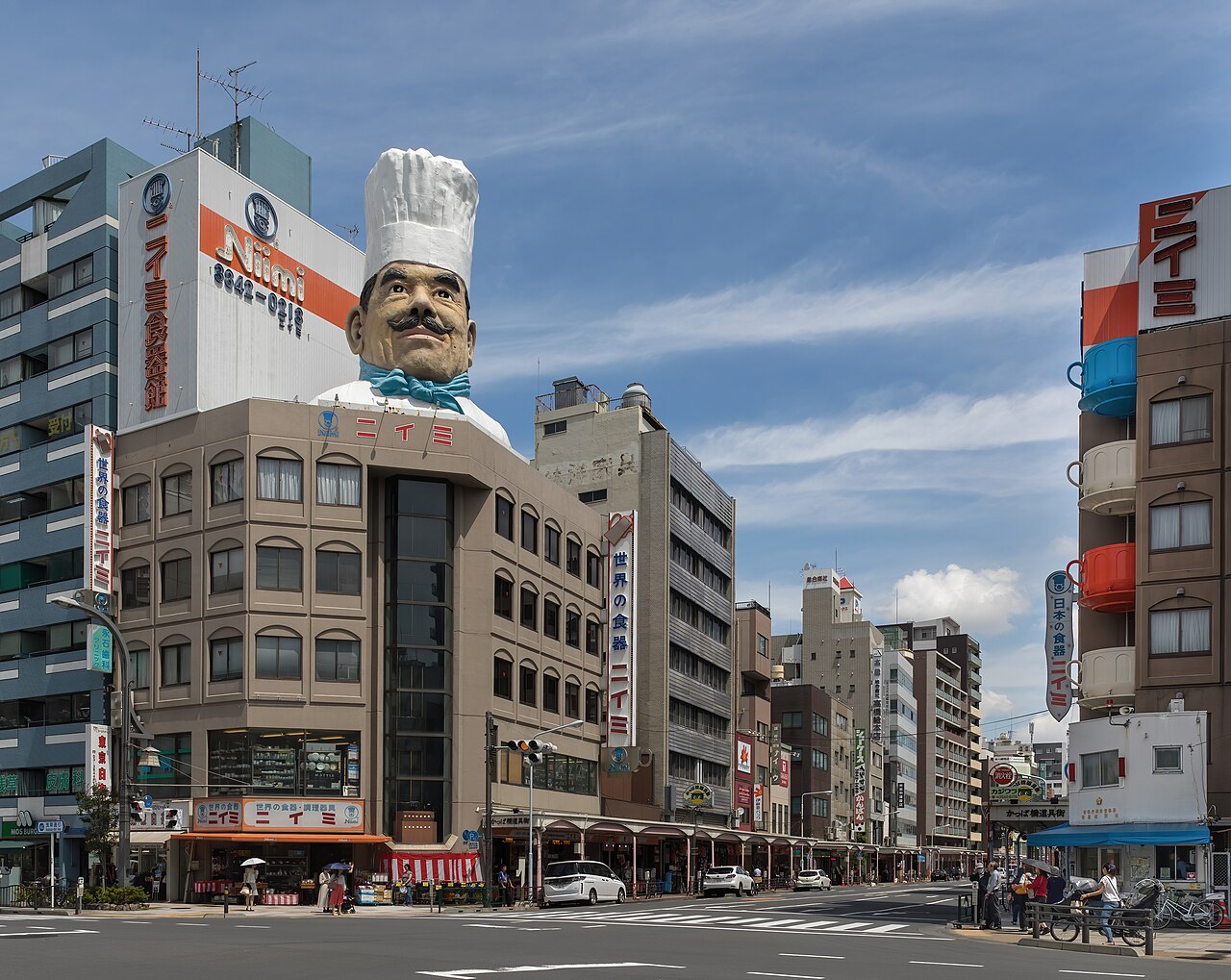
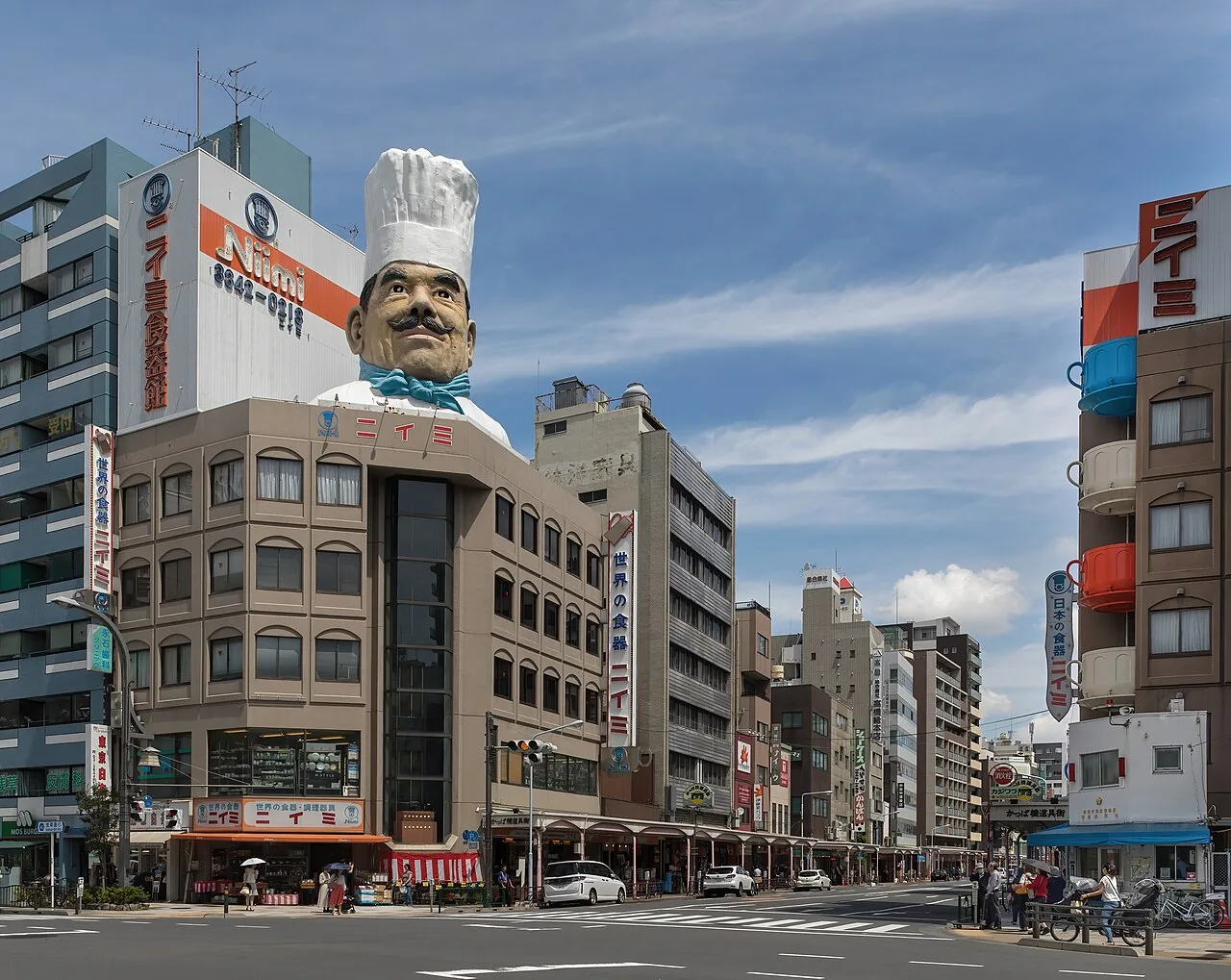
Kappabashi is a straight line between two places you were probably going anyway. Ten minutes east is Senso-ji and Asakusa; ten minutes west is Ueno Park. Fifteen minutes north on foot is Kozukappara and Jokan-ji, the darker end of the old city, if you want the afternoon to have some weight to it. Look up as you walk the street: the giant chef’s head on the Niimi building at the Asakusa end is the landmark everyone uses to meet.
Related: Ramen and soba noodle classes by area — the ¥6,900 studio that makes noodles from flour is on Matsugaya, one street off Kappabashi, so you can learn the cut in the morning and buy the blade in the afternoon. Also Yanaka on a weekday: the free loop from Nippori to Nezu.
Quick answers
What is Kappabashi?
Kappabashi Dougu Street is an 800-meter street of about 170 restaurant-supply shops between Ueno and Asakusa in Taito City, Tokyo, known for professional kitchen knives, cookware, ceramics and the plastic food models seen in restaurant windows.
How much do knives cost on Kappabashi Street?
A stainless santoku is ¥6,000 to ¥10,000, a good 210 mm gyuto ¥10,000 to ¥18,000, clad carbon steel ¥15,000 to ¥30,000, and hand-forged knives by named smiths ¥30,000 to ¥80,000. Whetstones ¥4,000 to ¥8,000. Purchases over ¥5,500 are tax-free with a passport, and engraving is usually free.
Is Kappabashi open on Sunday?
Mostly no. It is a trade street: most shops open Monday to Saturday, roughly 10:00 to 17:00, and many, including the knife shop Tsubaya, close on Sunday. Go on a weekday.
How much does a good Japanese knife cost in Kappabashi?
A well-made stainless gyuto or santoku from a Kappabashi shop costs around ¥10,000. Around ¥30,000 buys the knives Tokyo’s professional cooks use. Purchases over ¥5,500 are tax-free for visitors with a passport.
Can I take a knife bought in Japan on the plane?
Only in checked luggage. A knife in carry-on baggage will be confiscated. Kappabashi shops will pack the knife for air travel, but you must put it in the suitcase you check in.
When is the Kappabashi festival?
The Kappabashi Dougu Matsuri is held in the second week of October each year. The 2026 dates are October 6 to 12.
Practical notes
- Where: Kappabashi Dougu Street, Taito City. Tawaramachi Station (Ginza Line), 5 minutes; Asakusa Station (Tsukuba Express), 5 minutes; Ueno or Asakusa on foot, about 15.
- When: weekdays, 10:00 to 17:00. Avoid Sundays. Festival: October 6 to 12, 2026.
- Budget: ¥10,000 for a very good stainless gyuto or santoku; ¥30,000 for a professional one. Tax-free over ¥5,500 with passport.
- Flying home: checked luggage only. Ask the shop to pack it for the plane.
- Worth booking: the 2-hour sharpening class if your knife costs more than ¥20,000; the soba class if you have kids or two hours to spare.
LOCAL SIDE JAPAN checked shop counts, opening patterns and festival dates against the Kappabashi Dougu Street association (kappabashi.or.jp) and the shops’ own notices on September 14, 2026. Prices for classes are quoted as ranges from the booking sites on that date and change with the exchange rate.