Arakawa & Taito

  • What they are: Two neighbouring wards at the top of old Edo. Taito holds Asakusa, Ueno, Kappabashi and Yanaka; Arakawa holds Minowa, Minamisenju and Nippori.
  • Area: Taito 10.11 km² — the smallest of the 23 wards. Arakawa 10.16 km², the 22nd. Together they are smaller than Adachi by itself.
  • Population: Taito 217,496 in 138,806 households (1 September 2026). Arakawa 222,278 in 125,357 households (1 January 2025).
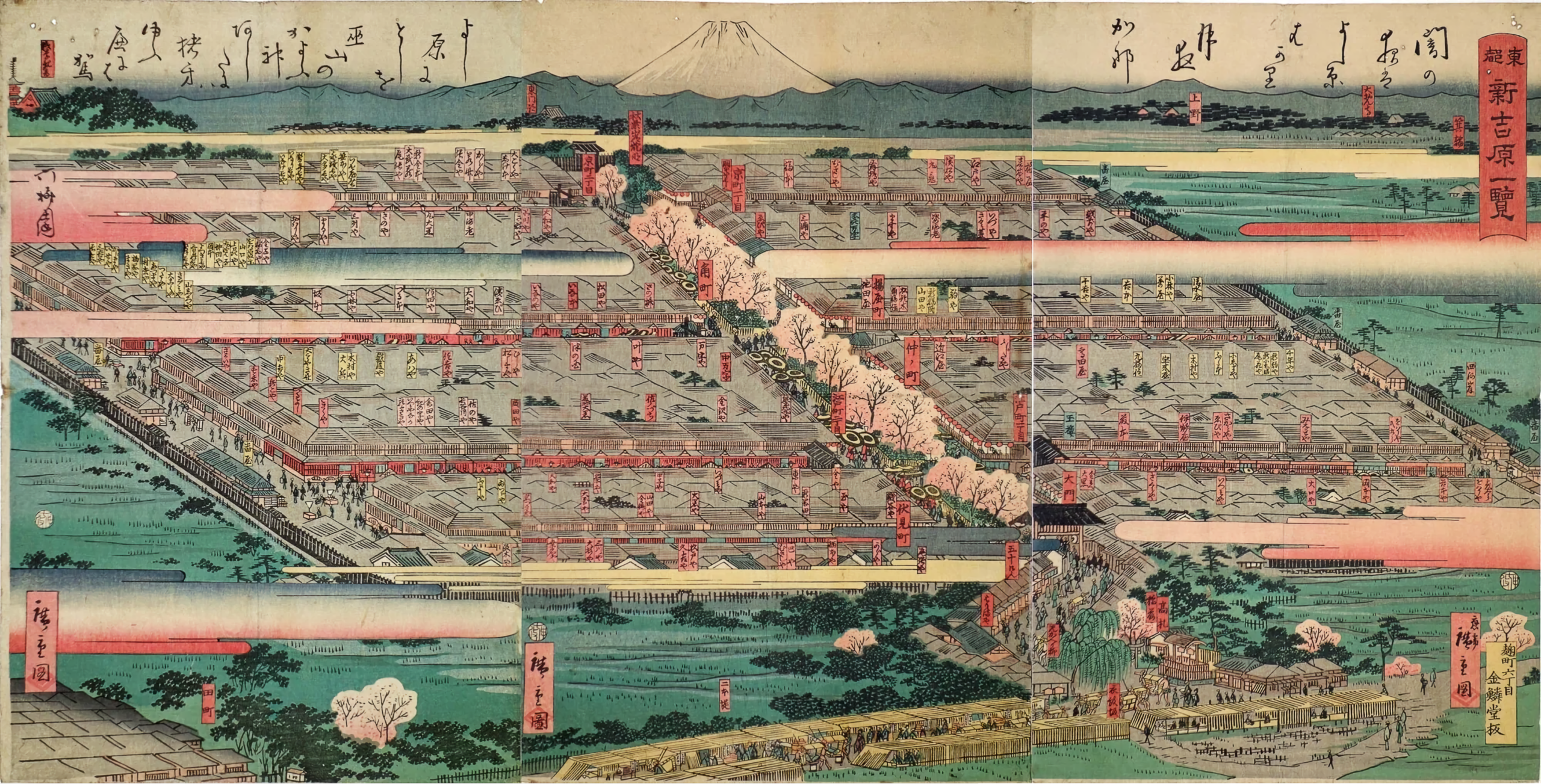
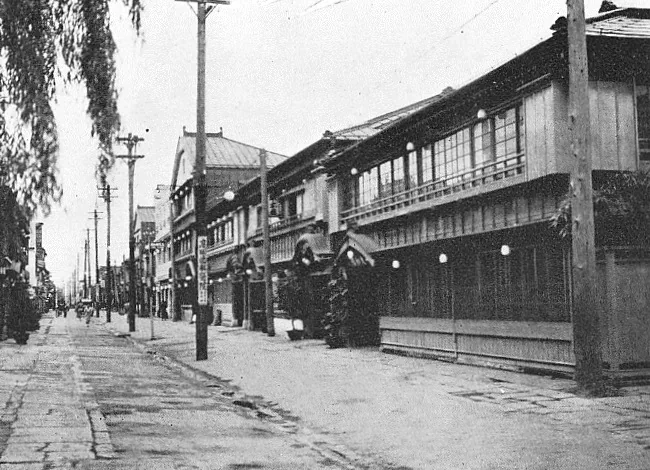
  • Known for: Senso-ji and the Asakusa crowds, Ueno’s museums, Kappabashi’s knife shops, Yanaka’s surviving old town, and the Yoshiwara licensed quarter that used to be here.
  • Nearest hubs: Asakusa, Ueno, Nippori. Four separate stations are called Asakusa — check which line your booking means.

Where are Taito and Arakawa?

They sit side by side on the west bank of the Sumida River, directly north-east of central Tokyo. Taito is the smallest of the 23 wards at 10.11 square kilometres and Arakawa is the 22nd at 10.16 — together they are smaller than Adachi on its own, and they hold more of what visitors come to Tokyo for than any other pair of wards in the city. You can walk from Senso-ji to Ueno in half an hour and from Ueno to Yanaka in another twenty minutes.

What is in Asakusa?

Senso-ji, Nakamise, the rickshaws, and almost everything this site writes about doing with your hands. Asakusa is where Tokyo sells its traditional crafts to visitors, and the honest question is always which hour is worth the money:

One practical warning before you book anything here. Four separate stations are called Asakusa: the Ginza line, the Toei Asakusa line and the Tobu Skytree line are two to five minutes apart, but the Tsukuba Express station of the same name is on the far side of Senso-ji and is not a transfer station at all. If a confirmation says only “Asakusa Station”, ask which line and which exit.

What else is worth your time in Taito?

What is Arakawa known for?

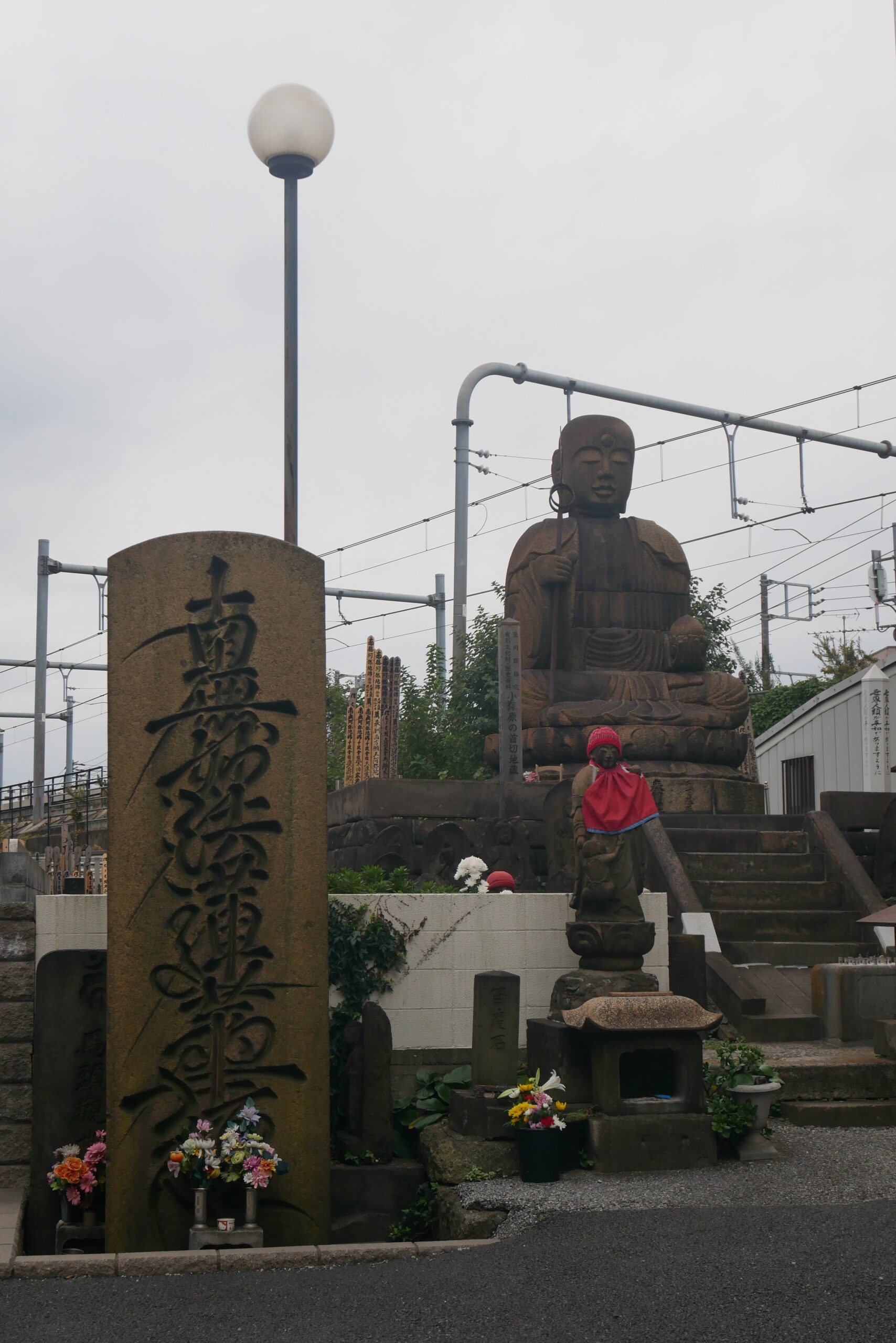
Arakawa is what is left over when the famous parts of Taito end, and it is where the city kept the things it did not want to look at. Jokanji is the temple where the women of the Yoshiwara licensed quarter were buried, a minute from Minowa Station. Kozukappara is the execution ground beside Minami-Senju, which most people walk past without knowing. Both are free, both are quiet, and both are ten minutes from Asakusa.

Arakawa also still has the Toden Arakawa line, Tokyo’s last surviving tram, which runs from Minowabashi west across the top of the city.

Is Asakusa worth visiting?

Yes, and almost everyone does it wrong by arriving at the wrong hour. Nakamise after 10:00 is a queue. The same street at 07:00 is empty, the temple is open, and the photographs contain you and the gate rather than four hundred other people. Do Senso-ji first thing, do the workshops mid-morning, and be out of the district by early afternoon — Kappabashi, Yanaka and the river are all within twenty minutes and all quieter.

How do I get here?

Asakusa: Ginza line from Ueno or Ginza, Toei Asakusa line, Tobu Skytree line. Ueno: every JR line, plus the Ginza and Hibiya lines. Nippori for Yanaka, and the Keisei Skyliner from Narita stops there, which makes Yanaka the easiest first neighbourhood in Tokyo to see straight off a plane. Minowa on the Hibiya line for Jokanji and the tram.

Every Taito and Arakawa guide on this site

  • Tea Ceremony in Tokyo by Area: The Real Ones, the Kimono Ones, and What They Cost (2026)

    Tea Ceremony in Tokyo by Area: The Real Ones, the Kimono Ones, and What They Cost (2026)

    This article contains affiliate links to booking sites. If you book through them, LOCAL SIDE JAPAN earns a small commission at no extra cost to you. The tea ceremonies are ranked by what you get for the money, not by what pays; the one this site recommends most costs ¥6,500 and the one it recommends least costs more. How this site is made →

    TOKYO / EXPERIENCES / TEA CEREMONY, BY AREA

    “Tea ceremony in Tokyo” now means two different products sold under one name. One is a tea ceremony: a small tatami room, a host who has trained for years in one of the tea schools, a bowl of matcha made in front of you with the movements that have not changed since the 1500s, and an hour in which nothing else happens. The other is a kimono photo session with a bowl of matcha at the end, and there is nothing wrong with it, except when you wanted the first thing and paid for the second. This is every tea ceremony you can book in Tokyo, by area, sorted into those two kinds, with what each costs and who it is for. Prices, durations, meeting points and review counts were read on the booking sites on September 21, 2026.
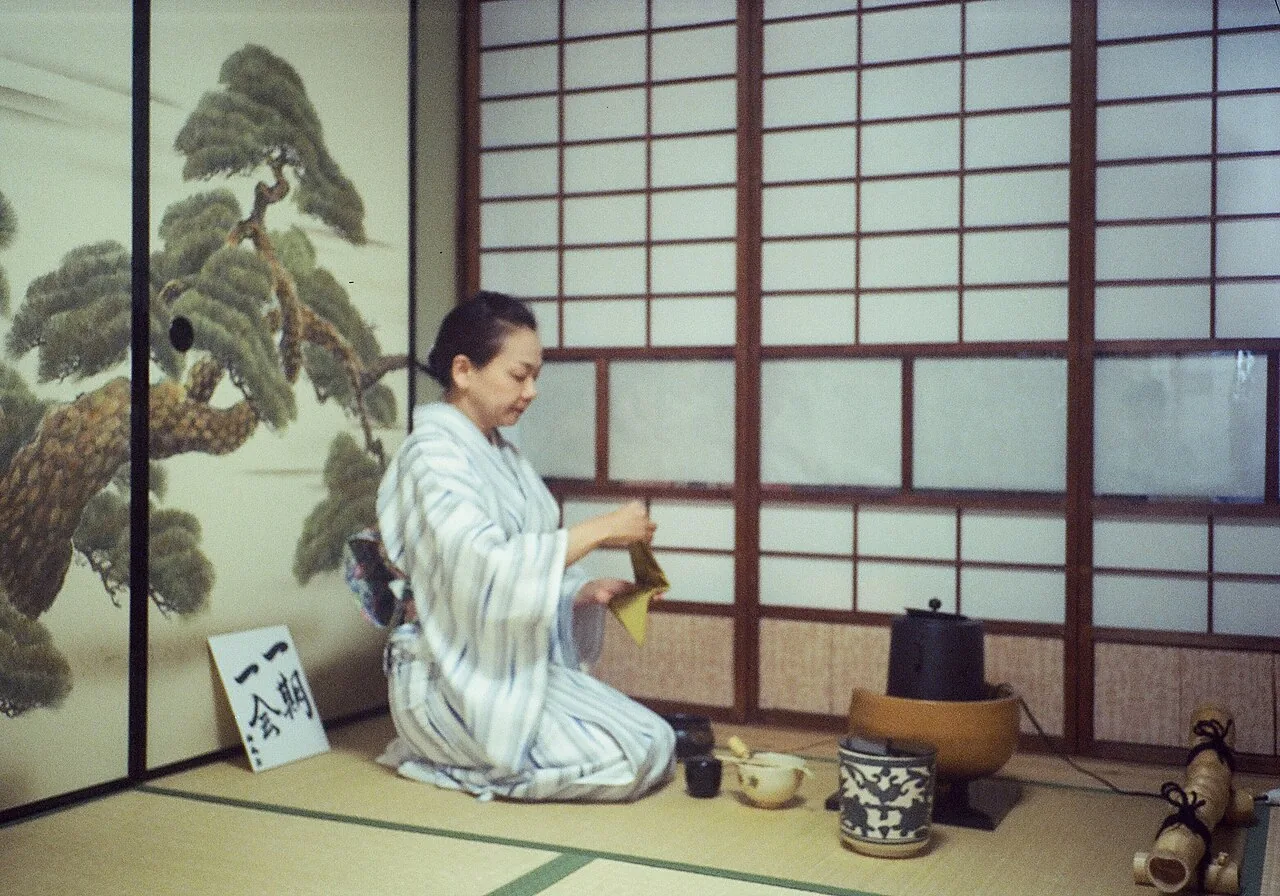
    Tea ceremony host in kimono preparing matcha in a tatami room
    A host preparing tea. The calligraphy behind her reads ichigo ichie, “one meeting, once”, which is the whole idea. Photo: Atticus Nguyen / Wikimedia Commons, CC BY-SA 4.0.

    First, the two kinds of tea ceremony you can book

    Tea first. Forty minutes to ninety in a proper tearoom, seated on tatami (a stool if your knees object), where the host makes tea for you, explains the objects, and then has you whisk a bowl yourself. A sweet, two bowls, some history, silence you did not expect to enjoy. These cost ¥3,500 to ¥8,000 and the good ones are run by people licensed by Urasenke or Omotesenke, the two big schools, and will say so.

    Kimono first. Ninety minutes of which the first thirty are being dressed in a rental kimono and the last fifteen are photographs, with a short, real tea ceremony in the middle by a host who does this twelve times a day. ¥8,000 to ¥15,000. The photographs will be good and the tea will be fine; you are paying for the costume. If that is what you want, the section below tells you which; if you want the tea, do not book these, because the ¥2,500 matcha hour in the Asakusa workshops ranking teaches you more for a third of the money, and so does everything in the “tea first” list.

    Tea ceremonies in Tokyo, area by area

    Kuramae and Asakusa: the most choice, and the best one

    Tea Ceremony Workshop by an Official Instructor is the one to book if you read no further. It is held in a private house in Kotobuki, three minutes from Kuramae Station and ten from Senso-ji, by a school licensed by Urasenke in Kyoto: ninety minutes, several kinds of tea and three sweets, ¥6,500, 4.9 from about 200 reviews. Tea first, in a real room, at a price the kimono places charge for the photographs. Nearby, on the tourist side of Kaminarimon, the Tea Ceremony Experience at Tokyo Tourist Lounge Asakusa is the relaxed version in a lounge rather than a tearoom, one hour, about ¥5,600, 5.0 from over 200 reviews, and honest in its own listing that it is designed for novices; and a 50-minute session with a tea master is the cheapest in the district at about ¥3,500, new and unreviewed. For the tea itself rather than the ritual, Matcha Experience with Japanese Tea Tasting, run by a former tea farmer in Kotobuki, tastes seven teas in ninety minutes for about ¥9,800, 5.0 from about 40 reviews.

    Kimono first, in Asakusa: Kimono Tea Ceremony at Maikoya Asakusa is the biggest operator in the category, ninety minutes, about ¥8,100, 4.9 from 727 reviews, dressing included, and it is exactly what it says: well run, formal room, good photographs, a real if brief ceremony. Two things before you book it: its cancellation policy is absolute — nothing refunded inside 24 hours, illness included, which the operator confirms in writing — and guests who paid for the private version describe a plain room with designated photo spots rather than the tearoom in the pictures. Both are below. Its two-hour version with sweets making is about ¥20,350, up from about ¥14,400 a month earlier. The small-group kimono tea ceremony near the Skytree is the same format from a smaller operator, about ¥9,800, 5.0 from over 200 reviews, and the one to choose if you want fewer people in the room.

    Yanaka and Bunkyo: the tearooms nobody advertises

    Two of the most authentic settings in the city are in the quiet wards north of Ueno. Tea Ceremony in a Small Tea Room is held at Senrakuan, a purpose-built tearoom in Sendagi, five minutes from the Yanaka Ginza steps: one hour, about ¥8,000, an English-speaking instructor, and a room the size the ritual was designed for. Do it after the Yanaka walk. Traditional Tea Ceremony with a Japanese Tea Master at OCHARU in Hongo, near the University of Tokyo, is a small-group hour with rare teas and a certificate, about ¥6,000, 4.8 from about 55 reviews. Neither has a kimono, which is the point.

    Shibuya: the cheapest, and the private one

    Shibuya Authentic Tea Ceremony: fifty minutes on the second floor of a building on Dogenzaka, small group, history and a bowl you whisk yourself, about ¥3,900, 5.0 from about 65 reviews. The best value in the city for a tea-first hour, in the least tea-like neighborhood. Private Japanese Tea Tasting and Matcha Ritual in Shibuya is the private version in a Japanese-style room, one hour, about ¥5,000, 5.0 from about 30 reviews.

    Shinjuku: kimono first, done properly

    Maikoya Shinjuku is the same operator as Asakusa in a newer room, ninety minutes, about ¥8,100, 5.0 from a smaller number of reviews; book it if your hotel is west and you want the kimono without the Asakusa crowds. Matcha Kimono Tea Ceremony in Tokyo, near Yotsuya, uses a simplified kimono you can put on yourself and spends more of the ninety minutes on the tea, about ¥9,000, 4.9 from about 110 reviews.

    Tokyo Station and Ginza: for people with an hour between things

    Private Japanese Tea Ceremony in the Tokyo Station Area: ninety minutes, private, from about ¥12,000 with group pricing, new. The price is for the privacy and the location; the tea is the same tea. Ginza’s listings are mostly thirty-minute demonstrations attached to something else, and are not worth a special trip.

    The east side: none in Sumida or Koto, and where to go instead

    There is no bookable tea ceremony east of the Sumida River; Kuramae and Asakusa, on the west bank, are the closest, and the Urasenke house in Kotobuki is a ten-minute walk from the river walk. What the east side has is the settings: Kiyosumi Garden in Koto has a tea pavilion over its pond that serves matcha and a sweet for a few hundred yen with no ceremony and no booking, and Mukojima Hyakkaen in Sumida does the same in season. Neither is a lesson; both are the thing the lesson is about.

    Which tea ceremony to book

    If you wantBookAreaAbout
    The real thing, best valueTea Ceremony Workshop by an Official Instructor (Urasenke-licensed)Kuramae¥6,500 · 90 min · 4.9 (206)
    The cheapest real hourShibuya Authentic Tea CeremonyShibuya¥3,900 · 50 min · 5.0 (65)
    A proper tearoom, quiet areaTea Ceremony in a Small Tea Room (Senrakuan)Sendagi / Yanaka¥8,000 · 1 h
    Kimono and photographsKimono Tea Ceremony at MaikoyaAsakusa or Shinjuku¥8,100 · 90 min · 4.9 (725)
    Kimono, smaller groupTea Ceremony in Asakusa with Kimono, Matcha and WagashiAsakusa / Skytree¥9,800 · 90 min · 5.0 (222)
    Nervous, first time in JapanTea Ceremony Experience at Tokyo Tourist LoungeAsakusa¥5,600 · 1 h · 5.0 (227)
    The tea itself, seven kindsMatcha Experience with Japanese Tea TastingKotobuki¥9,800 · 90 min · 5.0 (38)
    Private, centralPrivate Tea Ceremony, Tokyo Station areaMarunouchifrom ¥12,000 · 90 min

    What to know before you sit down

    • Knees: every listing above offers a stool or a chair if you ask. Ask when you book, not when you arrive.
    • Socks: you will take your shoes off. Clean socks without holes are the only dress code that matters.
    • Which school: Urasenke and Omotesenke are the two large ones and differ in details you will not notice; a host who names a school has trained for years, and that is the thing to look for in a listing.
    • The bowl: turn it twice clockwise before drinking, to avoid drinking from the front the host presented to you; turn it back after. That is the whole of the etiquette a guest needs, and the host will show you anyway.
    • Photographs: at kimono sessions, expected. At tea-first sessions, ask, and put the phone away during the making.
    • Children: the Tourist Lounge and Maikoya sessions take them; the Kuramae and Sendagi tearooms are better for anyone over ten who can sit still.

    What the reviews say, and what they mean

    The fourteen listings on this page carry about 1,782 reviews, and 727 of them sit on one operator. On 3 October 2026 I read every review rated three stars or below on the listings with a usable record, and the operators’ replies.

    Where the low reviews are

    ListingReviewsRated 3★ or below
    Maikoya Asakusa (kimono first)72711 (1.5%)
    Tokyo Tourist Lounge, Asakusa2333 (1.3%)
    Small-group kimono, near the Skytree2230
    Official Instructor, Kuramae2064 (1.9%)
    Matcha Kimono, Yotsuya1113 (2.7%)
    Shibuya Authentic660
    Maikoya Asakusa, two-hour version621 (1.6%)
    OCHARU, Hongo563 (5.4%)
    Matcha Experience, tea tasting380
    Maikoya Shinjuku320
    Private tasting, Shibuya280
    Senrakuan / 50-min tea master / Tokyo Station private0—

    Three listings have no reviews, including Senrakuan in Sendagi, which this page recommends on the strength of the room rather than the record. That is a judgement, not a measurement, and it is fair to say so.

    Maikoya: the cancellation policy is the thing to know

    Eleven low reviews in 727 is not a bad rate for the busiest operator in the category. But one of them is worth the whole section. A guest who cancelled inside 24 hours with food poisoning was refused a refund, and the operator’s public reply sets out the rule exactly: cancellations inside 24 hours are “non-refundable in all cases, except in the event of large-scale natural disasters or transportation shutdowns” (February 2026). Date changes are offered “where circumstances allow”, refunds are not.

    If you are booking a kimono tea ceremony on a day you might be ill, jet-lagged or delayed, that is the sentence to read twice. It is applied uniformly and the operator says so plainly, which is at least honest; it is also stricter than most things on this site.

    The second thing is about the room. A guest who paid ¥72,000 for a private ceremony for two in December 2025 described fluorescent lighting, “minimal decorations”, the sound of other ceremonies through the walls, and specific corners set up to photograph well with the rest of the space empty. This page says at the top that with the kimono-first bookings you are paying for the costume and the photographs. That review is what that sentence looks like at the top of the price range. Two further reviewers say solo guests get less of the host’s attention than groups.

    Where no complaint repeats

    The small-group kimono ceremony near the Skytree (223 reviews, three at four stars, nothing lower), the Shibuya hour (66), the private Shibuya room (28), the seven-tea tasting in Kotobuki (38) and Maikoya’s own Shinjuku branch (32) have no review below four stars between them. The Kuramae Urasenke workshop this page recommends first has four in 206 and no pattern among them.

    OCHARU in Hongo shows three in 56, which is the highest rate on the page, but 56 reviews is a small enough base that three can be three bad afternoons rather than a fault. Worth knowing, not worth avoiding.

    Which of these are made for foreigners

    The tea-first half of this page is priced close to the Japanese market. The kimono-first half is not, and that is the clearest split this series has found.

    The Ochanomizu Urasenke tea school, on the third floor of the Ikenobo building five minutes from JR Ochanomizu, charges Japanese students ¥3,500 a lesson for beginners and ¥4,500 thereafter, mizuya fee included, with no joining fee and no annual fee (checked 3 October 2026). Instruction is in Japanese.

    • Tea first: ¥3,500–¥8,000. The Shibuya hour at ¥3,900 is the Japanese price. The Kuramae Urasenke workshop at ¥6,500 is under twice it, for ninety minutes, several teas, three sweets and English. On any reading that is a fair price for the language and the one-off.
    • Kimono first: ¥8,100–¥9,800 for ninety minutes; ¥20,350 for Maikoya’s two-hour version with sweets making. Two to three times a Japanese lesson for the ninety-minute sessions, and the tea inside it is shorter. The gap is the kimono, the dresser and the photographs, which are real costs — a full kimono set with hair is ¥3,850 at a Japanese shop in Asakusa, so roughly ¥4,000 of the gap is accounted for and the rest is the room and the photographer.
    • ¥72,000 for two is a different product entirely and should be judged as a private photo session, not as tea.

    None of this is a foreigner surcharge in the way the word is usually meant. It is the same thing this page already says: decide first whether you want the tea or the photographs, because the two cost different money and the listings deliberately blur them. If it is the tea, a Japanese school will teach you for ¥3,500 and the English-language tea-first hours start at ¥3,900.

    Where this joins the rest of the east side

    Tea ceremony is one of the seven hours ranked in Asakusa Workshops: Which Hour Is Worth ¥7,000, where the ¥2,500 matcha class is the recommendation. The other experiences compared by area are kintsugi and sushi classes, plus kimono rental by price , samurai and ninja experiences by kind and Japanese cooking classes and the quiet crafts — whose ¥2,500 matcha-making hour in Asakusa is the cheapest way to learn the whisking without the ceremony — and the east side’s own are Edo Kiriko glass and knives on Kappabashi. Everything bookable is on the Experiences page.

    Quick answers

    Where is the best tea ceremony in Tokyo?

    For an authentic ceremony at a fair price, the Urasenke-licensed workshop in a private house in Kotobuki near Kuramae and Asakusa: ¥6,500 for 90 minutes, 4.9 from about 200 reviews. For a kimono and photographs, Maikoya in Asakusa or Shinjuku, about ¥8,100. For the cheapest real hour, the Shibuya tea ceremony on Dogenzaka, about ¥3,900.

    How much does a tea ceremony cost in Tokyo?

    ¥3,500 to ¥8,000 for a tea-first session of 50 to 90 minutes in a tearoom; ¥8,000 to ¥10,000 for a kimono-and-tea session where dressing and photographs take most of the time (about ¥20,000 for a two-hour version with sweets making); ¥12,000 and up for private sessions in central Tokyo.

    Is a tea ceremony in Asakusa worth it?

    Yes, if you choose the right kind. Asakusa and neighboring Kuramae have the widest choice in Tokyo, from a ¥3,500 fifty-minute session to the Urasenke-licensed ¥6,500 workshop to Maikoya’s ¥8,100 kimono version. Decide first whether you want the tea or the kimono.

    Tea ceremony with or without kimono?

    Without, if you want to learn about tea: the dressing takes 30 minutes of a 90-minute session and the ceremony is shortened to fit. With, if you want the photographs; Maikoya and the small-group Asakusa session are the well-run ones.

    Is there a tea ceremony in Sumida or east Tokyo?

    No bookable ceremony east of the river. Kuramae and Asakusa on the west bank are closest. Kiyosumi Garden in Koto serves matcha and a sweet in its pond-side pavilion without a ceremony or booking, for a few hundred yen.

    What should I wear to a tea ceremony?

    Anything you can sit on the floor in, and clean socks, because shoes come off. Kimono sessions provide the kimono. A stool or chair is available at every listing above if kneeling is a problem; ask when booking.


    LOCAL SIDE JAPAN read the prices, durations, meeting points, inclusions and review counts of every session above on Viator on September 21, 2026. Prices are approximate and move with the exchange rate; several use group pricing. This is a researched comparison of the listings and their reviews, not a firsthand report on each tearoom, and the article says so here rather than pretending otherwise. Nothing was provided free by an operator.
    Written by Kizuku. I run the Sunamachi Ginza Sumo Stable, a sumo experience in Koto City, and I write about the east side of Tokyo I live and work in. More about this site →

  • Kintsugi Workshops in Tokyo by Area: Asakusa, Shinjuku, Shibuya, Aoyama, Ginza (2026)

    Kintsugi Workshops in Tokyo by Area: Asakusa, Shinjuku, Shibuya, Aoyama, Ginza (2026)

    This article contains affiliate links to booking sites. If you book through them, LOCAL SIDE JAPAN earns a small commission at no extra cost to you. The workshops are ranked by what you get for the money, not by what pays; the cheapest one is also the best reviewed. How this site is made →

    TOKYO / EXPERIENCES / KINTSUGI, BY AREA

    Kintsugi, the repair of broken pottery with lacquer and gold, has become the workshop everyone in Tokyo wants to book, and there are now a dozen places to do it, from a ¥1,500 hour above a whisky shop in Kabukicho to a ¥23,000 afternoon with a master in Aoyama. They are not the same thing. Real kintsugi takes months, because natural lacquer cures slowly; every workshop that sends you home the same day with a finished piece is using a fast version, and the price mostly buys the setting, the group size and how honest the teacher is about that. Here are the workshops in Tokyo by area, what each actually does, and which to book depending on what you want out of the hour. Prices and reviews were read on the booking sites on September 21, 2026.

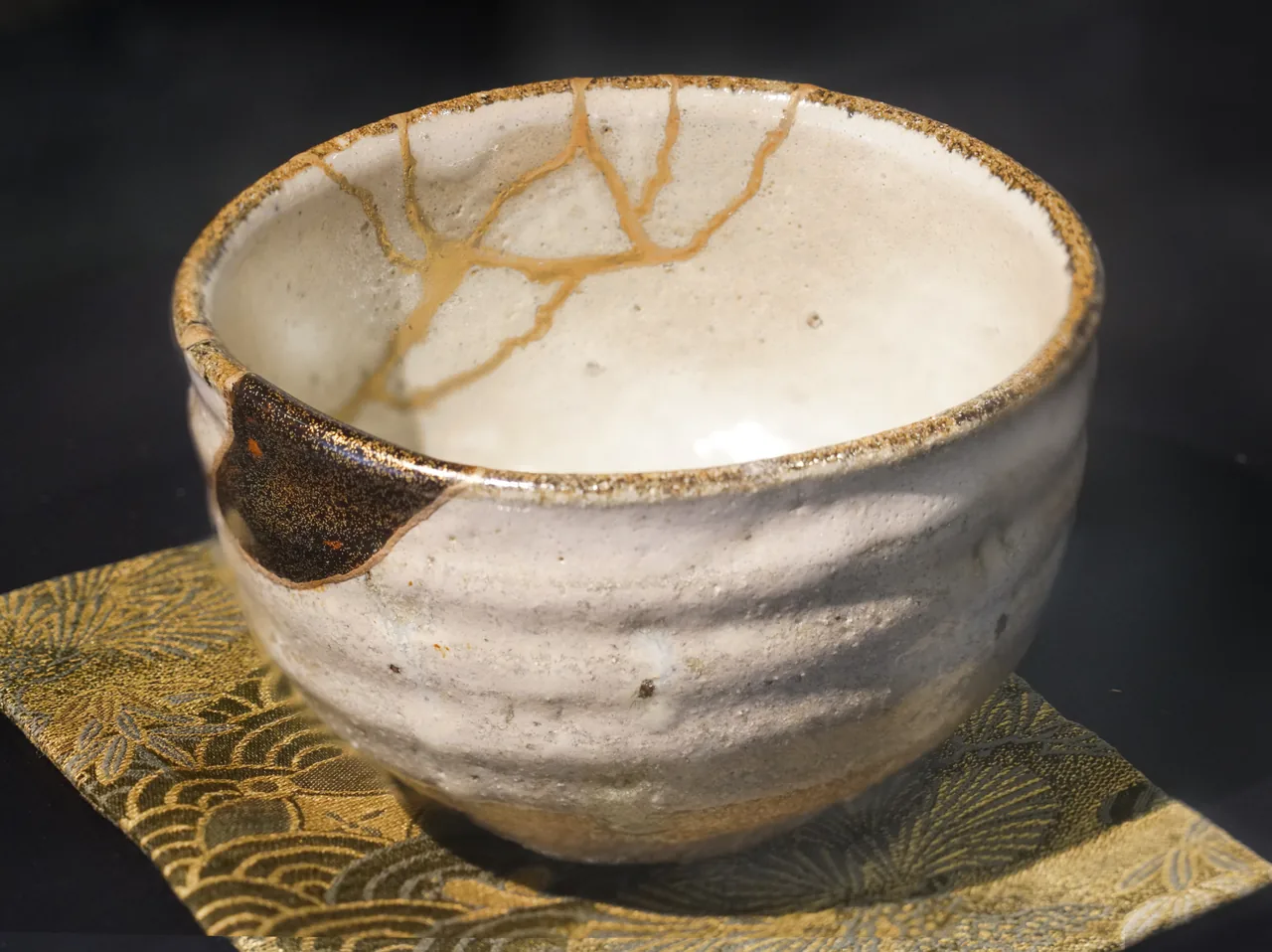
    Tea bowl repaired with kintsugi gold lacquer seams
    A tea bowl with real kintsugi: lacquer seams dusted with gold, months in the making. Your workshop piece will look like this by the end of the hour, and that is the point to understand first. Photo: Jean-Pierre Dalbéra / Wikimedia Commons, CC BY 2.0.

    Fast facts

    • Cheapest: ¥1,500, Kabukicho, Shinjuku — one hour
    • Most reviewed: Asakusa, 4.9 from over 1,200 reviews, from ¥2,400
    • Real urushi and real gold: Minami-Aoyama, ¥9,900 for an hour or ¥23,000 for two with the master
    • Dearest: ¥27,800, Dogenzaka, Shibuya — two hours, with matcha
    • Duration: one to two hours. You take the piece home the same day
    • On the east side: none. The nearest to Sumida and Koto is Asakusa
    • Booking: in advance. These are studios of six to twelve people, not drop-in shops

    What is kintsugi?

    Kintsugi is the Japanese craft of repairing broken pottery with lacquer and gold, so that the break is highlighted rather than hidden. The name means “golden joinery”. Traditionally the pieces are glued, filled and built up with urushi, the sap of the lacquer tree, each layer curing for days in a humid box, and gold powder is dusted onto the final wet layer. A full traditional repair takes six weeks to three months.

    The idea behind it is the reason people want to do it: a repaired bowl is not a damaged bowl, it is a bowl with a history, and the repair is made the most visible thing about it.

    Is a one-hour kintsugi workshop real kintsugi?

    Traditional kintsugi uses urushi, the sap of the lacquer tree, to glue the pieces, fill the gaps and build the seam, with each layer curing for days in a humid box before the next; the gold powder goes on last, onto wet lacquer, and the whole repair takes six weeks to three months. Nobody can do that in an hour. What the workshops do is kan’i kintsugi, “simplified kintsugi”: the pieces are joined with a fast-curing adhesive or a synthetic lacquer, the seam is painted, and brass or gold powder is dusted on. It looks the same across a table, it is food-safe or not depending on the materials (ask), and it teaches you the hand movements and the idea. A few workshops use real urushi for one stage and real gold for the finish, and charge accordingly. None of this makes the cheap ones a con; it makes them an introduction, which is what most people want. The honest question is whether the teacher tells you. The good ones do, unprompted.

    How much does a kintsugi workshop cost in Tokyo?

    • ¥1,500–¥2,400 — one hour, simplified method, a small provided plate. Shinjuku and Asakusa. Budget another ¥2,000–¥5,000 if you want a piece worth keeping.
    • ¥4,900–¥6,600 — an hour making a gold-seamed pendant or earrings instead of a plate. The better souvenir if you would never use a repaired dish.
    • ¥9,900–¥12,000 — one to one and a half hours in a studio or a café, Aoyama or Ginza. Still the simplified method.
    • ¥18,000–¥23,000 — two hours, small groups, tea or sake included, and in the Aoyama case the master teaching with pure gold on the finish. This is as close to the real craft as a single afternoon gets.

    For comparison, a Japanese-language studio charges about ¥8,800 for the same simplified method over two to two and a half hours — and lets you bring your own broken piece. The full price comparison is below. Real urushi is not sold as a workshop at any price: Japanese studios teach it as a course of four or five sessions over months, because each lacquer layer has to cure.

    Which kintsugi workshop is nearest to me?

    Ten studios, and they are not spread evenly: six of the ten sit in a line from Shibuya through Aoyama to Shirokanedai, and the whole east half of the city has none. Addresses below are the operators’ own meeting points, checked on October 11, 2026.

    AreaStudio and addressFromTime
    AsakusaZEN Craft Studio, Tosei Building 10F, 1-27-2 Asakusa, Taito City¥2,4001 h
    AsakusaTsugutsugu Asakusa, 1-1-2 Kaminarimon, Taito City — ground floor on Asakusa-dori, a short walk from Tawaramachi or Asakusa Station¥6,6001 h
    ShinjukuChopsticks Studio, 1-5-4 Kabukicho, 8F (liquor shop on the ground floor, take the lift)¥1,5001 h
    Shibuyamon cadeau, Nishinaya Building 4F, 1-18-8 Dogenzaka — up Dogenzaka from Shibuya¥22,0002 h
    ShibuyaZoniya Torii, B1, 2-8 Uguisudanicho (accessory version)¥4,9001 h
    AoyamaTNCA Minami-Aoyama Studio, 3-8-2 Minamiaoyama, Minato City — basement of the OG building¥9,9001 h
    AoyamaSame studio, with Master Taku and pure gold¥23,0002 h
    GinzaCafe AOU Ginza Forest, Daiwa Ginza Building ground floor, 6-2 Ginza, Chuo City¥12,0001 h 30
    ShirokanedaiSunview Heights 104, 5-4-3 Shirokanedai, Minato City — about 10 minutes on foot from Shirokanedai Station¥18,0002 h
    EbisuTsugutsugu Ebisu, 2-21-2 Ebisu, Shibuya City — just off Meiji-dori, across the river (accessory version)¥6,6001 h
    Prices are the lowest listed option at each studio. Two pairs share an operator: Tsugutsugu runs both Asakusa and Ebisu, and the two Aoyama entries are the same atelier.

    If you are staying in Asakusa, Ueno, Sumida or Koto, Asakusa is your answer and the only one that is not a train ride. If you are on the Yamanote west side, Shibuya, Aoyama, Shirokanedai and Ebisu are within a few stops of each other and the decision is about price and whether you want real gold, not distance. Kabukicho is the cheapest in the city by a wide margin and the one to take if the price is what is stopping you.

    Where can I do a kintsugi workshop in Tokyo?

    Asakusa: the cheapest and the most reviewed

    Traditional Kintsugi Workshop in Asakusa, at ZEN Craft Studio on the tenth floor of a building a few minutes from Senso-ji: one hour, about ¥2,400, bilingual staff, 4.9 from 1,214 reviews, which makes it the most-booked kintsugi workshop in Japan. It is a simplified-kintsugi class in a busy studio that also runs the chopstick and calligraphy hours, and it is the right first one on price. Two things its reviewers say that the listing does not: the piece included is one of two small mass-produced dishes that the studio has broken in advance, and a larger one is a ¥5,000 upgrade; and much of the hour goes on filing the crack wider before you fill it, which staff confirmed to one guest is not how it is traditionally done. Both are set out below. If you are doing Asakusa anyway, this is the pick, and it is why kintsugi is also in the Asakusa workshops ranking. The same operator runs a ¥3,000 version; the difference is the piece. For children, a kid-friendly accessory version makes a gold-seamed pendant instead of a plate, about ¥6,600.

    Shinjuku (Kabukicho): the cheapest in the city

    Japanese Gold Repair Kintsugi Workshop in Shinjuku: one hour, about ¥1,500, on the eighth floor above a whisky shop in Kabukicho, from the operator that runs the ¥1,000 chopstick classes. A premium plate is ¥2,000 extra. 5.0 from a small number of reviews; the same simplified method as Asakusa, in a less atmospheric room, for less money. Right if you are staying in Shinjuku and want the hour without the trip east.

    Shibuya: the relaxing one, and the accessory one

    Kintsugi and Matcha at mon cadeau, Shibuya: two hours, about ¥22,000, a maximum of six people in a small studio up Dogenzaka, with matcha and a sweet during the lacquer’s setting time and a choice of your own piece from the shelf. 5.0 from over a hundred reviews. This is the one people describe as the calmest two hours of their trip, and it is priced like it; the technique is still simplified kintsugi, so you are paying for the room, the tea and the attention. There is a version with sake tasting at about ¥27,800. For something cheaper in the same area, the Kintsugi Accessory Workshop in Shibuya makes a pendant or earrings with gold seams in an hour for about ¥4,900, 5.0 from 110 reviews, and is the better souvenir if you would never use a repaired plate.

    Aoyama: the master, and the real gold

    Two workshops at the same studio in Minami-Aoyama, in the basement of a building near Omotesando. Authentic Kintsugi Workshop in Tokyo: one hour, about ¥9,900, you put on a samue work jacket, repair a provided plate, and there is “a chance” the master, Taku, is in that day — but the studio has stated in public that the owner teaches only its advanced workshops and that this one is “an introductory class guided by trained staff”; 4.9 from 501 reviews. It also allows no date changes and no refunds, with no exceptions, which the studio confirms in writing. Read this one’s reviews before booking. Pure Gold Kintsugi Workshop with Master Taku: two hours, about ¥23,000, the same studio with the master teaching and pure gold powder on the finish, 5.0 from over 200 reviews. Between the two, the expensive one is the one to take if you want the closest thing to the real craft you can get in an afternoon; the cheap one is the Asakusa hour at four times the price with a nicer address. Personal pieces are not accepted at either.

    Ginza: in a café, on the way to somewhere

    Discover the Art of Kintsugi in Ginza: ninety minutes, about ¥12,000, held at a café on the ground floor of a Ginza office building, private groups, 5.0 from about 40 reviews. The listing itself notes that authentic kintsugi takes weeks and that this is the simplified method, which is the right kind of honesty. It is the workshop for people whose day is in Ginza and who want it between a department store and dinner.

    Shirokanedai and Ebisu: quiet, residential, new

    Kintsugi Experience in Shirokanedai: two hours in a private studio in a residential building ten minutes from Shirokanedai Station, about ¥18,000, Japanese tea and snacks, a chopstick rest as a second piece. New, so few reviews. It reads as a quieter, more personal version of the Shibuya format at a lower price, in a neighborhood no visitor otherwise sees, and it is the one I would watch. In Ebisu, the accessory operator runs the same 60-minute kintsugi-style accessory workshop as in Asakusa, about ¥6,600.

    The east side: none yet, and the reason

    There is no bookable kintsugi workshop in Sumida, Koto or the wards north of them; Asakusa, across the river, is the closest. The craft the east side does have, and does better than anywhere, is glass: the Edo Kiriko cutting workshop in Kinshicho is ¥4,400 booked direct, and it is a real technique done in real time rather than a simplified one, which is worth knowing when you are choosing where an afternoon goes.

    Which kintsugi workshop in Tokyo is best?

    If you wantBookAreaAbout
    The best value, full stopTraditional Kintsugi Workshop (ZEN Craft)Asakusa¥2,400 · 1 h · 4.9 (1,214)
    The cheapest hourGold Repair Kintsugi WorkshopShinjuku¥1,500 · 1 h · 5.0 (18)
    The calmest two hoursKintsugi & Matcha at mon cadeauShibuya¥22,000 · 2 h · max 6 · 5.0 (113)
    Closest to the real craftPure Gold Kintsugi with Master TakuAoyama¥23,000 · 2 h · 5.0 (227)
    A wearable souvenirKintsugi Accessory WorkshopShibuya¥4,900 · 1 h · 5.0 (116)
    With childrenKintsugi-Style Accessory, kid friendlyAsakusa / Ebisu¥6,600 · 1 h
    A quiet private studioKintsugi Experience, ShirokanedaiShirokanedai¥18,000 · 2 h · new
    Between shopping and dinnerDiscover the Art of KintsugiGinza¥12,000 · 1.5 h · 5.0 (44)

    Can you eat off a kintsugi plate you made in a workshop?

    Usually no, and you should assume not unless the studio says otherwise in writing. The one-hour workshops join the pieces with a fast-curing adhesive or a synthetic lacquer rather than urushi, and those repairs should not meet food, hot liquid or a dishwasher. Treat what you make as an object to look at.

    This is not a secret the studios keep — it is a price tier. One Aoyama operator states in its public review replies that food-safe repairs and more advanced restoration are offered in its higher-level classes, not in the introductory hour. If you want a bowl you will actually eat from, ask before you book, and expect to pay for a longer course.

    Questions worth asking before you book

    • Real urushi or synthetic? Only matters if it matters to you; but the answer tells you how honest the listing is.
    • Can I use the piece for food afterwards? Synthetic-lacquer repairs often should not touch food or hot liquid. Decorative is the safe assumption.
    • Can I bring my own broken piece? Usually not; the Aoyama studio says so explicitly. Some smaller studios allow it by arrangement.
    • Can I carry it home? Yes; it is dry when you leave. Wrap it in a shirt in the suitcase; hand baggage is fine too.
    • Do I need Japanese? No. Every workshop above lists English instruction.

    What the reviews say, and what they mean

    The ten listings on this page carry about 2,241 reviews, and 1,715 of those sit on the two biggest workshops. On 3 October 2026 I read every review rated three stars or below on both, plus the operators’ replies — which in this category are more useful than the reviews, because both studios answer in detail and both concede things their listings do not say.

    Where the low reviews are

    ListingReviewsRated 3★ or below
    Asakusa, ZEN Craft Studio1,21413 (1.1%)
    Aoyama, “Authentic Kintsugi”50111 (2.2%)
    Aoyama, Pure Gold with Master Taku2271 (0.4%)
    Shibuya, accessory workshop1161 (0.9%)
    Shibuya, mon cadeau1130
    Ginza440
    Shinjuku, Kabukicho180
    Kid-friendly accessory / Shirokanedai / Ebisu0—

    Three of the ten have no reviews at all. The pattern below comes entirely from the two with real records.

    Asakusa: the plate is pre-broken, and the good one costs ¥5,000 more

    Five of the six low reviews I read say the same thing, in four languages. The ¥2,400 includes one of two small mass-produced dishes — one reviewer calls it a soy-sauce dish — which the studio has broken in advance, in the same place each time, and anything larger is an upgrade quoted at ¥5,000. “The choice of plates is limited and most are extra,” as one put it (a reviewer on Viator, March 2026).

    Two reviewers also describe spending most of the hour filing the crack wider before filling it, and one reports asking whether that was traditional and being told by staff that it was not (May 2026). Three say they were given little or no explanation of what kintsugi is or where it comes from.

    None of that makes it a bad hour — 1,167 of 1,214 reviewers gave it five stars and the complaint rate is 1.1%. But the honest question this page opens with is whether the teacher tells you what you are doing, and at this one the answer from its unhappy minority is no. Budget ¥2,400 plus ¥5,000 if you want to repair something you would keep. The studio is on the tenth floor and one reviewer missed it entirely; take the building name, not the address.

    Aoyama: the operator has told us what the ¥9,900 is not

    The cheaper of the two Minami-Aoyama workshops has the worst record on this page — 11 low reviews in 501, six of them single stars — and its replies are the most informative text in this whole comparison, because the studio states plainly what the listing leaves vague:

    • It is not food-safe, and that is by design. Reviewers report joining the piece with superglue rather than lacquer. The studio’s reply: “Tableware suitable for food use, as well as more advanced restoration methods, are offered in our higher-level classes.”
    • The master does not teach it. The studio’s reply: “Direct instruction by the owner is available only in our advanced workshops; this experience is an introductory class guided by trained staff.” Two reviewers describe the owner present but working on his own pieces.
    • There are no refunds and no date changes, at all. The studio’s reply: “our confirmation message clearly states that date or time changes and refunds are not possible, and unfortunately we are unable to make exceptions.” Two of the six single stars are from people who booked the wrong date and paid twice.
    • It is in a basement and people cannot find it. Two reviewers; one missed the class having flown from the United States for it.

    The two-hour Pure Gold class with the master in the same studio has one low review in 227. If you are going to Aoyama, that is the one the numbers point at — and it is the one this page already recommended.

    Where no complaint repeats

    mon cadeau in Shibuya (113 reviews, one four-star and nothing lower), the Ginza café (44, all five), the Shibuya accessory workshop (116, one three-star) and the Shinjuku hour (18, all five). The Ginza listing is also the one that states in its own description that authentic kintsugi takes weeks and that this is the simplified method. On the evidence, saying so costs it nothing.

    Which of these are made for foreigners

    The simplified workshop is cheaper for visitors than for Japanese customers — and the reason it is cheaper is the thing reviewers are complaining about.

    Kintsugi Kurashi, a Japanese-language studio, sells a one-day simplified-kintsugi workshop at ¥8,800 including tax for two to two and a half hours (checked 3 October 2026). That is three and a half times the Asakusa price for the same method. The difference is not the gold powder. It is this: the Japanese workshop expects you to bring your own broken thing — pottery, porcelain, glass, a wooden piece, a snapped handle — and the tourist workshops hand you a pre-broken dish, because visitors do not travel with the bowl that broke.

    Which is the whole point of kintsugi, and it is the one part that cannot be sold to someone on a ten-day trip. A repaired soy-sauce dish you were given is a craft lesson. A repaired bowl you already owned is the thing the craft is actually about. If you live here, or you are coming back, bring the bowl and pay the ¥8,800.

    And real urushi is not a workshop at all, at any price. Japanese studios sell it as a course: around ¥6,600 a session, four to five sessions minimum because each lacquer layer has to cure for days, plus a joining fee of about ¥11,000 — roughly ¥38,000 to ¥44,000 spread over months. This page says at the top that nobody can do that in an hour, and the Japanese price list is the proof. The ¥23,000 Pure Gold class in Aoyama is the closest thing anyone sells in a single afternoon, and it is priced honestly against that.

    Where this joins the rest of the east side

    The same by-area comparison exists for tea ceremony and sushi classes, the kimono shops are compared by what each price includes, and the other quiet hours — calligraphy, ikebana, wagashi, washi and pottery — are sorted by what you actually take home. Kintsugi is one of the seven hours ranked in Asakusa Workshops: Which Hour Is Worth ¥7,000. The east side’s own crafts are Edo Kiriko glass in Sumida and knife sharpening on Kappabashi, and everything bookable on this side of the river is on the Experiences page.

    Quick answers

    Is there a kintsugi workshop near me in Tokyo?

    Probably, if you are west of the Sumida. Asakusa has two (from ¥2,400), Kabukicho in Shinjuku has the cheapest in the city at about ¥1,500, and Shibuya, Minami-Aoyama, Ginza, Shirokanedai and Ebisu have one each. There is no kintsugi workshop anywhere on the east side — not in Sumida, Koto, Taito east of Asakusa, Arakawa or Adachi — so from those wards Asakusa is the nearest, and it is the only one you can reach on foot from Senso-ji.

    Where can I do a kintsugi workshop in Tokyo?

    Asakusa (ZEN Craft Studio, about ¥2,400), Shinjuku/Kabukicho (about ¥1,500), Shibuya (mon cadeau, about ¥22,000 with matcha; accessory workshop about ¥4,900), Minami-Aoyama (TNCA studio, ¥9,900 to ¥23,000 with a master), Ginza (about ¥12,000) and Shirokanedai (about ¥18,000). All are bookable online with English instruction.

    How much does a kintsugi workshop cost in Tokyo?

    From about ¥1,500 (Shinjuku) and ¥2,400 (Asakusa) for a one-hour simplified class, ¥4,900 to ¥6,600 for accessory-making versions, ¥9,900 to ¥12,000 for a nicer studio, and ¥18,000 to ¥23,000 for two hours with a master or with tea and a small group.

    Is a one-hour kintsugi workshop real kintsugi?

    No. Traditional kintsugi uses natural urushi lacquer and takes weeks to months to cure. One-hour workshops use simplified kintsugi with fast-setting adhesive or synthetic lacquer and brass or gold powder, so you can take a finished piece home. A few studios use real urushi for one stage and pure gold for the finish and charge more.

    Which is the best kintsugi workshop in Tokyo?

    For value, the Asakusa workshop at ZEN Craft Studio: about ¥2,400, 4.9 from nearly 1,200 reviews. For the closest thing to the real craft, the Pure Gold workshop with Master Taku in Aoyama, about ¥23,000. For the most relaxing, mon cadeau in Shibuya with matcha, about ¥22,000, maximum six people.

    Can I bring my own broken pottery to a kintsugi workshop?

    Usually not. Most Tokyo workshops provide the piece, and the Aoyama studio states that personal items are not allowed. Ask in advance if it matters; some small studios accept them by arrangement.

    Is there a kintsugi workshop in Sumida or east Tokyo?

    Not yet. Asakusa, across the Sumida River, is the closest. The east side’s own bookable craft is the Edo Kiriko glass-cutting workshop in Kinshicho, ¥4,400 booked directly.


    LOCAL SIDE JAPAN read the prices, durations, meeting points, inclusions and review counts of every workshop above on Viator on September 21, 2026. Prices are approximate and move with the exchange rate; group-size pricing applies at several. This is a researched comparison of the listings and their reviews, not a firsthand report on each studio, and the article says so here rather than pretending otherwise. Nothing was provided free by an operator.
    Written by Kizuku. I run the Sunamachi Ginza Sumo Stable, a sumo experience in Koto City, and I write about the east side of Tokyo I live and work in. More about this site →

  • Sumida River on Foot: From Skytree to Senso-ji the Slow Way

    Sumida River on Foot: From Skytree to Senso-ji the Slow Way

    This article contains affiliate links to booking sites. If you book through them, LOCAL SIDE JAPAN earns a small commission at no extra cost to you. The walk itself is free and is described in full. How this site is made →

    TOKYO / SUMIDA & TAITO / THE RIVER

    Most people do the Skytree and Senso-ji as two separate stops joined by a train. They are 1.5 kilometers apart with a river in between, and the river is the best part. This is the walk from the base of the tower to the temple gate along the Sumida, on the east bank going north and the west bank coming back if you want it, past two shrines nobody visits, a bridge shaped like an X, and the cherry trees a shogun planted three hundred years ago to give the townspeople somewhere to go. It takes an hour if you walk and a morning if you do it properly.

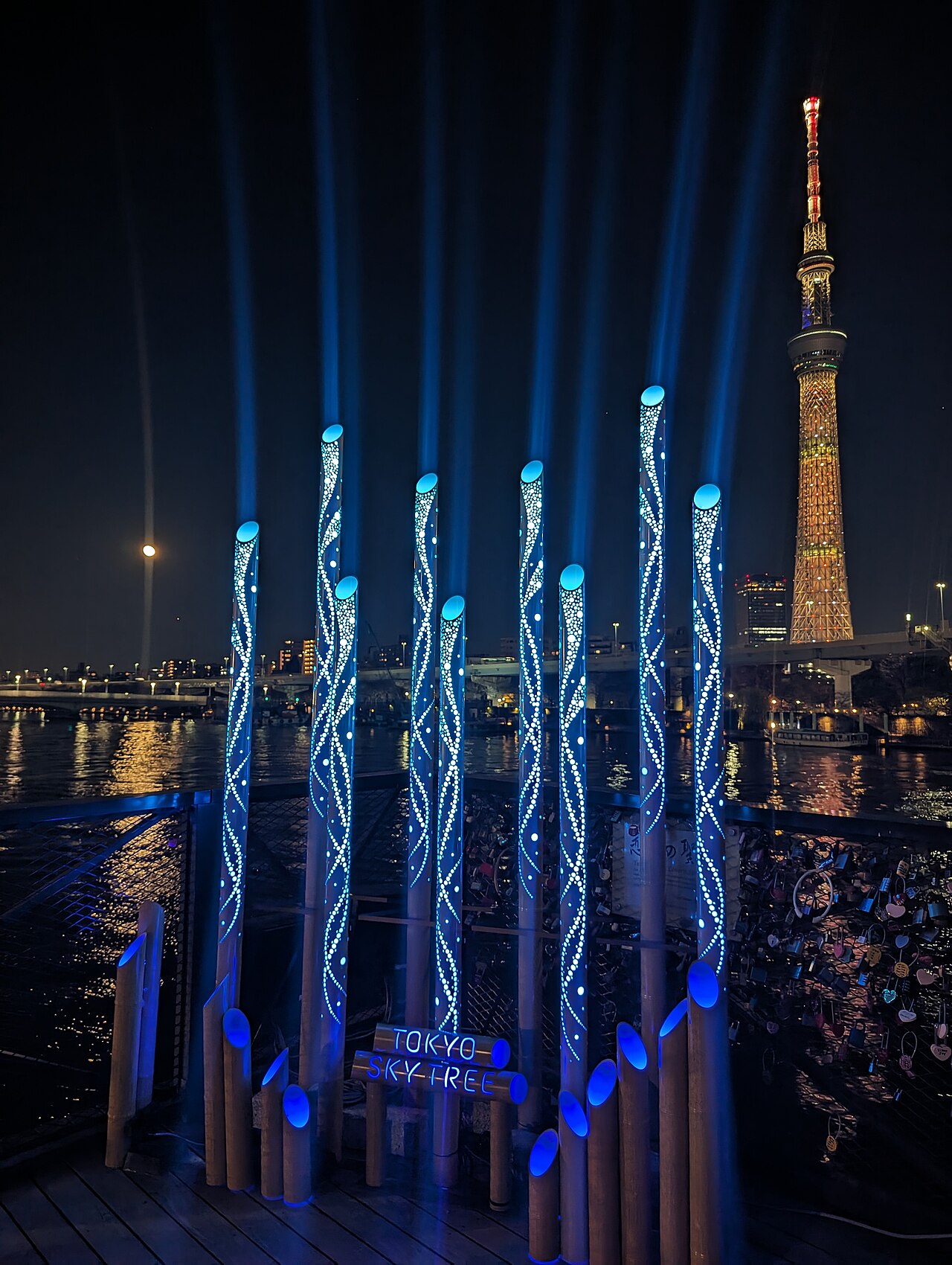
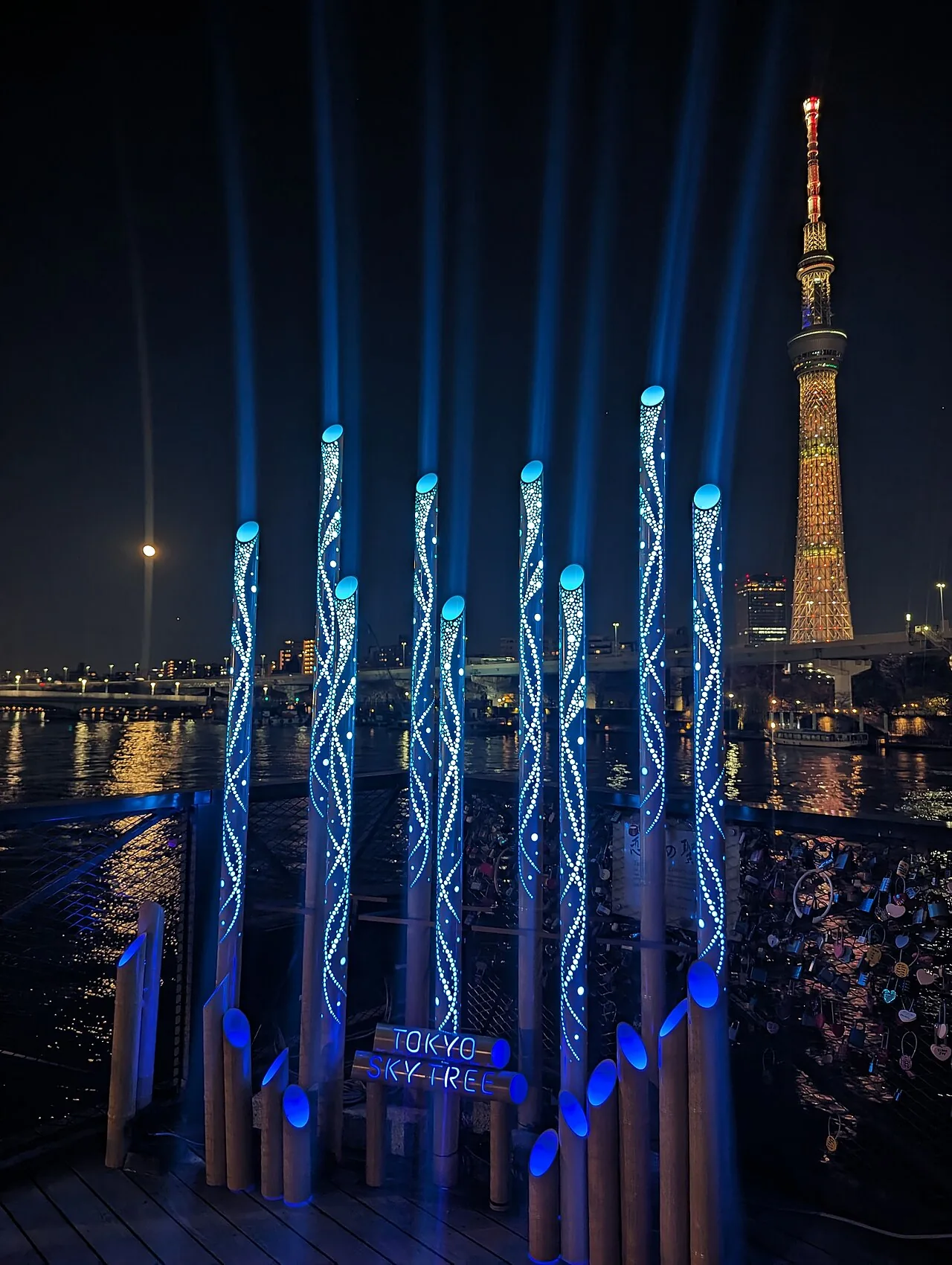
    Sumida River Walk pedestrian bridge at night with Tokyo Skytree behind
    The Sumida River Walk, under the railway bridge, at night. Photo: Justin Ormont / Wikimedia Commons, CC BY-SA 4.0.

    Fast facts

    • Cost: ¥0. The route is public and signposted; the shrines are free.
    • Distance: About 3 km using both banks.
    • Time: 60–90 minutes walking, a morning if you stop.
    • Start: Oshiage / Tokyo Skytree Station. End: Asakusa Station.
    • Best time: 07:00–09:00 or dusk. Avoid the last Saturday of July unless you are there for the fireworks.
    • Booking: none needed. Guided versions exist at about ¥6,600–¥7,500.

    Can you walk from Tokyo Skytree to Senso-ji?

    Yes, and it is the best free hour in east Tokyo. It is about three kilometres from the foot of the tower to the temple gate, 60 to 90 minutes at a walking pace, entirely on public paths, and signposted most of the way. You cross the Sumida River on a pedestrian deck bolted to the side of a railway bridge, and the tower is behind you the whole way.

    Almost everybody takes the train instead, which is one stop and takes four minutes. The train is the mistake. The walk is the part of Tokyo the two attractions are standing in, and it costs nothing.

    What is the Sumida River walk route?

    1. Start under the Skytree (Oshiage or Tokyo Skytree Station). You can ride back down this same river afterwards for ¥1,000 on the water bus from Asakusa, or see the district from a rickshaw or a ¥2,000 guided walk. Do not go up the tower; that is a different day, and when you do, buy the ticket from the official site — the marketplaces charge up to twice as much, and there is a free lift hall in Sumida City Office that looks straight at it. Walk west along the Kitajukken River, the narrow canal at the tower’s foot, on the path called Tokyo Mizumachi: a row of small shops and cafés built into the railway arches. Five minutes.
    2. Sumida River Walk. Where the canal meets the river, a pedestrian deck hangs off the side of the Tobu railway bridge. It opened in 2020 and is the only place you can cross the Sumida with trains passing a few meters above your head and the Skytree filling the sky behind you. Cross it, look back, and cross back; it is short and the view is the point.
    3. Sumida Park, east side. Stay on the Sumida ward bank and walk north. This stretch of park is the quiet one. The cherry trees along here descend from the ones the eighth shogun, Yoshimune, had planted in the 1710s so that ordinary Edo people would have a place for outings; it is one of the oldest deliberate public parks in the city.
    4. Ushijima Shrine, set back from the river in the park. A shrine with a bronze cow you stroke to cure whatever hurts (rub the cow’s leg, then your own). The three-legged torii, with a small extra gate on each side, is unusual enough that people who know shrines come here just to see it. Free, always open.
    5. Sakurabashi, the X-shaped footbridge further north, built for pedestrians only in 1985 to join the two halves of the park. Cross it to the Taito side. At cherry blossom time this is the most crowded 200 meters in east Tokyo; the rest of the year it is a bridge with a good view of the tower.
    6. Sumida Park, west side, walking south now toward Asakusa. This is the busier bank, with the river terrace at water level, the boat pier, and the golden flame on the Asahi building across the water. Come off the terrace at Azumabashi, the red bridge, and you are two minutes from Kaminarimon.
    7. Senso-ji, if you have not been. If you have, walk instead to Imado Shrine a few minutes north, which claims to be the home of the beckoning cat and is where locals come to pray for a partner.

    Total: about 3 kilometers, 60 to 90 minutes without stops. Everything is free. There are public toilets in both halves of the park and convenience stores at both ends.

    When is the best time to walk the Sumida River?

    • Early morning, 7:00 to 9:00, any season: joggers, dog walkers, a man doing tai chi, and the tower with the sun behind it. The Mizumachi cafés open around 8:00 or 9:00.
    • Dusk: the tower lights come on, the yakatabune boats start leaving Azumabashi with their lanterns lit, and the river terrace fills with people who live here. Bring a can from the convenience store; drinking on the terrace is normal.
    • Late March: the cherry blossom on both banks is the reason the park exists. Expect the crowds that come with that.
    • Last Saturday of July: the Sumida River Fireworks, seen by around a million people. Not a walk that day; a standing event.

    Do I need a guide for the Sumida River walk?

    You do not need a guide for this walk. Two exist that follow roughly the same water, and both are cheap enough to be reasonable if you would rather have someone explain the shrines than read about them:

    If you would rather be on the water than beside it, the public water bus runs from the pier at Azumabashi down to Hinode and Odaiba for the price of a train ticket, and the evening version of the river is the yakatabune dinner boat, which leaves from the same pier.

    Where this joins the rest of the east side

    From the Skytree end, Daikokuyu is ten minutes’ walk for a bath afterwards and Kyojima twenty. From the Asakusa end, Kappabashi is fifteen minutes west and the workshops in the streets behind Senso-ji are right there, along with the kimono rental shops, compared by what each price includes. Further up the same river, past where this walk ends, is the kilometer-long apartment wall built to stop fire, which is what the Sumida bank looks like when nobody is trying to make it pretty.

    The rest of the ward, in order, is in Things to Do in Sumida Beyond the Skytree: 10 Places.

    Quick answers

    How far is the walk from Tokyo Skytree to Senso-ji?

    About 1.5 kilometers direct, or around 3 kilometers if you follow the river through both halves of Sumida Park and cross at Sakurabashi. Allow 60 to 90 minutes without stops. The route is flat and free.

    What is the Sumida River Walk?

    A pedestrian deck attached to the Tobu railway bridge between Tokyo Skytree and Asakusa, opened in 2020. It lets you cross the Sumida River on foot with trains passing overhead and a full view of the Skytree, and connects to Tokyo Mizumachi, the shops built under the railway arches.

    Is Sumida Park worth visiting outside cherry blossom season?

    Yes. The east bank is quiet year-round, with Ushijima Shrine and its bronze cow, and the west bank has the river terrace with views of the Skytree and the Asahi building. Early morning and dusk are the best times.

    Do I need a tour to walk the Sumida River?

    No. The route is signposted and entirely public. Guided options exist for around ¥6,600 to ¥7,500 if you want the shrines and Senso-ji explained, but the walk itself needs no booking.


    Practical notes

    • Start: Oshiage / Tokyo Skytree Station. End: Asakusa Station. About 3 km via both banks, 60–90 minutes.
    • Cost: ¥0. Shrines free. Cafés at Mizumachi from about ¥500.
    • Best time: 7:00–9:00 or dusk. Avoid the last Saturday of July unless you are there for the fireworks.
    • Worth booking: only if you want the shrines and the temple explained; both guided walks are under ¥8,000.

    LOCAL SIDE JAPAN checked the Sumida River Walk, Mizumachi and Sumida Park details against Tobu Railway’s and Sumida City’s public information on September 18, 2026. Tour prices are from the booking sites on that date.

    Written by Kizuku. I run the Sunamachi Ginza Sumo Stable, a sumo experience in Koto City, and I write about the east side of Tokyo I live and work in. More about this site →

  • Asakusa Workshops: Which Hour Is Worth ¥7,000, and Which Isn’t

    Asakusa Workshops: Which Hour Is Worth ¥7,000, and Which Isn’t

    This article contains affiliate links to booking sites. If you book through them, LOCAL SIDE JAPAN earns a small commission at no extra cost to you. The rankings below are by value, not by what pays; the cheapest option is recommended first. How this site is made →

    TOKYO / TAITO CITY / ASAKUSA

    Asakusa has become Tokyo’s workshop district. Within ten minutes of Senso-ji you can now book an hour of calligraphy, candy sculpting, matcha whisking, ring making, lucky-cat painting, incense blending or a tea ceremony in a rented kimono, most of them between ¥2,500 and ¥8,000, most of them rated five stars by people who had a nice time. The reviews are not wrong. They are also not useful, because everything is five stars.

    Here is a better sorting: what you actually take home, how much of the hour is craft versus photo, and whether the same money would be better spent two streets away. Prices are from the booking sites in September 2026 and move with the yen.

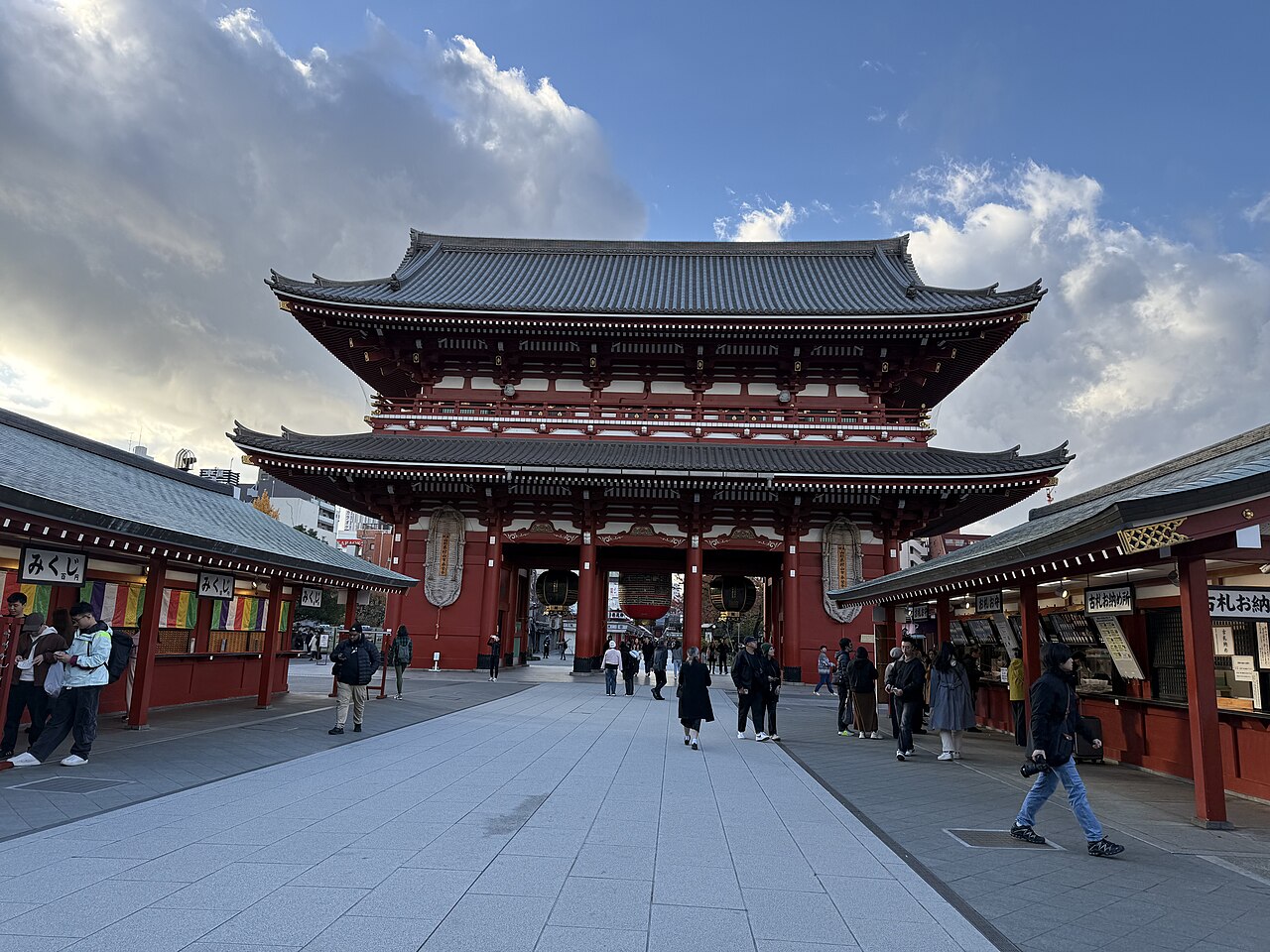
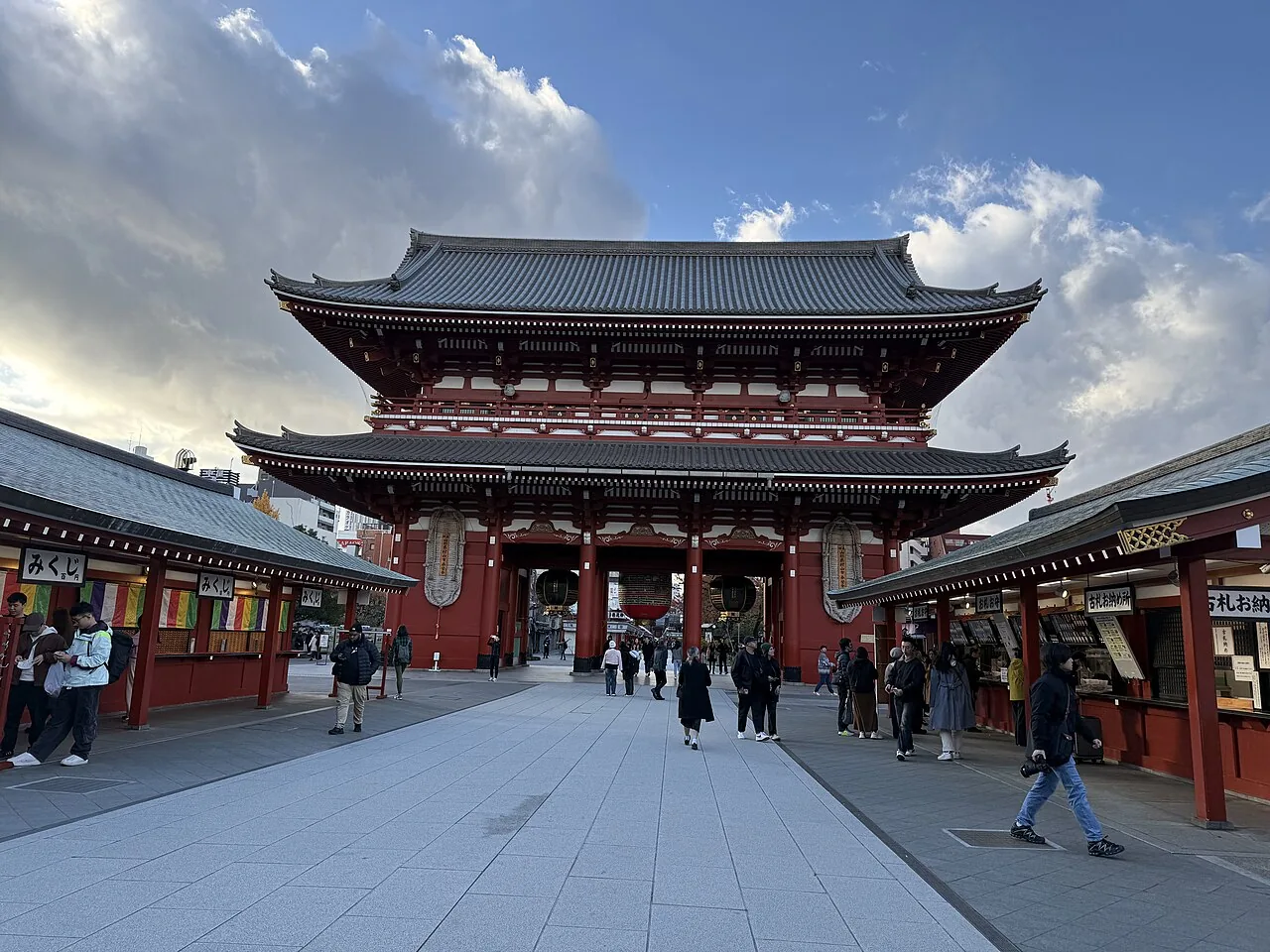
    Senso-ji temple in Asakusa, Tokyo
    Senso-ji. The workshops are in the streets behind it. Photo: LMP 2001 / Wikimedia Commons, CC BY-SA 4.0.

    Do these

    Candy sculpting at Ameshin, about ¥4,000

    Amezaiku is sugar pulled and cut into an animal in the three minutes before it hardens, with scissors, by hand. Ameshin is a real Asakusa craft shop whose artisans do this for a living; the workshop is their teaching room, not a studio built for tourists. You will make something lopsided and you will be delighted with it. Two hours, and the best value-for-craft on this list. One caveat on the booking rather than the shop: this particular listing has no reviews at all, so the recommendation rests on what Ameshin is, not on anyone else’s experience of booking it this way. The review depth across this page is below. Candy Art Workshop at Ameshin (Viator).

    Matcha and wagashi, about ¥2,500

    One hour: you whisk a bowl of matcha properly, you eat a seasonal sweet, someone explains why the bowl is turned. It is the cheapest thing here by a distance and the one with the most reviews (over 1,300 at 5.0), which for once is deserved, because the format is simple and hard to do badly. If you only book one thing in Asakusa and you are not sure about any of it, book this. Matcha Making Class with Japanese Sweets (Viator).

    Worth it if you want the object

    Calligraphy, about ¥7,800

    Ninety minutes with a brush, ink and a teacher, and you leave with a character you wrote, mounted. The price is high for what is essentially a lesson, but a piece of your own calligraphy is the one Asakusa souvenir nobody else on your street will have, and the teaching is real. Worth it if you would frame the result; not worth it if you would fold it into a suitcase and forget it. Calligraphy Workshop in Asakusa (Viator).

    A ring made from an old coin, about ¥7,700

    You take a vintage Japanese coin, punch and hammer it into a ring, and wear it out. One hour. It is metalwork-lite, but the ring is real, fits, and is the kind of thing people ask about for years. Good for couples; good for teenagers who are sick of temples. Ring-Making Workshop with Vintage Coins (Viator).

    Know what you are buying

    Tea ceremony in a kimono, around ¥9,000 and up

    This is two products in one: a kimono fitting and a short tea ceremony, and most of the ninety minutes is the fitting and the photographs. That is fine if the photographs are the point; they will be good. If you want to understand tea, the ¥2,500 matcha hour above teaches you more for a third of the money. Do not book this one for the tea. Every tea ceremony in the city, sorted into the tea-first and kimono-first kinds, is in Tea Ceremony in Tokyo by Area.

    Painting a lucky cat, about ¥3,000 to ¥4,000

    You paint a blank ceramic maneki-neko. It is exactly that, for an hour, and it is the workshop people bring small children to. The cat is charming and survives a suitcase. Skip it if you are two adults without kids; there is no craft to learn, only a cat to decorate.

    Kimono rental without the ceremony, from about ¥7,000

    If what you want is to walk Asakusa in a kimono, rent one and skip the packaged ceremony. Go at 9:00, before Nakamise fills, and give it back by early afternoon; the crowds after noon are the reason the photos in the listings were all taken in the morning. Kimono Rental in Asakusa with Photography Option (Viator).

    Four more Asakusa workshops, sorted the same way

    • Kintsugi, about ¥2,400, do it. One hour repairing a broken piece of pottery with lacquer and gold powder, and you take the piece home. The real craft takes weeks of curing; the workshop uses a fast-setting version, which the teacher will tell you. For the price it is the best-value hour on this page after the matcha — but the piece included is one of two small pre-broken dishes and a larger one is a ¥5,000 upgrade, which the listing does not say. Kintsugi Workshop in Asakusa (Viator), 4.9 from about 1,200 reviews. Every other kintsugi class in the city, by area, is in Kintsugi Workshops in Tokyo by Area.
    • Chopstick making, ¥1,000, do it with children. Plane a pair of chopsticks from a blank, oil them, put them in a box. An hour, and the cheapest thing in Asakusa you can take home that you made. Chopsticks Making Class in Asakusa (Viator), 5.0 from about 2,000 reviews.
    • Washi lantern painting, ¥16,000 to ¥20,000, know what you are buying. Ninety minutes painting a real paper lantern of the kind that hangs outside izakaya. The object is wonderful and awkward to carry home, and the price is the highest on this page for a craft that is mostly your own brushwork. For a couple who will actually hang it, yes; otherwise the calligraphy scroll folds flat. Washi Paper Lantern Workshop in Asakusa (Viator), new, a handful of reviews.
    • Knife sharpening, about ¥10,000, do it on Kappabashi instead. The “knife workshop” listings around Asakusa are mostly a sharpening lesson; the one worth paying for is the two-hour class on Kappabashi where you sharpen the knife you have just bought, covered in the Kappabashi guide.

    And the two hours that cost nothing

    The best thing in Asakusa is still free and still ignored: Senso-ji at 6:30 in the morning, when the main hall is open, the incense is lit, the shutters on Nakamise are down and painted with the shops’ own murals, and there are more locals than visitors. Do that, eat breakfast, and then decide whether you want a workshop at all. Half the people who do this do not. Getting round the district itself — a ¥5,500 rickshaw against a ¥2,000 guided walk — is compared in rickshaw or guide in Asakusa. The same hours across the whole city — calligraphy, ikebana, wagashi, washi papermaking, pottery, coin rings — are sorted by what you actually walk out holding. If what you actually want is the kimono rather than a craft, the shops around the temple are sorted by what each price really includes — the cheapest one on that page includes hair and make-up and several dearer ones do not.

    From the temple it is fifteen minutes on foot to Kappabashi, where the one workshop I would pay for above ¥10,000 lives: learning to sharpen the knife you just bought.

    The walk in from the Skytree side, along the river and over the Sumida River Walk bridge, is described in Sumida River on Foot; it ends at Kaminarimon and is the best way to arrive.

    What the reviews say, and what they mean

    These eight bookings carry about 5,050 reviews between them, and two of them have the cleanest records of anything in this series. Read on 3 October 2026, with the operators’ replies.

    How good the records actually are

    WorkshopReviewsRated 3★ or below
    Chopstick making2,1574 (0.19%)
    Matcha and wagashi1,3653 (0.22%)
    Kintsugi1,21413 (1.1%)
    Calligraphy1790
    Kimono rental (Yae)770
    Coin ring470
    Washi lantern painting80
    Candy sculpting at Ameshin0—

    Chopstick making and the matcha hour are, by the numbers, the two safest bookings in Tokyo. Four low reviews in 2,157 and three in 1,365 — roughly one in five hundred. Nothing else this site has looked at comes close, and it is a point in favour of the simple formats: plane a stick, whisk a bowl. There is not much to get wrong.

    The exception at the other end is the one with no reviews: the Ameshin candy listing. The shop is a real Asakusa amezaiku workshop and that is why it is first on this page, but nobody has reviewed this booking, so treat the recommendation as being about Ameshin rather than about the listing.

    The one thing that repeats, and it is the same shop three times

    The coin ring, the chopsticks and the kintsugi are the same operator in the same room near Senso-ji — one reviewer in September 2026 describes several of these activities running at once in a small space. Across 4,330 reviews of those three bookings, the single complaint that recurs is not about the teaching. It is the pricing model:

    • Coin ring: the free coins are foreign ones; Japanese and older coins cost extra. Eight of its twenty-three four-star reviews say so.
    • Chopsticks: “It costs extra if you want decent wood or engraving” (a reviewer on Viator, September 2026).
    • Kintsugi: the included piece is one of two small pre-broken dishes; a larger one is a ¥5,000 upgrade.

    None of these is a scandal and the satisfaction rates are extraordinary. But the advertised price is an entry price in all three cases, and the honest budget for the thing you would actually want to keep is higher: roughly ¥3,000–¥5,000 for a ring rather than ¥2,500, and ¥2,400 plus ¥5,000 for a kintsugi plate worth repairing. Decide at the counter, not after you have started.

    Which of these are made for foreigners

    Asakusa’s cheap hours genuinely undercut the Japanese market. Its expensive ones do not. Every figure below is from a Japanese-language operator’s own price page.

    This pageWhat a Japanese customer paysVerdict
    Kintsugi ¥2,400¥8,800 for 2–2.5 h, and you bring your own broken pieceFar cheaper here — but you get a dish they broke for you
    Coin ring ¥7,700¥6,500–7,500 at a Japanese Asakusa workshopThe same money
    Calligraphy ¥7,800¥2,000 trial, or ¥3,400 a lesson on a monthly planTwo to four times — you are paying for English and a one-off
    Kimono rental from ¥7,000¥3,850 full set with hair, same streetsAbout double

    All prices checked 3 October 2026. The pattern is consistent and it is useful: the ¥1,000–¥4,000 hours on this page — chopsticks, matcha, kintsugi, the lucky cat — are cheaper than a Japanese person can buy the same hour for, because they are built for volume and the materials are the cheapest version. The ¥7,000-and-up ones are where the visitor premium sits, and calligraphy is the clearest case of it.

    Which does not make them wrong to book. It makes the free hours at the bottom of this page and the cheap crafts at the top the better value, and it means that if you want calligraphy badly enough to pay ¥7,800, you are buying a teacher who will work in English rather than a better lesson.

    Quick answers

    Which Asakusa workshop is the best value?

    Candy sculpting (amezaiku) at Ameshin, about ¥4,000 for two hours with real artisans, and the one-hour matcha and wagashi class at about ¥2,500. Both are near Senso-ji and bookable online.

    How much do Asakusa workshops cost?

    Between ¥2,500 (matcha) and ¥9,000 and up (kimono plus tea ceremony). Calligraphy is about ¥7,800, coin-ring making about ¥7,700, lucky-cat painting ¥3,000 to ¥4,000, kimono rental from about ¥7,000.

    Is the kimono tea ceremony in Asakusa worth it?

    Only for the photographs. Most of the 90 minutes is the fitting and photos; the ¥2,500 matcha class teaches more about tea for a third of the price.

    What is free to do in Asakusa?

    Senso-ji at 6:30 in the morning, when the main hall is open, the incense is lit and the Nakamise shutters show their painted murals. Nakamise shops open around 10:00.

    Are Asakusa workshops suitable for children?

    Lucky-cat painting is the one families choose; the candy workshop has a minimum age (check the listing); matcha and calligraphy suit older children.


    Practical notes

    • Best value: Ameshin candy sculpting (~¥4,000, 2 hours) and the matcha hour (~¥2,500).
    • Best souvenir: your own calligraphy or a coin ring (~¥7,700–7,800).
    • For photos: kimono rental, morning only. For tea: not the kimono package.
    • With small kids: lucky-cat painting; the candy workshop has a minimum age, check the listing.
    • Timing: book workshops for the afternoon and give the morning to the temple. Nakamise shops open around 10:00.

    LOCAL SIDE JAPAN checked prices, durations and review counts on the booking sites on September 14, 2026. Prices are quoted as approximate and change with the exchange rate. Nothing here was provided free by an operator.
    Written by Kizuku. I run the Sunamachi Ginza Sumo Stable, a sumo experience in Koto City, and I write about the east side of Tokyo I live and work in. More about this site →

  • Yanaka on a Weekday: The Old Tokyo That Survived

    Yanaka on a Weekday: The Old Tokyo That Survived

    This article contains affiliate links to booking sites. If you book through them, LOCAL SIDE JAPAN earns a small commission at no extra cost to you. Everything in the first half of this article is free and needs no booking. How this site is made →

    TOKYO / TAITO CITY / YANAKA

    Yanaka is the part of Tokyo that did not burn. The 1923 earthquake missed it, the 1945 firebombing mostly missed it, and the property developers of the 1980s could not make the narrow lanes and the enormous cemetery pay. So it is still here: wooden houses, sixty-odd temples, a shopping street that closes at six, and cats that have clearly never been told about Shibuya.

    It is also, by now, on every list. The trick is not finding Yanaka; it is going on a weekday morning, walking the right loop, and knowing which of the things people sell here are worth your afternoon.

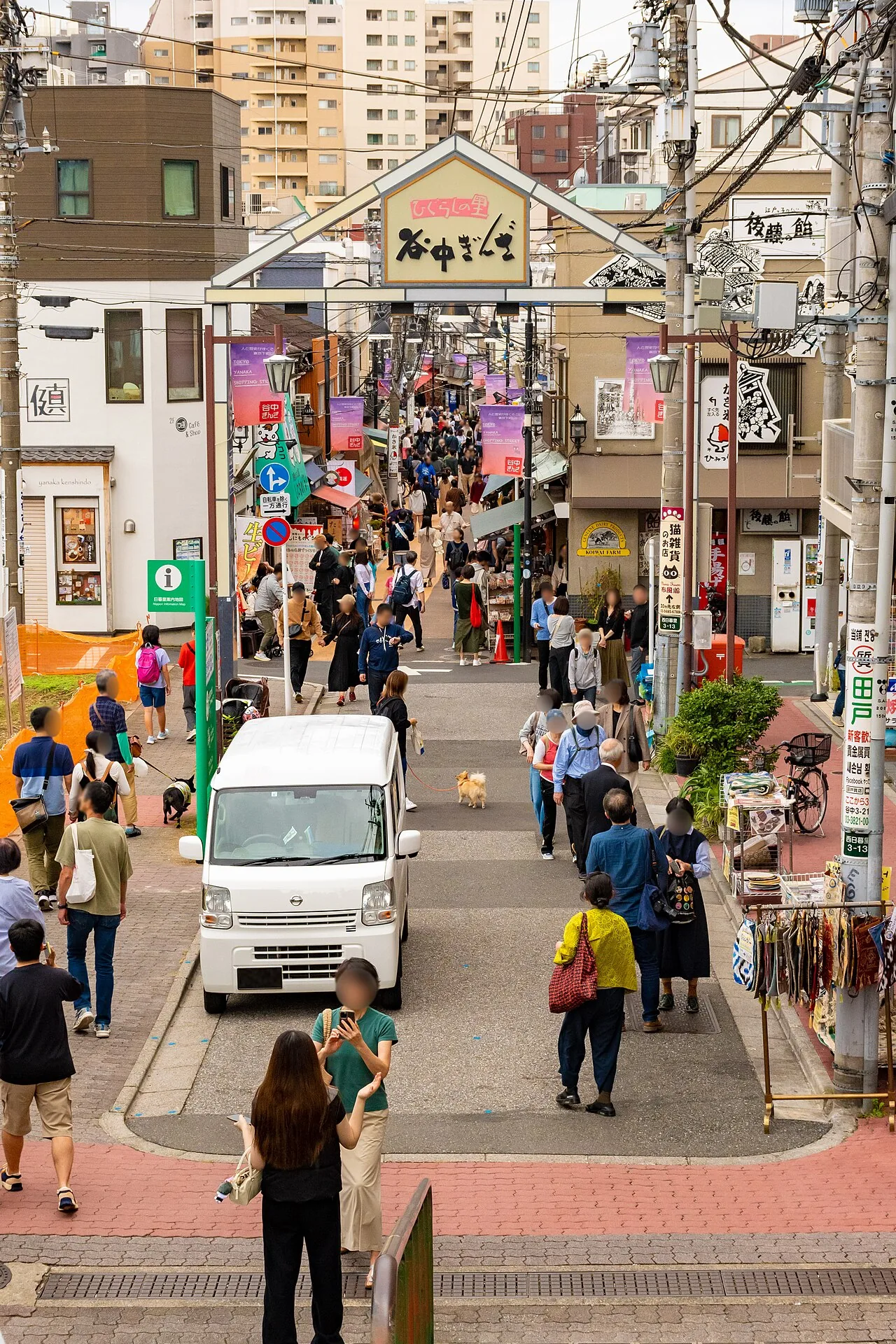
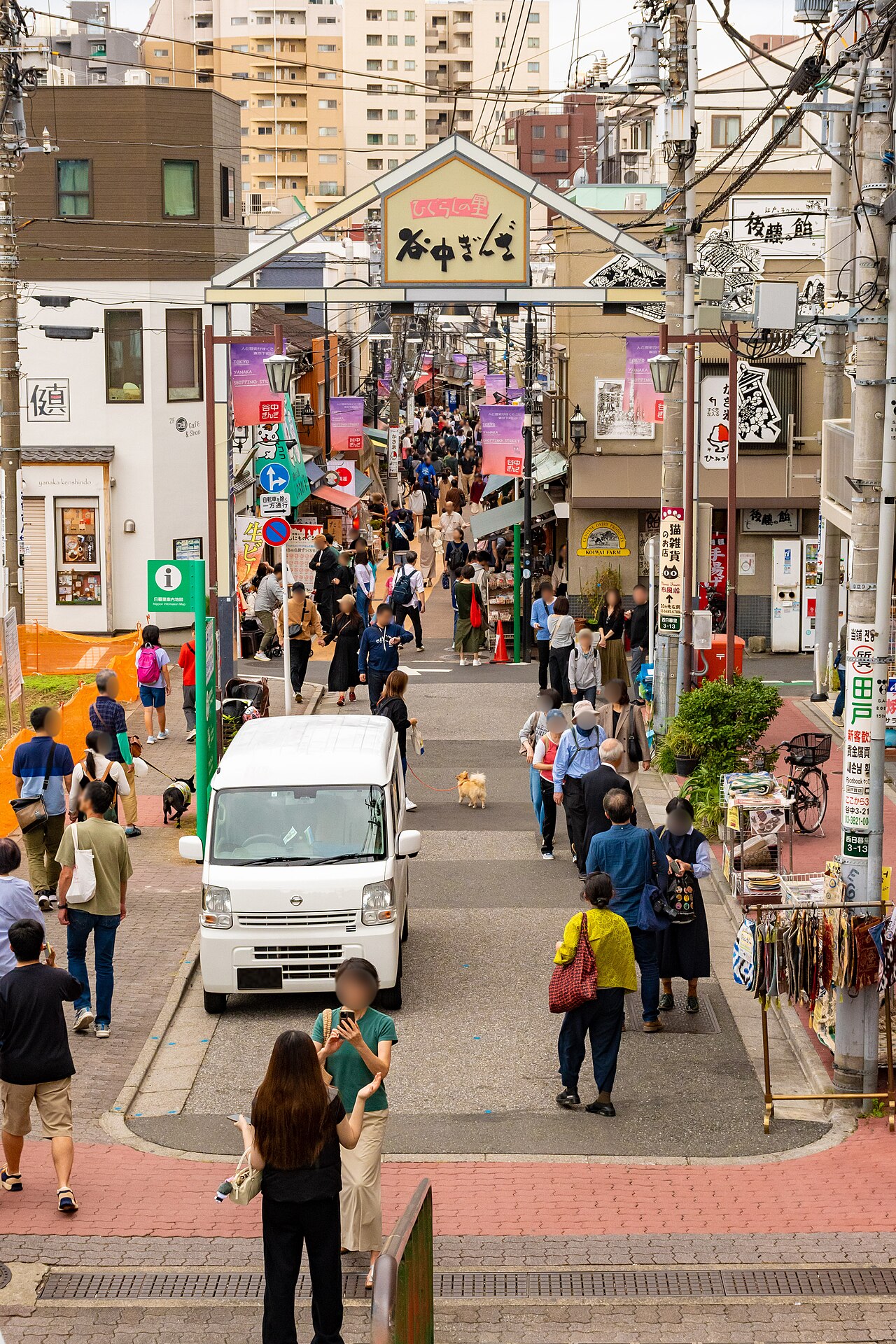
    Yanaka Ginza shopping street seen from the top of the Yuyake Dandan steps
    Yanaka Ginza from the top of the Yuyake Dandan steps. Photo: SuFlyer / Wikimedia Commons, CC0.

    The loop, in the right order

    Start at Nippori Station (JR Yamanote, Keisei from the airport), west exit. This is the only way to do Yanaka in one line without doubling back.

    1. Yanaka Cemetery (谷中霊園), five minutes from the station. Ten hectares, a cherry-tree avenue, the grave of the last shogun, and almost nobody. Walk the main avenue north to south. It is a park that happens to have graves in it, and the locals treat it as one.
    2. Yuyake Dandan (夕やけだんだん), the steps. At the bottom is the shopping street; at the top, at dusk, is the view everyone photographs. Go down them now and come back up them at five.
    3. Yanaka Ginza (谷中銀座), 170 meters, about 70 shops. Croquettes, taiyaki, a sake shop that pours by the glass, a cat-shaped everything. Most shops open around 10:00 and shut between 17:00 and 19:00. Eat standing up; that is what the street is for.
    4. The back lanes south of the street. This is the part most people miss. Turn left at the end of Yanaka Ginza and wander toward Nezu: temples with their gates open, a public bath, a sake brewer’s old warehouse turned into a café, and the wooden houses that make the neighborhood what it is.
    5. Nezu Shrine (根津神社), the finish. A 1706 shrine with a tunnel of small red torii and, in April, 3,000 azaleas on the hillside. Nezu Station (Chiyoda Line) is five minutes further on.

    Three hours at a walking pace, four with lunch. The whole thing is free.

    What to know before you go

    • Weekday mornings. Weekend afternoons on Yanaka Ginza are shoulder-to-shoulder and the croquette queue is twenty minutes. A Tuesday at 10:30 is a different street.
    • Cash. The street-food windows are ¥150 to ¥400 a piece and many do not take cards. Bring coins.
    • The cats are optional. Yanaka sells itself as “cat town.” There are some real cats and a great many ceramic ones. Do not build the day around it.
    • Nippori Fabric Town is on the other side of the station: a kilometer of fabric shops, with the Tomato main store as the anchor. Closed Sundays. Only worth it if you sew, in which case it is worth a whole separate morning.
    • Temples close. Grounds are generally open in daylight; halls are not. Do not expect to go inside.

    When a booking is worth it here

    Yanaka has more bookable “experiences” than almost anywhere on the east side, and most of them are guided walks that cover the same loop I just gave you for free. Skip those unless you want the company. Three things are different, because you cannot do them on your own:

    Cook in a Yanaka house

    The wooden houses are the reason the neighborhood exists, and the only way inside one is to be invited. Private home cooking in Yanaka is two hours in a local kitchen making an ordinary Japanese dinner, the kind that never appears on a restaurant menu. Around ¥18,500 per person, private, 5.0 from close to two hundred reviews. Of everything on the booking sites for this neighborhood, this is the one I would pay for.

    Ikebana, for real

    Same host, different room. Ikebana in Yanaka is 90 minutes of flower arrangement in a house that suits it. Small group, sells out, and unlike the ten-minute “try ikebana” add-ons in Asakusa, you leave understanding why the empty space matters.

    If you do want a guide

    Take the cheap one. The Old Quarter of Tokyo: Yanaka Walking Tour is three hours, around ¥7,000, 4.8 from nearly seven hundred reviews, and covers the loop above with the stories attached. The ¥30,000 “eat like a local” food walks are pleasant, but you are paying ¥25,000 for someone to hand you croquettes you could buy for ¥200.

    Two things you can book in Yanaka itself, rather than somewhere else in Tokyo. The private ikebana workshop here is the best version in the city and the reason is the shopping — you pick your own flowers at a Yanaka florist first, which no studio class lets you do. And the tearooms in Yanaka and Bunkyo are two of the most authentic settings in Tokyo and the ones nobody advertises. Calligraphy, ikebana and wagashi, by area → / Tea ceremonies by area →

    Where this fits with the rest of the east side

    Yanaka is the gentle end of a line that gets darker as you go north-east: twenty minutes’ walk from Nippori is Kozukappara, the old execution ground, and Jokan-ji, where the Yoshiwara women were buried. Fifteen minutes south is Kappabashi if you want to leave with a knife instead of a croquette. Do Yanaka first; it is the one you will want to end on if you only do one.

    Quick answers

    How do I get to Yanaka?

    Start at Nippori Station (JR Yamanote Line, or Keisei from Narita Airport), west exit. Walk through Yanaka Cemetery, down the Yuyake Dandan steps to Yanaka Ginza, then through the back lanes to Nezu Shrine and Nezu Station on the Chiyoda Line. The loop takes about three hours.

    What are Yanaka Ginza’s opening hours?

    Yanaka Ginza is a 170-meter shopping street of about 70 shops. Most open around 10:00 and close between 17:00 and 19:00. Some shops rest on Monday or Tuesday, but the street never fully closes. Bring cash for street food.

    Is Yanaka worth visiting?

    Yes, on a weekday morning. Yanaka survived the 1923 earthquake and the 1945 firebombing, so it keeps wooden houses, dozens of temples and an old shopping street. Weekend afternoons are crowded; a weekday before 11:00 is a different place.

    What can I book in Yanaka that I cannot do on my own?

    A private home-cooking session or an ikebana class inside a real Yanaka house. The wooden houses are private, and being invited in is the only way to see one. Guided walks cover the same streets you can walk for free.


    Practical notes

    • Start: Nippori Station, west exit (JR Yamanote / Keisei). End: Nezu Station (Chiyoda Line).
    • Time: 3 hours walking, 4 with lunch. Best on a weekday, arriving by 10:30.
    • Cost: ¥0 to walk. ¥1,000 to ¥2,000 if you eat your way down Yanaka Ginza. Cash.
    • Yanaka Ginza hours: shops open about 10:00, close 17:00 to 19:00. Some shops rest on Mondays or Tuesdays; the street never fully closes.
    • Nezu Shrine azaleas: April. The garden charges a small entry fee during the festival; the shrine is free.
    • Worth booking: the home-cooking evening or the ikebana session, both in a real Yanaka house. The guided walk only if you want a storyteller.

    LOCAL SIDE JAPAN checked shop numbers and hours against the Yanaka Ginza shopping association, Nippori Fabric Town’s official holiday list and Nezu Shrine’s notices on September 14, 2026. Class prices are quoted as ranges from the booking sites on that date.

    Written by Kizuku. I run the Sunamachi Ginza Sumo Stable, a sumo experience in Koto City, and I write about the east side of Tokyo I live and work in. More about this site →

  • Kappabashi Knife Street: Prices, the Shops Worth Your Time, and How to Buy

    Kappabashi Knife Street: Prices, the Shops Worth Your Time, and How to Buy

    This article contains affiliate links to booking sites. If you book through them, LOCAL SIDE JAPAN earns a small commission at no extra cost to you. Walking the street and buying a knife needs no booking at all. How this site is made →

    TOKYO / TAITO CITY / KAPPABASHI

    Kappabashi is an 800-meter street of about 170 shops that exists to sell restaurants their equipment. Pots the size of bathtubs. Ten thousand identical rice bowls. The plastic sushi in every restaurant window in Japan. And, in about sixteen of those shops, some of the best kitchen knives you can buy anywhere, at prices that make the airport duty-free version look like a joke.

    It sits between Ueno and Asakusa, ten minutes’ walk from either, and most visitors do it wrong: they arrive on a Sunday, find half the shutters down, buy a knife from the first shop that speaks English, and put it in their carry-on. Here is how to do it right, in about two hours.

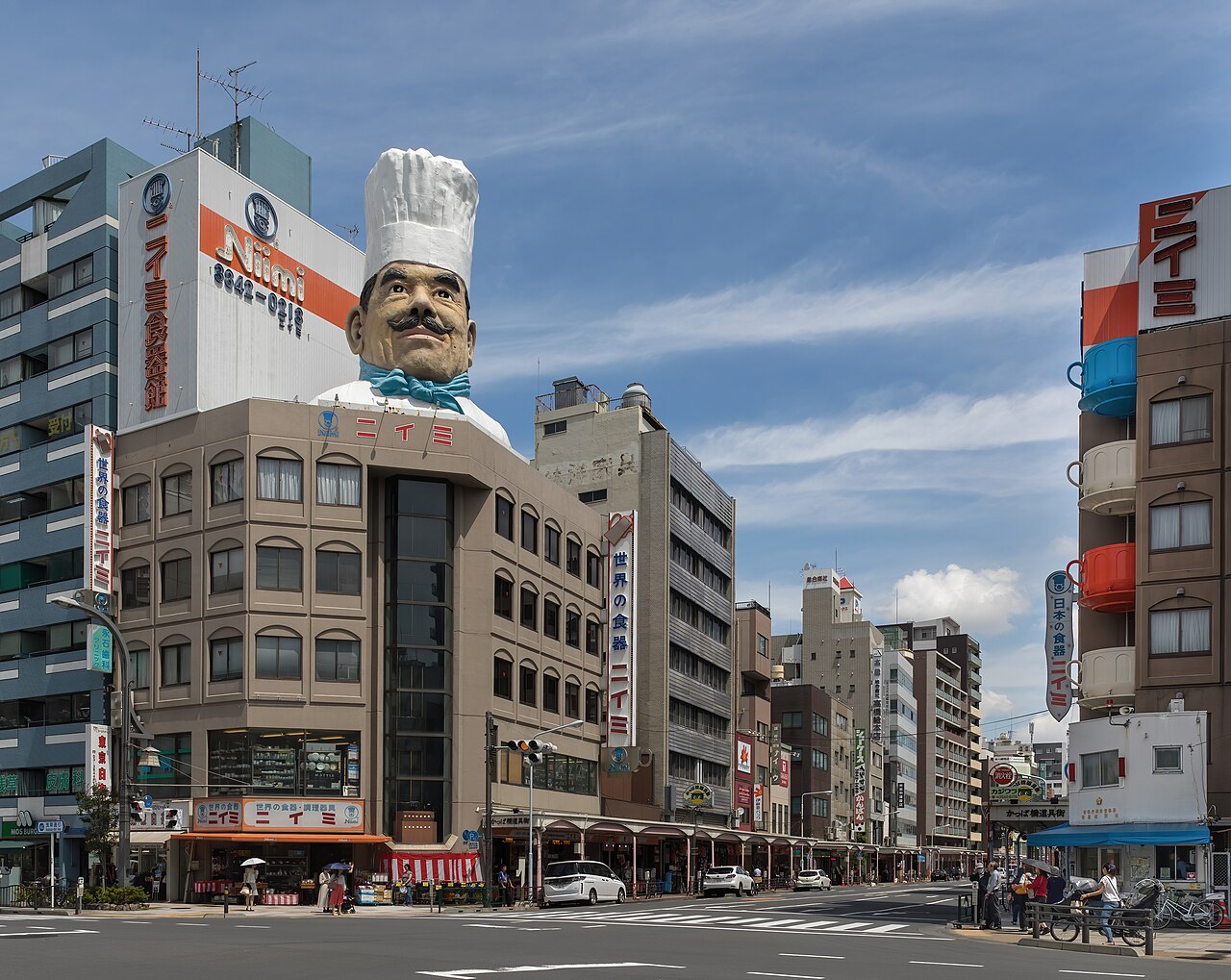
    The southern end of Kappabashi Dougu Street in Taito City on a sunny morning
    The Asakusa end of the street, before the shutters go up. Photo: Basile Morin / Wikimedia Commons, CC BY-SA 4.0.

    Fast facts

    • Where: Kappabashi Dougu Street, Taito City
    • Nearest: Tawaramachi Station (Ginza line) 5 min; Asakusa Station (Tsukuba Express) 5 min; 15 min on foot from Ueno or Asakusa
    • Best time: Weekdays, 10:00–17:00. Avoid Sundays, when many shops close
    • Budget: About ¥10,000 for a very good stainless gyuto or santoku; about ¥30,000 for a professional one
    • Tax-free: Over ¥5,500 with your passport
    • Flying home: Checked luggage only — ask the shop to pack it for the plane

    What is Kappabashi?

    Kappabashi Dougu Street is Tokyo’s restaurant supply district — about eight hundred metres of shops in Taito City, between Ueno and Asakusa, selling the things restaurants are made of: knives, pots, chopping boards, crockery, noren curtains, menu boards, bamboo steamers, and the plastic food samples that sit in Japanese restaurant windows. It has roughly 170 shops, sixteen of which sell knives.

    It is also the answer to “where is the knife street in Tokyo”. There is no other street like it in the city, and the knives are the reason most visitors come, although the sign painters and the steamer shop are the reason to walk the whole length of it.

    First, the rules nobody tells you

    • Not on a Sunday. This is a trade street. Most shops open Monday to Saturday, roughly 10:00 to 17:00, and many close on Sunday, including Tsubaya, one of the knife shops you actually want. Go on a weekday if you can.
    • Checked luggage only. A knife in your hand baggage will be confiscated at the airport, every time. Shops pack knives for flying; you still have to put the package in the suitcase you check in.
    • Bring your passport. Purchases over ¥5,500 at the main knife shops are tax-free (10%) for visitors, but only with the physical passport, not a photo of it.
    • Engraving is usually free. The bigger shops will laser your name or a word onto the blade while you wait or within a day or two. Decide beforehand what you want it to say; “TOKYO 2026” ages better than a joke.
    • Cash is not required but is faster. The main knife shops take cards. Some of the smaller crockery and tool shops still prefer cash.

    Which Japanese knife should I buy?

    If you cook at home and want one knife, buy a gyuto (a Japanese chef’s knife, 210 mm) or a santoku (shorter, taller, better for vegetables and small kitchens). Get it in stainless unless you already know how to care for carbon steel, which rusts if you leave it wet. A properly made stainless gyuto from a Kappabashi shop costs around ¥10,000. Around ¥30,000 buys the knives professional cooks in Tokyo actually use. Above ¥80,000 you are buying a named blacksmith and a story, which is a fine thing to do on a trip, but not necessary for dinner.

    Single-bevel knives (yanagiba for sashimi, deba for breaking down fish, usuba for vegetables) are the ones that look most “Japanese” in the window. They are also the ones most likely to sit in a drawer at home. Buy one only if you already fillet fish.

    Kappabashi knife prices, in yen

    WhatPrice on the streetWorth it for
    Stainless santoku, 165–180 mm, machine-made¥6,000–10,000A first Japanese knife, a gift, a small kitchen
    Stainless gyuto, 210 mm, good factory brand¥10,000–18,000Most people; the one knife to buy
    Clad carbon-steel gyuto or santoku¥15,000–30,000Cooks who will dry it after every use
    Hand-forged, named smith¥30,000–80,000Professionals and collectors
    Single-bevel yanagiba (sashimi)¥15,000–60,000Only if you already fillet fish
    Whetstone, #1000 and #3000 pair¥4,000–8,000Everyone who buys any of the above
    EngravingUsually free, same day or nextAnything you are keeping
    Tax-free saving10% over ¥5,500 with a passportBring the physical passport

    Those are shop prices in September 2026 and they move with the yen. Two things do not change: the same knife is cheaper here than in a department store or at the airport, and a ¥10,000 knife you can sharpen will outlast a ¥30,000 knife you cannot. Budget for the whetstone.

    Which knife shop in Kappabashi should I go to?

    You do not need all sixteen knife shops on Kappabashi Street. Three cover almost everyone; two more are for comparing.

    • Kama-Asa (釜浅商店): the easiest first stop. More than 80 knife types laid out by use, staff who explain in English (and French), free engraving, tax-free counter. It is not the cheapest, but you will leave understanding what you bought. They also sell the cast-iron pans and the copper that Tokyo kitchens use.
    • Tsubaya (つば屋): the sharpening people. A narrower, more serious shop with a lifetime resharpening promise on what you buy there. Closed Sundays. If you want a knife you will send back to be sharpened in ten years, this is the counter.
    • Union Commerce (ユニオンコマース): the shop with the biggest wall of blades on the street and the most English-speaking staff, which makes it the busiest with visitors; prices are fair, the range runs from ¥8,000 gyuto to named smiths, and it is the right place if you want to compare twenty knives in one visit.
    • Seisuke Knife (清助刃物): a small shop stocking blades from Sakai, Seki and Echizen smiths rather than one brand, with hand-forged carbon steel for people who know what that means.
    • Kamata Hakensha (かまた刃研社): began as a sharpening service and still feels like one. Good for a second opinion, good for whetstones, and the place to ask how to look after the thing you just bought.

    Walk the whole street before you pay anything. It takes twenty minutes end to end, and the plastic-food shops, the sign painters, and the shop that sells nothing but bamboo steamers are half the reason to come.

    Is Kappabashi a tourist trap?

    No — and the simplest proof is who else is shopping there. Kappabashi is a trade street. Its customers are the people who run restaurants in Tokyo, which is why most shops keep trade hours (roughly 10:00 to 17:00, Monday to Saturday) and why several of the best ones, including Tsubaya, close on Sundays. A street built for tourists would open at weekends.

    On price, it is the opposite of a trap. The same knife costs more in a department store and considerably more at the airport. A properly made stainless gyuto is about ¥10,000 here, engraving is usually free, and purchases over ¥5,500 are tax-free with your passport. Nobody is charging a visitor premium, because the shop next door is selling to a chef.

    Where you can waste money is on yourself. Two ways, and both are common:

    • Buying the knife that looks most Japanese rather than the one you will use. The single-bevel blades in the window — yanagiba, deba, usuba — photograph beautifully and live in a drawer. Buy a gyuto or a santoku unless you already fillet fish.
    • Buying at the first shop. The street is twenty minutes end to end. Walk it before you pay anything.

    The one genuinely touristy thing on Kappabashi is the plastic food — the sample-making workshops are priced for visitors and are fun rather than useful. That is a small corner of a working street, not the street.

    The honest warning is a different one: a Japanese knife you cannot sharpen is blunt within a year, and most people fly home without learning how. Budget for a whetstone and an hour of teaching, or buy a cheaper knife.

    When it is worth booking something

    Buying a knife needs no booking. Two things do, and both are better done here than anywhere else in Tokyo.

    Learn to sharpen it before you fly home

    A Japanese knife you cannot sharpen is a Japanese knife that will be blunt within a year. The skill takes one lesson to learn badly and a few years to learn well, and the first lesson is worth every yen. Two options, one long and one short:

    Use the big knife you will never buy

    The soba knife, a rectangular cleaver the length of your forearm, is the most photographed blade on the street and the least practical to own. The right way to meet it is a soba-making class: knead, roll, cut with the enormous knife, eat what you made. The Kappabashi soba-making class runs about 50 minutes, costs ¥6,900, and has 110 reviews at 5.0 with 99% of travellers recommending it (checked October 9, 2026 — it was ¥8,900 when we first wrote this, so the price has come down). It is the best thing on this street for children who are bored of pots.

    Cook with one before you commit to carrying one home

    A ¥30,000 gyuto is a strange thing to buy on the evidence of holding it in a shop for ninety seconds. If you are not sure whether you want a Japanese knife or just want the idea of one, use one first.

    The useful coincidence is that the best cooking classes for this are in the same ward. One in Iriya, ten minutes north of here in Taito, starts in a Japanese supermarket — you buy the ingredients first, which teaches you more about Japanese cooking than the cooking does — and it is the cheapest hour in the city worth having. Asakusa, a fifteen-minute walk east, has the most-booked sushi class in Japan. In both you are handed the kind of knife the shops here sell, and after two hours of using one you will know whether you want it. Cooking classes by area, with the prices and what each kitchen actually is → / Sushi classes by area →

    One warning that applies to every sushi class in Tokyo and is almost never in the listing: in most of them you never touch the raw fish. The chef cuts it; you shape the rice. If handling the fish is the point for you, ask before booking, not at the counter.

    There are also guided “knife town” walks (roughly ¥9,000 to ¥16,000 for 1.5 to 4 hours). They are fine, and they solve the language problem in the smaller shops, but the three shops above speak enough English that most people do not need one. Spend the money on the sharpening lesson instead.

    If you are here in October

    The street holds its own festival, the Kappabashi Dougu Matsuri, in the second week of October every year; the 2026 dates are October 6 to 12. Shops put out bargain bins, there are stalls in the street, and the crowds are local rather than tourist. It is the one week the street is busy on purpose.

    The rest of the day

    Kappabashi is a straight line between two places you were probably going anyway. Ten minutes east is Senso-ji and Asakusa; ten minutes west is Ueno Park. Fifteen minutes north on foot is Kozukappara and Jokan-ji, the darker end of the old city, if you want the afternoon to have some weight to it. Look up as you walk the street: the giant chef’s head on the Niimi building at the Asakusa end is the landmark everyone uses to meet.

    Related: Ramen and soba noodle classes by area — the ¥6,900 studio that makes noodles from flour is on Matsugaya, one street off Kappabashi, so you can learn the cut in the morning and buy the blade in the afternoon. Also Yanaka on a weekday: the free loop from Nippori to Nezu.

    Quick answers

    What is Kappabashi?

    Kappabashi Dougu Street is an 800-meter street of about 170 restaurant-supply shops between Ueno and Asakusa in Taito City, Tokyo, known for professional kitchen knives, cookware, ceramics and the plastic food models seen in restaurant windows.

    How much do knives cost on Kappabashi Street?

    A stainless santoku is ¥6,000 to ¥10,000, a good 210 mm gyuto ¥10,000 to ¥18,000, clad carbon steel ¥15,000 to ¥30,000, and hand-forged knives by named smiths ¥30,000 to ¥80,000. Whetstones ¥4,000 to ¥8,000. Purchases over ¥5,500 are tax-free with a passport, and engraving is usually free.

    Is Kappabashi open on Sunday?

    Mostly no. It is a trade street: most shops open Monday to Saturday, roughly 10:00 to 17:00, and many, including the knife shop Tsubaya, close on Sunday. Go on a weekday.

    How much does a good Japanese knife cost in Kappabashi?

    A well-made stainless gyuto or santoku from a Kappabashi shop costs around ¥10,000. Around ¥30,000 buys the knives Tokyo’s professional cooks use. Purchases over ¥5,500 are tax-free for visitors with a passport.

    Can I take a knife bought in Japan on the plane?

    Only in checked luggage. A knife in carry-on baggage will be confiscated. Kappabashi shops will pack the knife for air travel, but you must put it in the suitcase you check in.

    When is the Kappabashi festival?

    The Kappabashi Dougu Matsuri is held in the second week of October each year. The 2026 dates are October 6 to 12.


    Practical notes

    • Where: Kappabashi Dougu Street, Taito City. Tawaramachi Station (Ginza Line), 5 minutes; Asakusa Station (Tsukuba Express), 5 minutes; Ueno or Asakusa on foot, about 15.
    • When: weekdays, 10:00 to 17:00. Avoid Sundays. Festival: October 6 to 12, 2026.
    • Budget: ¥10,000 for a very good stainless gyuto or santoku; ¥30,000 for a professional one. Tax-free over ¥5,500 with passport.
    • Flying home: checked luggage only. Ask the shop to pack it for the plane.
    • Worth booking: the 2-hour sharpening class if your knife costs more than ¥20,000; the soba class if you have kids or two hours to spare.

    LOCAL SIDE JAPAN checked shop counts, opening patterns and festival dates against the Kappabashi Dougu Street association (kappabashi.or.jp) and the shops’ own notices on September 14, 2026. Prices for classes are quoted as ranges from the booking sites on that date and change with the exchange rate.

    Written by Kizuku. I run the Sunamachi Ginza Sumo Stable, a sumo experience in Koto City, and I write about the east side of Tokyo I live and work in. More about this site →

  • The Temple Where Yoshiwara’s Forgotten Women Were Buried

    The Temple Where Yoshiwara’s Forgotten Women Were Buried

    This article may contain affiliate links to booking sites. If you book through them, LOCAL SIDE JAPAN earns a small commission at no extra cost to you. How this site is made →

    HIDDEN HISTORY · MINOWA, TOKYO

    One minute from Minowa Station stands a temple with a brutal nickname: Nagekomi-dera, the “Throw-in Temple.” Behind that name are the women of Yoshiwara—workers sold into contracts, victims of fire, earthquake and disease, and people whose lives were often reduced to entertainment for someone else. Jōkanji is where Tokyo remembers them.

    Jokanji temple in Minamisenju, known for memorialising women of the Yoshiwara pleasure district
    Jōkanji in Minamisenju. Photo: Abasaa / Wikimedia Commons / Public domain.

    Fast facts

    • Admission: Free. No entrance fee for the publicly accessible areas; the grounds are open in daytime
    • Where: Minamisenju, Arakawa City, Tokyo, just north of the former Yoshiwara district
    • Nearest: Minowa Station (Hibiya line), about 1 minute on foot
    • Note: Some cemetery sections may be closed. Keep voices low and do not photograph mourners

    The temple outside Yoshiwara’s walls

    Jōkanji was founded in 1655, only two years before the licensed pleasure district moved from central Edo to Shin-Yoshiwara. The new district occupied what is now Senzoku in Taitō City. Jōkanji stood beyond its northern side, close enough to become inseparable from the lives and deaths inside.

    Yoshiwara is often sold to modern audiences as a world of elaborate courtesan fashion, cherry blossoms and ukiyo-e beauty. It was also a controlled compound. A wall and moat separated it from surrounding fields, and entry was channelled through a principal gate. Many women had been sold into years of service through poverty and debt. Their movement was restricted, their earnings absorbed by contracts, and disease or fire could end a life long before freedom arrived.

    View of Shin-Yoshiwara, July 1860, by Utagawa Hiroshige II. Collection of the Ota Memorial Museum of Art; via Wikimedia Commons / Public domain
    View of Shin-Yoshiwara, July 1860, by Utagawa Hiroshige II. Collection of the Ota Memorial Museum of Art; via Wikimedia Commons / Public domain.

    The print above is seductive from a distance: an orderly square floating among rice fields. Look again and its geometry becomes the story. Yoshiwara was not simply a colourful neighbourhood. It was a bounded commercial system in which female bodies, labour and time were tightly managed.

    Why was it called the “Throw-in Temple”?

    The nickname became associated with Jōkanji after the Ansei Edo earthquake of 1855. The disaster devastated Yoshiwara, and the bodies of women killed there were buried at the temple in a manner described by local history as resembling being “thrown in.” The phrase is shocking because the treatment was shocking.

    But the nickname can produce a false villain. Jōkanji was not the institution exploiting these women; it became a place that received and memorialised people whom the licensed district and wider society had left without secure family graves. The temple’s role was remembrance.

    Over the centuries, women and others connected with Yoshiwara continued to be buried here. A commonly cited estimate places the number at roughly 25,000, though it should be read as an estimate rather than a complete modern census. More concrete evidence survives in Jōkanji’s historical death registers, which record courtesans and their children across generations.

    “Born into suffering, dead at Jōkanji”

    The emotional centre of the grounds is the Shin-Yoshiwara Sōreitō, the collective memorial tower. Set into it is a line by the poet Hanamata Kasui:

    Umarete wa kugai, shishite wa Jōkanji.

    “Born into a world of suffering; dead, they came to Jōkanji.”

    Kugai literally evokes a sea or world of suffering, a Buddhist expression that also became inseparable from the hardship of women in licensed prostitution. The inscription refuses the glamorous Yoshiwara of souvenir imagery. It compresses an entire economic system into one life trajectory: hardship first, an anonymous temple burial last.

    Do not visit looking for a spectacle. The memorial contains no visual trick capable of representing thousands of individual lives. Its force comes from repetition—the knowledge that each name in a register once belonged to someone with habits, fears and plans beyond the identity assigned to her by a brothel.

    Yoshiwara survived into the age of photography

    The licensed district did not vanish with the shogunate. It was rebuilt after repeated fires and disasters, changed its legal form, and continued into the twentieth century. A photograph from 1932 shows a district more modern in architecture but still shaped by controlled sexual commerce.

    Historical photograph of Tokyo's Yoshiwara district in 1932
    Yoshiwara in August 1932. Unknown photographer, published in Rekishi Shashin; via Wikimedia Commons / Public domain.

    Japan’s Anti-Prostitution Law was enacted in 1956 and fully implemented in 1958, ending the licensed system. Yet the old map remains legible in present-day streets, and parts of the area continue as an adult-entertainment district. The historical Yoshiwara is therefore neither a vanished Edo fantasy nor a simple preserved attraction. It is a place where historical coercion, commercial nostalgia and current working lives overlap.

    The writer who asked to be buried here

    Novelist and essayist Nagai Kafū repeatedly visited Jōkanji. He spent much of his writing life walking Tokyo’s pleasure quarters and marginal neighbourhoods, recording the urban worlds that official modernisation preferred to erase.

    Kafū felt such attachment to the forgotten women memorialised here that he wished to be buried at Jōkanji. That request was not realised, but friends and admirers later established a poetry monument and a mound containing his writing brushes. The temple holds a memorial service for him, Kafū-ki, each year on April 30.

    Japanese writer Nagai Kafu, who repeatedly visited Jokanji temple
    Writer Nagai Kafū in 1927. Unknown photographer; via Wikimedia Commons / Public domain.

    His presence changes the tone of the site. Jōkanji is not only a cemetery of social history; it is also a place about who gets remembered in literature. Kafū recognised that the women excluded from respectable civic narratives were part of Tokyo’s story, not a footnote outside it.

    A respectful walk from Minowa to old Yoshiwara

    1. Begin at Tokyo Metro Minowa Station. Jōkanji is about one minute away, before the modern city has time to become scenic.
    2. Visit the main temple area first. Read the signs and remember that some cultural properties or cemetery sections may not always be open.
    3. Pay respects at the Shin-Yoshiwara collective memorial. Avoid posed or “haunted Tokyo” photography.
    4. Look for the Kafū monuments. They connect the cemetery to the literature of Tokyo’s disappearing backstreets.
    5. Walk south toward the former Yoshiwara. The old district’s rectangular outline can still be sensed in the street pattern; the former Great Gate area and Mikaeri Yanagi mark the historic approach.

    Be especially careful with photography after leaving the temple. The former Yoshiwara remains a working adult-entertainment area. Do not photograph workers, customers, entrances, private businesses or local residents without clear permission. History does not cancel anyone’s present-day privacy.

    Jōkanji also fits naturally into a deeper walk through northern Edo’s buried boundary. Continue to the nearby Kozukappara execution ground and Kubikiri Jizō, where another quiet temple landscape preserves people excluded from ordinary records.

    Before you go

    • Name: Jōkanji (浄閑寺), also known as Nagekomi-dera
    • Address: 2-1-12 Minamisenju, Arakawa-ku, Tokyo
    • Nearest station: Tokyo Metro Hibiya Line, Minowa Station
    • Walking time: About one minute from Minowa Station; about five minutes from Minowabashi on the Tokyo Sakura Tram
    • Suggested visit: About 20–30 minutes at the temple; 60–90 minutes with a respectful walk toward former Yoshiwara
    • Closing time: 4:30 p.m. from December through February; 5:00 p.m. from March through November
    • Admission: No standard entrance fee for publicly accessible areas
    • Etiquette: Keep voices low, do not enter closed sections, and never treat graves as horror-film props

    Related: Kappabashi, fifteen minutes south: how to buy a Japanese knife without getting it wrong.

    Related: Yanaka on a weekday: the free loop from Nippori to Nezu.


    Where this joins the rest of the east side

    Jokanji sits between two of the east side’s darker sites: the Kozukappara execution ground is a ten-minute walk away at Minamisenju, and the Yoshiwara quarter itself is fifteen minutes south, on the way to Asakusa. North across the Senju Ohashi is Kita-Senju, the old post town where the highway out of Edo began.

    Quick answers

    Where is Jokanji temple?

    In Minamisenju, Arakawa City, about one minute from Minowa Station on the Hibiya subway line, just north of the former Yoshiwara district in Taito City. The grounds are free and open in daytime.

    Why is Jokanji called the Throw-in Temple?

    The nickname Nagekomi-dera dates from the Ansei earthquake of 1855, when the bodies of Yoshiwara women killed in the disaster were buried at the temple in a manner local history describes as ‘thrown in’. The temple received and memorialized women whom the licensed district left without family graves.

    How many Yoshiwara women are buried at Jokanji?

    A commonly cited estimate is around 25,000 over the centuries, based on the temple’s death registers, which record courtesans and their children across generations. The figure is an estimate rather than a modern count.

    Can visitors go inside Jokanji?

    The grounds, the Shin-Yoshiwara memorial tower and the Nagai Kafu monument are open to visitors. It is an active temple and a burial ground: no tripods, quiet voices, and a small bow at the memorial are appropriate.

    LOCAL SIDE JAPAN checked historical, location and access information against Jōkanji and Arakawa City materials on September 12, 2026. The often-repeated total of roughly 25,000 burials is presented as an estimate. Opening conditions may change for ceremonies, maintenance or temple circumstances.

    Written by Kizuku. I run the Sunamachi Ginza Sumo Stable, a sumo experience in Koto City, and I write about the east side of Tokyo I live and work in. More about this site →

  • Tokyo’s Old Execution Ground Hides Beside a Train Station.

    Tokyo’s Old Execution Ground Hides Beside a Train Station.

    This article may contain affiliate links to booking sites. If you book through them, LOCAL SIDE JAPAN earns a small commission at no extra cost to you. How this site is made →

    HIDDEN HISTORY · MINAMISENJU, TOKYO

    Step out of Minamisenju Station and Tokyo looks entirely ordinary: railway tracks, apartment blocks, bicycles and convenience stores. Then, a few minutes away, you meet a stone Buddha nearly four metres tall. It stands beside the remains of one of Edo’s principal execution grounds—and the place where a grim encounter helped change Japanese medicine.

    Kubikiri Jizo at the former Kozukappara execution ground
    Kubikiri Jizo at the former Kozukappara execution ground. Photo: Nesnad / Wikimedia Commons / CC BY-SA 4.0.

    A place Tokyo did not erase—only build around

    The name is Kozukappara, sometimes written Kozukahara. During the Edo period, this northern edge of the city was used as an execution ground, while Suzugamori served a similar role on Edo’s southern approach. Punishment here was deliberately public: the location stood near a major road into the capital, turning state power into something travellers could see.

    Local history describes a site of roughly 2,000 tsubo—about 6,600 square metres—that continued operating until July 1873. You may see claims that more than 200,000 people died here. That figure is repeated in local accounts, but surviving records are incomplete, so it is better understood as a traditional estimate than a precise count.

    Modern infrastructure cut through the former grounds. Railway construction altered the landscape, and the great stone figure was moved from its earlier position south of the freight line. That is what makes the area so unsettling today. There is no dramatic ruin and no theatrical entrance. The city simply continued—tracks beside graves, homes beside memorials, commuters passing a place of punishment without necessarily knowing its name.

    Enmeiji temple beside the former Kozukappara execution ground in Minamisenju
    Enmeiji in Minamisenju. Photo: Abasaa / Wikimedia Commons / Public domain.

    The “Beheading Jizo” was built for mercy, not execution

    The most visible survivor is at Enmeiji: Kubikiri Jizo, usually translated as “Beheading Jizo.” The nickname easily creates the wrong impression. The statue was not an instrument of punishment. It was erected in 1741 to console those who had been executed and those who died without anyone to tend their graves.

    Almost four metres high and assembled from 27 pieces of granite, the seated figure has a physical weight that photographs barely communicate. It does not look toward a scenic garden. Railway steel, utility wires and the compact geometry of the neighbourhood surround it. That collision—compassion carved in stone, framed by everyday transport—is the real image of Kozukappara.

    Pause here rather than treating it as a checklist stop. Enmeiji is a working Buddhist temple and this is a memorial to real people, many of whose names are gone. Quiet voices, discreet photography and a small bow are more appropriate than ghost-hunting poses.

    The execution ground that opened an anatomy book

    Kozukappara also holds an extraordinary place in the history of Japanese medicine. In 1771, physicians including Sugita Genpaku, Maeno Ryotaku and Nakagawa Jun’an attended the dissection of an executed person here. They brought a Dutch anatomy book—commonly known in Japan as Tafel Anatomia—and compared its illustrations with the body before them.

    The accuracy of the European anatomical images convinced them that the text had to be translated. The task was formidable: their command of Dutch was limited, specialist dictionaries were scarce and the medical vocabulary they needed often did not yet exist in Japanese. Their work eventually produced Kaitai Shinsho in 1774, a landmark Japanese translation of Western anatomy.

    An anatomical illustration from the eighteenth-century Japanese medical work Kaitai Shinsho
    A page from Kaitai Shinsho. Source: National Diet Library Digital Collections via Wikimedia Commons / Public domain.

    The story should not be polished into an uncomplicated tale of scientific progress. New knowledge came through the body of a person killed by the state, whose identity is often omitted when the episode is retold. Kozukappara forces those two histories—medicine and punishment—into the same frame.

    Ekoin: graves, remembrance and the Kanzo memorial

    On the other side of this fragmented historical landscape is Ekoin. The temple was established here in 1667 by the better-known Ekoin in Ryogoku to pray for prisoners who died in jail and people executed at Kozukappara.

    Its grounds contain graves connected with the political upheavals at the end of the Tokugawa shogunate, including those of Yoshida Shoin and Hashimoto Sanai, both executed during the Ansei Purge. Near the main hall stands the Kanzo memorial, commemorating the 1771 dissection witnessed by Genpaku and his colleagues.

    The 1922 unveiling of the Kanzo memorial at Ekoin temple in Minamisenju
    The Kanzo memorial unveiling at Ekoin in 1922. Unknown photographer, originally published in Rekishi Shashin; via Wikimedia Commons / Public domain.

    Do not assume every cultural property is always accessible. Ekoin remains an active religious site, some objects are not normally open to the public, and ceremonies take priority. The reward is not a collection of spectacular objects. It is the rare sensation of standing where several versions of Japanese history overlap: criminal justice, Buddhism, political dissent, translation and medicine.

    A one-hour walk through the buried edge of Edo

    1. Start at Minamisenju Station. The JR Joban Line, Tokyo Metro Hibiya Line and Tsukuba Express all stop here.
    2. Walk to Enmeiji. Find Kubikiri Jizo and notice how tightly the temple, road and railway occupy the former execution-ground landscape.
    3. Continue to Ekoin. Look for the Kanzo memorial and the registered graves that are accessible without entering restricted areas.
    4. Finish by walking the ordinary streets. The absence of a preserved “historic district” is part of the story: modern Minamisenju grew directly across the old boundary of Edo.

    If you want to continue deeper into eastern Tokyo, pair this visit with the extraordinary disaster-planning architecture of the Shirahige-Higashi firewall apartments. Together, the two places show how Tokyo hides difficult history inside structures that still serve daily life.

    Before you go

    • Area: Minamisenju, Arakawa City, Tokyo
    • Nearest station: Minamisenju Station
    • Enmeiji: 2-34-5 Minamisenju, Arakawa-ku, Tokyo
    • Ekoin: 5-33-13 Minamisenju, Arakawa-ku, Tokyo
    • Time needed: About 45–75 minutes for both temples and the surrounding streets
    • Best time: Daylight hours; avoid arriving near closing time
    • Cost: No standard admission fee for the publicly accessible grounds; do not enter closed or private areas
    • Etiquette: These are active temples and memorial spaces. Keep voices low, do not photograph worshippers or ceremonies without permission, and never stage “scary” photos beside graves.

    Related: Kappabashi, fifteen minutes south: how to buy a Japanese knife without getting it wrong.

    Related: Yanaka on a weekday: the free loop from Nippori to Nezu.


    Where this joins the rest of the east side

    Ten minutes’ walk away is Jokanji, where the women of Yoshiwara were buried. Across the Senju Ohashi to the north is Kita-Senju, the first post town on the road these condemned prisoners were paraded along. The other Shinsengumi-era grave on the east side is Kondo Isami’s at Itabashi.

    Quick answers

    Where is the Kozukappara execution ground?

    In Minamisenju, Arakawa City, a few minutes from Minamisenju Station (Hibiya line, Tsukuba Express, JR Joban line). The main surviving landmarks are the Kubikiri Jizo at Enmeiji beside the tracks and Ekoin temple across the road. Both are free.

    How many people were executed at Kozukappara?

    Local accounts repeat a figure of over 200,000 between the 1600s and 1873, but surviving records are incomplete and the number is a traditional estimate rather than a count. The site was about 6,600 square meters.

    What is the Kubikiri Jizo?

    A seated stone Jizo almost four meters high, assembled from 27 granite pieces, erected at Enmeiji in 1741 to console the executed and the unclaimed dead. Despite the nickname ‘Beheading Jizo’ it was built for mercy, not punishment.

    What happened at Kozukappara in 1771?

    Physicians Sugita Genpaku, Maeno Ryotaku and Nakagawa Jun’an watched the dissection of an executed person here and compared it with a Dutch anatomy book. The accuracy convinced them to translate it, producing Kaitai Shinsho in 1774, a landmark of Japanese medicine.

    LOCAL SIDE JAPAN checked historical and access information against Arakawa City materials on September 12, 2026. Temple access and visible areas can change for ceremonies, maintenance or local circumstances. Historical totals for executions are estimates and are identified as such above.

    Written by Kizuku. I run the Sunamachi Ginza Sumo Stable, a sumo experience in Koto City, and I write about the east side of Tokyo I live and work in. More about this site →