This article contains affiliate links to booking sites. If you book through them, LOCAL SIDE JAPAN earns a small commission at no extra cost to you. The tea ceremonies are ranked by what you get for the money, not by what pays; the one this site recommends most costs ¥6,500 and the one it recommends least costs more. How this site is made →
TOKYO / EXPERIENCES / TEA CEREMONY, BY AREA
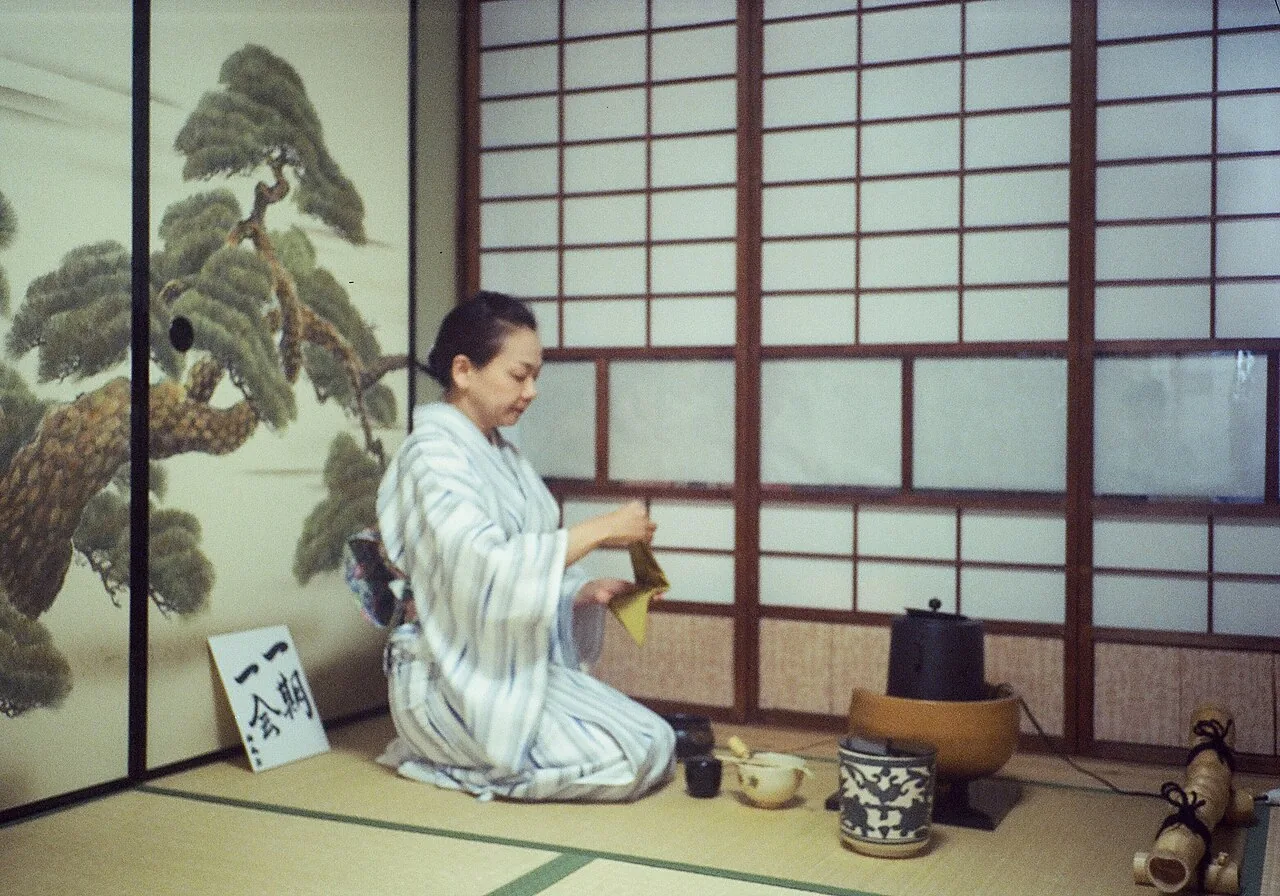
“Tea ceremony in Tokyo” now means two different products sold under one name. One is a tea ceremony: a small tatami room, a host who has trained for years in one of the tea schools, a bowl of matcha made in front of you with the movements that have not changed since the 1500s, and an hour in which nothing else happens. The other is a kimono photo session with a bowl of matcha at the end, and there is nothing wrong with it, except when you wanted the first thing and paid for the second. This is every tea ceremony you can book in Tokyo, by area, sorted into those two kinds, with what each costs and who it is for. Prices, durations, meeting points and review counts were read on the booking sites on September 21, 2026.
On this page
First, the two kinds of tea ceremony you can book
Tea first. Forty minutes to ninety in a proper tearoom, seated on tatami (a stool if your knees object), where the host makes tea for you, explains the objects, and then has you whisk a bowl yourself. A sweet, two bowls, some history, silence you did not expect to enjoy. These cost ¥3,500 to ¥8,000 and the good ones are run by people licensed by Urasenke or Omotesenke, the two big schools, and will say so.
Kimono first. Ninety minutes of which the first thirty are being dressed in a rental kimono and the last fifteen are photographs, with a short, real tea ceremony in the middle by a host who does this twelve times a day. ¥8,000 to ¥15,000. The photographs will be good and the tea will be fine; you are paying for the costume. If that is what you want, the section below tells you which; if you want the tea, do not book these, because the ¥2,500 matcha hour in the Asakusa workshops ranking teaches you more for a third of the money, and so does everything in the “tea first” list.
Tea ceremonies in Tokyo, area by area
Kuramae and Asakusa: the most choice, and the best one
Tea Ceremony Workshop by an Official Instructor is the one to book if you read no further. It is held in a private house in Kotobuki, three minutes from Kuramae Station and ten from Senso-ji, by a school licensed by Urasenke in Kyoto: ninety minutes, several kinds of tea and three sweets, ¥6,500, 4.9 from about 200 reviews. Tea first, in a real room, at a price the kimono places charge for the photographs. Nearby, on the tourist side of Kaminarimon, the Tea Ceremony Experience at Tokyo Tourist Lounge Asakusa is the relaxed version in a lounge rather than a tearoom, one hour, about ¥5,600, 5.0 from over 200 reviews, and honest in its own listing that it is designed for novices; and a 50-minute session with a tea master is the cheapest in the district at about ¥3,500, new and unreviewed. For the tea itself rather than the ritual, Matcha Experience with Japanese Tea Tasting, run by a former tea farmer in Kotobuki, tastes seven teas in ninety minutes for about ¥9,800, 5.0 from about 40 reviews.
Kimono first, in Asakusa: Kimono Tea Ceremony at Maikoya Asakusa is the biggest operator in the category, ninety minutes, about ¥8,100, 4.9 from 727 reviews, dressing included, and it is exactly what it says: well run, formal room, good photographs, a real if brief ceremony. Two things before you book it: its cancellation policy is absolute — nothing refunded inside 24 hours, illness included, which the operator confirms in writing — and guests who paid for the private version describe a plain room with designated photo spots rather than the tearoom in the pictures. Both are below. Its two-hour version with sweets making is about ¥20,350, up from about ¥14,400 a month earlier. The small-group kimono tea ceremony near the Skytree is the same format from a smaller operator, about ¥9,800, 5.0 from over 200 reviews, and the one to choose if you want fewer people in the room.
Yanaka and Bunkyo: the tearooms nobody advertises
Two of the most authentic settings in the city are in the quiet wards north of Ueno. Tea Ceremony in a Small Tea Room is held at Senrakuan, a purpose-built tearoom in Sendagi, five minutes from the Yanaka Ginza steps: one hour, about ¥8,000, an English-speaking instructor, and a room the size the ritual was designed for. Do it after the Yanaka walk. Traditional Tea Ceremony with a Japanese Tea Master at OCHARU in Hongo, near the University of Tokyo, is a small-group hour with rare teas and a certificate, about ¥6,000, 4.8 from about 55 reviews. Neither has a kimono, which is the point.
Shibuya: the cheapest, and the private one
Shibuya Authentic Tea Ceremony: fifty minutes on the second floor of a building on Dogenzaka, small group, history and a bowl you whisk yourself, about ¥3,900, 5.0 from about 65 reviews. The best value in the city for a tea-first hour, in the least tea-like neighborhood. Private Japanese Tea Tasting and Matcha Ritual in Shibuya is the private version in a Japanese-style room, one hour, about ¥5,000, 5.0 from about 30 reviews.
Shinjuku: kimono first, done properly
Maikoya Shinjuku is the same operator as Asakusa in a newer room, ninety minutes, about ¥8,100, 5.0 from a smaller number of reviews; book it if your hotel is west and you want the kimono without the Asakusa crowds. Matcha Kimono Tea Ceremony in Tokyo, near Yotsuya, uses a simplified kimono you can put on yourself and spends more of the ninety minutes on the tea, about ¥9,000, 4.9 from about 110 reviews.
Tokyo Station and Ginza: for people with an hour between things
Private Japanese Tea Ceremony in the Tokyo Station Area: ninety minutes, private, from about ¥12,000 with group pricing, new. The price is for the privacy and the location; the tea is the same tea. Ginza’s listings are mostly thirty-minute demonstrations attached to something else, and are not worth a special trip.
The east side: none in Sumida or Koto, and where to go instead
There is no bookable tea ceremony east of the Sumida River; Kuramae and Asakusa, on the west bank, are the closest, and the Urasenke house in Kotobuki is a ten-minute walk from the river walk. What the east side has is the settings: Kiyosumi Garden in Koto has a tea pavilion over its pond that serves matcha and a sweet for a few hundred yen with no ceremony and no booking, and Mukojima Hyakkaen in Sumida does the same in season. Neither is a lesson; both are the thing the lesson is about.
Which tea ceremony to book
| If you want | Book | Area | About |
|---|---|---|---|
| The real thing, best value | Tea Ceremony Workshop by an Official Instructor (Urasenke-licensed) | Kuramae | ¥6,500 · 90 min · 4.9 (206) |
| The cheapest real hour | Shibuya Authentic Tea Ceremony | Shibuya | ¥3,900 · 50 min · 5.0 (65) |
| A proper tearoom, quiet area | Tea Ceremony in a Small Tea Room (Senrakuan) | Sendagi / Yanaka | ¥8,000 · 1 h |
| Kimono and photographs | Kimono Tea Ceremony at Maikoya | Asakusa or Shinjuku | ¥8,100 · 90 min · 4.9 (725) |
| Kimono, smaller group | Tea Ceremony in Asakusa with Kimono, Matcha and Wagashi | Asakusa / Skytree | ¥9,800 · 90 min · 5.0 (222) |
| Nervous, first time in Japan | Tea Ceremony Experience at Tokyo Tourist Lounge | Asakusa | ¥5,600 · 1 h · 5.0 (227) |
| The tea itself, seven kinds | Matcha Experience with Japanese Tea Tasting | Kotobuki | ¥9,800 · 90 min · 5.0 (38) |
| Private, central | Private Tea Ceremony, Tokyo Station area | Marunouchi | from ¥12,000 · 90 min |
What to know before you sit down
- Knees: every listing above offers a stool or a chair if you ask. Ask when you book, not when you arrive.
- Socks: you will take your shoes off. Clean socks without holes are the only dress code that matters.
- Which school: Urasenke and Omotesenke are the two large ones and differ in details you will not notice; a host who names a school has trained for years, and that is the thing to look for in a listing.
- The bowl: turn it twice clockwise before drinking, to avoid drinking from the front the host presented to you; turn it back after. That is the whole of the etiquette a guest needs, and the host will show you anyway.
- Photographs: at kimono sessions, expected. At tea-first sessions, ask, and put the phone away during the making.
- Children: the Tourist Lounge and Maikoya sessions take them; the Kuramae and Sendagi tearooms are better for anyone over ten who can sit still.
What the reviews say, and what they mean
The fourteen listings on this page carry about 1,782 reviews, and 727 of them sit on one operator. On 3 October 2026 I read every review rated three stars or below on the listings with a usable record, and the operators’ replies.
Where the low reviews are
| Listing | Reviews | Rated 3★ or below |
|---|---|---|
| Maikoya Asakusa (kimono first) | 727 | 11 (1.5%) |
| Tokyo Tourist Lounge, Asakusa | 233 | 3 (1.3%) |
| Small-group kimono, near the Skytree | 223 | 0 |
| Official Instructor, Kuramae | 206 | 4 (1.9%) |
| Matcha Kimono, Yotsuya | 111 | 3 (2.7%) |
| Shibuya Authentic | 66 | 0 |
| Maikoya Asakusa, two-hour version | 62 | 1 (1.6%) |
| OCHARU, Hongo | 56 | 3 (5.4%) |
| Matcha Experience, tea tasting | 38 | 0 |
| Maikoya Shinjuku | 32 | 0 |
| Private tasting, Shibuya | 28 | 0 |
| Senrakuan / 50-min tea master / Tokyo Station private | 0 | — |
Three listings have no reviews, including Senrakuan in Sendagi, which this page recommends on the strength of the room rather than the record. That is a judgement, not a measurement, and it is fair to say so.
Maikoya: the cancellation policy is the thing to know
Eleven low reviews in 727 is not a bad rate for the busiest operator in the category. But one of them is worth the whole section. A guest who cancelled inside 24 hours with food poisoning was refused a refund, and the operator’s public reply sets out the rule exactly: cancellations inside 24 hours are “non-refundable in all cases, except in the event of large-scale natural disasters or transportation shutdowns” (February 2026). Date changes are offered “where circumstances allow”, refunds are not.
If you are booking a kimono tea ceremony on a day you might be ill, jet-lagged or delayed, that is the sentence to read twice. It is applied uniformly and the operator says so plainly, which is at least honest; it is also stricter than most things on this site.
The second thing is about the room. A guest who paid ¥72,000 for a private ceremony for two in December 2025 described fluorescent lighting, “minimal decorations”, the sound of other ceremonies through the walls, and specific corners set up to photograph well with the rest of the space empty. This page says at the top that with the kimono-first bookings you are paying for the costume and the photographs. That review is what that sentence looks like at the top of the price range. Two further reviewers say solo guests get less of the host’s attention than groups.
Where no complaint repeats
The small-group kimono ceremony near the Skytree (223 reviews, three at four stars, nothing lower), the Shibuya hour (66), the private Shibuya room (28), the seven-tea tasting in Kotobuki (38) and Maikoya’s own Shinjuku branch (32) have no review below four stars between them. The Kuramae Urasenke workshop this page recommends first has four in 206 and no pattern among them.
OCHARU in Hongo shows three in 56, which is the highest rate on the page, but 56 reviews is a small enough base that three can be three bad afternoons rather than a fault. Worth knowing, not worth avoiding.
Which of these are made for foreigners
The tea-first half of this page is priced close to the Japanese market. The kimono-first half is not, and that is the clearest split this series has found.
The Ochanomizu Urasenke tea school, on the third floor of the Ikenobo building five minutes from JR Ochanomizu, charges Japanese students ¥3,500 a lesson for beginners and ¥4,500 thereafter, mizuya fee included, with no joining fee and no annual fee (checked 3 October 2026). Instruction is in Japanese.
- Tea first: ¥3,500–¥8,000. The Shibuya hour at ¥3,900 is the Japanese price. The Kuramae Urasenke workshop at ¥6,500 is under twice it, for ninety minutes, several teas, three sweets and English. On any reading that is a fair price for the language and the one-off.
- Kimono first: ¥8,100–¥9,800 for ninety minutes; ¥20,350 for Maikoya’s two-hour version with sweets making. Two to three times a Japanese lesson for the ninety-minute sessions, and the tea inside it is shorter. The gap is the kimono, the dresser and the photographs, which are real costs — a full kimono set with hair is ¥3,850 at a Japanese shop in Asakusa, so roughly ¥4,000 of the gap is accounted for and the rest is the room and the photographer.
- ¥72,000 for two is a different product entirely and should be judged as a private photo session, not as tea.
None of this is a foreigner surcharge in the way the word is usually meant. It is the same thing this page already says: decide first whether you want the tea or the photographs, because the two cost different money and the listings deliberately blur them. If it is the tea, a Japanese school will teach you for ¥3,500 and the English-language tea-first hours start at ¥3,900.
Where this joins the rest of the east side
Tea ceremony is one of the seven hours ranked in Asakusa Workshops: Which Hour Is Worth ¥7,000, where the ¥2,500 matcha class is the recommendation. The other experiences compared by area are kintsugi and sushi classes, plus kimono rental by price , samurai and ninja experiences by kind and Japanese cooking classes and the quiet crafts — whose ¥2,500 matcha-making hour in Asakusa is the cheapest way to learn the whisking without the ceremony — and the east side’s own are Edo Kiriko glass and knives on Kappabashi. Everything bookable is on the Experiences page.
Quick answers
Where is the best tea ceremony in Tokyo?
For an authentic ceremony at a fair price, the Urasenke-licensed workshop in a private house in Kotobuki near Kuramae and Asakusa: ¥6,500 for 90 minutes, 4.9 from about 200 reviews. For a kimono and photographs, Maikoya in Asakusa or Shinjuku, about ¥8,100. For the cheapest real hour, the Shibuya tea ceremony on Dogenzaka, about ¥3,900.
How much does a tea ceremony cost in Tokyo?
¥3,500 to ¥8,000 for a tea-first session of 50 to 90 minutes in a tearoom; ¥8,000 to ¥10,000 for a kimono-and-tea session where dressing and photographs take most of the time (about ¥20,000 for a two-hour version with sweets making); ¥12,000 and up for private sessions in central Tokyo.
Is a tea ceremony in Asakusa worth it?
Yes, if you choose the right kind. Asakusa and neighboring Kuramae have the widest choice in Tokyo, from a ¥3,500 fifty-minute session to the Urasenke-licensed ¥6,500 workshop to Maikoya’s ¥8,100 kimono version. Decide first whether you want the tea or the kimono.
Tea ceremony with or without kimono?
Without, if you want to learn about tea: the dressing takes 30 minutes of a 90-minute session and the ceremony is shortened to fit. With, if you want the photographs; Maikoya and the small-group Asakusa session are the well-run ones.
Is there a tea ceremony in Sumida or east Tokyo?
No bookable ceremony east of the river. Kuramae and Asakusa on the west bank are closest. Kiyosumi Garden in Koto serves matcha and a sweet in its pond-side pavilion without a ceremony or booking, for a few hundred yen.
What should I wear to a tea ceremony?
Anything you can sit on the floor in, and clean socks, because shoes come off. Kimono sessions provide the kimono. A stool or chair is available at every listing above if kneeling is a problem; ask when booking.
LOCAL SIDE JAPAN read the prices, durations, meeting points, inclusions and review counts of every session above on Viator on September 21, 2026. Prices are approximate and move with the exchange rate; several use group pricing. This is a researched comparison of the listings and their reviews, not a firsthand report on each tearoom, and the article says so here rather than pretending otherwise. Nothing was provided free by an operator.