This article contains affiliate links to booking sites. If you book through them, LOCAL SIDE JAPAN earns a small commission at no extra cost to you. Everything in the first half of this article is free and needs no booking. How this site is made →
TOKYO / TAITO CITY / YANAKA
Yanaka is the part of Tokyo that did not burn. The 1923 earthquake missed it, the 1945 firebombing mostly missed it, and the property developers of the 1980s could not make the narrow lanes and the enormous cemetery pay. So it is still here: wooden houses, sixty-odd temples, a shopping street that closes at six, and cats that have clearly never been told about Shibuya.
It is also, by now, on every list. The trick is not finding Yanaka; it is going on a weekday morning, walking the right loop, and knowing which of the things people sell here are worth your afternoon.
On this page
The loop, in the right order
Start at Nippori Station (JR Yamanote, Keisei from the airport), west exit. This is the only way to do Yanaka in one line without doubling back.
- Yanaka Cemetery (谷中霊園), five minutes from the station. Ten hectares, a cherry-tree avenue, the grave of the last shogun, and almost nobody. Walk the main avenue north to south. It is a park that happens to have graves in it, and the locals treat it as one.
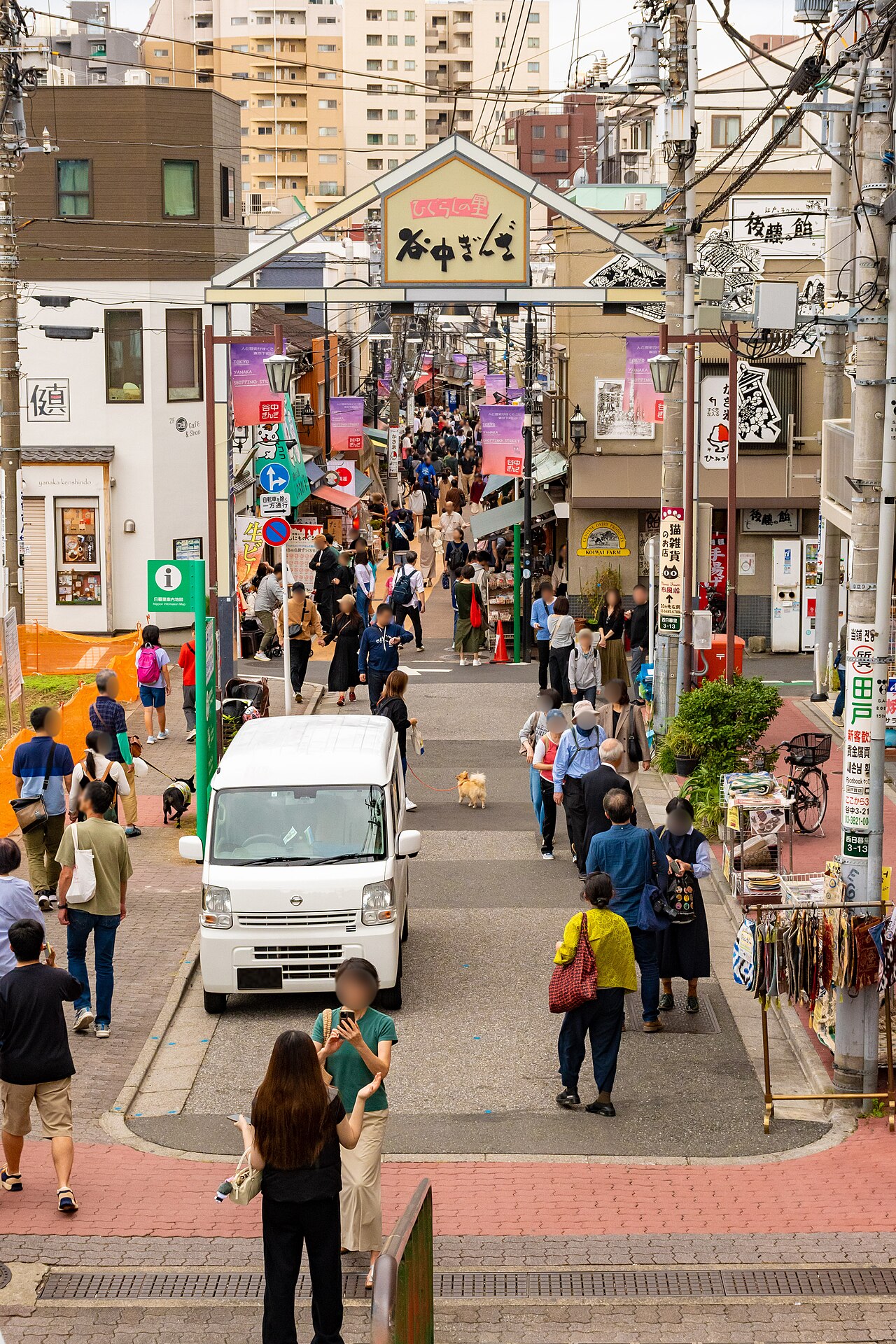
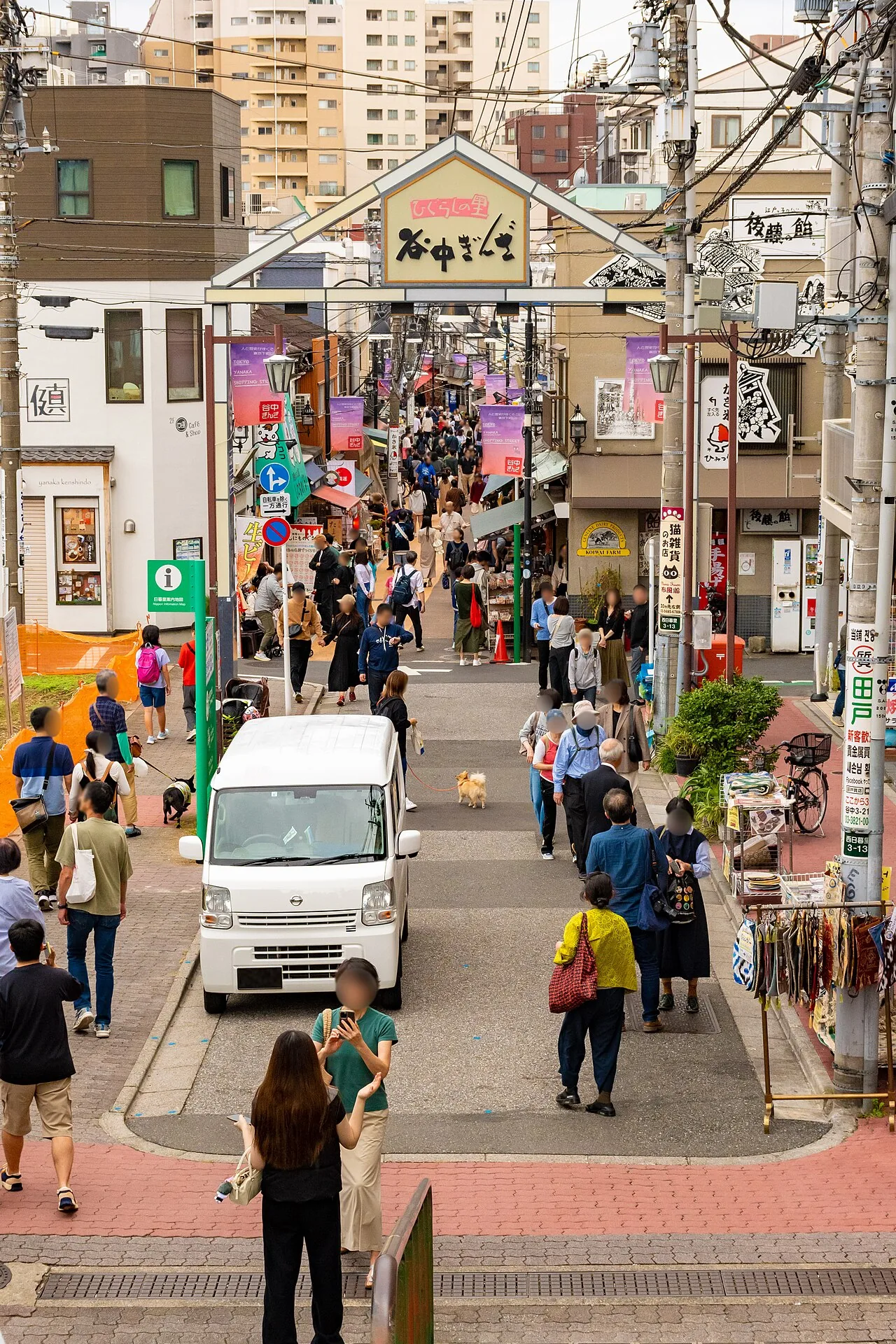
- Yuyake Dandan (夕やけだんだん), the steps. At the bottom is the shopping street; at the top, at dusk, is the view everyone photographs. Go down them now and come back up them at five.
- Yanaka Ginza (谷中銀座), 170 meters, about 70 shops. Croquettes, taiyaki, a sake shop that pours by the glass, a cat-shaped everything. Most shops open around 10:00 and shut between 17:00 and 19:00. Eat standing up; that is what the street is for.
- The back lanes south of the street. This is the part most people miss. Turn left at the end of Yanaka Ginza and wander toward Nezu: temples with their gates open, a public bath, a sake brewer’s old warehouse turned into a café, and the wooden houses that make the neighborhood what it is.
- Nezu Shrine (根津神社), the finish. A 1706 shrine with a tunnel of small red torii and, in April, 3,000 azaleas on the hillside. Nezu Station (Chiyoda Line) is five minutes further on.
Three hours at a walking pace, four with lunch. The whole thing is free.
What to know before you go
- Weekday mornings. Weekend afternoons on Yanaka Ginza are shoulder-to-shoulder and the croquette queue is twenty minutes. A Tuesday at 10:30 is a different street.
- Cash. The street-food windows are ¥150 to ¥400 a piece and many do not take cards. Bring coins.
- The cats are optional. Yanaka sells itself as “cat town.” There are some real cats and a great many ceramic ones. Do not build the day around it.
- Nippori Fabric Town is on the other side of the station: a kilometer of fabric shops, with the Tomato main store as the anchor. Closed Sundays. Only worth it if you sew, in which case it is worth a whole separate morning.
- Temples close. Grounds are generally open in daylight; halls are not. Do not expect to go inside.
When a booking is worth it here
Yanaka has more bookable “experiences” than almost anywhere on the east side, and most of them are guided walks that cover the same loop I just gave you for free. Skip those unless you want the company. Three things are different, because you cannot do them on your own:
Cook in a Yanaka house
The wooden houses are the reason the neighborhood exists, and the only way inside one is to be invited. Private home cooking in Yanaka is two hours in a local kitchen making an ordinary Japanese dinner, the kind that never appears on a restaurant menu. Around ¥18,500 per person, private, 5.0 from close to two hundred reviews. Of everything on the booking sites for this neighborhood, this is the one I would pay for.
Ikebana, for real
Same host, different room. Ikebana in Yanaka is 90 minutes of flower arrangement in a house that suits it. Small group, sells out, and unlike the ten-minute “try ikebana” add-ons in Asakusa, you leave understanding why the empty space matters.
If you do want a guide
Take the cheap one. The Old Quarter of Tokyo: Yanaka Walking Tour is three hours, around ¥7,000, 4.8 from nearly seven hundred reviews, and covers the loop above with the stories attached. The ¥30,000 “eat like a local” food walks are pleasant, but you are paying ¥25,000 for someone to hand you croquettes you could buy for ¥200.
Two things you can book in Yanaka itself, rather than somewhere else in Tokyo. The private ikebana workshop here is the best version in the city and the reason is the shopping — you pick your own flowers at a Yanaka florist first, which no studio class lets you do. And the tearooms in Yanaka and Bunkyo are two of the most authentic settings in Tokyo and the ones nobody advertises. Calligraphy, ikebana and wagashi, by area → / Tea ceremonies by area →
Where this fits with the rest of the east side
Yanaka is the gentle end of a line that gets darker as you go north-east: twenty minutes’ walk from Nippori is Kozukappara, the old execution ground, and Jokan-ji, where the Yoshiwara women were buried. Fifteen minutes south is Kappabashi if you want to leave with a knife instead of a croquette. Do Yanaka first; it is the one you will want to end on if you only do one.
Quick answers
How do I get to Yanaka?
Start at Nippori Station (JR Yamanote Line, or Keisei from Narita Airport), west exit. Walk through Yanaka Cemetery, down the Yuyake Dandan steps to Yanaka Ginza, then through the back lanes to Nezu Shrine and Nezu Station on the Chiyoda Line. The loop takes about three hours.
What are Yanaka Ginza’s opening hours?
Yanaka Ginza is a 170-meter shopping street of about 70 shops. Most open around 10:00 and close between 17:00 and 19:00. Some shops rest on Monday or Tuesday, but the street never fully closes. Bring cash for street food.
Is Yanaka worth visiting?
Yes, on a weekday morning. Yanaka survived the 1923 earthquake and the 1945 firebombing, so it keeps wooden houses, dozens of temples and an old shopping street. Weekend afternoons are crowded; a weekday before 11:00 is a different place.
What can I book in Yanaka that I cannot do on my own?
A private home-cooking session or an ikebana class inside a real Yanaka house. The wooden houses are private, and being invited in is the only way to see one. Guided walks cover the same streets you can walk for free.
Practical notes
- Start: Nippori Station, west exit (JR Yamanote / Keisei). End: Nezu Station (Chiyoda Line).
- Time: 3 hours walking, 4 with lunch. Best on a weekday, arriving by 10:30.
- Cost: ¥0 to walk. ¥1,000 to ¥2,000 if you eat your way down Yanaka Ginza. Cash.
- Yanaka Ginza hours: shops open about 10:00, close 17:00 to 19:00. Some shops rest on Mondays or Tuesdays; the street never fully closes.
- Nezu Shrine azaleas: April. The garden charges a small entry fee during the festival; the shrine is free.
- Worth booking: the home-cooking evening or the ikebana session, both in a real Yanaka house. The guided walk only if you want a storyteller.
LOCAL SIDE JAPAN checked shop numbers and hours against the Yanaka Ginza shopping association, Nippori Fabric Town’s official holiday list and Nezu Shrine’s notices on September 14, 2026. Class prices are quoted as ranges from the booking sites on that date.