Koto City

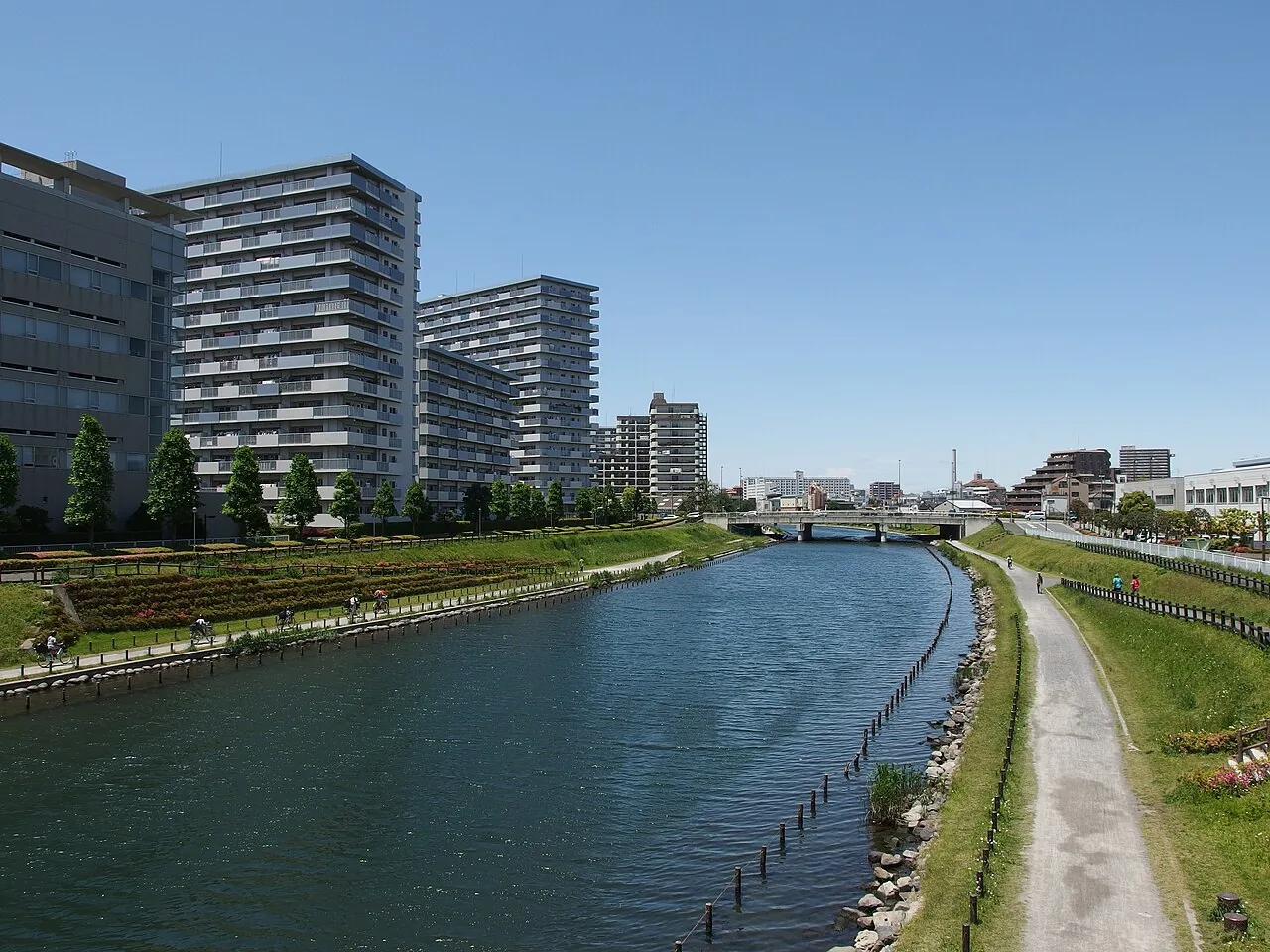
  • What it is: The ward south-east of the Sumida River, built on reclaimed land and cut through by canals.
  • Area: 42.99 km² — 6th of the 23 wards, and still growing seaward.
  • Population: 543,103 in 297,036 households (Koto City, 1 March 2026). Ward established 15 March 1947.
  • Borders: Sumida and Chuo to the north and west, Edogawa across the Arakawa to the east, Tokyo Bay to the south.
  • Known for: Canals and the boat trade, Kiyosumi-Shirakawa coffee, teamLab Planets in Toyosu, and the shopping street at Sunamachi Ginza.
  • Nearest hubs: Kiyosumi-Shirakawa, Monzen-Nakacho, Kinshicho (just over the Sumida border), Toyosu for the bay.

Where is Koto City?

Koto is the ward between the Sumida River and the Arakawa, running from the old canal district in the north down to the reclaimed islands on Tokyo Bay. It is 42.99 square kilometres, the sixth largest of the 23 wards, and about 543,000 people live in it. The northern half is three hundred years old; the southern half did not exist until the twentieth century.

What is Koto known for?

Water. Ieyasu cut the Onagi River through the marsh east of Edo in the 1590s to bring salt into the city, the timber yards followed, and for three centuries everything Edo ate and burned arrived here by boat. That history is why the ward is a grid of canals rather than streets, and why its museums are about cargo, fire and rivers rather than temples. The modern answers are Kiyosumi-Shirakawa, which became Tokyo’s coffee-roasting district, and Toyosu, which has the fish market and teamLab Planets.

What should I do in Koto?

The full list is in the twelve places worth your time in Koto City. The short version:

Is Koto worth visiting?

Most people come for teamLab Planets in Toyosu and leave again, which is a shame, because the half of the ward they drive past is the older and stranger one. Koto has no single famous sight. What it has is the best concentration of small, free or nearly free museums in Tokyo, a canal network you can walk along for hours, and a shopping street that still functions as one.

How do I get to Koto?

Kiyosumi-Shirakawa (Toei Oedo and Tokyo Metro Hanzomon lines) for the north, about fifteen minutes from Otemachi. Monzen-Nakacho for Fukagawa. Toyosu (Yurakucho line, Yurikamome) for the bay, the market and teamLab Planets. From Sumida you can walk in over any of the bridges.

Every Koto guide on this site

  • Fukagawa Edo Museum: Tickets, Hours and What Is Inside the 1840s Street (2026)

    Fukagawa Edo Museum: Tickets, Hours and What Is Inside the 1840s Street (2026)

    This article contains one affiliate link to a booking site. If you book through it, LOCAL SIDE JAPAN earns a small commission at no extra cost to you. The museum itself is ¥400 and needs no booking. How this site is made →

    TOKYO / KOTO CITY / FUKAGAWA

    The Fukagawa Edo Museum is a hangar with a town inside it. Walk through the lobby, down a staircase, and you are standing in a street of 1840s Fukagawa, at full size, with the roofs a few meters below the ceiling and a cat on one of them: a rice shop, a greengrocer, a boat landing with a boat in it, a fire tower, and a row of one-room tenements you can go into and sit on the floor of, each one furnished for the person who lived there. The lights dim to evening, a rooster crows, a vendor’s call comes from somewhere, and it is morning again. Tickets are ¥400, it is three minutes from Kiyosumi-Shirakawa Station, and it is the single best thing on Tokyo’s east side for anyone under twelve or over sixty. Everything below was checked on September 20, 2026.
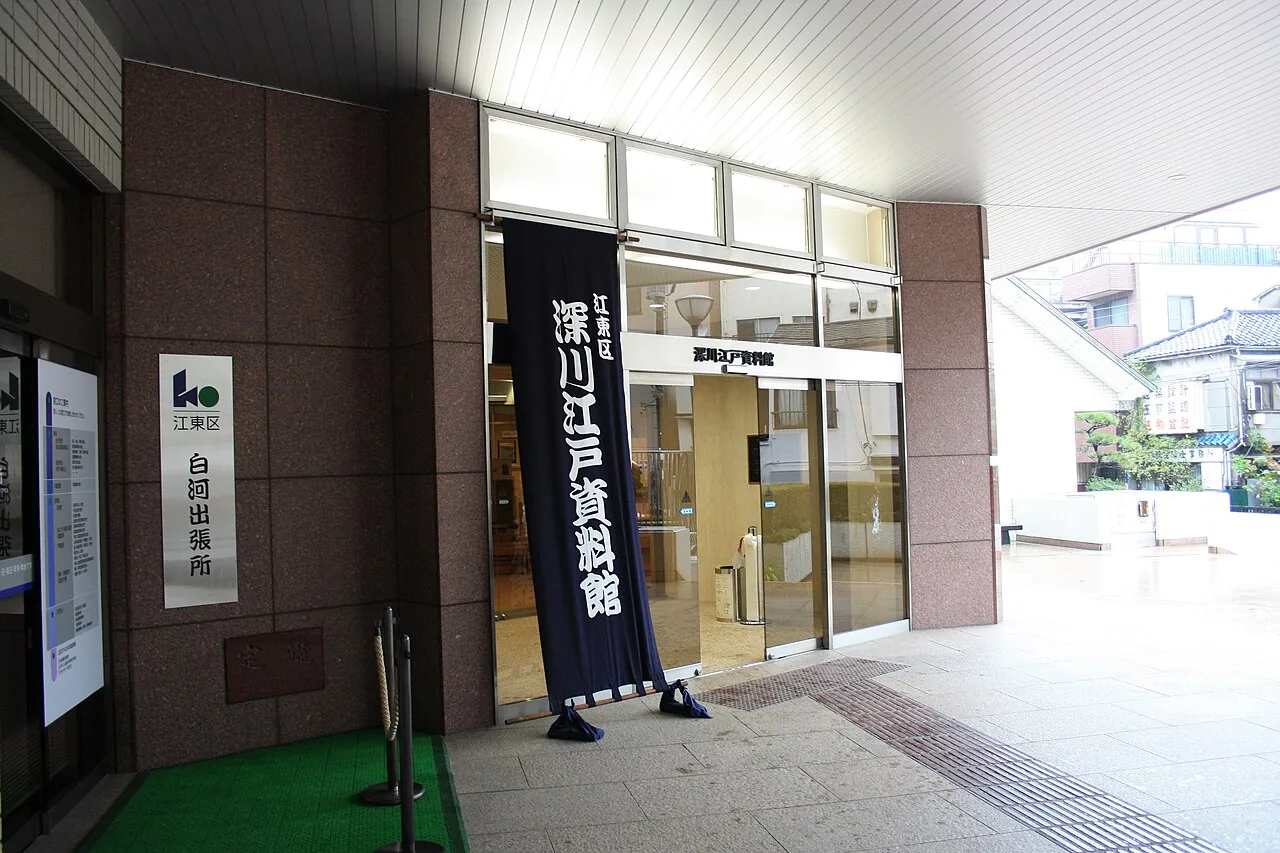
    Entrance of the Fukagawa Edo Museum in Shirakawa, Koto City, with its indigo noren banner
    The entrance on Shirakawa 1-chome. Photography is allowed inside, which is why the interior is worth seeing rather than being shown here. Photo: Lionel Allorge / Wikimedia Commons, CC BY-SA 3.0.

    Fast facts

    • Price: ¥400 adults, ¥50 school students. Cash only
    • Hours: 9:30–17:00, last entry 16:30
    • Closed: 2nd and 4th Monday of the month, and New Year
    • Address: 1-3-28 Shirakawa, Koto City, Tokyo
    • Nearest station: Kiyosumi-Shirakawa, exit A3, 3 minutes
    • Time needed: 1 hour, 90 minutes with the free volunteer guide
    • Booking: none. Cash at the counter, same day only
    • Guides: free volunteer guides at the door, some with good English

    How much are Fukagawa Edo Museum tickets, and when is it open?

    • Admission: ¥400 for adults; ¥50 for elementary, junior-high and high-school students; ¥300 and ¥30 for groups of twenty or more; ¥200 and ¥20 with a disability certificate. Tickets are sold at the counter, valid that day only; bring cash. No advance booking exists or is needed.
    • Hours: 9:30 to 17:00, last entry 16:30.
    • Closed: the second and fourth Monday of each month (open if that Monday is a public holiday), and the New Year holiday. Not closed every Monday, unlike most Tokyo museums.
    • Joint ticket: a combined ticket covers this museum and Koto City’s two other history museums, the Basho Memorial Museum by the Sumida and the Nakagawa Funabansho Museum by the Arakawa. Ask at the counter; it is worth it only if you will do all three, which is a full day.
    • Address and access: 1-3-28 Shirakawa, Koto City. Kiyosumi-Shirakawa Station (Hanzomon and Oedo lines), exit A3, three minutes, past the wall of Kiyosumi Garden. Monzen-Nakacho Station is fifteen minutes on foot.
    • Time needed: an hour is enough; ninety minutes if you take the volunteer guide.

    What is inside the Fukagawa Edo Museum?

    The permanent exhibit is one large room and one idea: a block of Saga-cho, the riverside district of Fukagawa, as it stood in the Tenpo era at the end of the 1830s, rebuilt at full scale from records and from the buildings that survived into the twentieth century. There is a street with a rice wholesaler and a vegetable shop, a canal-side landing with a boathouse and a choki-bune, the narrow fast boat that took customers to the pleasure quarters, a fire lookout tower, a shrine, a public toilet, and behind them the nagaya, the wooden tenement rows where most of Edo actually lived, in single rooms of four and a half or six tatami mats.

    The rooms are the reason to come. Each tenement is furnished as a specific person’s home: a clam seller with his baskets, a woodblock carver with his tools, a widow who teaches the shamisen, a young clerk with almost nothing. You take your shoes off and go in, open the cupboards, lift the lids of the pots, sit at the low desk. Nothing is behind glass. The museum’s volunteer guides, retired locals, some with good English, will walk with you and tell you whose room it is and what they ate; accept the offer, it is free and it turns the set into a neighborhood.

    Overhead the lighting runs through a whole day in well under an hour, dawn to noon to a lantern-lit evening and a thunderstorm, with the sounds to match, so stay long enough to see the street change. On the entrance floor there is a smaller gallery on the history of the district, the canals and the lumber trade, and the Fukagawa festival’s portable shrines. Since April 2026 the museum has been staging regular rakugo and storytelling performances inside the reconstructed town, in Japanese; the schedule is on its site, and even without the language, a storyteller kneeling on a stage in an Edo street at dusk is worth timing a visit for.

    Is the Fukagawa Edo Museum worth it?

    For ¥400, yes, and the price is not really the question. The question is the hour. This is one room. You will have seen the whole street in fifteen minutes and the exhibit does not get bigger after that, so if you measure a museum by how much of it is left to walk, you will think you have been short-changed and leave.

    What you are paying for is the second half of the hour, when you stop reading and start opening things. Sit on the floor of the clam seller’s room, look at how little is in it, work out where he slept and where the baskets went, and wait for the lights to go to evening. People who do that come out saying it was the best ¥400 they spent in Tokyo. People who walk the street once and look for the next gallery come out puzzled. It is the same museum.

    Skip it if you only want Edo in the abstract, with timelines and big models — that is the Edo-Tokyo Museum, and it costs ¥800. Skip it if you are travelling with nobody under twelve and have exactly one morning in east Tokyo. Take it if you have children, if you are over sixty, if you are already in Kiyosumi-Shirakawa for the garden, or if you have ever wondered what the inside of an ordinary Edo house looked like and found that no book shows you.

    Fukagawa Edo Museum or the Edo-Tokyo Museum?

    Cost is the smallest difference between them: ¥400 here, ¥800 there. The big Edo-Tokyo Museum in Ryogoku, which reopened on March 31, 2026 after four years closed and raised its adult ticket from ¥600 to ¥800 that day, is the museum of the whole city: the Nihonbashi bridge, the daimyo mansions, the kabuki theater, Meiji and the war and the Olympics, with English throughout and half a day needed; it opens 9:30 to 17:30, to 19:30 on Saturdays, and closes on Mondays rather than on two of them. Seniors 65 and over pay ¥400, university students ¥480, high-school students ¥300, and junior high and under go free. Fukagawa is the museum of one street and the people who could not afford a house on it, and you are in it rather than looking at it. If you have one museum morning in east Tokyo, take the big one; if you have children, take this one; if you are already in Kiyosumi-Shirakawa for the garden and the coffee, this one is three minutes away and the choice makes itself.

    How do you get to the Fukagawa Edo Museum?

    Kiyosumi-Shirakawa Station, exit A3, then three minutes on foot with the wall of Kiyosumi Garden on your left. The station is on two lines, which is why the museum is easier to reach than its address suggests.

    • From Tokyo Station: walk to Otemachi and take the Hanzomon line four stops. About fifteen minutes door to door.
    • From Ryogoku: two stops on the Oedo line, via Morishita. This is the one to know if you are doing the Edo-Tokyo Museum and this on the same day.
    • From Shibuya: the Hanzomon line runs straight through, no change.
    • On foot: fifteen minutes from Monzen-Nakacho, which is the walk to do if you are also going to Fukagawa Fudo-do.

    There is no museum car park worth using and no need for one. The building is the low grey one with an indigo noren at the door, set back from Kiyosumi-dori; the sign at street level is small and in Japanese, so look for the banner rather than the name.

    What else is near the Fukagawa Edo Museum?

    • Kiyosumi Garden, ¥150, across the road: the stroll garden the founder of Mitsubishi built in the 1880s. Do it first, at 9:00, before the museum opens. The full Kiyosumi-Shirakawa morning →
    • Fukagawa-meshi: the district’s dish, clams in miso over rice, at the restaurants around the museum for ¥1,000 to ¥1,500. Fukagawa Kamasho, a minute away, is the well-known one.
    • Fukagawa Fudo-do, fifteen minutes south: the free fire ritual with taiko drums at 9:00, 11:00, 13:00, 15:00 and 17:00. The 13:00 one fits after lunch.
    • Basho Memorial Museum, ¥200, twenty minutes’ walk north-west by the river, where the poet lived in the 1680s before setting off from Senju; the second museum on the joint ticket.
    • If you want to make something after looking at it: when we went through every listing in the city, Koto had no kintsugi workshop and no tea ceremony — the whole east side has neither. The nearest tea ceremony is in Kuramae, three stops up the Oedo line, which is also where the best one in Tokyo is; for kintsugi the nearest is Asakusa, which is where the cheapest and the most-reviewed ones are. Both are a short enough hop to do in the same afternoon as this. Tea ceremonies by area → / Kintsugi workshops by area, with the prices →
    • The Fukagawa Hachiman Festival, mid-August, when the portable shrines the museum shows come out and the crowd throws water over them; the full version every third year, next in 2029.

    Do you need a guide at the Fukagawa Edo Museum?

    Without, for almost everyone: the museum’s own volunteers are the best guides it could have and they are free. The one packaged tour that includes it is a three-hour Kiyosumi-Shirakawa morning on Viator (about ¥10,000, garden and coffee included) that is really about the neighborhood, with the museum as an option; good on your first days in Japan if you want the area explained, unnecessary otherwise.

    Where does this fit on Tokyo’s east side?

    The museum is stop three on the twelve things to do in Koto City, and the boat landing inside it is the small version of the real one at the Nakagawa checkpoint down the Onagi River. The tenements it rebuilds are what burned in 1923 and 1945 and what the Shirahige-Higashi firewall was built to protect the survivors of. For the city-scale version, the Edo-Tokyo Museum in Ryogoku is two stops away.

    Quick answers

    How much are Fukagawa Edo Museum tickets?

    ¥400 for adults and ¥50 for elementary to high-school students, bought at the counter on the day; no advance booking. Groups of 20 or more pay ¥300 and ¥30. A joint ticket with the Basho Memorial Museum and the Nakagawa Funabansho Museum is available at the counter.

    What are the Fukagawa Edo Museum’s opening hours?

    9:30 to 17:00, last entry 16:30. Closed on the second and fourth Monday of the month (open when that Monday is a public holiday) and over the New Year holiday.

    How do I get to the Fukagawa Edo Museum?

    Kiyosumi-Shirakawa Station on the Hanzomon or Oedo subway line, exit A3, then three minutes on foot past Kiyosumi Garden. The address is 1-3-28 Shirakawa, Koto City. From Tokyo Station it is about 15 minutes via Otemachi.

    Is the Fukagawa Edo Museum good for children?

    Yes, the best museum on Tokyo’s east side for them: a full-size 1840s street with houses you can enter, cupboards you can open and a day-to-night lighting cycle with sound. Children’s tickets are ¥50. Allow an hour.

    Fukagawa Edo Museum or Edo-Tokyo Museum?

    The Edo-Tokyo Museum in Ryogoku (reopened March 31, 2026) costs ¥800 and covers the whole city’s history over half a day with full English; the Fukagawa Edo Museum costs ¥400 and is one rebuilt street you walk through in an hour. Take the big one for history, this one for children or if you are already in Kiyosumi-Shirakawa.


    LOCAL SIDE JAPAN checked admission, hours and closing days against the Koto City Cultural Community Foundation’s museum pages and Koto City’s tourism page on September 20, 2026, and the tour price on Viator the same day. Fukagawa Kamasho and the other restaurants are mentioned as landmarks, not reviewed.
    Written by Kizuku. I run the Sunamachi Ginza Sumo Stable, a sumo experience in Koto City, and I write about the east side of Tokyo I live and work in. More about this site →

  • Things to Do in Koto City, Tokyo: 12 Places, by Someone Who Works There (2026)

    Things to Do in Koto City, Tokyo: 12 Places, by Someone Who Works There (2026)

    This article contains affiliate links to booking sites. If you book through them, LOCAL SIDE JAPAN earns a small commission at no extra cost to you. Nine of the twelve places below are free or under ¥600 and need no booking at all. How this site is made →

    TOKYO / KOTO CITY / THE LIST

    Koto City is the ward that Tokyo’s canals built and that most visitors only touch at teamLab Planets and Toyosu Market before going back across the river. That is a mistake, and an easy one to fix, because the rest of the ward is fifteen minutes away and mostly free. Here are twelve things to do in Koto City, from the Meiji garden and the roaster district in the north-west to the bridge you can walk across at the mouth of the bay, chosen and ordered by someone who works in Kitasuna and has done all of them more than once. Prices and hours were checked on September 18, 2026.

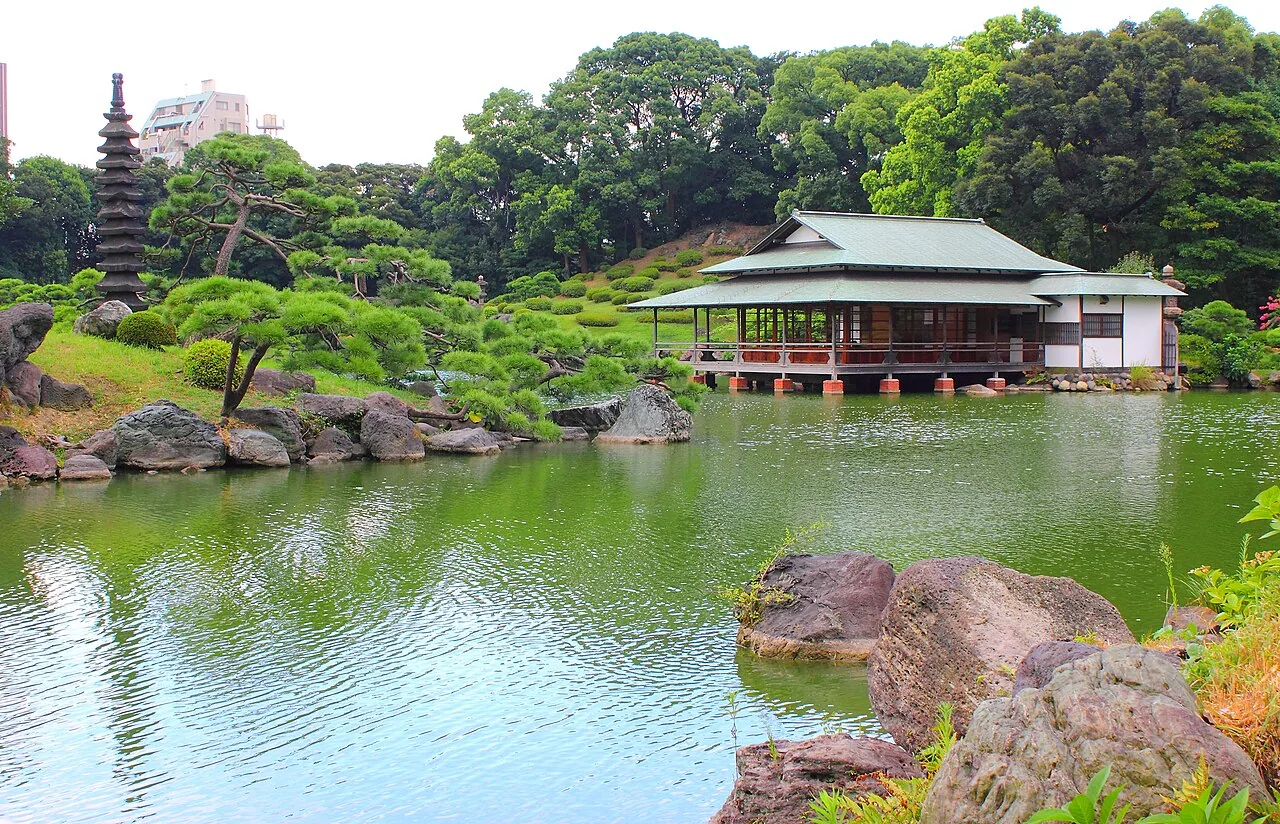
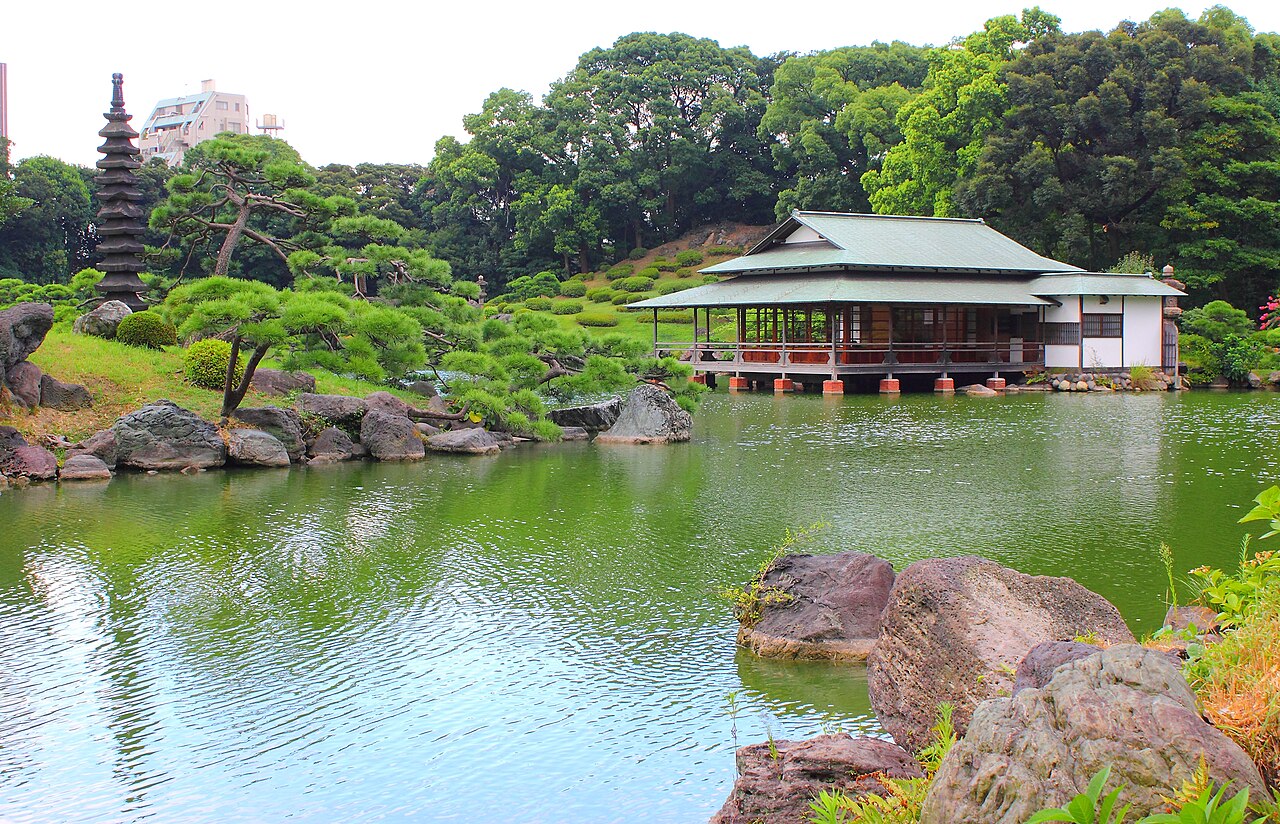
    Kiyosumi Garden pond with stepping stones and pine trees, Koto City, Tokyo
    Kiyosumi Garden, ¥150, the best-value hour in the ward. Photo: Kakidai / Wikimedia Commons, CC BY-SA 4.0.

    The best things to do in Koto City, in order

    1. Kiyosumi Garden, ¥150

    A stroll garden built in the 1880s by the founder of Mitsubishi, who had famous stones shipped from all over Japan and set them around a pond you cross on stepping stones. Herons, turtles, carp, and at 9:00 on a weekday almost nobody. ¥150, open 9:00 to 17:00, directly outside exit A3 of Kiyosumi-Shirakawa Station. The full morning around it is in Kiyosumi-Shirakawa on a weekday.

    2. The coffee roasters of Kiyosumi-Shirakawa

    Blue Bottle opened its first shop outside the United States here in 2015, in a former warehouse, because the ceilings were high and the rent was not. Allpress Espresso is in a converted timber warehouse behind the garden; ARiSE roasts in the back of a counter with a few stools; KOFFEE MAMEYA Kakeru serves coffee as a tasting course. A pastry and a latte cost ¥1,200 to ¥1,800 at any of them. Weekday mornings; Saturday afternoons have queues.

    3. Fukagawa Edo Museum, ¥400

    A full-size block of 1840s Fukagawa rebuilt inside a hall: tenements, a rice shop, a boat landing, a fire tower, with the lighting cycling from dawn to night every twenty minutes. You go into the houses and sit on the floor. ¥400 for adults, ¥50 for children, closed the second and fourth Monday. Three minutes from the garden and the single best thing in the ward for children. Tickets, hours and what is inside →

    4. The fire ritual at Fukagawa Fudo-do, free

    Five times a day, at 9:00, 11:00, 13:00, 15:00 and 17:00, monks light a fire in the main hall and chant over four taiko drums, loud enough to feel in your chest. Watching is free; sit in the hall, be quiet, do not photograph the ritual. Next to Monzen-Nakacho Station. Tomioka Hachimangu, the shrine where Edo’s professional sumo tournaments began, is next door and also free.

    5. Sunamachi Ginza shopping street, the price of lunch

    Six hundred and seventy meters of independent food shops, prepared-food counters, fishmongers and greengrocers, and the best cheap lunch on the east side: yakitori, tempura, oden and dumplings bought from counters and eaten standing. It is a working market, not a tourist one; keep entrances clear and ask before photographing staff. Bus from Kinshicho or Nishi-Ojima, or 15 minutes on foot from Minami-Sunamachi. The walk that starts here is in the Onagi River guide.

    6. The ¥100 boats on the Yokojukken River

    A 1.9-kilometer waterside park made from an old canal, with rowing and pedal boats for ¥100 per 30 minutes and, on scheduled days, free rides in traditional wooden boats rowed by volunteers who will hand you the oar. Cash only, no change given, children with an adult. Ten minutes from Sunamachi Ginza. Details and the calendar in the boat park guide.

    7. The Nakagawa boat checkpoint, ¥200

    Edo inspected every boat entering the city from the east at a checkpoint on the Onagi River from 1661; the site was excavated in 1995 and the Nakagawa Funabansho Museum, fifty meters away, rebuilds it at scale and explains how a city of a million people was fed by water. Walk there along the riverside Salt Road from the boat park. Near Higashi-Ojima Station.

    8. The Lucky Dragon No. 5, free

    A museum built around one real wooden fishing boat, the one caught in the fallout of the 1954 Bikini hydrogen-bomb test, which inspired the opening scene of the first Godzilla film and was rescued from the Yumenoshima landfill by a citizens’ campaign. Free, closed Mondays, five minutes from Shin-Kiba Station. The story of the boat →

    9. Tokyo Gate Bridge on foot, free

    The 2.6-kilometer bridge at the mouth of Tokyo Bay that locals call the dinosaur bridge has a pedestrian deck, reached by a lift at Wakasu Park, with the whole bay, Haneda’s approach path and, on a clear day, Mount Fuji laid out from 60 meters up. Free; the walkway is generally open 10:00 to 17:00 with later hours on summer weekend evenings, so check the Tokyo Port Authority page before you go. Bus from Shin-Kiba to Wakasu Camp-jo.

    10. Museum of Contemporary Art Tokyo, ¥500

    MOT’s permanent collection is the best-value contemporary art ticket in the city, in a building at the edge of Kiba Park, whose lawns and playground are the ward’s best picnic ground. Closed Mondays. Twenty minutes’ walk from Kiyosumi-Shirakawa through the park, or Kiba Station.

    11. teamLab Planets, from about ¥3,800

    The barefoot, wade-through-water digital art museum in Toyosu is in Koto City, and it is the one thing on this list you must book ahead. Official tickets are date-priced, from about ¥3,800 on weekdays; Klook sells them at the same face value as the official site, which is the one to use if the official site’s dates are sold out. Avoid the resellers on other booking sites charging ¥7,000 and up for the same ticket. Go at opening or after 18:00; wear trousers you can roll up.

    12. Toyosu Market and the tuna auction

    Tokyo’s wholesale fish market moved here from Tsukiji in 2018. The public galleries and the sushi counters are free to enter and open from 5:00; the Senkyaku Banrai complex beside it has seventy restaurants and a rooftop hot spring with a view of the bay. Watching the tuna auction from the deck needs a lottery entry a month ahead; if you missed it, the guided tuna auction and market tour (about ¥19,000, 4.9 from 55 reviews) gets you onto the auction floor’s viewing deck with someone who explains the bidding, and is the only paid thing on this list that is worth the money for most people.

    Things to see in Koto City if you have longer

    • Kameido Tenjin: the wisteria shrine, late April, with the red arched bridge from Hiroshige’s print. Free.
    • Kiba Park’s lumber-raft demonstrations: the ward’s old timber trade, on festival days in autumn, by men who still know how to walk on floating logs.
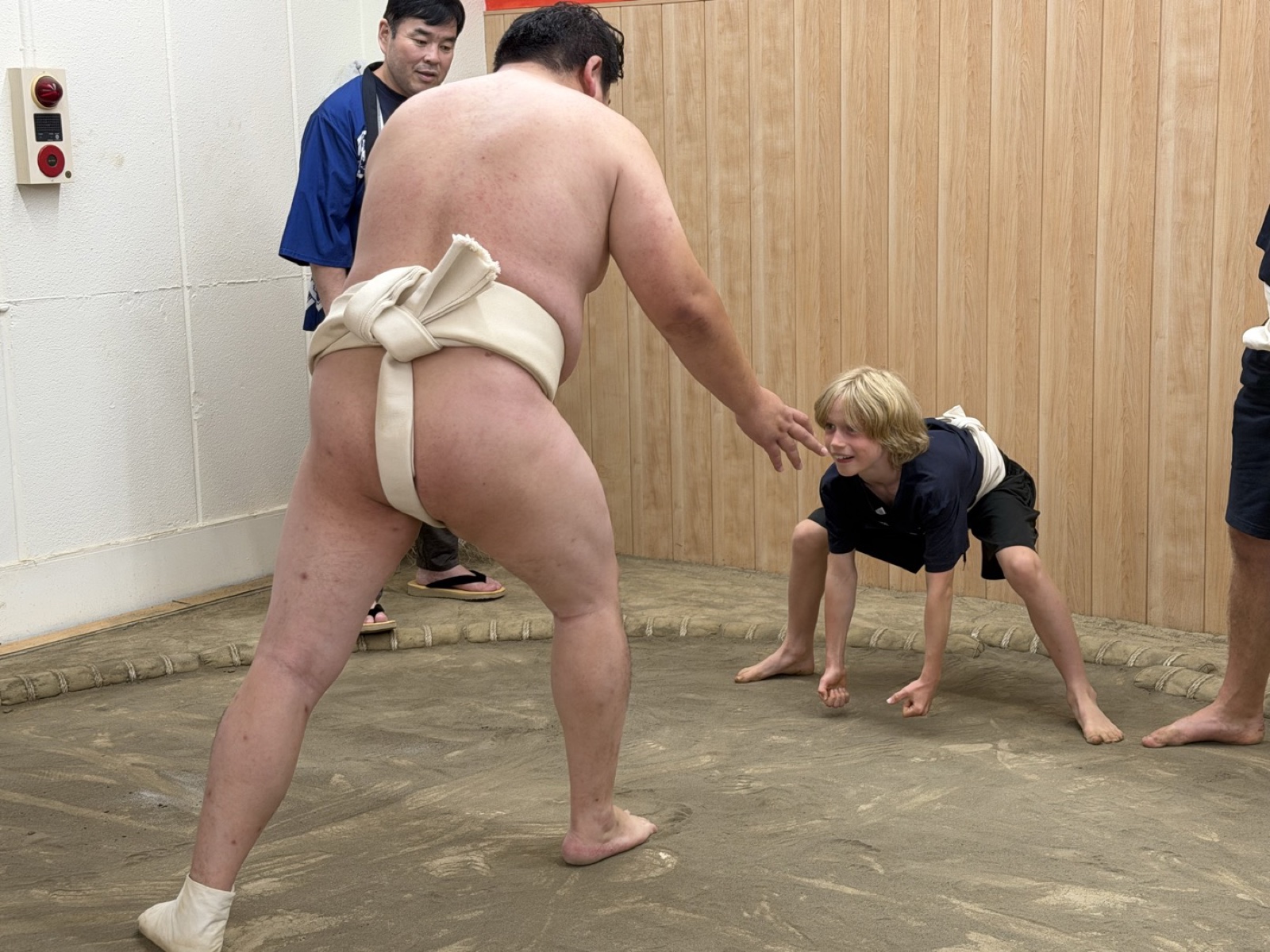
    • The Sunamachi Ginza Sumo Stable, in Kitasuna: 90 minutes with former professional wrestlers — bouts from the edge of a real ring, then the ring itself if you want it. Adults ¥11,000, children 4–12 ¥7,700, under 4 free; 11:00 and 15:30; 3-38-16 Kitasuna. The writer of this site runs it, so this is an interest declared rather than a neutral pick — the other ways to see sumo in Tokyo, with prices, are in this comparison. Check times and book direct →
    • Ariake and Odaiba’s Koto half: the Big Sight, the Gundam, the beach. Well covered elsewhere; not what this site is for.
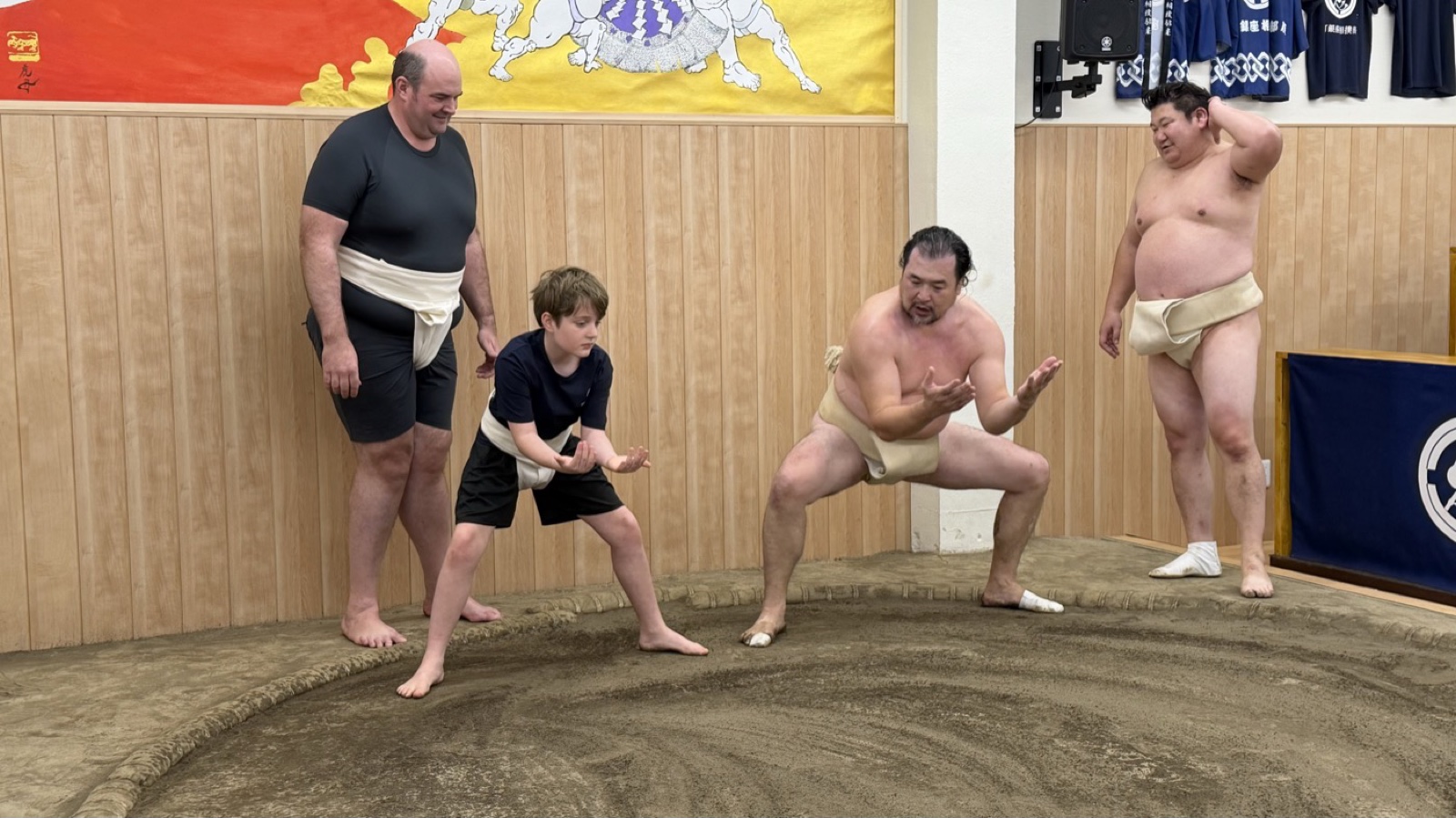
    A boy and his father in practice mawashi copying a wrestler through the shiko warm-up at the Sunamachi Ginza Sumo Stable
    The shiko warm-up at the Sunamachi Ginza Sumo Stable in Kitasuna, listed above. The writer of this site runs it, so the photograph is his and the entry is an interest declared, not a neutral pick. Photo: LOCAL SIDE JAPAN.

    How to do Koto City in a day

    Morning: Kiyosumi Garden at 9:00, coffee, the Fukagawa Edo Museum, fukagawa-meshi for lunch, the 13:00 fire ritual (1 to 4 above; all within a 20-minute walk). Afternoon: Toei Shinjuku line to Nishi-Ojima, the ¥100 boats, the Onagi River walk to the checkpoint museum, dinner bought on Sunamachi Ginza (5 to 7). Or: Yurakucho line to Toyosu for teamLab at 18:00 and the market’s sushi counters, if you booked. Total cost of the first two, without food: ¥750.

    Where this joins the rest of the east side

    Koto is the southern end of the east side. North across the Sumida is Ryogoku and the Kokugikan; east along the river is the buried lock at Komatsugawa in Edogawa; the Edo Kiriko workshop and the tattoo-friendly baths are two stops away in Sumida. Everything in the ward is on the Koto City page.

    The next ward north has its own list: Things to Do in Sumida Beyond the Skytree.

    Quick answers

    What is Koto City known for?

    Canals and the old Fukagawa waterfront, Kiyosumi Garden, the coffee roasters of Kiyosumi-Shirakawa, Sunamachi Ginza shopping street, Toyosu fish market, teamLab Planets, Kiba Park and the Museum of Contemporary Art Tokyo. It was the lumber and shipping district of Edo and is still cut by working waterways.

    Is Koto City worth visiting?

    Yes, for a full day. Most of the best things are free or under ¥600 and within a short walk of Kiyosumi-Shirakawa or Sunamachi; teamLab Planets and Toyosu Market are the two paid draws. It is 15 to 30 minutes from Tokyo Station by subway.

    What is free to do in Koto City?

    The fire ritual at Fukagawa Fudo-do, Tomioka Hachimangu, the Daigo Fukuryu Maru museum, walking Tokyo Gate Bridge, Kiba Park, Kameido Tenjin, the Onagi River Salt Road and Sunamachi Ginza. Kiyosumi Garden is ¥150 and the boats on the Yokojukken are ¥100.

    How do I get to Koto City from Tokyo Station?

    Hanzomon line to Kiyosumi-Shirakawa (change at Otemachi, about 15 minutes), Toei Shinjuku line to Nishi-Ojima or Higashi-Ojima for the canals, Yurakucho line to Toyosu, JR Keiyo line to Shin-Kiba for the Lucky Dragon museum and Gate Bridge.

    Is teamLab Planets in Koto City and how much is it?

    Yes, in Toyosu. Official tickets are date-priced from about ¥3,800 on weekdays, more on weekends; Klook sells them at face value. Book ahead and avoid third-party resellers charging ¥7,000 or more for the same entry.


    LOCAL SIDE JAPAN checked admissions and hours against the Tokyo Metropolitan Park Association (Kiyosumi Garden), Koto City Cultural Community Foundation (Fukagawa Edo Museum), Fukagawa Fudo-do, MOT, the Tokyo Port Authority (Gate Bridge walkway) and Koto City (boats), and ticket prices on the teamLab, Klook and Viator sites, on September 18, 2026. The writer runs a sumo experience in the ward; it is listed with that interest declared and is not one of the twelve.

    Related: Koto City has the only sumo experience in Tokyo where everyone gets into the ring in a real mawashi rather than a costume. All nine Tokyo sumo experiences compared → — including where that one loses.

    Written by Kizuku. I run the Sunamachi Ginza Sumo Stable, a sumo experience in Koto City, and I write about the east side of Tokyo I live and work in. More about this site →

  • Kiyosumi-Shirakawa on a Weekday: Garden, Coffee, Fire Ritual, ¥550 Total

    Kiyosumi-Shirakawa on a Weekday: Garden, Coffee, Fire Ritual, ¥550 Total

    This article contains affiliate links to booking sites. If you book through them, LOCAL SIDE JAPAN earns a small commission at no extra cost to you. The neighborhood is described in full first; the two guided versions come at the end, with what they actually cost. How this site is made →

    TOKYO / KOTO CITY / KIYOSUMI-SHIRAKAWA

    Kiyosumi-Shirakawa gets called “Tokyo’s Brooklyn” by people who have been to neither. What it actually is: a low, flat, canal-cut district of old timber warehouses that the lumber trade left behind, into which, starting around 2015, coffee roasters moved because the ceilings were high and the rent was not. Blue Bottle opened its first shop outside the United States here. The neighborhood around it never changed to match. There is a 140-year-old garden, a Buddhist temple that burns a fire five times a day, a museum that is a rebuilt Edo street, and a very good contemporary art museum, and on a weekday morning you can have all of them nearly to yourself.

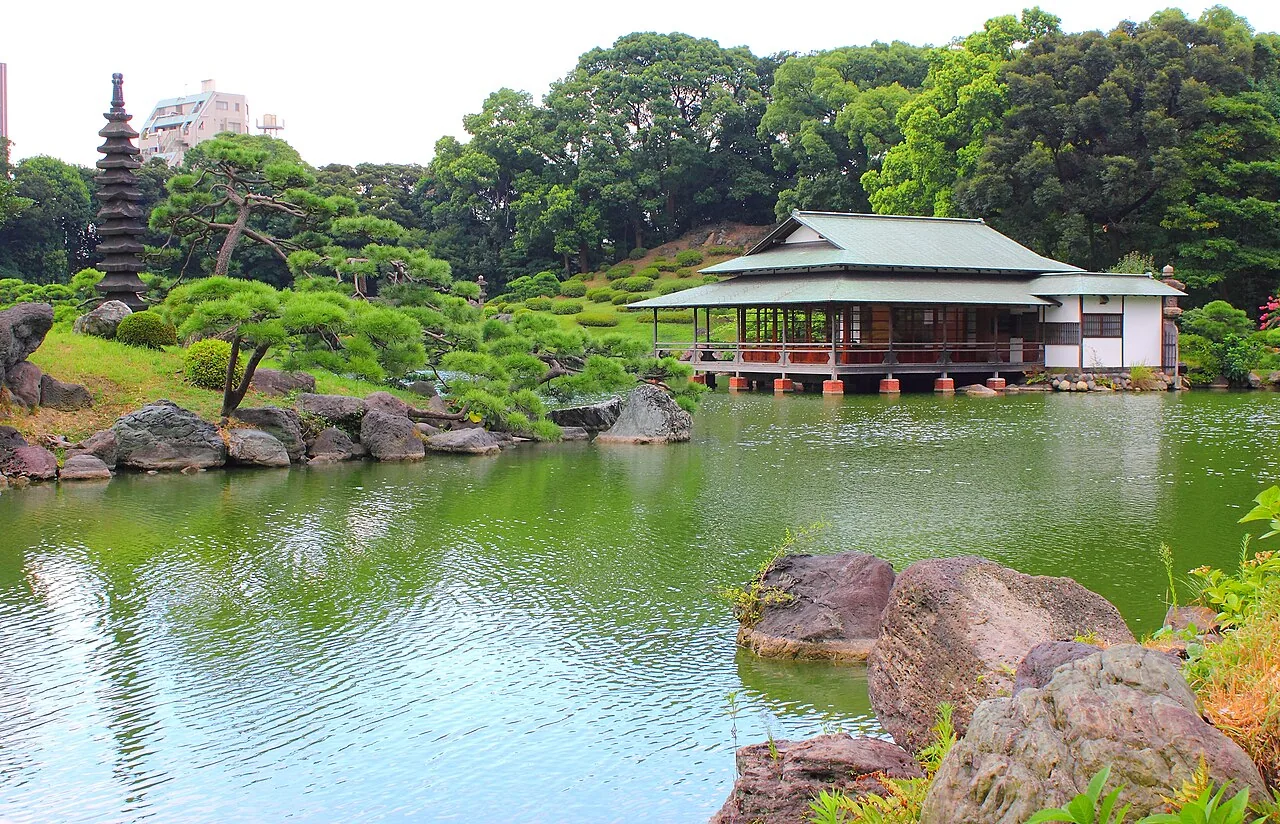
    Kiyosumi Garden pond with stepping stones and pine trees, Koto City, Tokyo
    Kiyosumi Garden, ¥150 at the gate. Photo: Kakidai / Wikimedia Commons, CC BY-SA 4.0.

    A morning here, in order

    1. Kiyosumi Garden, 9:00. Come out of Kiyosumi-Shirakawa Station (Hanzomon or Oedo line) exit A3 and the wall of the garden is in front of you. ¥150 for adults, ¥70 over 65, free for children; open 9:00 to 17:00, last entry 16:30, closed only December 29 to January 1. It was built in the 1880s by Iwasaki Yataro, the founder of Mitsubishi, who had famous stones shipped from all over Japan on his own boats and set them around a pond you cross on stepping stones. Turtles, herons, carp, and at 9:00 almost nobody. Give it forty-five minutes.
    2. Coffee, 10:00. The roasters are scattered along Kiyosumi-dori and the side streets to the east. Allpress Espresso is in a converted timber warehouse on the far side of the garden and is the one that photographs best; ARiSE Coffee Roasters is a counter with a few stools run by a man who roasts in the back; Blue Bottle‘s original Japan shop is on Hirano 1-chome and is a Blue Bottle. Pick one. The pastry-and-latte breakfast will cost ¥1,200 to ¥1,800 wherever you go.
    3. Fukagawa Edo Museum, 11:00. Three minutes from the garden. Inside a hangar they rebuilt a full-size block of 1840s Fukagawa: tenement houses, a rice shop, a boat landing, a fire tower, with the lighting cycling from dawn to night every twenty minutes and a rooster crowing on a loop. You can go into the houses and sit on the floor. ¥400 for adults, ¥50 for children. Volunteer guides in English usually on hand and worth accepting. One hour. Full guide to the museum →
    4. Lunch: fukagawa-meshi. The dish this district is named for is clams in miso ladled over rice, invented for fishermen who did not have time to sit down. Several places around the museum serve it for ¥1,000 to ¥1,500; the one facing the museum entrance is fine.
    5. Fukagawa Fudo-do, 13:00. Fifteen minutes’ walk south, or one stop to Monzen-Nakacho. This is a branch of Narita-san, and five times a day, at 9:00, 11:00, 13:00, 15:00 and 17:00, the monks perform goma: a fire lit in the main hall, sutras chanted over four large taiko drums, loud enough to feel in your chest. Watching is free and you can sit in the hall; nobody minds foreigners as long as you are quiet and do not photograph the ritual itself. Twenty-five minutes. Tomioka Hachimangu, the shrine that started professional sumo’s Edo tournaments, is next door and also free. Sumo is still the thing this ward is best at selling badly: the nine ways to see it in Tokyo, compared, including which ones let you into the ring and which run a lottery for it.
    6. Museum of Contemporary Art Tokyo, afternoon, if you have energy left. Twenty minutes’ walk east through Kiba Park. The permanent collection is ¥500 and is the best-value contemporary art ticket in the city; closed Mondays.

    Total spend for the day without the art museum: about ¥550 in admissions plus what you eat. This is a neighborhood where paying for a guide is a choice, not a necessity.

    When to come, and when not to

    • Weekday mornings are the neighborhood at its best. Saturday afternoon the coffee shops have queues down the street, mostly of Tokyo people, which is its own kind of interesting but not quiet.
    • Monday: MOT is closed every Monday; the Fukagawa Edo Museum closes on the second and fourth Monday of the month (it stays open when that Monday is a holiday). The garden and the temple are open every day.
    • Mid-August, every third year: the full Fukagawa Hachiman Festival, when spectators throw buckets of water over fifty portable shrines. 2026 was a full year; the next is 2029. The smaller annual version is still worth seeing.
    • Early November: the garden’s maples turn, and the garden runs evening openings. Late March for cherry blossom in Kiba Park.

    Two guided versions, and what they really cost

    Both of these exist on Viator and both are honest products. Read the price notes, because one of them is not what the headline number suggests.

    • Kiyosumi Shirakawa Morning Tour: Garden, Coffee and Japanese Sweets (Viator): three hours from 9:00, starting at the garden gate, then Allpress for coffee and a light breakfast, then a Japanese sweet, with a guide who lives here. Around ¥10,000, garden admission and the coffee included. It is the route above with the stories told and someone to order for you; good if you are on your first days in Japan and would like the neighborhood explained rather than found. New listing, a handful of five-star reviews.
    • Coffee Omakase at KOFFEE MAMEYA Kakeru + Kiyosumi Garden (Viator): this is a reserved seat at Kakeru, the tasting-menu coffee bar in a Kiyosumi warehouse where a barista serves a course of coffees the way a sushi chef serves a course of fish, followed by a walk to the garden. The Viator price of about ¥4,500 covers the seat reservation and the garden ticket; the coffee course itself, ¥8,500 to ¥10,000, is paid at the bar on the day. So the real cost is ¥13,000 to ¥14,500 per person. For a coffee person, Kakeru is one of the two or three places in Tokyo worth that; for everyone else, it is a lot of money for coffee, and the seat is also bookable directly from the shop if you plan ahead.

    Where this joins the rest of the east side

    Kiyosumi-Shirakawa sits at the top of the canal network that runs down through Koto City. The Onagi River and its old boat checkpoint are a thirty-minute walk east along the water; the ¥100 boat park on the Yokojukken is a little beyond it. North across the Sumida is Ryogoku and the Kokugikan. The Edo Kiriko glass workshop is two stations north on the Oedo line, and the tattoo-friendly sento are across the river in Sumida.

    The rest of the ward, in order, is in Things to Do in Koto City: 12 Places.

    Quick answers

    How much does Kiyosumi Garden cost and when is it open?

    Adults ¥150, over 65 ¥70, children free. Open 9:00 to 17:00 with last entry at 16:30, every day except December 29 to January 1. It is directly outside exit A3 of Kiyosumi-Shirakawa Station.

    Is Kiyosumi-Shirakawa worth visiting for coffee?

    Yes, on a weekday. Allpress Espresso, ARiSE Coffee Roasters and the original Blue Bottle Japan shop are all within ten minutes of the station, and a coffee and pastry costs ¥1,200 to ¥1,800. Saturday afternoons have long queues.

    What is the Fukagawa Edo Museum and how much is it?

    A full-size reconstruction of an 1840s Fukagawa street inside a hall, with houses you can enter and lighting that cycles from dawn to night. ¥400 for adults, ¥50 for children; closed the second and fourth Monday of the month. Three minutes from Kiyosumi Garden.

    Can visitors watch the fire ritual at Fukagawa Fudo-do?

    Yes, free. The goma fire ritual with taiko drums is held daily at 9:00, 11:00, 13:00, 15:00 and 17:00 in the main hall. Sit quietly and do not photograph the ritual. The temple is a fifteen-minute walk south of Kiyosumi-Shirakawa or next to Monzen-Nakacho Station.

    Do I need a guided tour for Kiyosumi-Shirakawa?

    No. Everything is walkable and signposted, and the whole morning costs about ¥550 in admissions. A guided morning tour costs around ¥10,000 and is useful mainly on your first days in Japan. The coffee omakase tour lists at about ¥4,500 but the coffee course, ¥8,500 to ¥10,000, is paid separately at the bar.


    Practical notes

    • Getting there: Kiyosumi-Shirakawa Station, Hanzomon line (from Shibuya, Omotesando, Otemachi) or Oedo line (from Ryogoku, Tsukishima). Exit A3 for the garden, B2 for the coffee streets.
    • Admissions: Kiyosumi Garden ¥150 / Fukagawa Edo Museum ¥400 / Fukagawa Fudo-do free / Tomioka Hachimangu free / MOT collection ¥500.
    • Cash: the garden gate and the museum take cards now; some of the smaller roasters and the fukagawa-meshi places do not. Carry ¥5,000.
    • Closed days: MOT every Monday; Fukagawa Edo Museum second and fourth Monday; garden and temples never, except the New Year holiday.
    • With kids: the Edo Museum is the best thing in the district for children; the garden’s stepping stones are the second best. Kiba Park has a large playground.

    LOCAL SIDE JAPAN checked garden and museum prices and hours against the Tokyo Metropolitan Park Association, Koto City Cultural Community Foundation and Fukagawa Fudo-do’s public information, and the tour prices and inclusions on Viator, on September 18, 2026. Prices are approximate and change with the exchange rate. Nothing here was provided free by an operator.

    Written by Kizuku. I run the Sunamachi Ginza Sumo Stable, a sumo experience in Koto City, and I write about the east side of Tokyo I live and work in. More about this site →

  • Tokyo Has a Museum Built Around One Fishing Boat.

    Tokyo Has a Museum Built Around One Fishing Boat.

    This article contains affiliate links to booking sites. If you book through them, LOCAL SIDE JAPAN earns a small commission at no extra cost to you. The place itself is free and is described first. How this site is made →

    TOKYO / KOTO CITY / HIDDEN HISTORY

    Tokyo has a museum built around one fishing boat.

    Not a replica. Not a digital projection. The actual wooden vessel fills the building from bow to stern.

    Its name is Daigo Fukuryu Maru—Lucky Dragon No. 5.

    In 1954, its 23 crew members were caught in radioactive fallout from a United States hydrogen-bomb test at Bikini Atoll. Years later, the abandoned boat was found on Tokyo’s former garbage island and saved by citizens.

    Today it stands inside a quiet, free museum in Yumenoshima Park, less than 15 minutes by train from Tokyo Station and almost entirely absent from most Tokyo itineraries.

    The preserved wooden fishing boat Daigo Fukuryu Maru inside its Tokyo exhibition hall
    The preserved Daigo Fukuryu Maru inside the exhibition hall. Photo: carpkazu / Wikimedia Commons, CC BY-SA 3.0.

    Fast facts

    • Admission: Free
    • Hours: 9:30–16:00
    • Closed: Mondays, or the next weekday when Monday is a public holiday
    • Address: Inside Yumenoshima Park, 2-1-1 Yumenoshima, Koto City, Tokyo
    • Nearest: Shinkiba Station, about 10 minutes on foot

    A normal fishing trip entered the nuclear age

    Daigo Fukuryu Maru was built in Wakayama Prefecture in 1947, first as a bonito boat and later converted for deep-sea tuna fishing from Yaizu Port in Shizuoka.

    On March 1, 1954, the crew was fishing about 160 kilometers east of the test site at Bikini Atoll in the Marshall Islands.

    They saw a sudden flash in the west. Minutes later came a sound like an earthquake. Then white material began falling onto the deck.

    The fishermen called it shi no hai—“ashes of death.” It was pulverized coral made radioactive by the explosion.

    The 23 men worked to return to Japan while the fallout remained on their boat, clothes, skin and catch. By the time they reached Yaizu, all were suffering symptoms of radiation exposure.

    The bomb was far larger than expected

    The test was called Castle Bravo. The bomb produced a yield of 15 megatons—about 1,000 times the explosive power of the atomic bomb dropped on Hiroshima, according to the exhibition hall.

    Its radioactive contamination spread beyond the test area. Daigo Fukuryu Maru became the best-known Japanese vessel involved, but it was not the only one. The museum’s research states that hundreds of Japanese fishing vessels landed contaminated tuna during 1954.

    The Marshall Islands suffered the direct and continuing consequences of 67 American nuclear tests conducted between 1946 and 1958. Several communities remain displaced from their home islands.

    This is why the exhibition hall prefers the broader term “Bikini Incident”. A story centered only on one Japanese boat can make the affected Marshallese communities—and the wider Pacific contamination—disappear from view.

    Historic black and white photograph of Daigo Fukuryu Maru before the 1954 Bikini incident
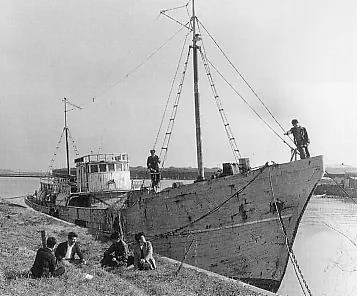
    Daigo Fukuryu Maru in the early 1950s, before the incident. Unknown photographer, via Wikimedia Commons, public domain.

    The tuna became national news

    The contaminated catch was called “atomic tuna.” Fish markets searched for affected shipments, tuna was buried or destroyed, and public fear spread far beyond one crew.

    The boat’s chief radio operator, Aikichi Kuboyama, died in September 1954 after months of treatment. His death became a powerful symbol in Japan’s growing movement against atomic and hydrogen bombs.

    The incident also changed Japanese popular culture. The original Godzilla appeared in cinemas later that year, opening with a fishing boat destroyed by a mysterious flash at sea. The connection is not subtle. Japan’s giant radioactive monster arrived in the same national atmosphere of shock and fear.

    That does not make this a Godzilla attraction. It makes the museum one of the real places that helps explain why the film meant more than a man in a monster suit stepping on buildings.

    How did the boat end up in a Tokyo park?

    After radiation levels fell and safety was confirmed, the vessel was rebuilt as a training ship named Hayabusa Maru for the Tokyo University of Fisheries.

    It was retired in 1967, sold for dismantling and eventually abandoned on reclaimed land at Yumenoshima.

    At that time, Yumenoshima was known as a huge garbage-disposal site. The name means “Dream Island,” which is either optimistic urban planning or extremely aggressive rebranding.

    Citizens learned that the vessel was lying there and organized a movement to preserve it. The Tokyo Metropolitan Government opened the exhibition hall in 1976.

    The boat survived because ordinary people decided that throwing it away would also throw away the memory attached to it.

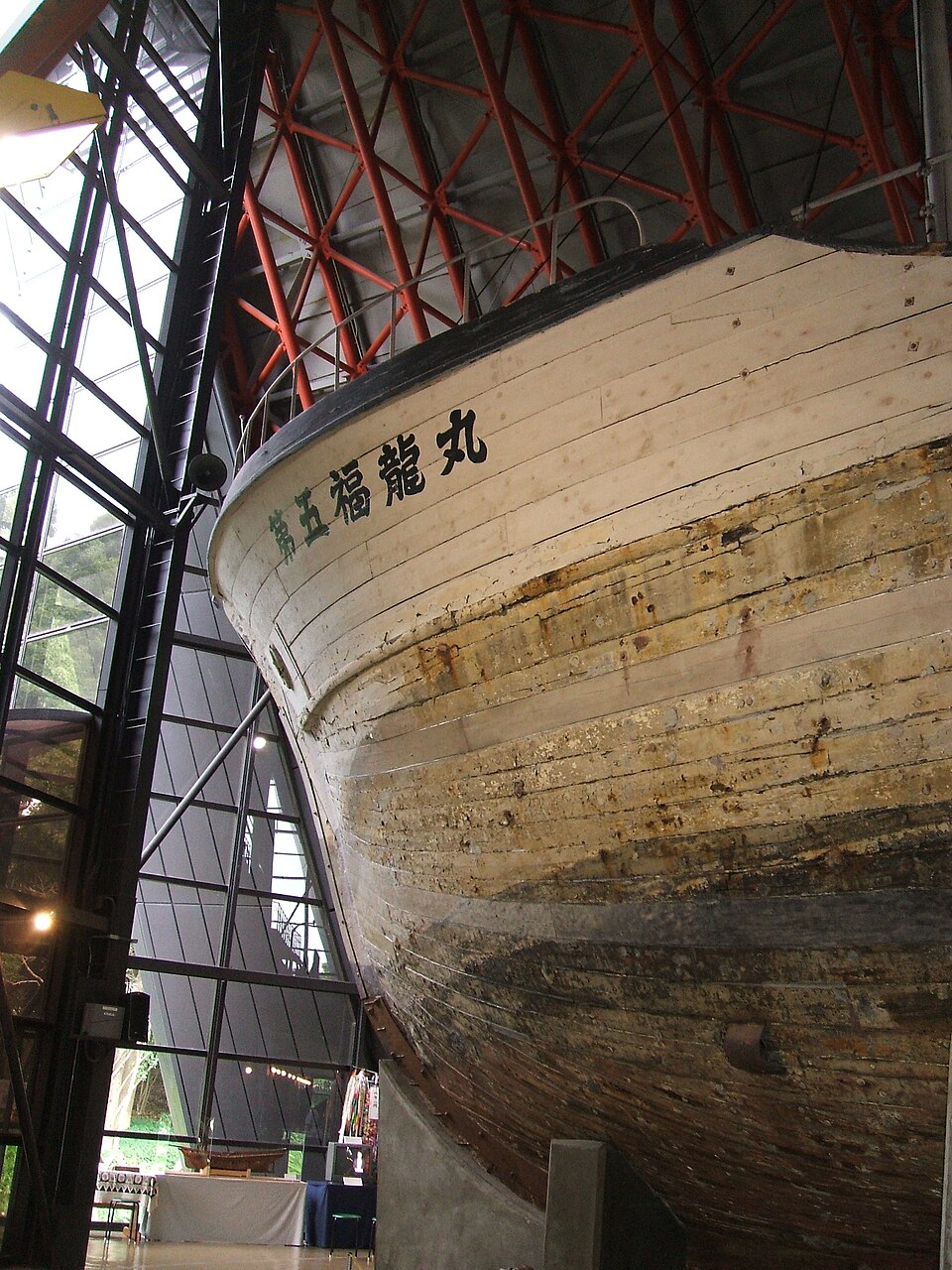
    The vessel’s bow and name
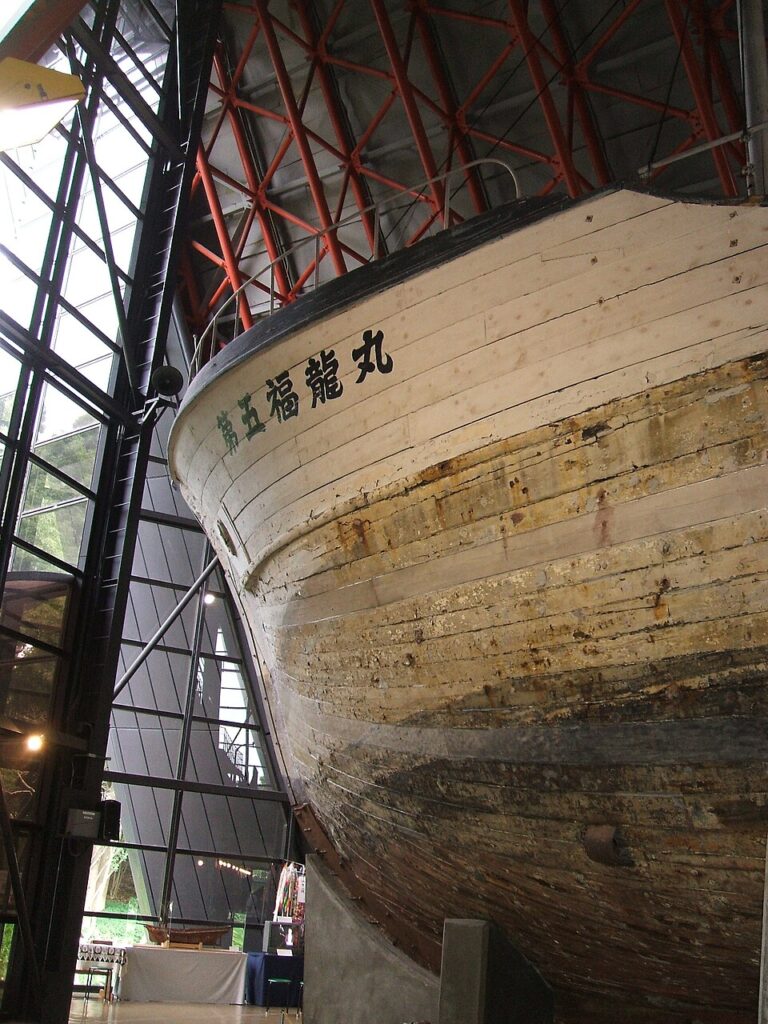
    The vessel’s bow and name. Photo: carpkazu / Wikimedia Commons, public domain.

    What it feels like inside

    The building is shaped around the ship. Walk in and the scale becomes immediate: roughly 30 meters long, six meters wide, 15 meters high and 140 tons.

    Wooden deep-sea fishing boats like this were once part of Japan’s postwar struggle to secure food. The hull is therefore two kinds of evidence at once—evidence of ordinary working life and evidence of nuclear damage.

    Exhibits cover the crew, contaminated tuna, radioactive rain, nuclear testing across the Pacific, settlements between Japan and the United States, the Marshall Islands and the international anti-nuclear movement.

    Outside are the vessel’s engine, a tuna memorial and a memorial to Aikichi Kuboyama.

    English information is available on the museum’s website, but the official site states that no English guide is provided for group tours. Use your phone’s translation camera for Japanese panels and allow enough time to read slowly.

    A museum that asks more than “what happened?”

    The obvious question is what happened to the fishermen.

    The more difficult questions come later. Who was warned? Whose suffering became visible? Whose remained distant? What does a country save, and what does it allow to disappear?

    This small Tokyo museum does not provide a comfortable sightseeing break. It provides something more valuable: a physical object that makes an enormous historical event human-sized.

    Twenty-three men went to catch tuna. One wooden boat returned carrying evidence of a nuclear test occurring far beyond Japan.

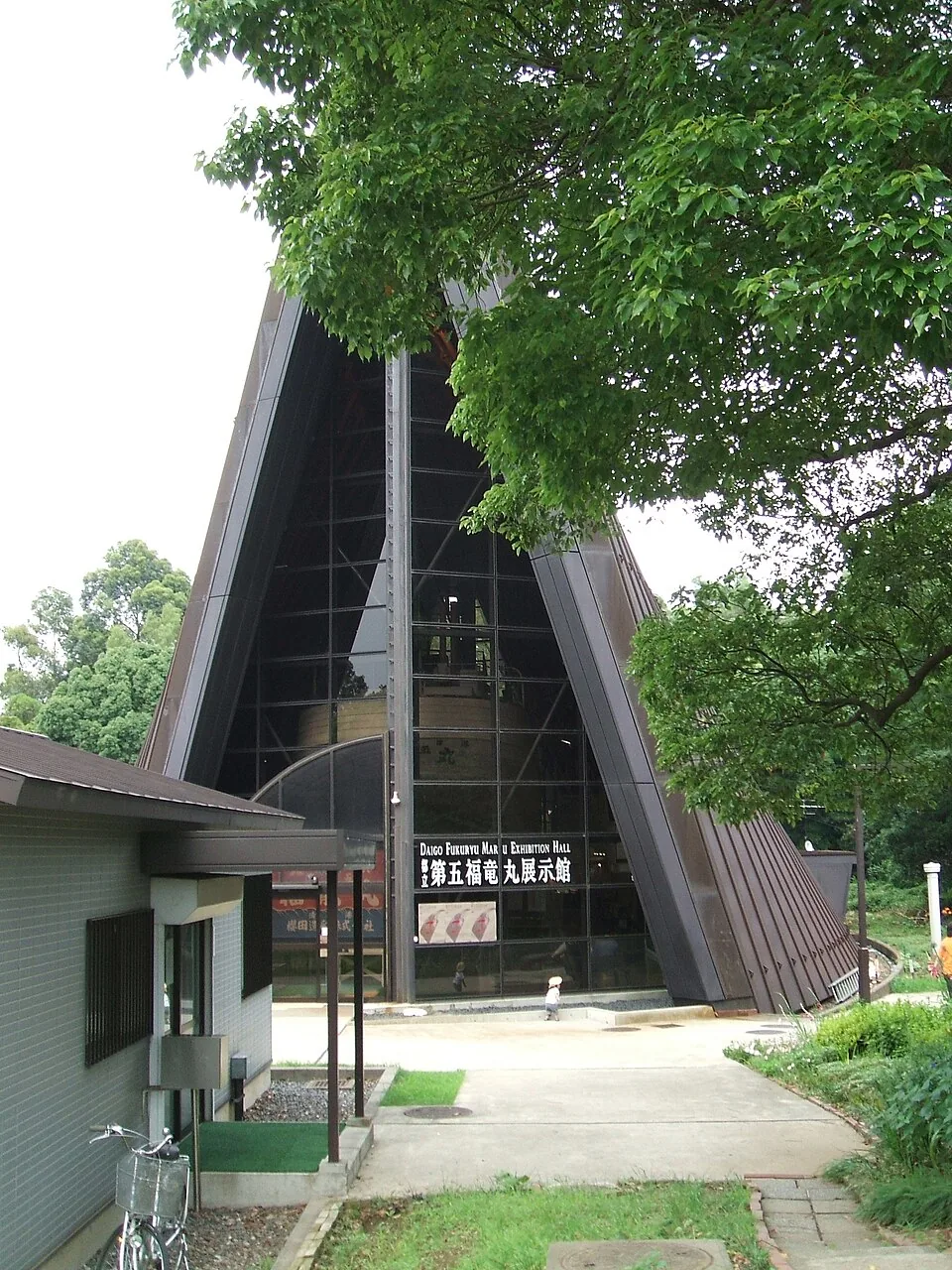
    Entrance of the Daigo Fukuryu Maru Exhibition Hall in Yumenoshima Park, Tokyo
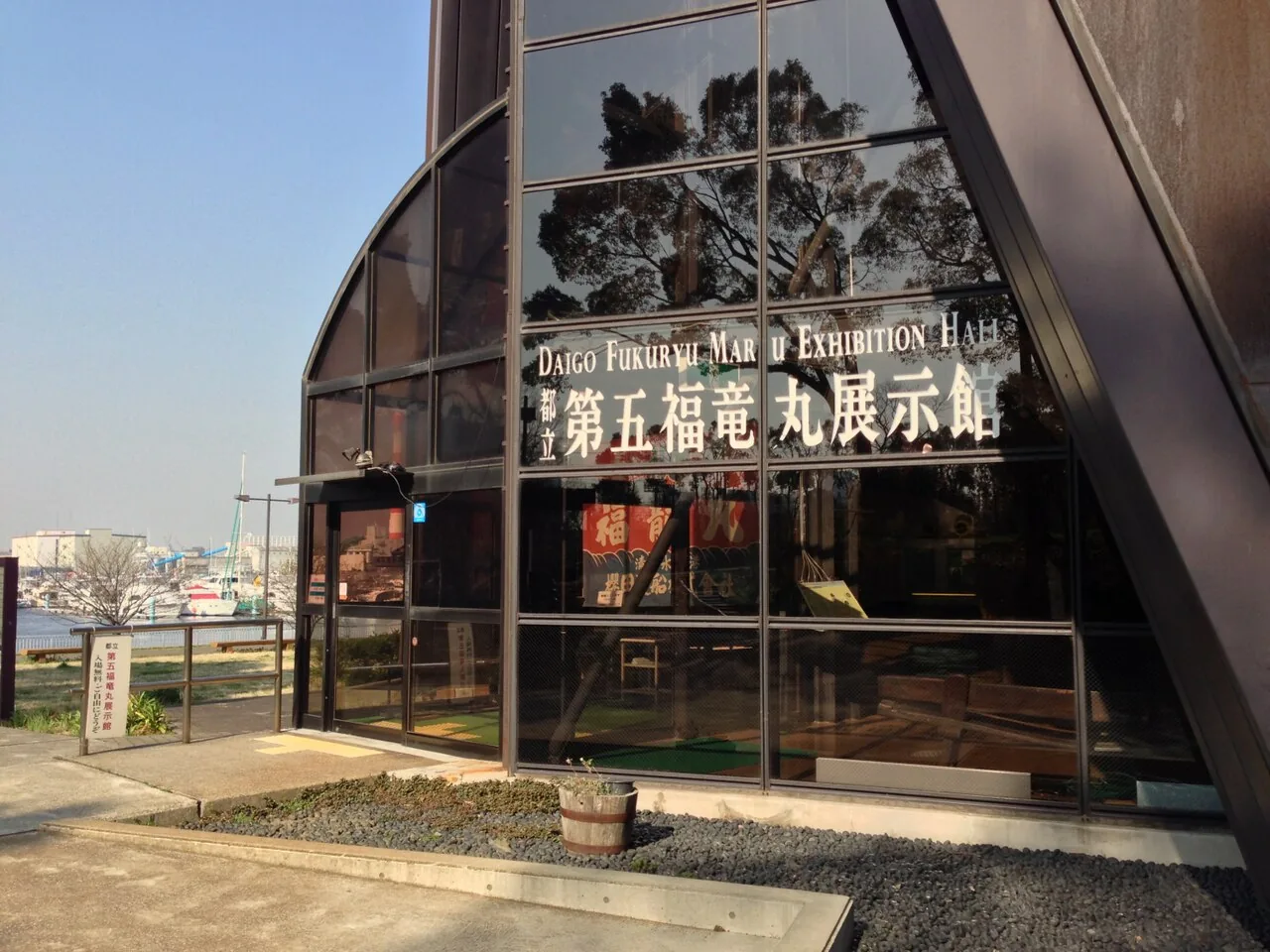
    The exhibition hall entrance in Yumenoshima Park. Photo: Tokyo-Walk / Wikimedia Commons, CC BY-SA 3.0.

    Make it a Yumenoshima half-day

    1. Shinkiba Station — arrive by the JR Keiyo Line, Tokyo Metro Yurakucho Line or Rinkai Line.
    2. Daigo Fukuryu Maru Exhibition Hall — allow 60–90 minutes if you want to read rather than simply photograph the ship.
    3. Yumenoshima Park — walk through the eucalyptus trees and open lawns.
    4. Yumenoshima Tropical Greenhouse Dome — add the greenhouse if it is open and you want a complete change of atmosphere.
    5. Tokyo Yumenoshima Marina — finish beside the modern boats, a strange visual contrast with the wooden vessel inside the museum.

    From Sunamachi Ginza, use a local bus or connect through Toyocho and Shinkiba depending on your starting point. Check a live route planner on the day because the best connection changes by time.

    Before you go

    • Official name: Daigo Fukuryu-Maru Exhibition Hall / 東京都立第五福竜丸展示館.
    • Address: Inside Yumenoshima Park, 2-1-1 Yumenoshima, Koto City, Tokyo.
    • Current hours: 9:30–16:00.
    • Admission: Free.
    • Regular closure: Mondays, or the following weekday when Monday is a public holiday.
    • Access: About ten minutes on foot from Shinkiba Station.
    • Language: The official website has English information; bring camera translation for detailed Japanese panels.
    • Photography: Follow the signs and staff instructions inside the exhibition hall.
    • Latest information: Check the museum’s news page before traveling because temporary closures and events may affect access.

    Tokyo is good at replacing what no longer seems useful.

    This boat escaped that fate.

    It was built to catch fish, exposed by a bomb, renamed, retired, abandoned and finally saved—not because it was beautiful, but because forgetting it would have been easier.

    Some places are worth visiting because they are fun.

    This one is worth visiting because it refuses to let history become abstract.


    Researched using current information from the Daigo Fukuryu-Maru Exhibition Hall, its official history and official access guide, checked September 12, 2026. This is a researched cultural guide, not a firsthand visit report. Hours and exhibition conditions may change.

    Making a day of it: Yumenoshima is two stops from Toyosu on the Yurakucho line, and most people combine this free museum with teamLab Planets (date-priced from about ¥3,800; Klook sells the official ticket at face value) or the fish market. Do the boat first, in the morning, when the hall is empty; the contrast with the art museum afterwards is the point.

    Where this joins the rest of the east side

    Yumenoshima is the seaward end of Koto City. The Onagi River checkpoint and the Yokojukken boat park are the same ward’s inland water story; Kiyosumi-Shirakawa, with the Fukagawa Edo Museum, is two stops from Tokyo Station on the way back. All the ward’s stories are on the Koto City page.

    Quick answers

    Where is the Daigo Fukuryu Maru museum and how much is it?

    In Yumenoshima Park, Koto City, about five minutes from Shin-Kiba Station (JR Keiyo, Yurakucho and Rinkai lines), 15 minutes by train from Tokyo Station. Admission is free. Closed Mondays.

    What happened to the Daigo Fukuryu Maru?

    On March 1, 1954 the tuna boat was fishing 160 km from Bikini Atoll when the US Castle Bravo H-bomb test (15 megatons) showered it with radioactive coral ash. All 23 crew suffered radiation sickness; radio operator Aikichi Kuboyama died in September 1954.

    Is the boat in the museum the real one?

    Yes. After decontamination it served as a training ship, was abandoned on the Yumenoshima landfill in 1967, and was saved by a citizens’ campaign. The 30-meter wooden vessel has filled the purpose-built hall since 1976.

    Is the Daigo Fukuryu Maru connected to Godzilla?

    Yes. The original Godzilla film opened later in 1954 with a fishing boat destroyed by a flash at sea, a direct reference to the incident and the national fear of ‘atomic tuna’ it caused.

    Written by Kizuku. I run the Sunamachi Ginza Sumo Stable, a sumo experience in Koto City, and I write about the east side of Tokyo I live and work in. More about this site →

  • Tokyo Has a ¥100 Boat Park. Almost Nobody Knows It.

    Tokyo Has a ¥100 Boat Park. Almost Nobody Knows It.

    This article contains affiliate links to booking sites. If you book through them, LOCAL SIDE JAPAN earns a small commission at no extra cost to you. The place itself is free and is described first. How this site is made →

    TOKYO / KOTO CITY / LOCAL WATERWAYS

    Tokyo has a park where you can row a wooden boat, pass a tiny rice field and pay just ¥100 for half an hour on the water.

    It is not beside Mount Fuji. It is not in a preserved village. It is wedged between apartment blocks, local roads and the everyday neighborhoods of Koto City.

    This is Yokojukken-gawa Shinsui Park—a 1.9-kilometer waterside park close to Sunamachi Ginza, built from part of an old canal.

    Come here after eating your way through the shopping street. Tokyo will suddenly become slower, greener and slightly harder to explain.

    A quiet canal and trees inside Yokojukken-gawa Shinsui Park in Tokyo
    A quiet stretch of the park’s canal. Photo: Guilhem Vellut / Wikimedia Commons, CC BY 2.0.

    Fast facts

    • Admission: The park is free
    • Rowing and pedal boats: ¥100 per boat for 30 minutes. Cash only and no change is given — bring ¥100 coins
    • Traditional wooden boat: About 20 minutes, free, on scheduled days, no reservation needed
    • Closed: The aquatic obstacle course is closed until the end of April 2027 for bridge reconstruction
    • Where: Between Ogibashi and Toyo, Koto City, Tokyo
    • Nearest: Toyocho Station, about 10 minutes on foot to the southern section; Minami-Sunamachi or Nishi-Ojima, 10 to 15 minutes

    A river turned into a neighborhood park

    Yokojukken-gawa means roughly “the river ten ken wide.” A ken was an old Japanese unit of length; ten of them is about 18 meters. The name is refreshingly practical. Edo-era branding departments were apparently busy elsewhere.

    The canal once formed part of the dense water network that moved people and goods through eastern Tokyo. After decades of industrialization and flood-control work, part of it was reshaped into a public waterside park.

    Koto City describes the theme as “a waterfront for residents.” That phrase explains the place better than “tourist attraction.” People walk dogs, children look for fish, older residents sit under trees, and almost nobody is performing Tokyo for an audience.

    The strange luxury of ¥100 boating

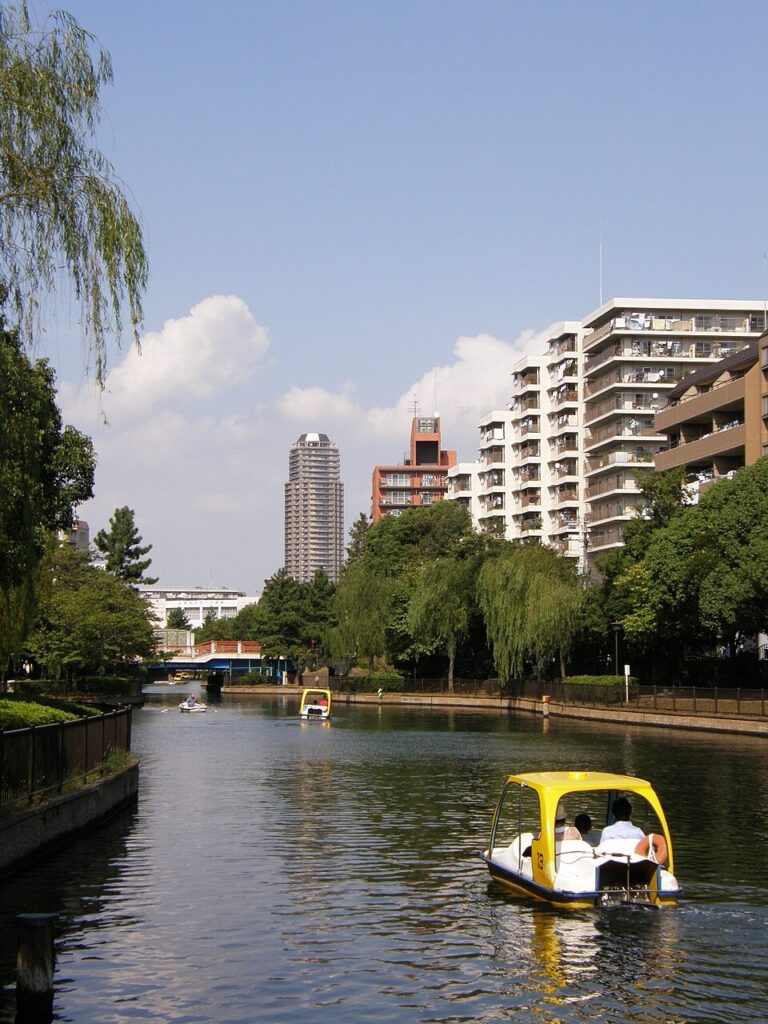
    At the park’s boat area, the current official price is ¥100 per boat for 30 minutes. There are rowing boats and pedal boats, subject to the operating calendar, weather and availability.

    One hundred yen in central Tokyo usually buys you almost nothing. Here, it buys temporary command of a very small vessel.

    The route is calm and contained. You are not launching into Tokyo Bay or navigating behind a container ship. You pedal or row past trees, bridges and residential buildings while local life continues on both banks.

    Bring ¥100 coins or other accepted cash denominations because the facility does not provide change. Children of elementary-school age or younger must ride with a guardian, and bad weather can close the boats without much ceremony.

    Pedal boats at the park. Boat styles may change
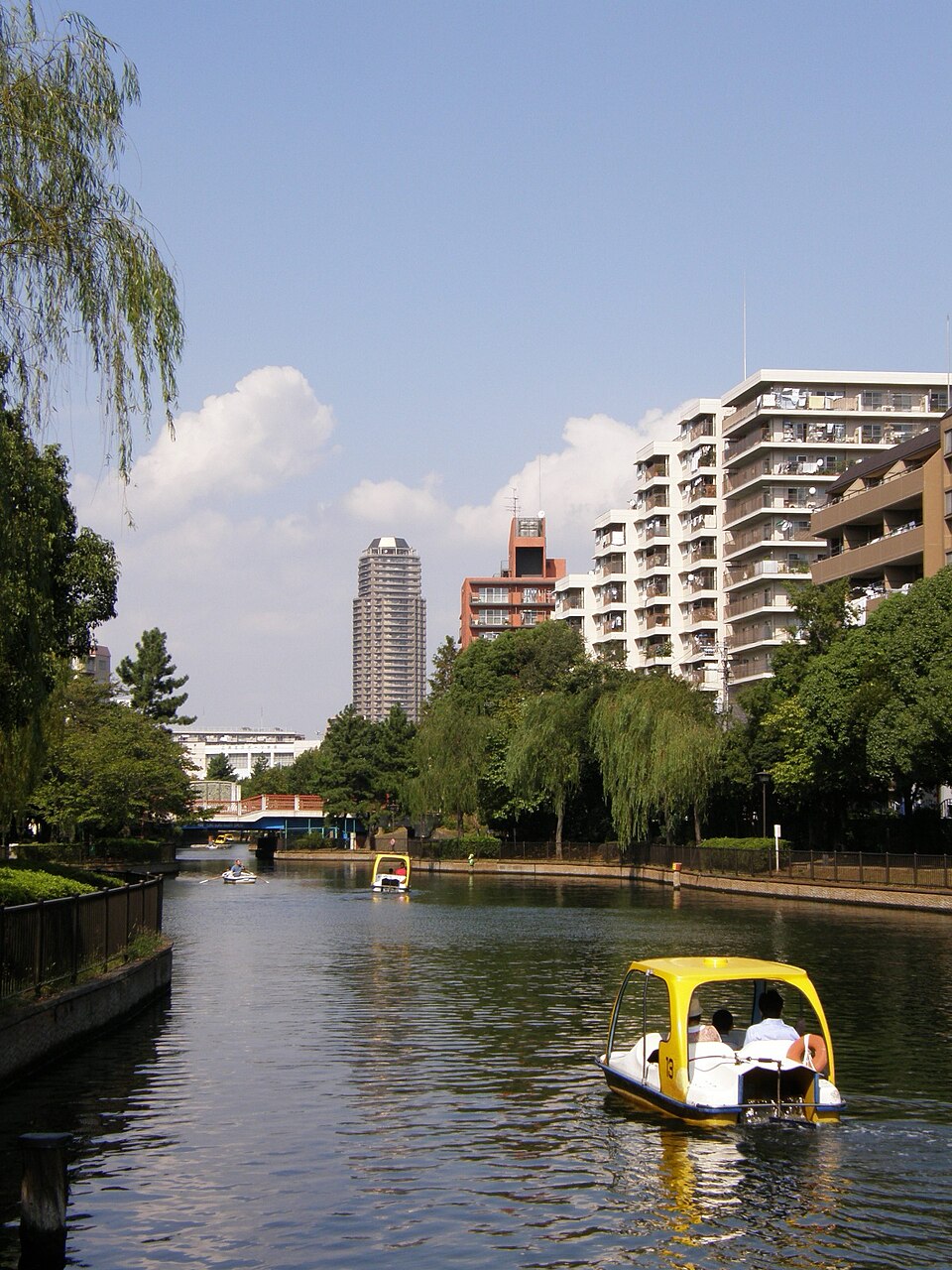
    Pedal boats at the park. Boat styles may change. Photo: resource70 / Wikimedia Commons, CC BY 3.0.

    A wooden boat from another version of Tokyo

    The park’s most unusual experience is the traditional Japanese wooden boat ride.

    Koto City owns seven wooden boats, with six kept at Yokojukken-gawa Shinsui Park. Volunteers from Wasen Tomo no Kai operate them to preserve the traditional skill of steering with a long wooden oar.

    On scheduled operating days, individuals can register at the Umibe boarding point without advance reservations. The ride lasts about 20 minutes and is currently free. Visitors may also be offered the chance to try working the oar.

    It is not a theme-park reconstruction with recorded shamisen music. The boat is real, the technique is real, and the apartment buildings in the background are also extremely real.

    Operation depends on the official calendar, rain, wind and heat conditions. Check the Koto City schedule on the morning of your visit. Do not build an international itinerary around one small volunteer boat without checking first.

    The view that explains eastern Tokyo

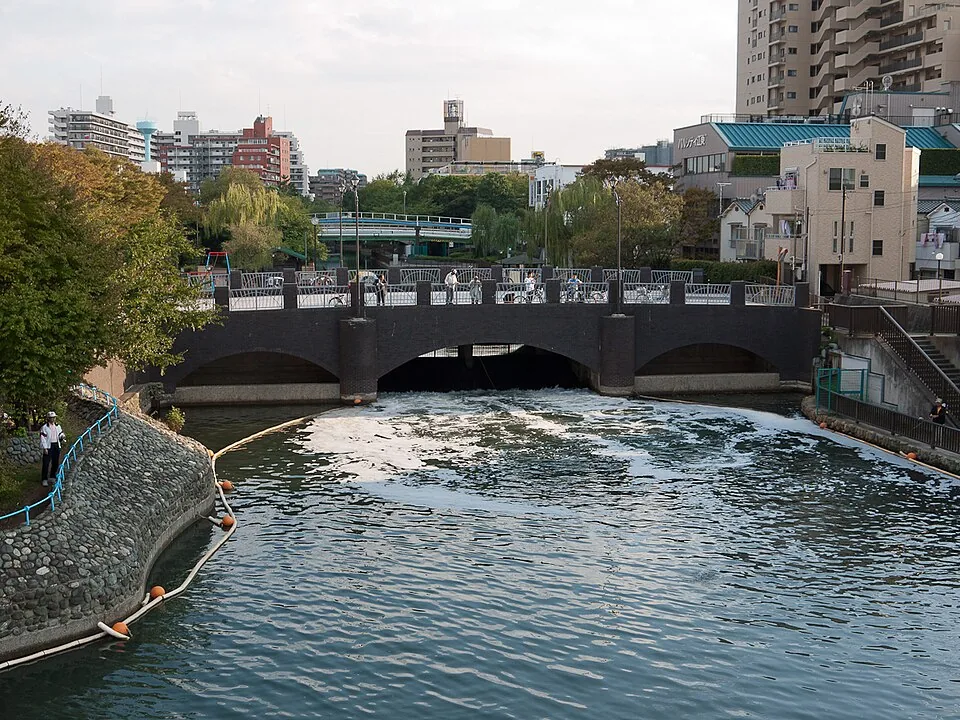
    At the northern end, the Yokojukken River meets the Onagi River near Onagigawa Clover Bridge. The X-shaped pedestrian bridge connects all four corners of the crossing.

    From here, you can see the canal running through ordinary residential Tokyo, with the Tokyo Skytree rising beyond the rooftops. It is a useful reminder that the tower did not land in an empty sightseeing district. It stands above neighborhoods with waterways, workshops, public housing and shopping streets.

    If you read our guide to the Onagi River and Nakagawa boat checkpoint, this is where the two stories connect: one canal carried Edo’s cargo; the other has become a place where locals spend a quiet Sunday.

    Yokojukken River seen from Onagigawa Clover Bridge in eastern Tokyo
    The Yokojukken River from Onagigawa Clover Bridge. Photo: Rs1421 / Wikimedia Commons, CC BY-SA 3.0.

    Yes, Tokyo has a rice field here

    Continue south and the park becomes a collection of small ecological zones: a bird island, iris beds, ponds and a community rice field.

    The rice field is not large enough to threaten Japan’s agricultural statistics. That is not the point. It lets neighborhood children see planting, growing and harvesting inside one of the world’s biggest cities.

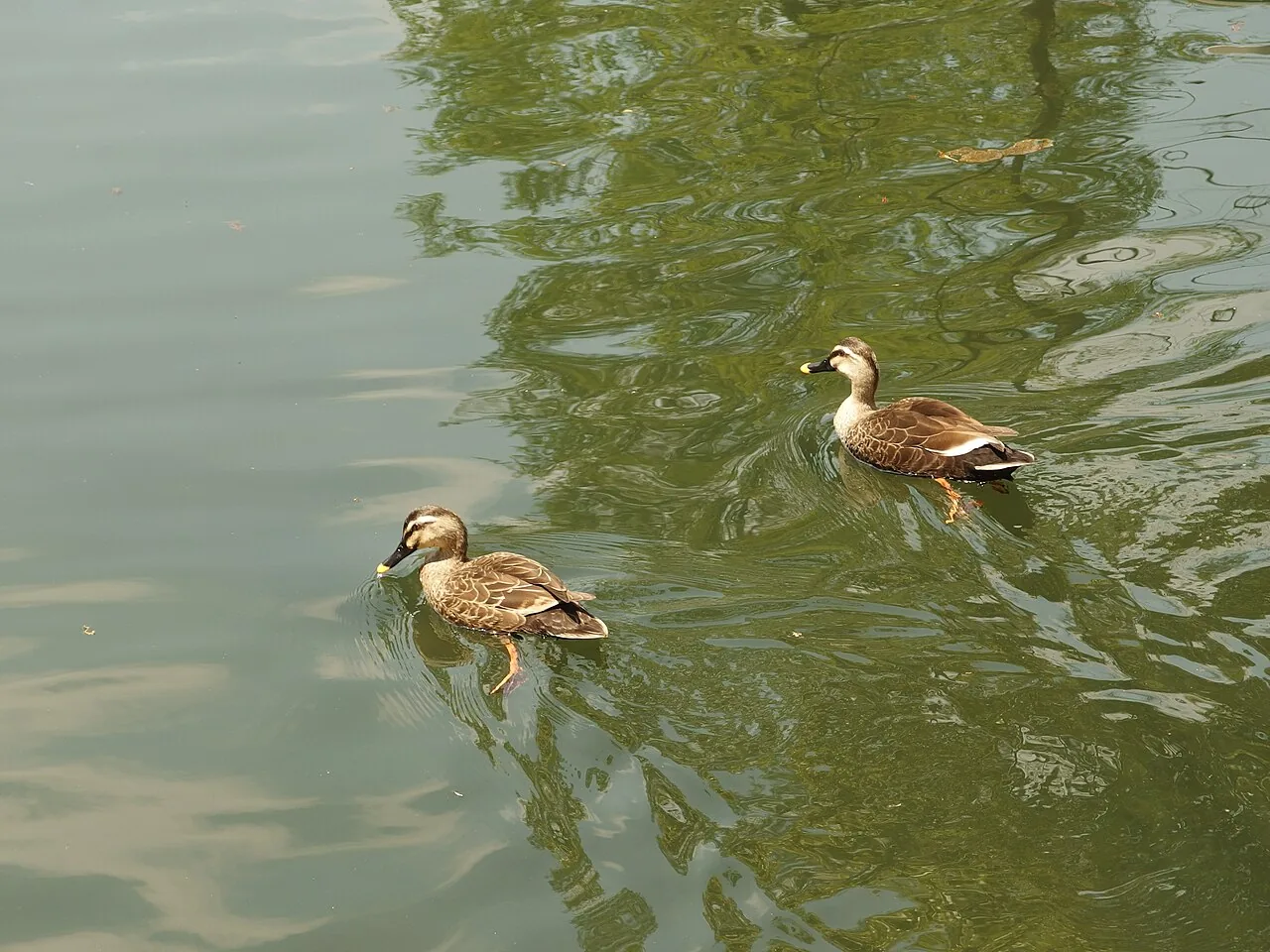
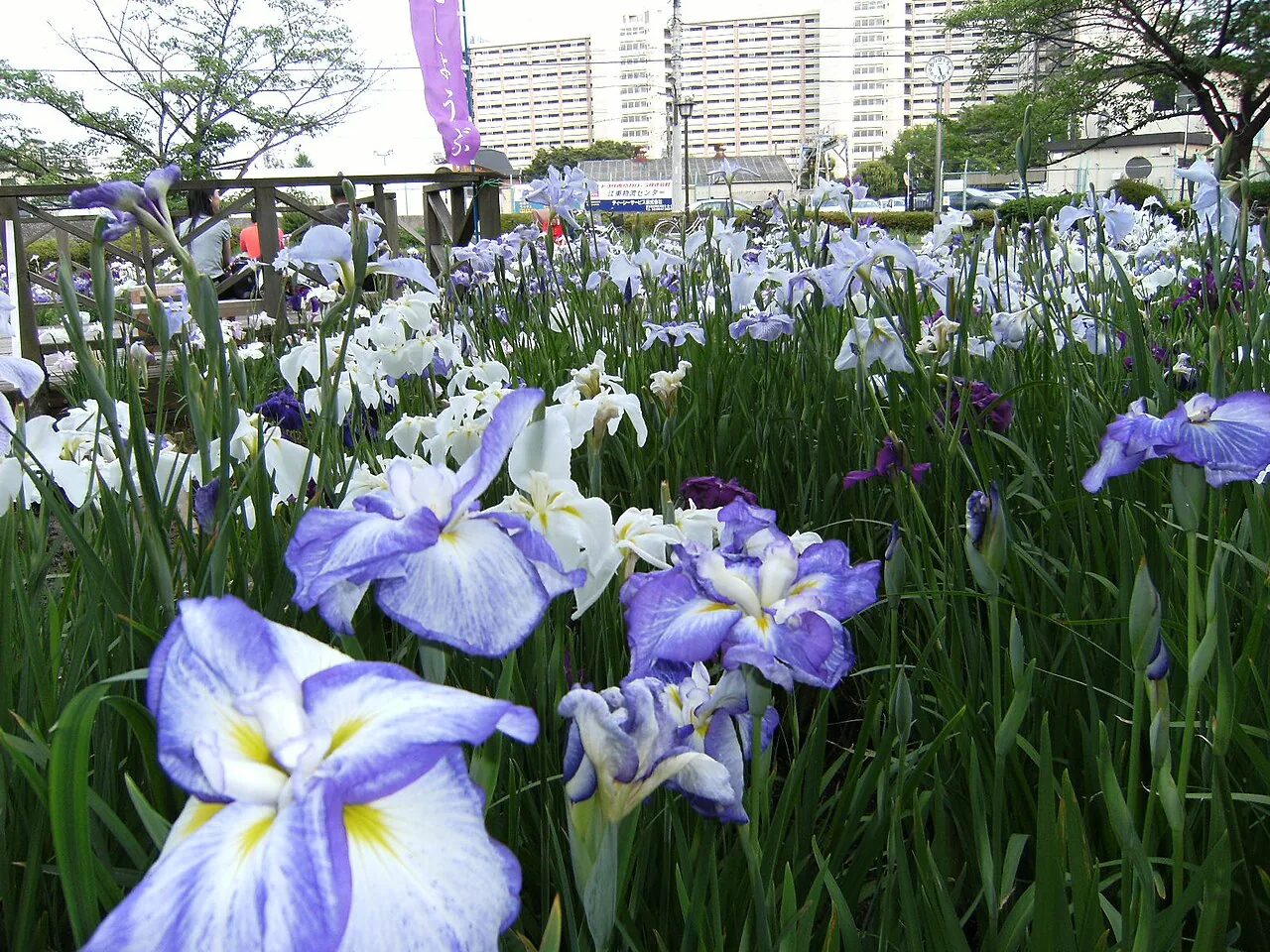
    In early summer, the Japanese irises add deep purple and white around the water. At other times, the attraction is quieter: ducks, turtles, reeds, insects and—if you are lucky—a kingfisher.

    This part works best when you stop trying to “complete” the park. Sit down. Watch the water. Accept that the next major attraction may be a duck doing absolutely nothing.

    Purple Japanese irises flowering beside the water in Yokojukken-gawa Shinsui Park
    Japanese irises beside the water. Photo: gorian21 / Wikimedia Commons, CC BY 3.0.

    Important: the water obstacle course is closed

    Older articles may show children crossing floating bridges and rope obstacles at the park’s aquatic playground.

    Do not arrive in swimwear based on a five-year-old blog post. Koto City currently lists the aquatic obstacle course as closed until the end of April 2027 because of bridge reconstruction work.

    The rest of the park, the walking route and activities shown as operating on their current calendars can still be enjoyed. Conditions change, so always check the official pages before visiting.

    Make it a Sunamachi half-day

    1. Sunamachi Ginza Shopping Street — start with yakitori, tempura, dumplings or whatever has the longest local queue.
    2. Walk toward Yokojukken-gawa Shinsui Park — allow roughly 15–25 minutes depending on where you leave the shopping street and which park entrance you use.
    3. Traditional boat or ¥100 boat — check the operating schedule before visiting.
    4. Walk south through the park — look for the bird habitat, rice field and seasonal flowers.
    5. Finish at Toyocho Station — the southern part of the park is about a ten-minute walk from the station.

    Allow three to four hours including food. The route is easy to combine with our Onagi River guide, but doing both properly turns it into a full day.

    Before you go

    • Official name: Yokojukken-gawa Shinsui Park / 横十間川親水公園.
    • Area: Between Ogibashi and Toyo in Koto City, Tokyo.
    • Admission: The park itself is free.
    • Rental boats: Currently ¥100 per boat for 30 minutes; operating days vary.
    • Traditional wooden boat: About 20 minutes and currently free on scheduled days; individuals do not need advance reservations.
    • Traditional boat reception: 10:00–14:15 at the Umibe boarding point on operating days.
    • Weather: Boats may stop because of rain, strong wind or dangerous heat.
    • Aquatic obstacle course: Closed until the end of April 2027 as currently announced.
    • Access: About ten minutes on foot from Toyocho Station to the park’s southern section; buses stop closer to other sections.

    Tokyo does not always need to be spectacular.

    Sometimes it is better when lunch costs a few hundred yen, the boat costs one coin, and the biggest event of the afternoon is discovering a rice field between apartment buildings.

    That is the local side.

    Related: How to actually get a sumo ticket in Tokyo (and what it really costs). Outside the three tournament months, the nine sumo experiences in Tokyo compared — one of them a few minutes from this park, on the shopping street.


    Researched using current information from Koto City’s park guide, its traditional wooden boat guide, rental boat information and aquatic playground closure notice, checked September 12, 2026. This is a researched neighborhood guide, not a firsthand visit report. Schedules and conditions may change.

    If you want the shopping street explained: a two-hour guided walk of Sunamachi Ginza exists on Viator, rated 5.0, from about ¥17,000 for a private group. It is a lot of money for a street you can eat your way down alone for ¥1,500, and that is the honest recommendation; book it only if you want the shopkeepers talked to on your behalf. The boats and the wooden-boat rides above are free or ¥100 either way.

    Where this joins the rest of the east side

    Make it a canal day: lunch on Sunamachi Ginza, the boats, then the Onagi River to the Nakagawa checkpoint museum, or south to the buried lock at Komatsugawa. The evening version of being on Tokyo’s water is a yakatabune dinner boat from Asakusa.

    Quick answers

    How much are the boats at Yokojukken River Water Park?

    ¥100 per boat for 30 minutes, for rowing or pedal boats, cash only with no change given. Children of elementary age or younger must ride with an adult. Boats stop in bad weather and follow a seasonal calendar.

    Where is Yokojukken-gawa Shinsui Park?

    In Koto City, a 1.9-kilometer waterside park running north from near Sunamachi Ginza shopping street to the Onagi River. Nearest stations: Minami-Sunamachi or Nishi-Ojima (Toei Shinjuku line), then 10 to 15 minutes on foot, or a bus from Kinshicho.

    Are the wooden boat rides free?

    Yes. Volunteers from Wasen Tomo no Kai operate Koto City’s traditional wooden boats on scheduled days from the Umibe boarding point; the 20-minute ride is free, no reservation, and you may be offered the oar. Check Koto City’s calendar on the morning of your visit.

    What else is near the boat park?

    Sunamachi Ginza shopping street for lunch, the Onagi River ‘Salt Road’ walkway, and the X-shaped Clover Bridge at the northern end with a view of the Skytree over the rooftops.

    Written by Kizuku. I run the Sunamachi Ginza Sumo Stable, a sumo experience in Koto City, and I write about the east side of Tokyo I live and work in. More about this site →

  • Tokyo Had a Checkpoint for Boats. Almost Nobody Visits It.

    Tokyo Had a Checkpoint for Boats. Almost Nobody Visits It.

    This article contains affiliate links to booking sites. If you book through them, LOCAL SIDE JAPAN earns a small commission at no extra cost to you. The place itself is free and is described first. How this site is made →

    TOKYO / KOTO CITY / WATERWAYS

    Tokyo once had a checkpoint for boats.

    Before trucks, container ports and next-morning delivery, rice, salt, vegetables and people moved through Edo by water. Boats entering the city along the Onagi River could be inspected at the Nakagawa checkpoint.

    The checkpoint is gone. The river is still here.

    Today, you can follow this forgotten logistics route through eastern Koto City—starting with lunch at Sunamachi Ginza Shopping Street and ending beside the reconstructed checkpoint at the Nakagawa Funabansho Museum.

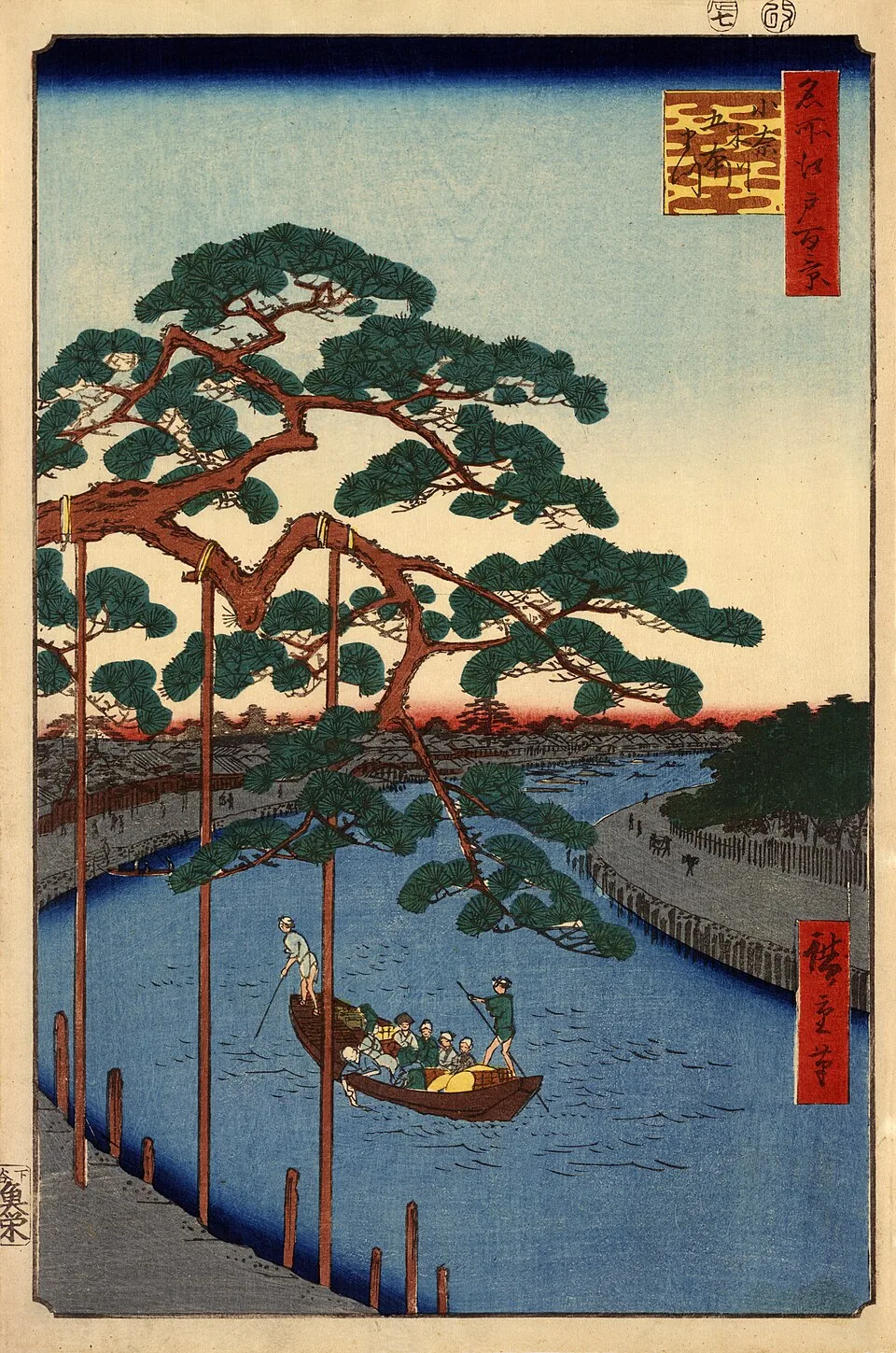
    Utagawa Hiroshige woodblock print showing boats on the Onagi River in Edo
    Five Pines, Onagi Canal, Utagawa Hiroshige, 1856. Wikimedia Commons / Library of Congress, public domain.

    Begin with the cargo you can eat

    Start at Sunamachi Ginza hungry.

    This 670-meter neighborhood shopping street is lined with independent food shops, greengrocers, fishmongers and stores selling the objects required for normal life. The prepared-food counters are the main attraction: yakitori, tempura, oden, dumplings and whatever smells best when you arrive.

    Buy a few things for lunch, but remember that this is a working local market. Keep entrances clear, ask before photographing shop staff and do not turn someone’s grocery run into an obstacle course.

    The food also fits the day’s story. Koto City grew through trade, waterways and the movement of everyday goods. You are about to follow one of the routes that helped feed Edo—after being fed yourself.

    The canal that carried salt into Edo

    The Onagi River is not a natural river. It was cut through the low wetlands east of Edo soon after Tokugawa Ieyasu entered the city in 1590.

    One of its most important jobs was carrying salt from Gyotoku, in present-day Chiba, toward Edo. Salt preserved food, supported cooking and kept a growing city alive. The canal also became a major route for rice, vegetables and other cargo arriving from eastern Japan.

    Parts of the riverside are now known as the Shio no Michi—the Salt Road. The name makes it sound like an epic mountain trail. In reality, it is a calm urban walkway used by dog walkers, cyclists and residents who are not thinking about seventeenth-century supply chains.

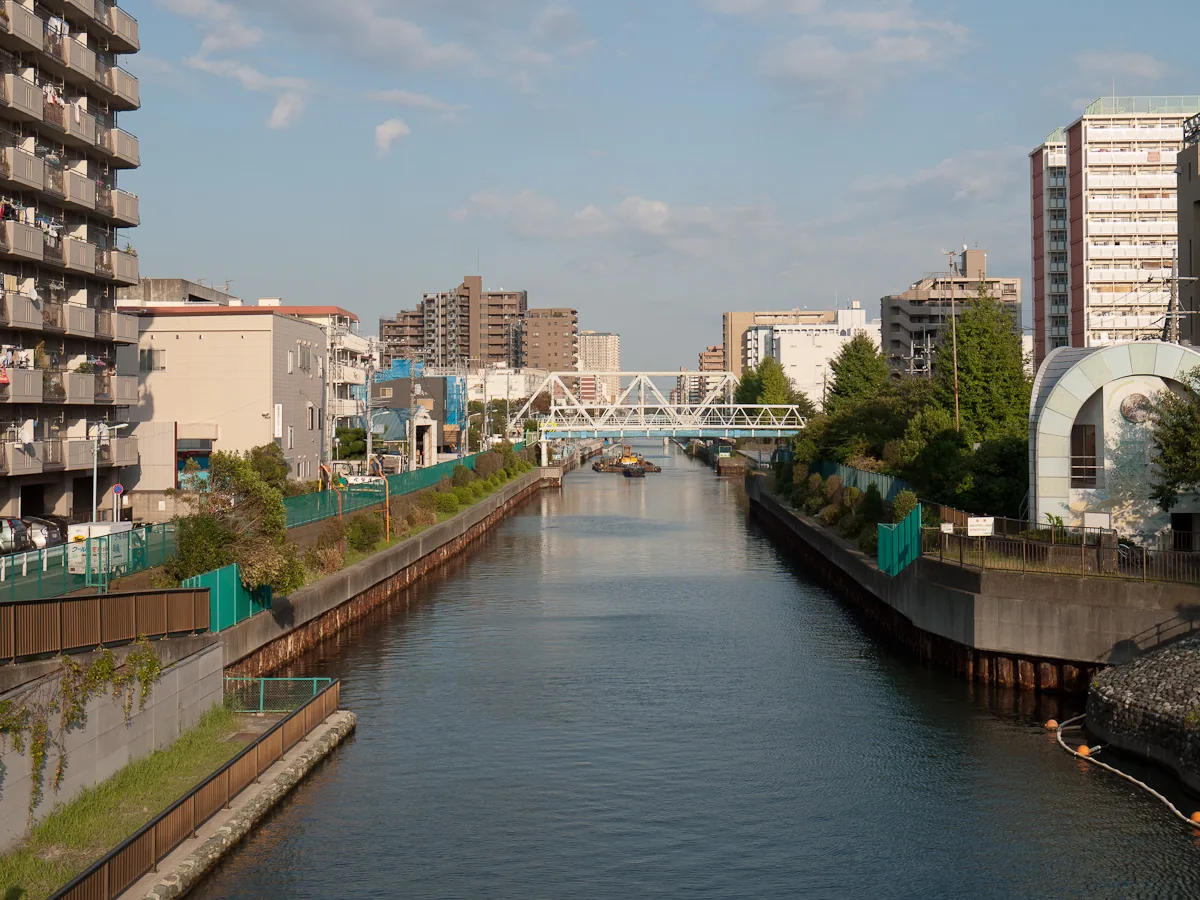
    The Onagi River flowing through residential Koto City in Tokyo
    The Onagi River seen from Clover Bridge. Photo: Rs1421 / Wikimedia Commons, CC BY-SA 3.0.

    Why did boats need a checkpoint?

    Edo controlled movement carefully. In 1661, a boat checkpoint was transferred to the eastern end of the Onagi River, near its meeting with the Nakagawa waterways.

    Officials monitored boats, passengers and cargo entering or leaving Edo. The system helped regulate traffic and watch for prohibited movement, including weapons and people traveling without authorization.

    Think of it as border control, customs and a traffic office sharing one waterfront desk—without barcode scanners and with considerably more paperwork made from actual paper.

    For years, the precise location was based largely on historical evidence. Excavations in 1995 uncovered posts, foundation stones and other remains, strongly confirming the site of the Nakagawa checkpoint.

    A museum for the Tokyo that moved by boat

    The Nakagawa Funabansho Museum stands about 50 meters north of the archaeological site.

    Its central display reconstructs the checkpoint with a large model. Exhibits explain the boats, cargo and river systems that connected Edo with inland Kanto and the northeast. Another gallery displays traditional Japanese fishing rods and tackle.

    This is not a museum of shoguns waving swords. It is a museum about systems: who moved, what they carried, where they were stopped and how an enormous city functioned before engines.

    An English museum leaflet is available online. Most interpretation is easiest with translation assistance, so keep your phone’s camera-translation function ready.

    Tokyo’s river elevator

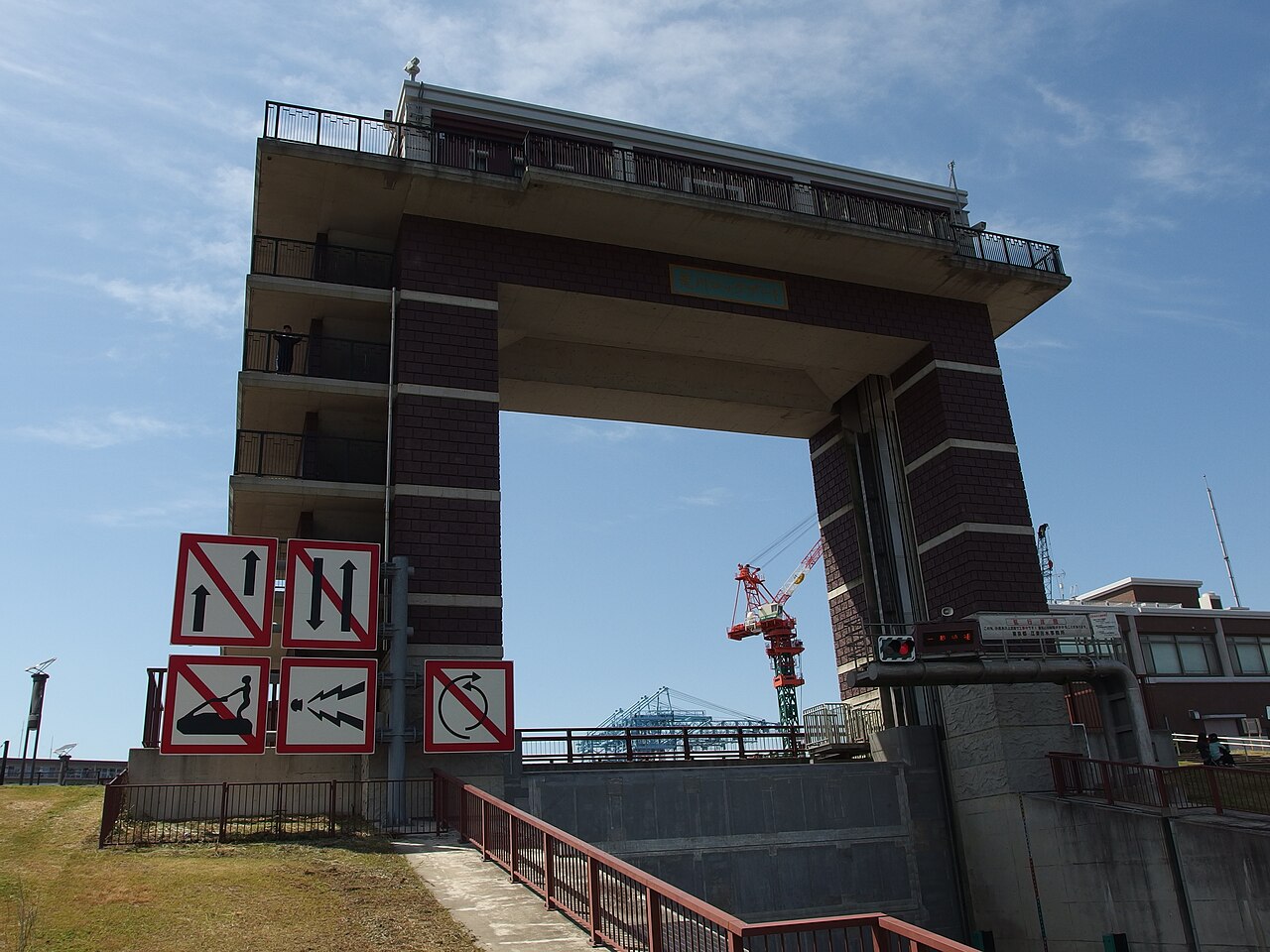
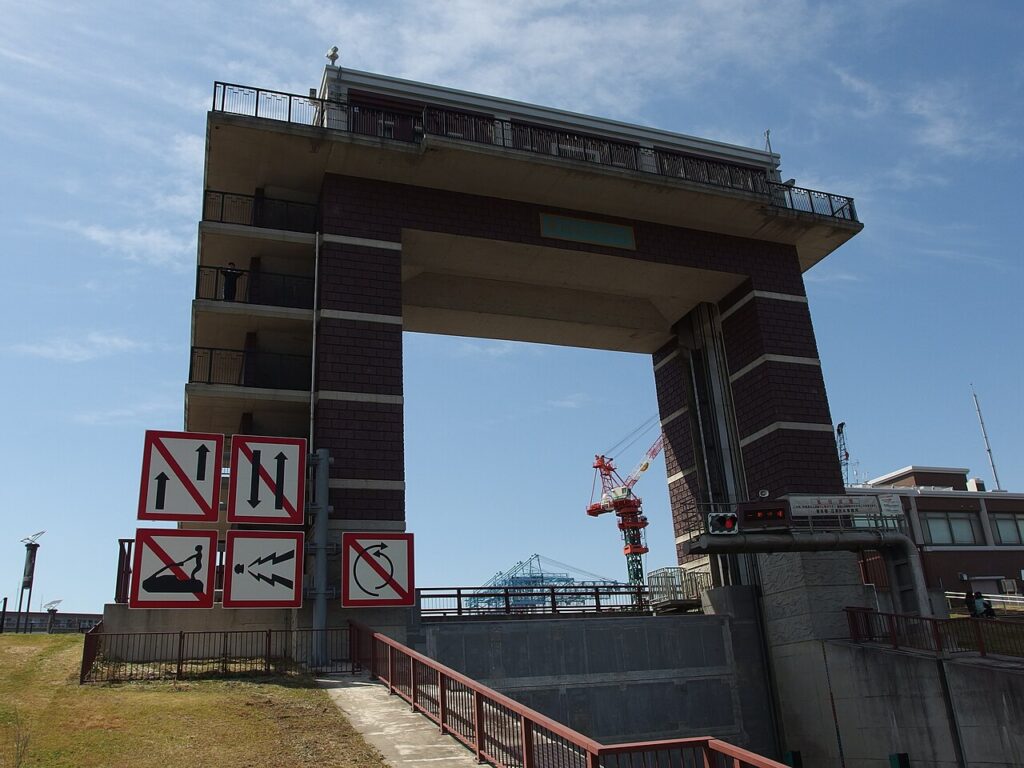
    Continue toward the Arakawa Lock Gate. The concrete structure allows boats to travel between the Old Nakagawa and the Arakawa even when their water levels differ.

    A boat enters the chamber, a gate closes, and the water level rises or falls before the opposite gate opens. Koto’s official tourism information describes a possible difference of up to about three meters.

    Calling it a “river elevator” is more appealing than calling it hydraulic infrastructure, but both descriptions are accurate.

    You may not see a boat pass during your visit. The structure is still worth seeing from the surrounding paths, especially if you enjoy the industrial side of Tokyo.

    The Arakawa Lock Gate
    The Arakawa Lock Gate. Photo: Guilhem Vellut / Wikimedia Commons, CC BY 2.0.

    The Old Nakagawa feels far from central Tokyo

    Near Higashi-Ojima Station, the canal landscape opens into the Old Nakagawa. Grassy banks, low bridges and wide skies replace the tight streets around Sunamachi.

    The Kyu-Nakagawa River Station provides a small waterfront base near the meeting point of the rivers. Depending on the day, the area may host local events or boating activities. On an ordinary afternoon, it is simply a good place to stop and watch the water.

    Tokyo is usually introduced vertically: towers, observation decks and buildings stacked above train stations. This part of the city makes more sense horizontally. Follow the waterways and the history connects itself.

    The calm Old Nakagawa River and green riverbanks in eastern Tokyo
    The Old Nakagawa. Photo: Guilhem Vellut / Wikimedia Commons, CC BY 2.0.

    A practical half-day route

    1. Sunamachi Ginza Shopping Street — arrive before lunch and explore the food counters.
    2. Shio no Michi Bridge and Onagi River — walk or cycle east along the canal.
    3. Arakawa Lock Gate — see the modern river-control structure.
    4. Old Komatsugawa Lock remains — a fragment of an earlier water-management system.
    5. Kyu-Nakagawa River Station — take a break beside the water.
    6. Nakagawa Funabansho Museum — finish with the reconstructed Edo checkpoint.
    7. Higashi-Ojima Station — the museum is about five minutes away on foot.

    Allow four to five hours including lunch. A bicycle shortens the travel time, but walk it if you enjoy quiet residential streets and canals.

    Before you go

    • Museum address: 1-15 Ojima 9-chome, Koto City, Tokyo.
    • Current museum hours: 9:30–17:00, with last admission at 16:30.
    • Current museum admission: Adults ¥200; discounted youth admission is available.
    • Regular closure: Mondays, or the following day when Monday is a public holiday, plus year-end and exhibition-change closures.
    • Transport: Start near Sunamachi Ginza and finish at Higashi-Ojima Station. Check your preferred walking, bus or bicycle route on the day.
    • Weather: Much of the route is outdoors with limited shade. Avoid the hottest afternoon hours in summer.
    • Latest information: Confirm museum openings and riverside restrictions on the official websites before visiting.

    Most travelers meet Edo through castles, samurai and famous temples.

    Along the Onagi River, you meet the people checking cargo, steering boats and making sure the city had enough salt for dinner.

    History looks different from the delivery entrance.


    Researched using current information from Koto City, the Nakagawa Funabansho Museum, Koto City Tourism Association and the Sunamachi Ginza Shopping Street, checked September 11, 2026. This is a researched neighborhood guide, not a firsthand visit report. Conditions may change.

    Guided or not: the only tour that covers this route is a private two-hour walk of Sunamachi Ginza with a guide (Viator, 5.0, from about ¥17,000 per group). The shopping street is the part where a guide adds something, ordering and explaining; the river walk and the museum need none, and the museum leaflet is in English. Most people should do it alone.

    Sumo before the walk, if you want it

    I run this one. Treat what follows as an interest declared, not a neutral recommendation — everything else on this site is chosen without one.

    This route starts at Sunamachi Ginza, and so does the sumo stable I run. The 11:00 session finishes at 12:30, which is roughly when this walk wants you to be eating your way down the shopping street anyway — so the two fit together on one half-day without rearranging anything. Ninety minutes with former professional wrestlers: bouts from the edge of a real ring, then the ring itself if you choose to.

    A child crouching in the tachiai starting position facing a wrestler on the dohyo at the Sunamachi Ginza Sumo Stable
    The tachiai, the crouch both wrestlers start from, at the stable at the top of this walk. Ninety minutes, and the last third of it is this. Photo: LOCAL SIDE JAPAN.

    ¥11,000 adults · ¥7,700 children 4–12 · under 4 free · 11:00 and 15:30 · 90 minutes · closed Wednesdays and Thursdays · 3-38-16 Kitasuna, a few minutes from the shopping street.

    If a hands-on session is not what you want, the other three ways to see sumo — the grand tournament at the Kokugikan, a real stable’s morning practice, and the commercial shows — are compared with prices in Sumo in Tokyo: morning practice vs sumo show vs the tournament, and tournament tickets are explained in how to actually get a ¥3,500 seat. And if you are weighing up the nine individual places rather than the three kinds, we compared all of them on the four things the listings leave out: whether everyone gets in the ring or it is decided by lottery, whether you wear a real mawashi or an inflatable suit, how close you sit, and what you eat.

    Where this joins the rest of the east side

    The checkpoint is one end of the delta’s water story; the buried Komatsugawa lock is a few minutes further along the river, and Kiyosumi-Shirakawa, with the Fukagawa Edo Museum’s rebuilt boat landing, is the upstream end. The ¥100 boats are on the way.

    The rest of the ward, in order, is in Things to Do in Koto City: 12 Places.

    Quick answers

    What is the Nakagawa Funabansho Museum?

    A Koto City museum about the boat checkpoint that controlled river traffic into Edo from 1661, with a large reconstruction of the checkpoint, exhibits on canal cargo, and a gallery of traditional fishing tackle. It stands 50 meters from the excavated site, near Higashi-Ojima Station.

    What was the Onagi River for?

    It was cut in the 1590s to carry salt from Gyotoku in Chiba into Edo, and later rice, vegetables and other cargo. The riverside path is still called the Shio no Michi, the Salt Road.

    How do I walk the Onagi River route?

    Start with lunch at Sunamachi Ginza shopping street, follow the Yokojukken River water park north to Clover Bridge, then walk east along the Onagi River to the museum, about 3 km in total. Flat, paved, and quiet.

    Why did Edo have a checkpoint for boats?

    To control who and what entered the capital: cargo, passengers, weapons and unauthorized travelers. The 1995 excavation uncovered posts and foundation stones confirming the checkpoint’s location.

    Written by Kizuku. I run the Sunamachi Ginza Sumo Stable, a sumo experience in Koto City, and I write about the east side of Tokyo I live and work in. More about this site →

  • A Tokyo Neighborhood That Still Feels Like Tokyo

    A Tokyo Neighborhood That Still Feels Like Tokyo

    This article may contain affiliate links to booking sites. If you book through them, LOCAL SIDE JAPAN earns a small commission at no extra cost to you. How this site is made →

    Tokyo is famous for neon lights, giant crossings and neighborhoods that never seem to sleep.

    But some of the best parts of the city are much quieter.

    Walk a few stations away from the places everyone already knows, and Tokyo begins to feel completely different.

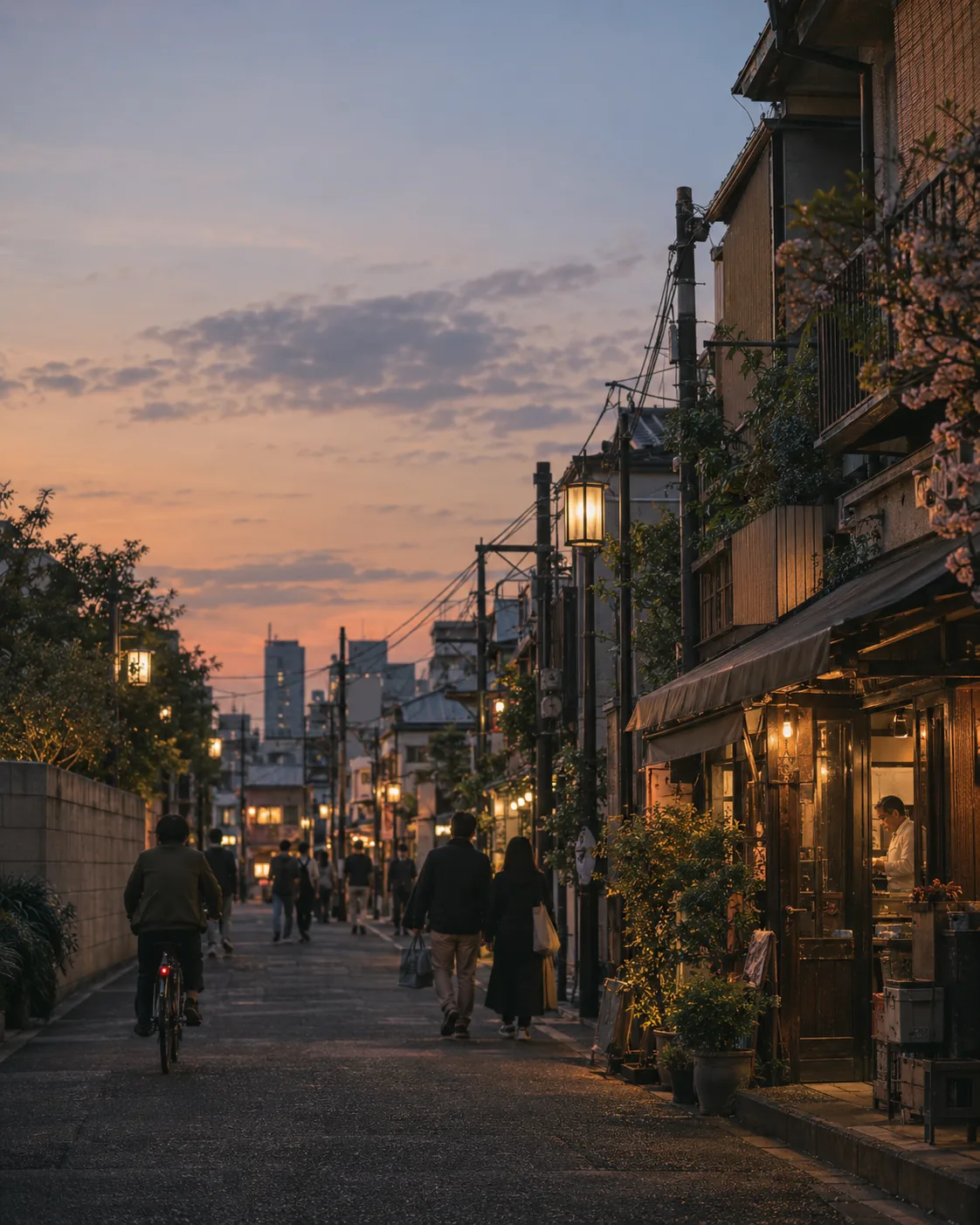
    Small shopping streets. Family-run stores. Old signs. People buying dinner on their way home.

    This is the Tokyo we love most.

    The Tokyo between the tourist attractions

    Most first-time visitors build their Tokyo trip around names they already know: Shibuya, Shinjuku, Asakusa, Harajuku.

    There is nothing wrong with those places. They are famous for a reason.

    But Tokyo is a city of neighborhoods.

    And once you start exploring those neighborhoods, the city becomes much more interesting.

    You begin to notice the small things.

    A tofu shop that has been making the same thing for decades.

    A tiny yakitori stand filling the street with smoke.

    A bicycle parked outside a family home.

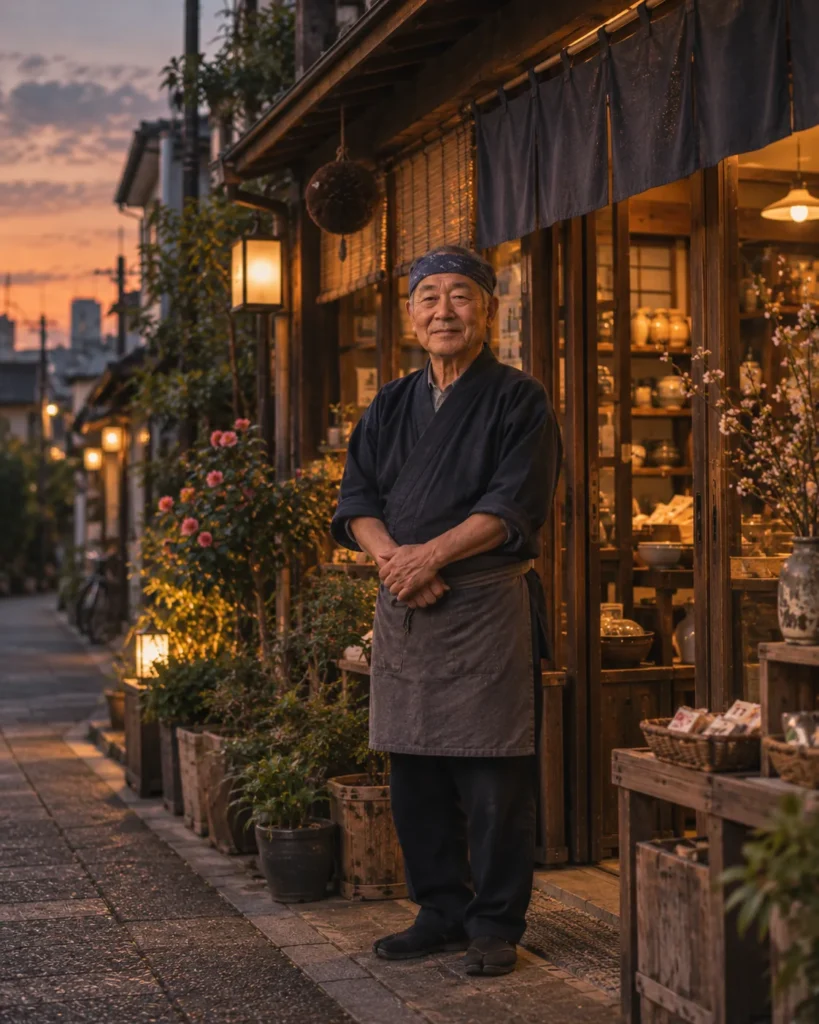
    A shopkeeper chatting with the same customers they have known for years.

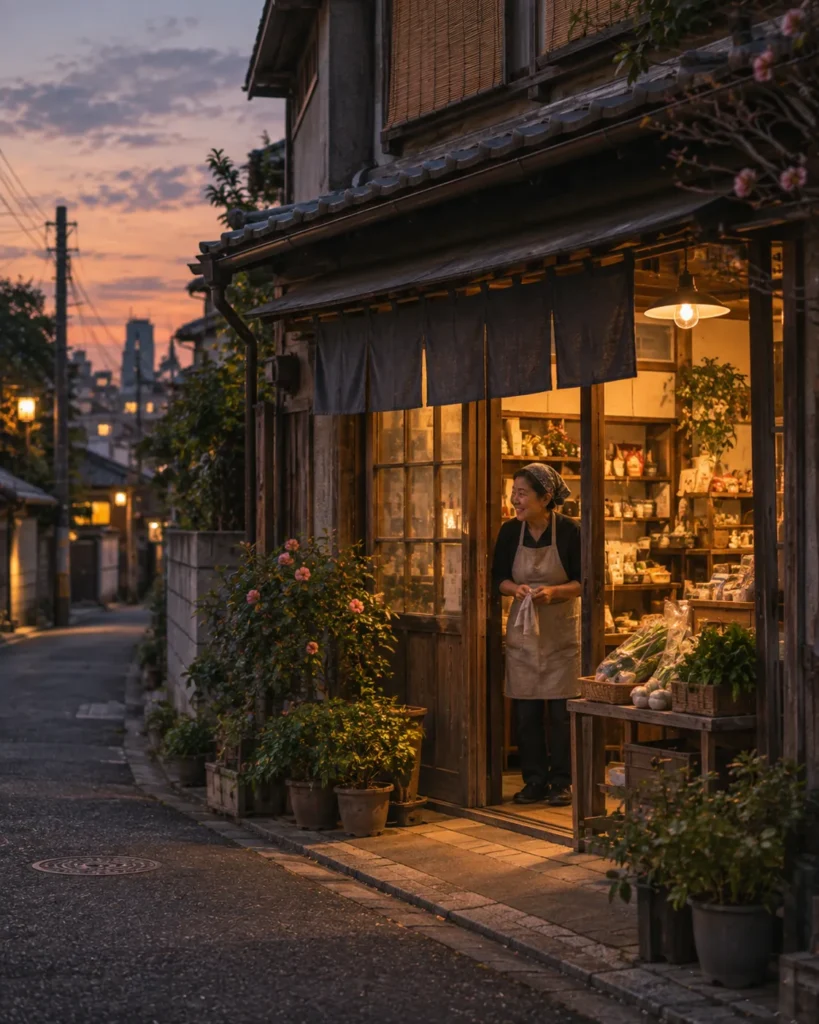
    A longtime shopkeeper standing outside a small Japanese store

    Why local shopping streets matter

    Japan’s neighborhood shopping streets are known as shotengai.

    They are not designed for tourists.

    They exist because people actually live there.

    You might find a butcher, a fish shop, a bakery, a tea store, a small restaurant and a place selling something so specific that you have no idea how it has survived for 50 years.

    That is exactly why we like them.

    A good shotengai is not an attraction.

    It is a piece of everyday life that visitors are temporarily allowed to step into.

    A small family-run shop in a local Japanese neighborhood

    Don’t arrive with a checklist

    The best way to explore a local neighborhood is to stop trying to optimize every minute.

    Walk slowly.

    Turn down a street because it looks interesting.

    Buy something even if you are not completely sure what it is.

    Sit somewhere that does not appear in every travel guide.

    The goal is not to collect landmarks.

    The goal is to notice the place.

    A small reminder: you are visiting someone’s neighborhood

    Local does not mean secret, and it definitely does not mean private property is suddenly a tourist attraction.

    Be curious, but be respectful.

    ・Ask before photographing people up close.
    ・Avoid blocking narrow streets or shop entrances.
    ・Support small businesses when you can.
    ・Do not treat ordinary residents like part of the scenery.

    The best local travel experiences happen when visitors and residents can both enjoy the same place.

    This is the side of Tokyo we want to show you

    LOCAL SIDE JAPAN is not about pretending famous places are bad.

    It is about showing that Japan has much more to offer beyond them.

    Sometimes the place you remember most will not be a temple, a tower or a famous crossing.

    It might just be a quiet street, a tiny shop and a conversation you did not expect to have.

    Come for Japan. Leave with a story.

    The sumo stable on one of these streets

    I run this one. Treat what follows as an interest declared, not a neutral recommendation — everything else on this site is chosen without one.

    The shopping street this article is really about is Sunamachi Ginza in Koto City, and the reason I know it well is that I work on it. The Sunamachi Ginza Sumo Stable is a 90-minute session with former professional wrestlers: you watch bouts from the edge of a real ring, then step into it yourself if you want to. It is on a working shopping street rather than in a tourist district, which is the whole argument of this article, so it would be odd to leave it out — and equally odd to pretend I found it.

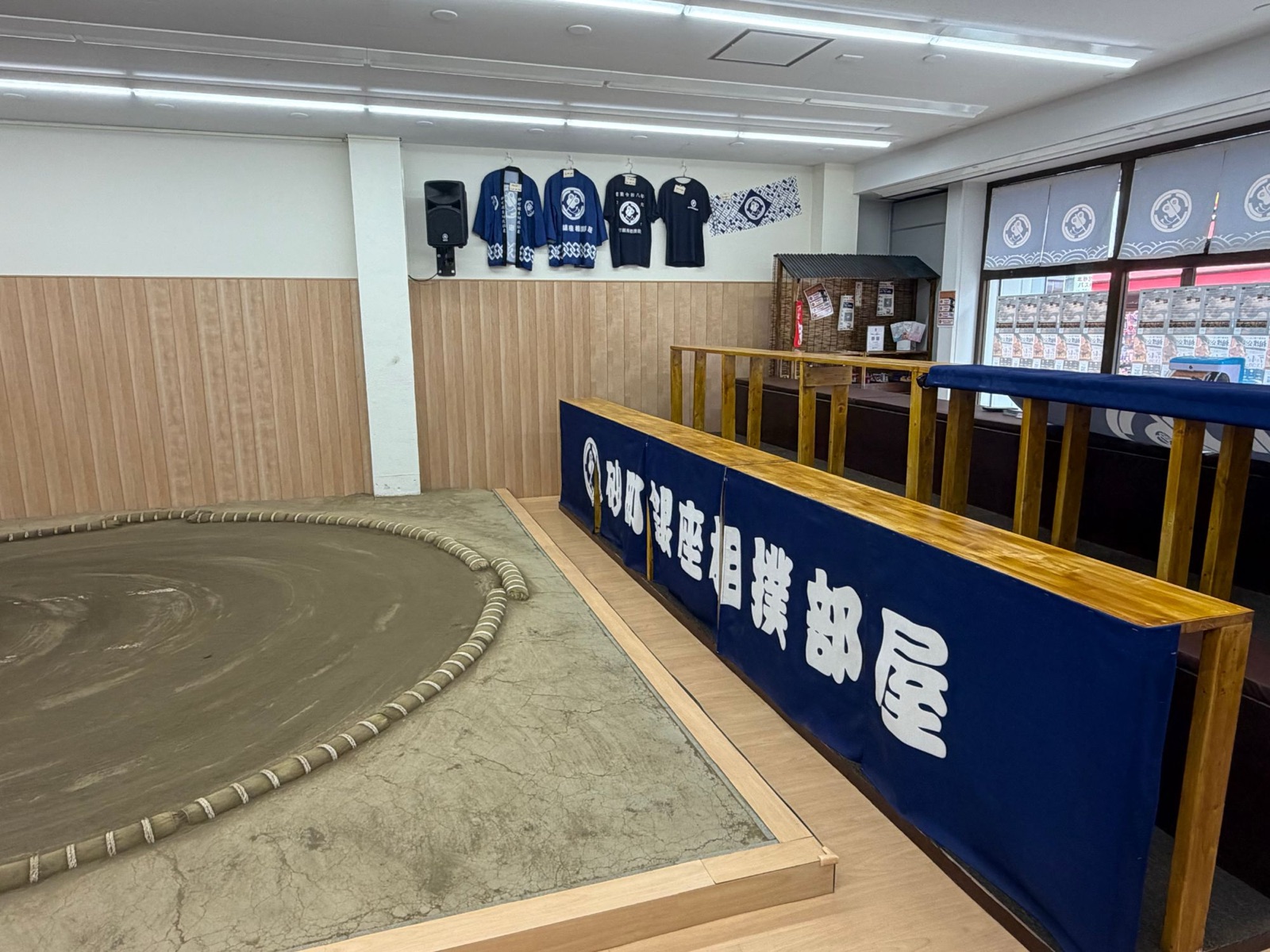
    The viewing counter at the Sunamachi Ginza Sumo Stable, running along the edge of the dohyo at ring level
    Inside: the counter runs along the edge of the clay at ring level, and there is nothing between it and the dohyo. Forty people maximum, no seat grades. It is a room on a shopping street, not an arena. Photo: LOCAL SIDE JAPAN.

    ¥11,000 adults · ¥7,700 children 4–12 · under 4 free · 11:00 and 15:30 · 90 minutes · closed Wednesdays and Thursdays · 3-38-16 Kitasuna, Koto City.

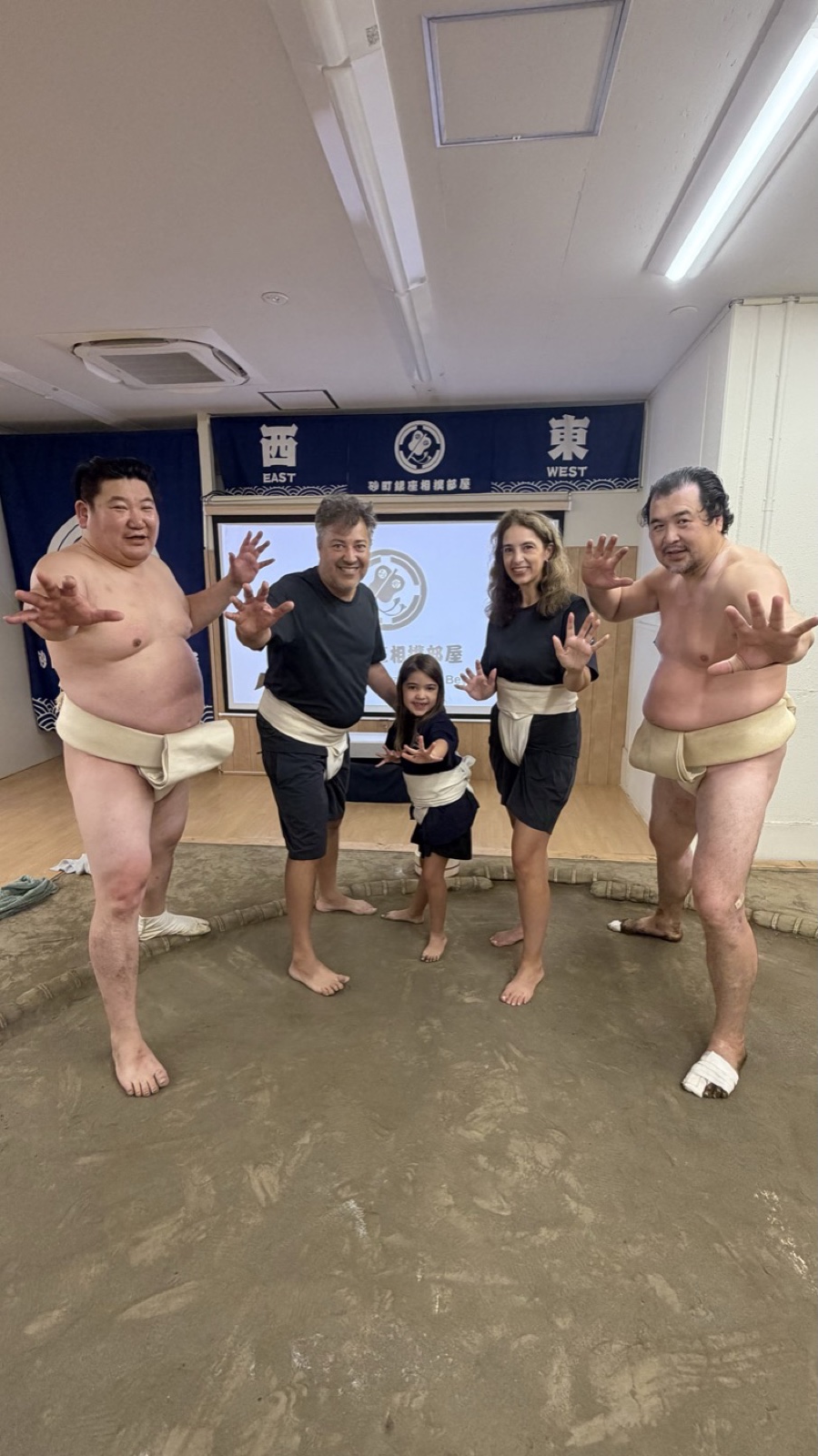
    Two wrestlers and a family of three, the adults in practice mawashi, posing on the dohyo at the Sunamachi Ginza Sumo Stable
    The end of a session: the photograph on the dohyo. The guests are still in the practice mawashi they were given. This is a room off a shopping street in Kitasuna, not a theatre. Photo: LOCAL SIDE JAPAN.

    If a hands-on session is not what you want, the other three ways to see sumo — the grand tournament at the Kokugikan, a real stable’s morning practice, and the commercial shows — are compared with prices in Sumo in Tokyo: morning practice vs sumo show vs the tournament, and tournament tickets are explained in how to actually get a ¥3,500 seat. And if you are weighing up the nine individual places rather than the three kinds, we compared all of them on the four things the listings leave out: whether everyone gets in the ring or it is decided by lottery, whether you wear a real mawashi or an inflatable suit, how close you sit, and what you eat.

    Where this joins the rest of the east side

    Start with the streets themselves: Kirakira Tachibana in Kyojima, Sunamachi Ginza, Yanaka on a weekday, Shibamata, and Kita-Senju’s standing bars. Sunamachi Ginza has no food tour and does not need one — the reasoning is in food tours by area, where ¥2,000 of croquettes here is set against ¥15,000 for the same number of bites at Tsukiji. Every ward is on the map on the homepage, and the things worth booking are on the Experiences page.

    Quick answers

    What is a shotengai?

    A neighborhood shopping street: butchers, fishmongers, bakeries, tofu shops and small restaurants that exist because people live nearby, not for tourists. Tokyo’s east side has dozens; Sunamachi Ginza, Kirakira Tachibana and Shibamata’s approach street are three to start with.

    Which Tokyo neighborhoods still feel local?

    On the east side: Kyojima and Mukojima in Sumida, Sunamachi and Kiyosumi-Shirakawa in Koto, Yanaka and Minowa in Taito and Arakawa, Kita-Senju in Adachi, Shibamata in Katsushika, and Oji and Akabane in Kita.

    How should visitors behave in a local shopping street?

    Ask before photographing people, keep entrances and narrow streets clear, buy something, and remember residents are not scenery. The best experiences happen when visitors and locals can both enjoy the same place.

    Written by Kizuku. I run the Sunamachi Ginza Sumo Stable, a sumo experience in Koto City, and I write about the east side of Tokyo I live and work in. More about this site →

    Related: How to actually get a sumo ticket in Tokyo (and what it really costs).