This article contains one affiliate link to a booking site. If you book through it, LOCAL SIDE JAPAN earns a small commission at no extra cost to you. Everything else in Kita-Senju is free or costs the price of a drink, and is described first. How this site is made →
TOKYO / ADACHI CITY / KITA-SENJU
Kita-Senju is where Tokyo stops pretending. Five train lines cross here and a million people a day pass through the station, and almost none of them are visitors, because there is nothing here that a guidebook would call a sight. What there is: the first post town on the old road north out of Edo, still laid out along its original street; the bridge where Basho set off on the journey that became The Narrow Road to the Deep North; the only fish market in Tokyo that still opens its gates to the public; a bathhouse with a garden; and, after dark, the densest run of cheap standing bars in the eastern half of the city. It is a place to spend an afternoon and an evening, in that order.
On this page
- What is Kita-Senju?
- What is there to see in Kita-Senju?
- When is Adachi Market open to the public?
- Is there a good sento in Kita-Senju?
- Where should I drink in Kita-Senju?
- Where to eat in Kita-Senju, beyond the bars
- The one thing worth paying a guide for
- Is Kita-Senju worth visiting?
- Where this joins the rest of the east side
- Quick answers
Fast facts
- Where: Adachi City, north Tokyo, on the Sumida River. Ten minutes from Ueno.
- Station: Kita-Senju — five lines (Hibiya, Chiyoda, JR Joban, Tobu Skytree, Tsukuba Express). Use the west exit for everything on this page.
- Cost: the post town and the market are free; a bathhouse is ¥600; an evening in the standing bars is about ¥1,000–¥3,000.
- Cash: the bars, the bath and the market are cash only. Bring ¥10,000 in small notes.
- Adachi Market public days: 2nd Saturday of every odd-numbered month (3rd Saturday in January), 09:00–11:00, canteens from 08:00. Free.
- Closed: Takara-yu on Fridays; Ohashi on Sundays and holidays.
What is Kita-Senju?
Kita-Senju is a station and a neighbourhood in Adachi City, at the top of Tokyo, ten minutes north of Ueno. Five railway lines meet there, which makes it one of the busiest interchanges in the country and one of the least visited by anyone who is not changing trains.
Before the railways it was Senju-juku, the first post town on the Nikko and Oshu highways — the roads running north out of Edo. The Senju Ohashi bridge, first built in 1594, was for decades the only fixed crossing of the Sumida, so everyone heading north came through here and most of them stayed the night. By the 1800s it was the largest post town near Edo, with around ten thousand people in it.
What is left of that is not a preserved street but an ordinary shopping street that never stopped being used, and — because this was always a place where travellers ate and drank before a long walk — the densest run of cheap standing bars on Tokyo’s east side.
What is there to see in Kita-Senju?
Senju-juku was the first stop on the Nikko and Oshu highways, the roads that ran north from Nihonbashi to the shogun’s mausoleum and beyond. The Senju Ohashi bridge across the Sumida, first built in 1594, was the only fixed crossing of the river for decades, so everyone heading north crossed it and most of them spent the night here; by the 1800s it was the biggest post town near Edo, with around ten thousand people. The street it grew along is now called Shukubamachi-dori, and it runs north from the station’s west exit as an ordinary shopping street, which is the point: it was never preserved, it just never stopped being used.
- Yokoyama residence, the one Edo-period merchant house left on the street. It was Matsuya, a wholesaler of handmade paper, and the deep tiled roof and the lattice front are what the whole street looked like. Exterior only, free; a plaque explains it.
- Nagura Clinic, a bone-setting practice that has been in the same family, in this spot, since about 1770. Patients used to come from across Japan; in Edo the word “Nagura” meant “bone-setter” the way “Hoover” means “vacuum”. It still operates, in a wooden building behind a gate, and you can look from the street.
- Senju-juku Historical Terrace, a small free room in a relocated storehouse that shows maps and finds from the post town. Ten minutes.
- The street itself: the lamp posts carry the crests of the daimyo who marched through, the pavement has tiles set into it with scenes of the road, and a few of the shop shutters are painted with the same. Look down and up rather than straight ahead.
When is Adachi Market open to the public?
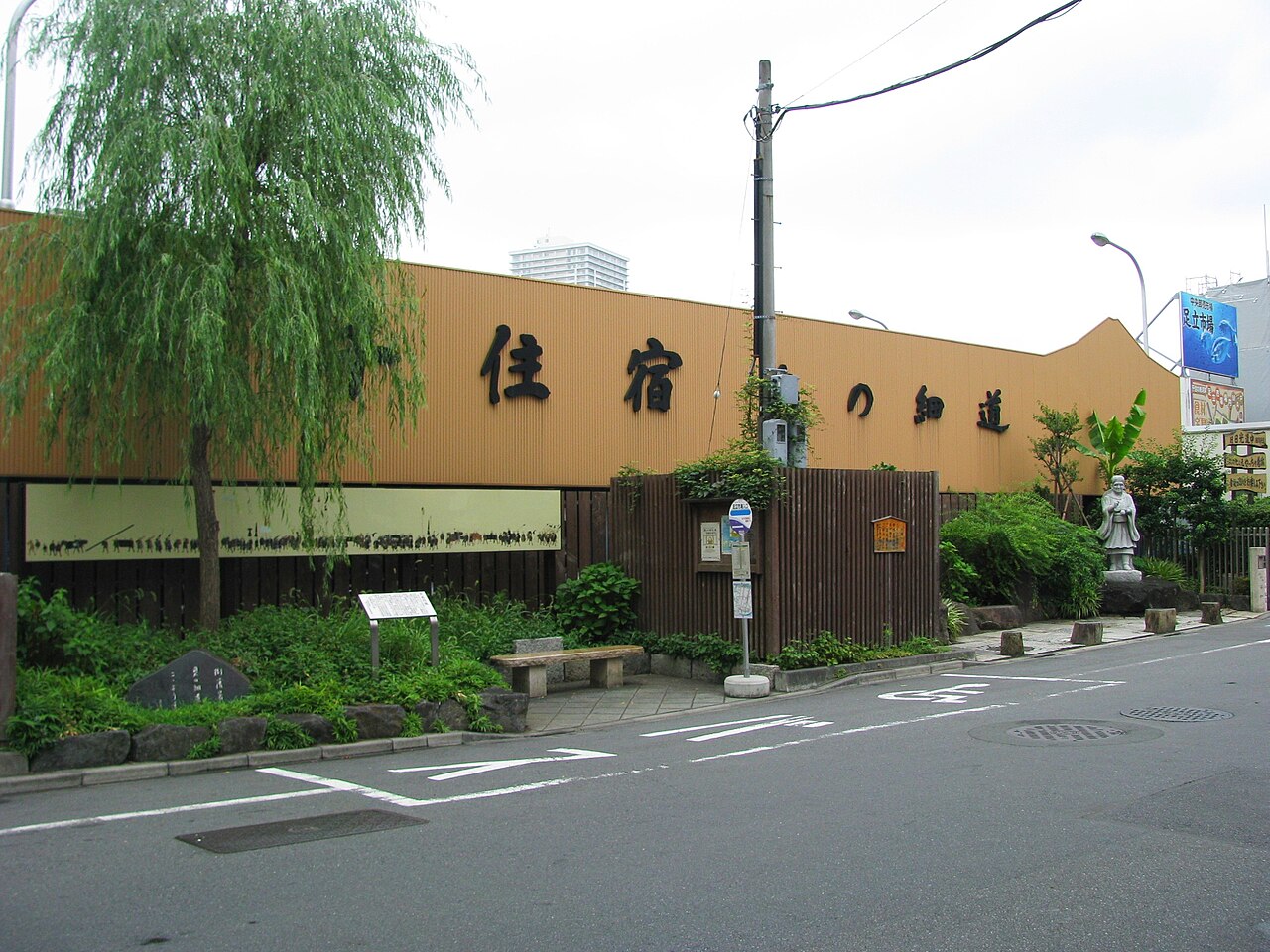
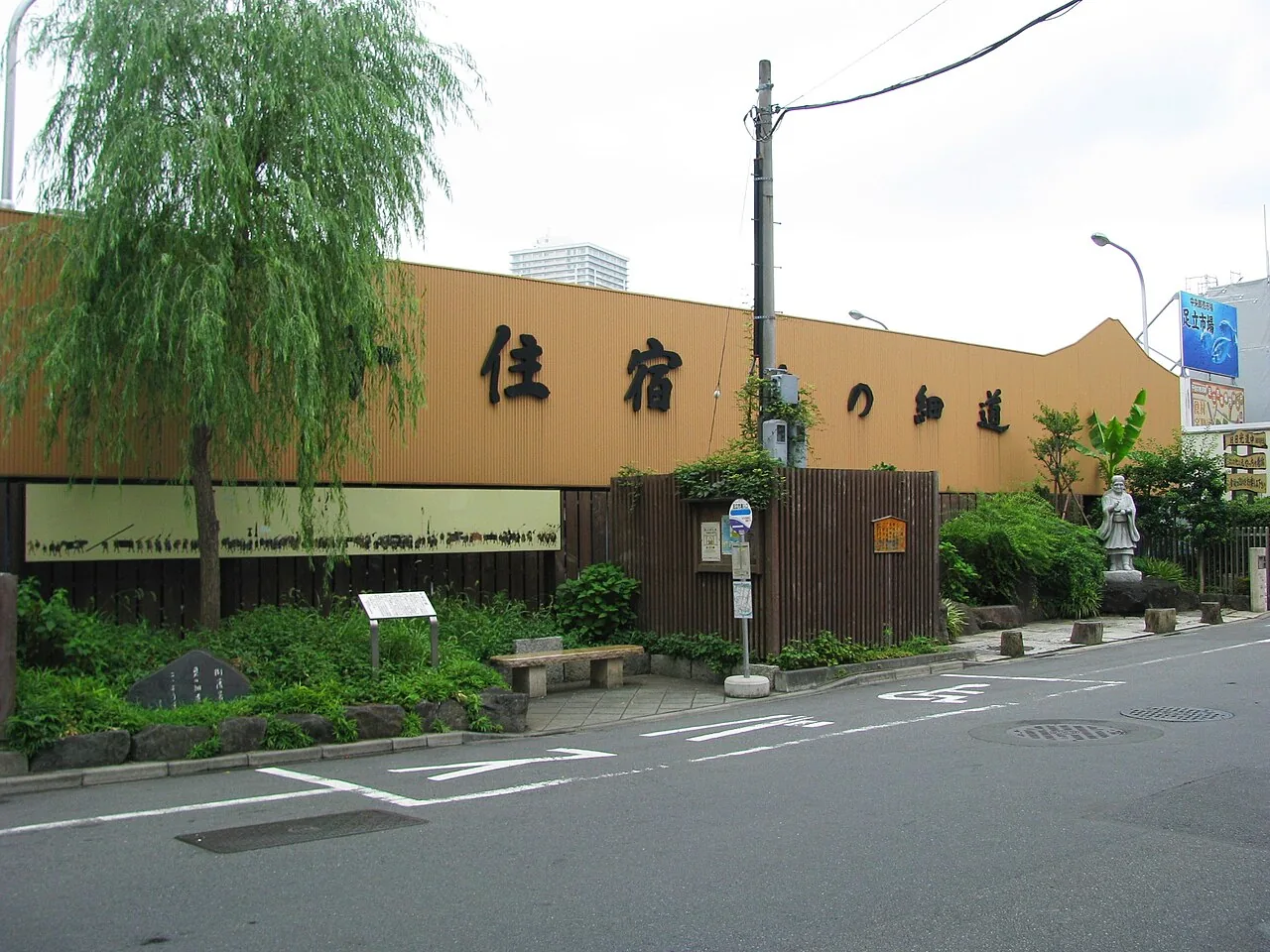
Walk south from the station instead, fifteen minutes, and you reach the river. On May 16, 1689, Matsuo Basho stepped off a boat here, said goodbye to his friends, and started walking north on a journey of five months and 2,400 kilometers. The book he wrote about it is the most famous piece of travel writing in Japanese, and it begins in Senju. There is a statue of him by the river and a long mural wall with his opening lines, the one in the photograph above, which happens to be the wall of the Adachi Market.
The market is Tokyo’s only wholesale market dealing in fish alone, a smaller and rougher cousin of Toyosu, and unlike Toyosu it lets the public in: on the second Saturday of every odd-numbered month (third Saturday in January), from 9:00 to 11:00, the wholesalers sell to anyone who walks in, and the market canteens open at 8:00. Entry is free. The next open days after this was written are November 14, 2026 and January 16, 2027. Sushi for breakfast at a market counter, paid for in cash, at a quarter of the Toyosu queue, is the best cheap morning on the east side; plan the whole visit around it if the dates fit.
Is there a good sento in Kita-Senju?
Takara-yu, twenty minutes’ walk north-west of the station or a short bus ride to Senju-Sakuragicho, is the sento people in Tokyo call “the king of the veranda”. Behind the bath is a real Japanese garden with a pond and carp, and a wooden veranda you sit on afterwards in your towel with a bottle of milk. The water is well water heated with wood, and there is a different medicinal bath each day. ¥600, open 15:00 to 23:30, closed Fridays. Bring your own towel or buy one at the counter. Tattoos: Takara-yu is listed as tattoo-friendly on the Japanese bath directories, though it does not print a policy itself; if you want it in writing, the baths in this list say yes in writing.
Where should I drink in Kita-Senju?
From about 17:00 the alleys around the west exit fill up. This is the senbero district, from sen (a thousand yen) and bero-bero (drunk): the idea is a beer and two or three plates for ¥1,000, standing, and then the next place (the word, the rules and the other districts are explained here). Two to know:
- Ohashi, founded in 1877, one long counter, no menu you can read, and one dish everyone orders: niku-dofu, beef and tofu simmered in soy, for a few hundred yen. Point at the pot. It is one of the oldest izakaya in Tokyo still run as one, and the regulars have been coming for forty years. Queue outside at 17:00 opening.
- Tenshichi, a standing kushi-katsu counter where the skewers are fried in front of you and cost around ¥100 to ¥200 each; dip once in the shared sauce, never twice. Loud, fast, and nobody stays more than forty minutes.
Neither has an English menu and neither needs one. Cash, a few words of Japanese, and the willingness to stand next to a stranger are the entry requirements. The alleys are safe, the drunks are cheerful, and the last Hibiya line train to central Tokyo leaves after midnight.
Where to eat in Kita-Senju, beyond the bars
- Ohashi, the 1877 izakaya above, also does lunch, and lunch is the way to get a seat without the queue: the niku-dofu and a bowl of rice for well under ¥1,500.
- Bird Court, a yakitori counter a few minutes from the west exit that sits at the top of the Japanese review sites for the whole ward; reservations only, evenings, and worth planning a night around if you like chicken cooked with care over charcoal.
- Tsunahachi, on the ninth floor of the Marui department store at the station, is a branch of the 1924 Shinjuku tempura house: a tempura set at lunch for around ¥2,000, a window over the tracks, English menu.
- A sushi class: the only one east of the river meets at the east exit at 10:30, small-group, takes children from eight, about ¥10,500; it is compared with the rest of Tokyo’s in Sushi Making Classes in Tokyo by Area.
- The market canteens at Adachi Market, on an open Saturday, for sushi at 8:00 with the wholesalers; see above for the dates.
- Shukubamachi-dori itself for everything else: the old post-town street has ramen, curry, a kissaten or two and a bakery, and nothing on it is a tourist restaurant.
The one thing worth paying a guide for
There is no Kita-Senju walking tour on the booking sites, and the post town above does not need one. What Senju has quietly become, though, is one of Tokyo’s roasting neighborhoods, with small artisan roasters in the back streets that you would never find, and one guide who lives here has built a tour around them:
- Senju Specialty Coffee and Cafe Culture Walking Tour (Viator): three hours from the west exit with a former teacher who has lived in Japan fifteen years, three tastings (a light roast, a Showa-era dark roast from a shop that has been roasting since the 1950s, and a technical pour-over), a snack with each, and you choose green beans and watch them roasted to take home. Maximum six people. About ¥13,000, everything included, no extra spending on the day. Expensive for coffee, but it is the only English-language way into the neighborhood’s back streets and the six reviews so far are all five stars. Book it for the morning and do the post town and the bars yourself afterwards.
Is Kita-Senju worth visiting?
Not on a three-day first trip. Yes on a second one, and it is the best cheap evening on the east side. There is no famous sight here: no temple anyone photographs, no tower, no museum you have heard of. What there is, is a working neighbourhood where an evening costs about ¥2,000 and nobody is selling you anything.
Three things make the trip worth making. The standing bars, which do the thing Tokyo is supposed to do and do it for a tenth of Ginza prices. Takara-yu, a bathhouse with a real garden behind the glass. And, six Saturdays a year, the fish market opening its counters to the public — sushi for breakfast at a quarter of the Toyosu price, with no queue.
If the market dates fit your trip, plan around them. If they do not, come for the evening and arrive at about five.
And one thing you can book in Senju itself: the only cooking class on this side of the city is here — udon, in a house behind a temple, rather than in a studio near a station. Tokyo cooking classes by area, and what each kitchen actually is →
Where this joins the rest of the east side
Kita-Senju is the gateway to Adachi, the ward at the top of the east side: the two-stop train to Nishiarai Daishi leaves from the next station up the Tobu line. South across the Senju Ohashi is Minami-Senju in Arakawa, with the Kozukappara execution ground and Jokanji, the “throw-in temple” of the Yoshiwara courtesans, both a fifteen-minute walk from the bridge. The Sumida River walk starts at the Skytree, one stop and a change away. No company runs a food tour here, which is looked at in food tours by area — the guided equivalents are all in Shinjuku and Ueno, and cost six to sixteen times what a night here does.
Quick answers
Is Kita-Senju worth visiting?
Yes, for an afternoon and evening rather than a day. The old Nikko highway post town (Shukubamachi-dori), the Basho departure point by the Senju Ohashi bridge, the Takara-yu bathhouse garden and the standing-bar alleys around the west exit are all free or cost the price of a drink.
When can the public visit Adachi Market?
On the second Saturday of every odd-numbered month (third Saturday in January), 9:00 to 11:00, with the canteens open from 8:00. Entry is free and cash is needed. After September 2026 the next dates are November 14, 2026 and January 16, 2027.
What is senbero in Kita-Senju?
Senbero means getting pleasantly drunk for ¥1,000: a drink and a couple of small plates at a standing bar, then moving on. The alleys by Kita-Senju’s west exit are the best-known senbero district in east Tokyo. Ohashi (est. 1877, niku-dofu) and Tenshichi (standing kushi-katsu) are the two classic stops. Cash only, no English menus.
How much is Takara-yu and when is it open?
¥600 for adults, open 15:00 to 23:30, closed Fridays. It is the bathhouse famous for its Japanese garden and veranda, about 20 minutes on foot north-west of Kita-Senju Station or by bus to Senju-Sakuragicho.
Where did Basho start The Narrow Road to the Deep North?
At Senju, on May 16, 1689, after arriving by boat up the Sumida. A statue of Basho and a mural wall with the opening lines stand beside the Senju Ohashi bridge and Adachi Market, about 15 minutes’ walk south of Kita-Senju Station.
The big halls by the west exit are pachinko; if the noise and the queue at the little window round the corner make no sense, this is how pachinko works, three-shop system and all.
Practical notes
- Getting there: Kita-Senju Station, on the Hibiya line (from Ginza, Roppongi, Ueno), Chiyoda line, JR Joban line, Tobu Skytree line and Tsukuba Express. Use the west exit for everything in this article.
- Order of the day: post town 14:00–16:00 → river and Basho 16:00 → Takara-yu 17:00 → bars from 18:30. On a market Saturday, start with the market at 8:00 and reverse the rest.
- Money: the bars, the bath and the market are cash. Bring ¥10,000 in small notes.
- Bar manners: order a drink first, then food; do not linger after you finish; pay at the counter; no tipping.
- Closed: Takara-yu Fridays; Ohashi Sundays and holidays; check Tenshichi’s hours on the day.
LOCAL SIDE JAPAN checked the Adachi Market open-day schedule against the market’s own site, Takara-yu’s price and hours against the Tokyo Sento Association (adult fare ¥600 from August 1, 2026), the post town details against Adachi City’s cultural-property pages, and the tour price and inclusions on Viator, on September 18, 2026. Prices are approximate and change with the exchange rate. Nothing here was provided free by an operator.