This article contains affiliate links to booking sites. If you book through them, LOCAL SIDE JAPAN earns a small commission at no extra cost to you. The shops are sorted by what the price actually includes, and the best value on this page costs ¥2,000 while the one that pays this site most costs ten times that. How this site is made →
TOKYO / EXPERIENCES / KIMONO RENTAL, BY PRICE AND AREA
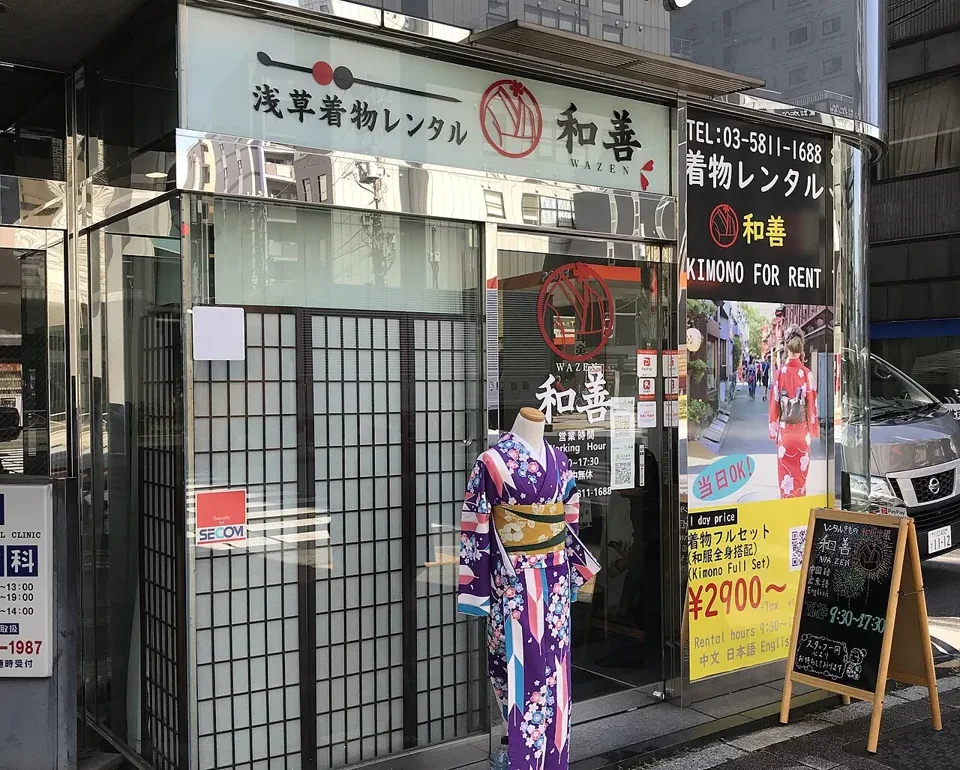
Asakusa has well over a hundred kimono rental shops within a ten-minute walk of Senso-ji, and their online prices run from ¥2,000 to ¥20,000 for what all of them call “kimono rental in Asakusa”. Here is the thing nobody tells you: the price does not track what you get. Reading every bookable listing in the district on September 24, 2026, the cheapest one — ¥2,000 — includes hair styling and make-up, and one of the ¥4,800 ones charges extra for hair at the counter. This page sorts the shops by price, says for each one exactly what the fee covers and what is billed on the day, and gives the two rules that decide whether the day works.
Fast facts
- Price range: ¥2,000 to ¥20,000 for the thing every shop calls “kimono rental in Asakusa”
- Best value: ¥2,000 at Ange — and it includes hair and make-up
- Always included: kimono, obi, nagajuban, tabi, zori, a bag, and a dresser who fits you in about 15 minutes
- Not always included: hair, make-up, luggage storage, and the time you have to be back
- Return: same day, usually 17:30–18:00. WARGO allows next-day. Late fees start around ¥1,000 per 10 minutes
- Booking: in advance for a specific shop; walk-ins exist but the good slots go first
- Watch out: there are four stations called Asakusa. Check which one your shop means before you set off
On this page
- How much is kimono rental in Asakusa?
- The four things that are not always included
- The shops, by price
- Outside Asakusa: Shinjuku, Ginza and the east side
- Which one to book
- The two rules that decide the day
- What the reviews say, and what they mean
- Is kimono rental in Asakusa worth it?
- Where this joins the rest of the east side
How much is kimono rental in Asakusa?
Between ¥2,000 and ¥20,000, and the price does not tell you what you get. That is the finding from reading every bookable listing in the district: the cheapest shop on this page includes hair styling and make-up, and one of the ¥4,800 ones charges extra for hair at the counter. So read the band you are in, not the number.
| Price | What that band actually buys |
|---|---|
| ¥2,000–¥3,500 | The full set, and at Ange (¥2,000) hair and make-up too. The best value in Asakusa sits at the bottom of the range, not the middle. |
| ¥3,500–¥5,000 | The busy middle, and the band where you must read the inclusions: some include hair, some bill it at the counter. |
| ¥5,000–¥7,000 | Hair, make-up and everything handled, in a private fitting rather than a production line. |
| ¥11,000 and up | You are no longer buying a kimono day. You are buying photographs, taken by a photographer. |
The four things that move between bands are always the same, and they are the subject of the next section: hair, make-up, luggage storage and your return time.
The four things that are not always included
Every shop in Asakusa rents the same core product: a washable polyester kimono, an obi, a nagajuban under-layer, tabi socks, zori sandals, a small bag, and a professional dresser who puts it all on you in about fifteen minutes. That part is genuinely the same at ¥2,000 and at ¥7,000. What varies, and what the listings bury, is these four:
- Hair. The biggest single difference in how the photographs look, and the item most often sold separately. WARGO includes it only if you pick the Deluxe option; the ¥4,800 Kaminarimon listing says plainly that hairstyling is an additional fee at the shop. Meanwhile ¥2,000 at Ange includes it.
- Make-up. Rarer than hair. Yui at ¥6,500 and AYAKA at ¥4,500 both state that make-up is not included; Ange at ¥2,000 and Yae at ¥6,900 both include it.
- Luggage storage. You will arrive with a bag and you cannot carry it in a kimono. Some shops store it free; Yui charges ¥550 and RikaWafuku ¥1,000–¥1,500 for a suitcase. Worth ¥1,000 of your comparison, because the alternative is a station coin locker you have to walk back to.
- The late fee. RikaWafuku adds ¥1,000 for every ten minutes past the return time. That is not unusual and it is the reason the second rule at the bottom of this page exists.
Two honest notes before the list. You do not have to book at all: the streets around Senso-ji are lined with shops advertising a full set on a board outside, and on a weekday out of season you can walk in and be dressed within half an hour. Booking ahead buys you a guaranteed slot on a Saturday, a holiday or a cherry-blossom weekend, when walking in genuinely does not work, and it buys you a process handled in English. And the kimono is polyester at every price below roughly ¥10,000, including at the shops that photograph best — nobody around you will know, and it is the right fabric for a day of walking in Tokyo weather.
The shops, by price
¥2,000–¥3,500: including the best value in Asakusa
Asakusa Rental Kimono (Ange, 1-6-3 Asakusa, second floor) is the best-value listing on this page and it is not close: about ¥2,000, and the inclusions line reads kimono and dressing service, hairstyle, shoes, socks, accessories, make-up. It is booked as a private activity, so only your group is in the slot, and it rates 5.0 — but from thirteen reviews, which is not a rating so much as thirteen people. The review depth across this whole page is the problem, and it is set out below. The obvious objection — that a ¥2,000 shop must be cutting something — is answered by shops charging twice as much for a listing whose hair is an extra. Book this one and spend the difference on lunch.
Rental Kimono and Photoshoot, about ¥2,800 on Kannon-dori, includes hair styling; the “photoshoot” in the title is staff taking pictures on your own phone, which is worth knowing before you expect files. Kimono, Furisode and Yukata Rental at The Room Asakusa, about ¥3,450, is the one to pick if you want a furisode — the long-sleeved formal kind — or a summer yukata rather than a standard komon. Hair design is included, luggage storage is free, there is free “mud insurance” for rain, and make-up and photography are paid add-ons. It is new and unreviewed.
¥3,500–¥5,000: the busy middle, where you must read the inclusions
WARGO, about ¥4,830 and 5.0 from around 30 reviews, is the pick of the tier and the national chain: morning and afternoon slots, the smoothest process for non-Japanese speakers, and the one that handles families best. Two things to know — the hair set comes only with the Deluxe option, and WARGO sells a next-day return for a fee, which is the single most useful add-on in the category.
Rental Kimono AYAKA, about ¥4,500, puts hair styling with rental ornaments in the price along with a locker and luggage storage, and states that make-up is not. The winter kimono experience at Kaminarimon has the best review record in the district — 5.0 from about 50 — and a shop a minute from the gate, and the staff will arrange a rickshaw or a tea ceremony for you while you are dressed; but hairstyling is an additional fee at the shop, so price it as ¥4,800 plus hair. OSHARE, about ¥3,600 with make-up and a tea ceremony in the title, is the cheapest way into that bundle, on a review record of five, one of which is a single star.
¥5,000–¥7,000: hair, make-up, and everything handled
Yae Kimono Rental is the one to book if you want nothing left to arrange at a counter: about ¥6,900, private, kimono and hair styling and make-up all included, a professional photo session as an optional upgrade, and 5.0 from over 75 reviews — by a distance the deepest review record in this comparison. One minute from Asakusa Station on the Ginza line.
The others in the tier are thinner. Premier Styling at about ¥5,000 offers a better rack and a simple hair setup; RikaWafuku, also about ¥5,000, is one of the few that styles men’s hair as well as women’s, but bills ¥1,000–¥1,500 for suitcase storage and ¥1,000 for every ten minutes you are late. Yui Kimono on Orange Street is about ¥6,500 with 5.0 from around 25 reviews and includes hair styling and accessories, but its own listing says make-up is not included, obijime cords are ¥550, luggage is ¥550, men’s hair styling is extra, and — despite how some listings for this shop are titled — the rental plans do not include matcha or sweets. If tea is what you are after, the tea ceremony comparison explains why a ¥6,500 Urasenke-licensed session teaches you more than a tea break bolted onto a kimono booking. AYAKA’s fuller plan, about ¥6,600, adds a walking guide to the photo spots and free luggage storage, and lets you decide about photographs on the day.
¥11,000 and up: when you are really buying photographs
Asakusa Kimono Photography Tour, about ¥19,000, 5.0 from about 35 reviews, is the benchmark: an English-speaking photographer, a local guide walking you around the district rather than posing you three times at the gate, kimono and hair set included, and at least 20 edited photographs emailed within three days. A guided photoshoot run out of Yae at about ¥20,000 promises more: 35-plus edited images, the raw files as well, WhatsApp contact beforehand, delivery in about three days. It is new, with only a couple of reviews, and the raw files are the reason to consider it over the established one.
Plus-size kimono rental with a photoshoot, about ¥11,900 and 4.4 from 14 reviews — two of those fourteen are single stars, and both are about meeting at the wrong Asakusa station, which is explained below — is here for one reason: it states plus sizes up front instead of leaving you to ask at a counter in a shop full of standard racks. Private, meeting at Asakusa Station, full set and snacks included.
For a couple or a proposal, this tier is worth it. For a solo traveller who just wants good pictures, ¥2,000 of rental and a friend with a phone at 9am gets most of the way there, because at that hour the photographs contain you and the temple rather than you and four hundred other people.
Outside Asakusa: Shinjuku, Ginza and the east side
Asakusa has the shops because Asakusa has the backdrop, and almost nowhere else in Tokyo is worth a special trip for this. Two exceptions. Kimono rental inside Shinjuku Gyoen, about ¥7,040 and 5.0 from a handful of reviews, puts you in a garden instead of a temple crowd: full set, dressing and hair for women take 60 to 90 minutes, then free time in the park, with the kimono back by 5:00 PM. Gyoen is quieter than Senso-ji on any day of the year, and it charges its own small admission. Yukata rental in Ginza, about ¥4,400 two minutes from Ginza Station, exists for summer evenings and for people staying centrally who are not going to Asakusa at all; the overtime fee is included in the price, which is unusual enough to mention.
East of the river there is no rental scene, and no reason to want one: the point of a kimono day is a street that looks like the kimono, and Asakusa is a ten-minute walk over Azumabashi from the Sumida bank. What the east side is good for is the second half of the day, after you change back — the river walk to the Skytree is a far better afternoon in your own shoes than in zori.
Which one to book
| If you want | Book | Price | What it includes |
|---|---|---|---|
| Best value, full stop | Asakusa Rental Kimono (Ange) | ¥2,000 | Hair, make-up, full set, private |
| Everything handled, best record | Yae Kimono Rental | ¥6,900 | Hair, make-up, private · 5.0 (76) |
| The solid middle | Makigawa Kimono Asakusa | ¥4,800 | Basic hair, props · 5.0 (27) |
| Family, children, English | WARGO | ¥4,830 | Hair with Deluxe only · next-day return |
| Furisode or yukata | The Room Asakusa | ¥3,450 | Hair, free storage, rain cover |
| Men’s hair styled too | RikaWafuku | ¥5,000 | Hair both · ¥1,000 per 10 min late |
| Plus sizes, stated up front | Plus-Size Kimono and Photoshoot | ¥11,900 | Private, photoshoot · 4.5 (14) |
| A real photographer | Asakusa Kimono Photography Tour | ¥19,000 | 20+ edited photos · 5.0 (35) |
| A garden, not a temple | Kimono inside Shinjuku Gyoen | ¥7,040 | Hair (women) · return by 5pm |
| Summer, staying central | Yukata Rental in Ginza | ¥4,400 | Yukata, overtime fee included |
The two rules that decide the day
Take the first slot of the morning. Shops open between 9:00 and 9:30. Senso-ji’s grounds are open all night and stay close to empty until about 9:30, fill by 10:30 and stay full until dusk. A 9:00 dressing puts you at the temple in the one hour of the day when the photographs have space in them, and it also means you are not behind twenty people waiting for a hair set at 11am on a Saturday.
Check the return time, then plan backwards. Most shops want the kimono back by 17:30, some by 17:00, and lateness is charged — RikaWafuku’s ¥1,000 per ten minutes is the published example. That quietly rules out anything you had in mind for the late afternoon on the far side of the city. WARGO and several others sell a next-morning return for an extra fee, and if you want an evening in the kimono that is the box to tick at booking, not a favour to ask at 17:20.
Three smaller things. Wear something thin and close-fitting underneath, because you will change in a small curtained space and the nagajuban goes over your own layer. Zori are worn with tabi socks and they rub after a few kilometres, so this is a day for one neighbourhood, not a city crossing. And the obi is tied tight enough that a large lunch is a mistake — eat afterwards, which is conveniently when the standing bars under the tracks open anyway.
What the reviews say, and what they mean
This is the first page in this series where the honest answer is that there is almost nothing to read. The eighteen listings above carry about 291 reviews between them. The sushi classes page covers fourteen listings and carries 9,040. Kimono rental is probably the single most-booked thing a visitor does in Asakusa, and the booking sites hold roughly three per cent of the evidence they hold for sushi.
How thin it actually is
| Listing | Reviews | Rated 3★ or below |
|---|---|---|
| Yae Kimono Rental | 77 | 2 four-star, nothing lower |
| Kaminarimon, winter kimono | 52 | 1 (1.9%) |
| Asakusa Kimono Photography Tour | 35 | 0 |
| WARGO | 30 | 1 (3.3%) |
| Makigawa Kimono Asakusa | 27 | 1 (3.7%) |
| Yui Kimono | 25 | 0 |
| Plus-size rental and photoshoot | 14 | 2 (14%) |
| Asakusa Rental Kimono (Ange) | 13 | 0 |
| Kimono inside Shinjuku Gyoen | 8 | 0 |
| OSHARE | 5 | 1 (20%) |
| Rental Kimono and Photoshoot | 3 | 0 |
| Guided photoshoot via Yae | 2 | 0 |
| The Room Asakusa (furisode/yukata) | 0 | — |
| Rental Kimono AYAKA | 0 | — |
| AYAKA, fuller plan | 0 | — |
| Premier Styling | 0 | — |
| RikaWafuku | 0 | — |
| Yukata rental, Ginza | 0 | — |
Six of the eighteen have no reviews at all. Twelve have fewer than forty. Only one, Yae, has enough of a record to be called a record, and it is a good one: 77 reviews, two at four stars and nothing below. Every other 5.0 on this page is a 5.0 from a number small enough to be one good week.
I read all six reviews rated three stars or below that exist across the entire category. Six, out of 291. There is no repeated complaint to report, because there is not enough material for anything to repeat.
Why the evidence is missing, and what it means for you
The absence is the finding. People do not book kimono rental through a booking site — they walk in off the street, which this page already tells you to do, and a walk-in leaves no review on Viator. The ratings you see are a thin slice of the people who pre-booked in English, not a verdict on the shop.
So read this page’s price tiers as a comparison of what is in the box — hair, make-up, luggage, the late fee — and not as a comparison of ratings. On this category the inclusions line is worth more than the star count, and that is unusual enough to say out loud.
The one thing worth knowing from the few low reviews: there are four Asakusa stations
Both single-star reviews on the plus-size listing are the same story, and it is a story about Tokyo rather than about the shop. A guest and the operator waited at different stations called Asakusa and never found each other; the booking was charged (a reviewer on Viator, March 2024). The operator’s public reply says the meeting address was the Ginza-line station and that in more than a hundred bookings nobody had gone to the wrong one before.
Four separate stations in Asakusa share the name. The Tokyo Metro Ginza line, the Toei Asakusa line and the Tobu Skytree line stations are two to five minutes apart and interchange with each other. The Tsukuba Express station called Asakusa is not one of them — it sits under Kokusai-dori on the far side of Senso-ji, and the Japanese railway listing for it states plainly that it is 「接続駅・乗換駅扱いになっていない」 — not treated as a connecting or transfer station at all. If your confirmation says “Asakusa Station” and nothing else, ask which line, and ask for the exit number. In a kimono you cannot walk briskly between them, and most of these bookings are ninety-minute slots.
Which of these are made for foreigners
For once this can be answered precisely, because the Japanese shops publish their prices in yen on their own sites and they are a short walk from the ones on this page.
Waraku, a minute from Asakusa Station, sells to Japanese customers (checked 2 October 2026): a full set with hair styling at ¥3,850 including tax — kimono, nagajuban, obi, undergarment, tabi, zori, bag, hair ornament, the dressing, the hair set and luggage storage. ¥3,278 for students, ¥6,578 for a couple, ¥3,850 for men. Return by 17:30.
Line that up against the tiers above and the picture is clear, and it is not the usual one:
- The ¥3,500–¥5,000 tier is the Japanese price. Makigawa at ¥4,800, WARGO at ¥4,830, AYAKA at ¥4,500 — these are a few hundred yen to a thousand above a Japanese walk-in, and what the difference buys is an English booking and a guaranteed slot. That is a fair trade, not a markup.
- The ¥2,000 listing undercuts the Japanese market. Ange at ¥2,000 with hair and make-up included is below what any Japanese-language shop on the same streets charges for the same contents. That is not a reason to avoid it — it is the best value on the page — but it is worth knowing that the price is unusual rather than normal, and worth confirming the inclusions on arrival.
- Above ¥7,000 you have stopped buying kimono. The ¥19,000 and ¥20,000 listings are photography with a kimono attached, and should be judged as photography: who shoots, how many edited images, how fast, and whether you get the raw files. The garment inside them costs ¥3,850 down the street.
And the return time is the same everywhere, which is the real constraint. Waraku takes its kimono back by 17:30 and the shops on this page are in the same band. The two rules at the bottom of this page exist because of it: the rental is not a day, it is a morning and an afternoon, and the late fees are charged in ten-minute blocks. Whether you paid ¥2,000 or ¥20,000, you are back at the counter before the light goes.
Is kimono rental in Asakusa worth it?
Yes, and it is one of the few things in Tokyo that is cheaper than it looks. A full set with hair costs about ¥3,850 at a Japanese-language shop on the same streets, and the English-language listings in the ¥3,500–¥5,000 band are a few hundred yen above that. For the price of two coffees you walk around Senso-ji dressed, with a professional dresser doing the part you cannot do yourself.
What makes it not worth it is the timing, not the money. Everything must be back by about 17:30, late fees run in ten-minute blocks, and after noon Nakamise is too crowded to photograph. Book the first slot of the day or do not book at all.
Above ¥7,000 you have stopped buying kimono and started buying photographs, and the ¥19,000 and ¥20,000 listings should be judged as photography: who shoots, how many edited images, how fast they arrive, and whether you get the raw files. The garment inside them is the same ¥3,850 set.
Where this joins the rest of the east side
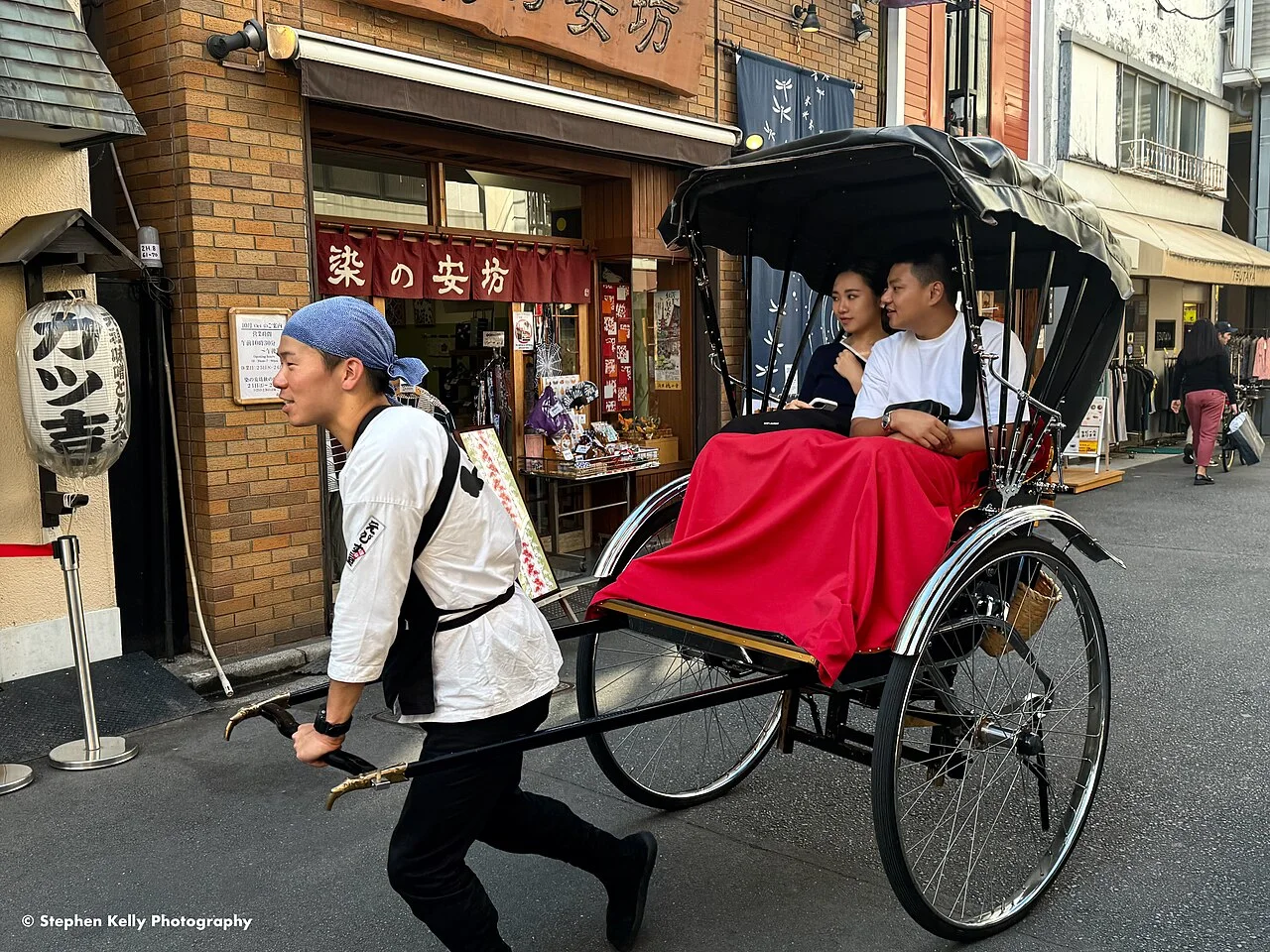
A kimono morning at Senso-ji is the west-bank half of a day whose east-bank half is the Sumida River walk. If you would rather make something than wear something, the same streets have the Asakusa workshops ranked by what they are actually worth, and the crafts compared by area are kintsugi, tea ceremony and sushi making, plus samurai and ninja experiences sorted by which of the four things they actually are , ramen classes by area, and rickshaws and walking tours — a ¥2,000 kimono plus a thirty-minute rickshaw is the cheapest good photo day in the district. Everything bookable on this site is on the Experiences page, and the area itself is in the east side guide.
Quick answers
What is the cheapest kimono rental in Asakusa?
About ¥2,000, at Ange, and it is also one of the few at any price that includes both hair styling and make-up. Asakusa prices run from ¥2,000 to ¥20,000, but the number does not track what you get — one of the ¥4,800 shops bills hair separately at the counter. Check hair, make-up, luggage storage and your return time before you compare prices.
How much does kimono rental in Asakusa cost?
From about ¥2,000 for a complete set — kimono, obi, tabi socks, zori sandals, bag and dressing — to about ¥20,000 for a session with a professional photographer. Most listings sit between ¥4,500 and ¥7,000. The price does not track the inclusions: the ¥2,000 listing at Ange includes hair and make-up, while one ¥4,800 listing charges for hair at the shop.
Do I need to book kimono rental in Asakusa in advance?
Not usually. Dozens of shops near Senso-ji take walk-ins and advertise prices on boards outside. Book ahead for weekends, public holidays, cherry blossom season and the first slot of the morning, and book ahead if you want the whole process handled in English.
Is hair styling included in kimono rental?
Sometimes, and it is the item to check first because it changes the photographs more than the kimono does. Ange (¥2,000), Makigawa (¥4,800), AYAKA (¥4,500) and Yae (¥6,900) include it. WARGO includes it only on the Deluxe option, and the ¥4,800 Kaminarimon listing charges for it at the shop. Make-up is separate again: Ange and Yae include it, Yui and AYAKA do not.
What time do you have to return a rented kimono?
Most Asakusa shops require return by 17:30, some by 17:00, and lateness is charged — RikaWafuku publishes ¥1,000 for every ten minutes. Check before planning your afternoon. WARGO and several others sell a next-morning return for an extra fee, which is the most useful add-on if you want to stay in the kimono into the evening.
What time should I rent a kimono in Asakusa?
The first slot, around 9:00 to 9:30 when shops open. Senso-ji is nearly empty until about 9:30 and full from 10:30 until dusk, so the early hour is the only one where the photographs have space in them, and you avoid the late-morning queue for hair styling.
Can men rent a kimono in Asakusa?
Yes. Most shops rent men’s sets — kimono, haori jacket, hakama on request — usually at the same price as or slightly below the women’s basic set, since hair styling is often not part of it. RikaWafuku is one of the few listings that states it styles men’s hair as well. Couple plans are standard.
What is the difference between a kimono and a yukata rental?
A yukata is unlined cotton with no under-layer, worn in summer, and usually rents for slightly less. A kimono has a nagajuban under-layer and more structure and is worn year round. Asakusa shops rent both; in July and August most people are in yukata and are more comfortable for it.
LOCAL SIDE JAPAN read the price, inclusions, exclusions, meeting point, return time and review record of every listing above on Viator on September 24, 2026. Prices are approximate, move with the exchange rate, and several shops price per group. This is a researched comparison of the listings and their reviews, not a firsthand report on each shop, and the article says so here rather than pretending otherwise. Nothing was provided free by an operator.