This article contains no affiliate links. Nobody pays LOCAL SIDE JAPAN to send you to a pachinko hall, and nobody should. The diagrams are ours; use them with a link back. How this site is made →
HOW JAPAN WORKS / PACHINKO
Gambling is a crime in Japan. Article 185 of the Penal Code, fine of up to ¥500,000, and the police mean it: the raids on underground baccarat rooms make the news every month. Japan also has 6,706 pachinko halls, three and a half million machines, and an industry that rented out ¥16.2 trillion of balls in 2024, a gross figure larger than the gaming revenue of Las Vegas, Macau and Singapore combined. Every one of those halls pays out cash to winners every day, and every one of them is legal. If you can understand how, you understand something true about how this country runs: not on rules, but on agreed-upon fictions that everyone maintains with a straight face.
On this page
- What is pachinko?
- What is a pachinko parlor?
- How does pachinko work?
- What do you win at pachinko?
- Is pachinko gambling?
- Is pachinko illegal in Japan?
- How do you turn pachinko balls into cash?
- Why is pachinko legal when gambling is banned?
- Can tourists play pachinko, and what does it cost?
- Why this is worth knowing even if you never play
- Quick answers
What is pachinko?
Pachinko is a Japanese arcade game, played on an upright pinball-like machine, that functions as gambling without legally being gambling. You rent small steel balls, fire them into a field of brass pins with a knob, and win more balls when they fall into the right pocket. The balls are exchanged at the counter for a prize, the prize is sold for cash at a separate booth around the corner, and because those are three different businesses, no single one of them has broken the law against gambling. The word itself is onomatopoeic: pachin, the sound of the ball striking.
There are 6,706 pachinko parlors left in Japan, down from 17,631 in 1995. The rest of this page answers the questions people actually ask about them, one at a time: what a parlor is, how the machine works, what you win, how the winnings become money, whether any of it is gambling, whether any of it is legal, and what happens if you walk into one yourself.
What is a pachinko parlor?
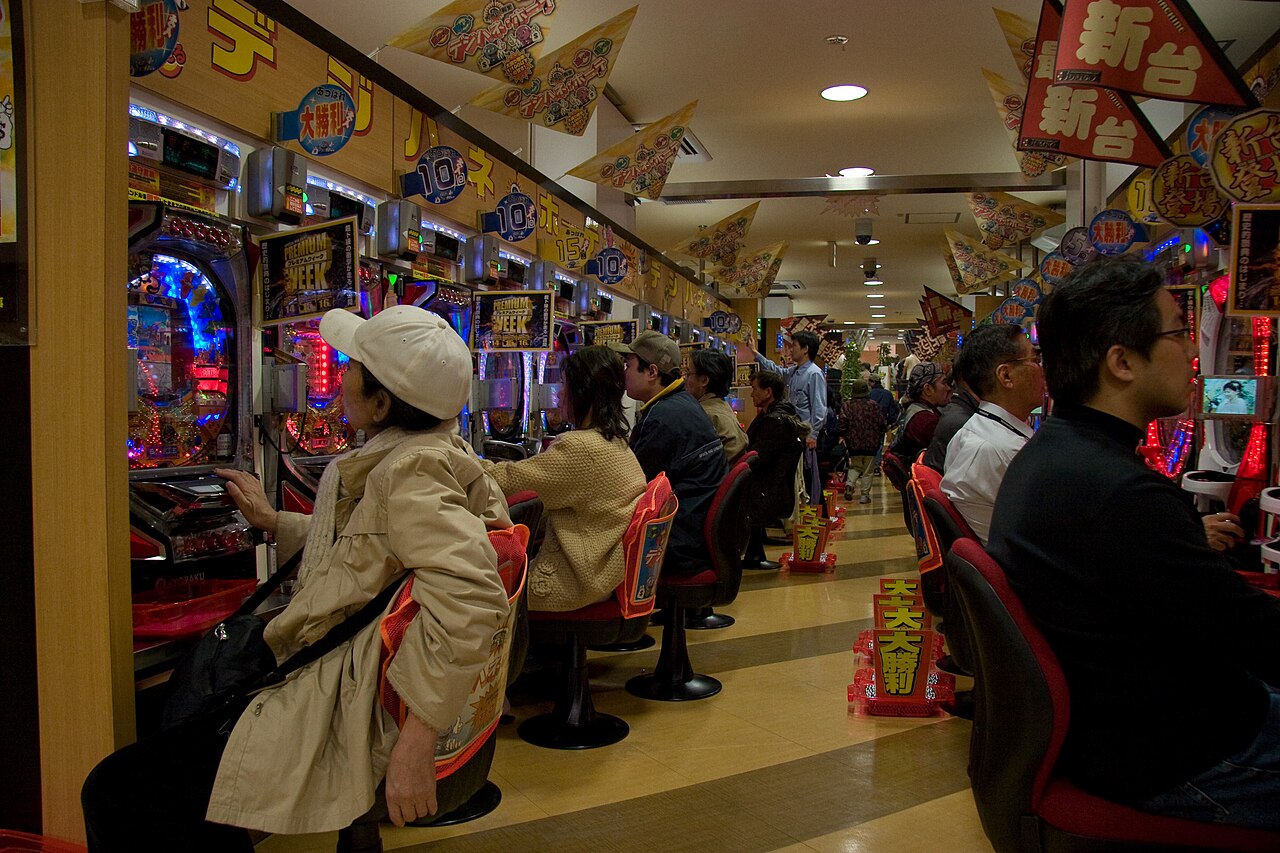
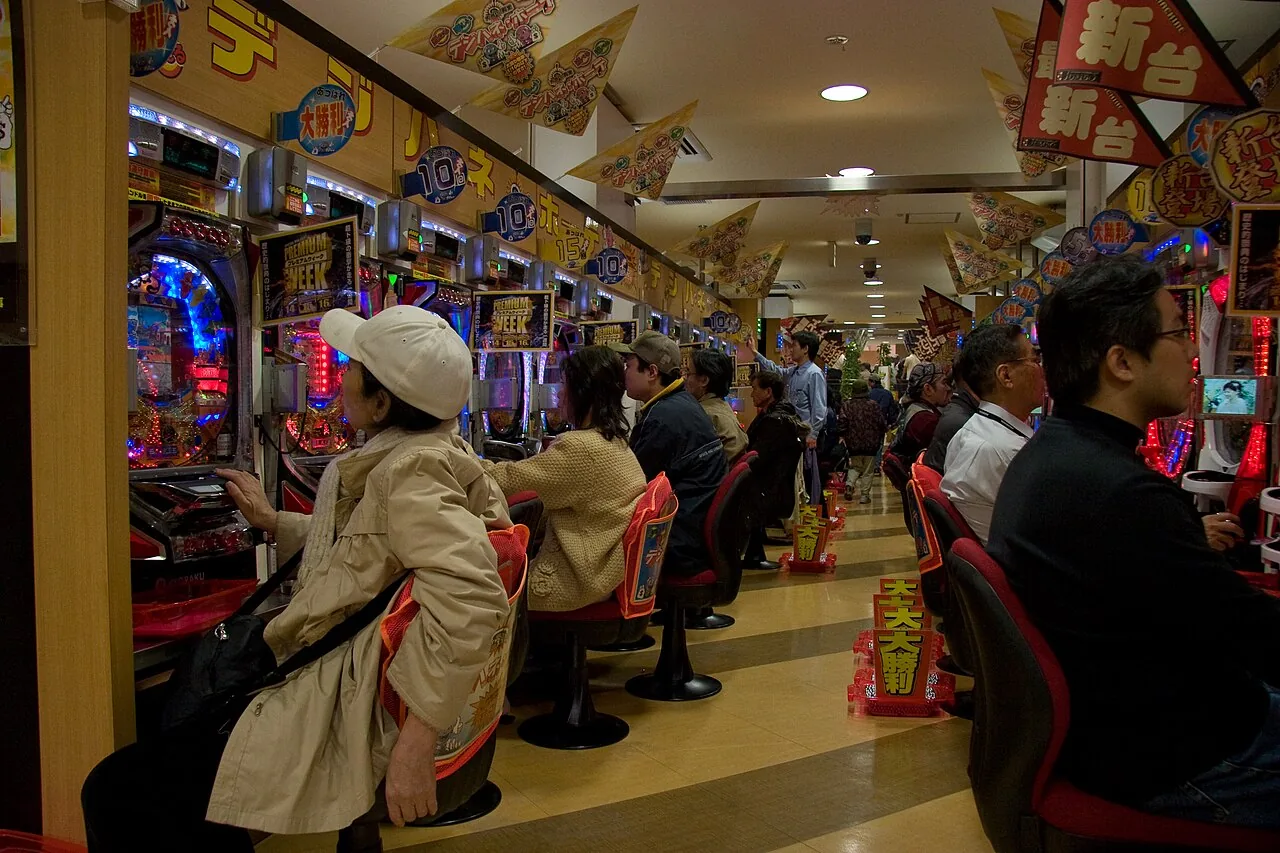
A pachinko parlor — pachinko-ya in Japanese, usually just called a hall — is a building containing a few hundred pachinko machines in rows. It is lit like a supermarket, loud enough that regulars wear earplugs, open from roughly 10:00 to 23:00, free to walk into, and open to anyone aged 18 or over with no ID check, no membership and no dress code. Many also contain pachislot, the slot-machine cousin played with medals rather than balls. There were 6,706 parlors in Japan at the end of 2024, down from 17,631 in 1995 — roughly one closing every day for fifteen years.
They are easiest to spot by the noise and the wall of vertical signage; in Tokyo they cluster around the big commuter stations, and there is at least one within a few minutes of almost every station on this side of the city.
How does pachinko work?
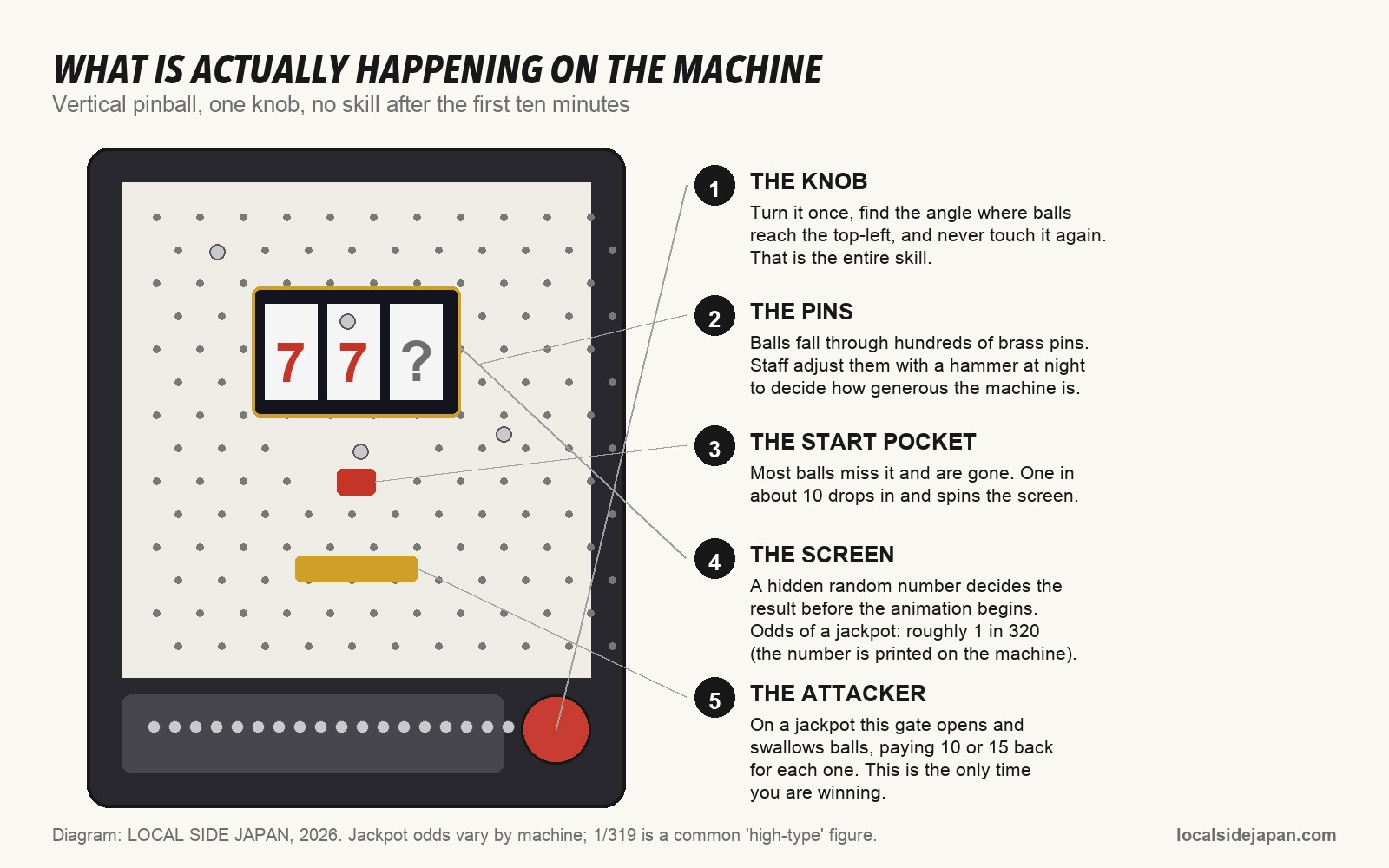
A vertical pinball machine the size of a fridge door, with one knob. You rent small steel balls, ¥4 each at a normal hall, ¥1 at the cheap ones; ¥1,000 gets you 250. You turn the knob, the machine fires balls up into a field of brass pins, and they fall. Most drop straight through and are gone. A few land in a pocket that spins three reels on a screen. If the reels match, a gate opens and, for a minute or so, every ball you fire into it comes back with ten or fifteen friends. That is the whole game. There is no strategy after you have found the knob angle that gets the balls to the top-left corner, which takes about ten minutes, and the result of each spin was decided by a random number before the animation started. The animation is there to make you feel something.
The sound is the first thing a visitor notices. Several hundred machines, each playing its own anime soundtrack at full volume, plus the steel-on-steel roar of balls, in a room with the acoustics of a car park. Regulars wear earplugs. Until 2020 they also smoked, and the halls were the last indoor place in Japan where a non-smoker could not breathe; the Health Promotion Act ended that in April 2020, which many owners will tell you hurt them more than any regulation aimed at the game itself.
What do you win at pachinko?
Not money — legally, you win a prize. The machine counts your balls and prints a receipt, and the counter exchanges that receipt for goods: chocolate, cigarettes, snacks, household items, in some halls a rice cooker. Almost nobody takes them. What everybody takes is the special prize (tokushu keihin), which in Tokyo is a small plastic card with a sliver of gold sealed inside, issued in denominations that correspond to ¥1,000, ¥2,500 and so on.
The special prize is the one you can sell for cash, and the way that works — and the reason the hall is not the one buying it back — is the subject of the next section.
Is pachinko gambling?
In every practical sense yes, and in law no. You pay money, chance decides the outcome, and you can walk out with more money than you came in with — which is gambling by any ordinary definition, and the reason Japan’s gambling-addiction problem is overwhelmingly a pachinko problem. But Japanese law defines the offence narrowly: gambling requires that the place taking your bet is the place paying you out. A pachinko hall gives you a prize and is forbidden from buying it back. A separate company, in a separate building, buys the prize. Because the bet and the payout happen at two different businesses, no single party has committed the offence.
Every adult in Japan understands this, and the term for the arrangement — santen hoshiki, the three-shop system — is ordinary vocabulary rather than slang.
Is pachinko illegal in Japan?
No. Pachinko is legal and licensed. Halls operate under the Amusement Business Act, are regulated by the prefectural police, and their machines, payout rates and opening hours are all set by regulation. Article 23 of that Act is the key clause: a hall may not give cash or securities as a prize, and may not buy back the prizes it gives. Halls comply with both. The cash exchange happens at an unconnected business nearby, which is not what the Act regulates.
Casino gambling, by contrast, has been illegal in Japan throughout — which is why the first casino resort, opening in Osaka in 2030, required its own legislation. Betting on horse racing, bicycle racing, powerboats and motorcycle racing is separately legal under its own laws. Pachinko is the one that is legal by not being called gambling at all.
How do you turn pachinko balls into cash?
In three steps: the hall gives you a gold card, a separate window buys the card for cash, and a wholesaler sells the card back to the hall. That is the three-shop system, and it exists because Article 23 of the Amusement Business Act forbids a hall from paying in cash or securities and forbids it from buying back the prizes it gives. The hall obeys both rules exactly.
So you leave the hall, walk around the corner, and find a small window in a wall, sometimes with a curtain, sometimes with a sign that says nothing at all. The person behind the window buys your gold card for cash at a fixed rate. This is a completely separate business from the hall. If you ask the hall staff where the window is, they will tell you they do not know. They know. And then a third company, a wholesaler, buys the gold cards from the window and sells them back to the hall, which puts them back on the shelf for tomorrow. Three companies, three transactions, and no single one of them has taken a bet and paid it out.
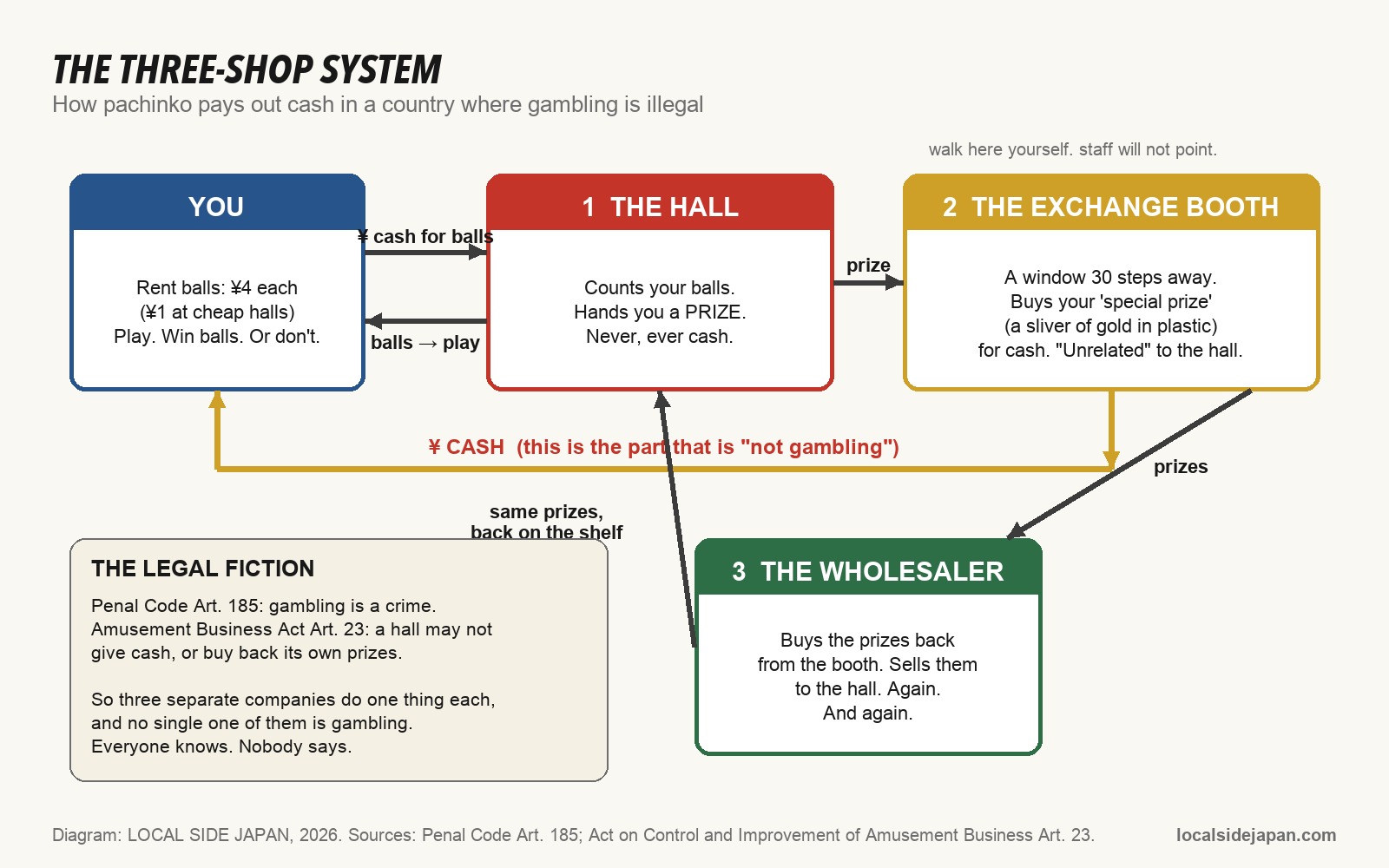
The National Police Agency has said in the Diet, more than once, that it is “not aware” of cash exchange taking place. The courts have upheld the arrangement when it has been tested. Every adult in Japan knows how it works, most have never played, and the phrase “three-shop system” (santen hoshiki) is ordinary vocabulary. In 2007 the price of gold rose so far that in Tokyo you could briefly get more for your special prize at a jeweler than at the window, and the whole industry had to quietly reissue its gold cards. That was the closest anyone has come to admitting what the cards are.
Why is pachinko legal when gambling is banned?
Pachinko began as a children’s game, a Japanese descendant of the Corinthian bagatelle boards that arrived from Europe in the 1920s. Nagoya licensed the first hall for adults in 1930. After the war a Nagoya hall owner called Takeichi Masamura reworked the pin layout so that balls could travel across the whole board, and every machine since has used a version of his design; his name is on the layout the way Doctor Diesel’s is on the engine. Through the 1950s and 60s pachinko was the working man’s evening, a few hundred yen of balls after the shift, cigarettes and chocolate at the counter, and the halls’ owners were disproportionately Korean-Japanese, who had been shut out of ordinary employment and built the industry in the gap.
In 1980 a manufacturer called SANKYO released “Fever”, the first machine with a spinning-reel jackpot, and pachinko stopped being pinball and became a slot machine that used balls. The 1990s were the peak: nearly 18,000 halls, thirty million players, and a gross turnover that peaked near ¥30 trillion. Then the long decline. A 2007 ban on the most generous slot machines; the 2008 crash; smartphones, which gave bored men something else to do with their hands; a 2018 police regulation that cut the maximum payout by a third, in the name of addiction prevention; the 2020 smoking ban; COVID. The halls closed at a rate of one a day for fifteen years. There are 6,706 left, and the number falls by about five percent a year.
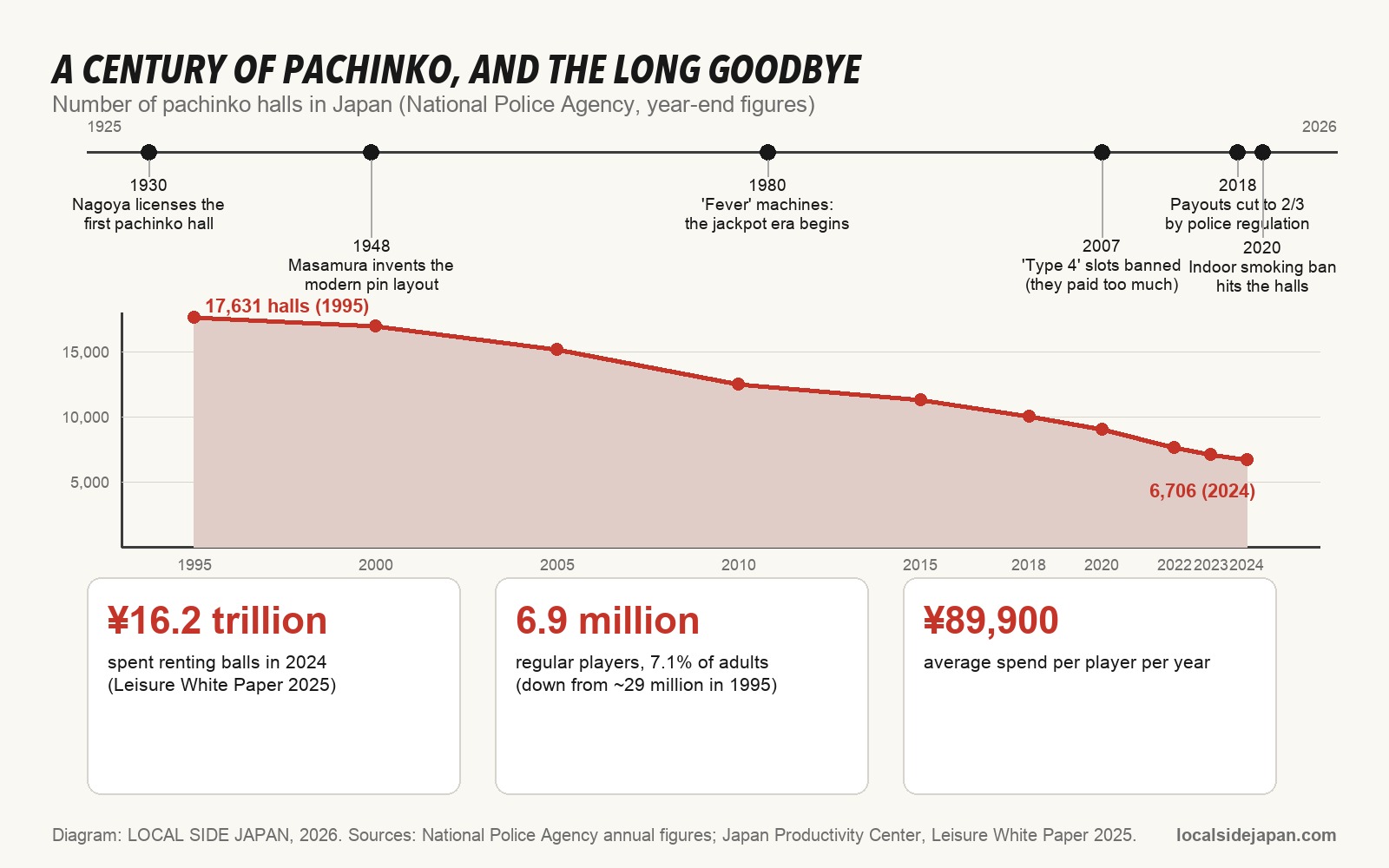
What has not declined is the money per player. The 6.9 million people who still play spend an average of ¥89,900 a year, and a hard core spend far more. Gambling addiction is a real and undercounted problem in Japan, and the halls are its main venue; the country’s first large national addiction survey, in 2017, was commissioned precisely because the government wanted to open casinos and needed to know what it was already dealing with. The answer was about three and a half percent of adults with a lifetime history of suspected problem gambling, most of it at pachinko. The first casino resort opens in Osaka in 2030. The halls do not expect to be helped by it.
Can tourists play pachinko, and what does it cost?
- You will lose. The hall keeps roughly 10 to 15 percent of everything rented. Budget ¥2,000 to ¥3,000 as the cost of a strange hour, and if it turns into more, you have understood the second half of this article.
- Anyone 18 or over can walk in. No passport, no membership, no dress code. The doors are open and the room is lit like a supermarket. You will be the only visitor and nobody will care.
- Go to a ¥1 hall. Look for 1円 on the sign outside; ¥1,000 gets you a thousand balls instead of 250, and an hour of play instead of ten minutes.
- Pick a machine with a low number on its display. The counter above each machine shows how many spins since the last jackpot; it does not change your odds, but a seat that says 800 will feel unfair, and one that says 40 will not.
- Put the note in the slot to your left, press the button, turn the knob about a third of the way and hold it. Balls that reach the top-left and fall through the middle are what you want. Adjust by a millimeter. Then stop adjusting.
- When you are done, press the call button. Staff will bring a tray or count your balls in the machine at the end of the row and hand you a receipt. Take it to the counter and say “tokushu keihin de” (special prize, please), or just hold it out; they know.
- Find the window yourself. Walk out, look for a narrow doorway or a hatch within a hundred meters, often on a side street, sometimes with a small camera and a laminated sign in Japanese. Slide the cards under the glass. Cash comes back. Say thank you to nobody in particular.
Why this is worth knowing even if you never play
Because the three-shop system is not really about pachinko. It is the clearest example of a pattern you will meet everywhere in Japan: the bathhouse rules that say one thing on the sign and another in practice, the bar that is “members only” until you walk in, the tip that is refused and the “service charge” that is not. The written rule is kept immaculate and the real rule lives next to it, and both are true, and asking which one is really true is the one question that marks you as foreign. Once you have stood at a window in a wall being handed ¥6,000 for three bits of plastic by a man who is not, legally, paying you for anything, you have the key to a lot of doors.
The east side of Tokyo has a hall at almost every station. The ones near Kita-Senju and along Kinshicho’s south exit are the big ones; the small ¥1 halls in Shibamata and Sunamachi are the gentle introduction. After an hour inside, any of the bathhouses in this list will get the sound out of your ears.
Quick answers
What is pachinko?
A Japanese arcade game played on an upright pinball-style machine with small steel balls, which functions as gambling without legally being gambling: the hall pays in prizes, and a separate booth nearby buys the prizes for cash. The name comes from pachin, the sound of the ball.
What is a pachinko parlor?
The hall where pachinko is played: a few hundred machines in rows, free to enter, open roughly 10:00 to 23:00 to anyone aged 18 or over, with no ID or membership needed. Japan had 6,706 of them at the end of 2024, down from 17,631 in 1995.
Is pachinko gambling, and is it legal in Japan?
Legally it is an ‘amusement business’, not gambling, because the hall gives prizes rather than cash and does not buy them back. The cash comes from a separate exchange booth nearby (the ‘three-shop system’). Gambling itself is a crime under Penal Code Article 185; pachinko is licensed under the Amusement Business Act. Everyone treats it as gambling in practice.
Can tourists play pachinko in Japan?
Yes. Anyone aged 18 or over can enter a hall; no ID, membership or Japanese is needed. Insert a ¥1,000 note, turn the knob, and press the call button when you want to stop. Budget ¥2,000 to ¥3,000 and expect to lose it.
How do you get money from pachinko?
Have your balls counted, take the receipt to the counter and ask for the ‘special prize’ (tokushu keihin): small plastic cards containing gold. Take them to the exchange booth, a small window usually within 100 meters of the hall, which buys them for cash. Hall staff will not tell you where the booth is.
How much does pachinko cost to play?
Balls are rented at ¥4 each at standard halls (¥1,000 = 250 balls) or ¥1 each at ‘1-yen’ halls (¥1,000 = 1,000 balls). The maximum value of a single prize is about ¥10,000 (¥9,600 plus tax) under the Amusement Business Act, and since 2018 a jackpot is capped at 1,500 balls.
How many pachinko halls are there in Japan?
6,706 at the end of 2024, according to the National Police Agency, down from 17,631 in 1995. Around 3.3 million machines are installed. The Leisure White Paper 2025 counts 6.9 million regular players and ¥16.2 trillion in ball rentals for 2024.
Practical notes
- Age: 18 and over. Halls check young-looking faces; carry ID if you are under 25.
- Hours: typically 10:00 to 22:45 or 23:00, set by prefectural ordinance. The morning queue at opening is regulars who believe the machines were reset generously overnight.
- Cash only for balls at most halls; some now take IC cards. Bring ¥1,000 notes.
- Noise: around 90 to 100 decibels. Earplugs are sold at the counter for a reason.
- Smoking: banned on the floor since April 2020; heated-tobacco rooms are allowed, and some halls are noticeably grey in the corners.
- Photography: generally not allowed inside. Ask, or don’t.
- Do not leave balls unattended in the tray, touch another player’s machine, or try to carry balls out of the building. All three are taken seriously.
LOCAL SIDE JAPAN checked the hall and machine counts against the National Police Agency’s year-end 2024 figures, the market size, player numbers and spend against the Japan Productivity Center’s Leisure White Paper 2025, the payout and prize limits against the 2018 amendment to the Amusement Business Act regulations, and the legal framework against Penal Code Article 185 and Amusement Business Act Article 23, on September 18, 2026. The diagrams are original and may be reused with attribution and a link.