This article contains no affiliate links. The diagram is ours; reuse it with a link back. How this site is made →
HOW JAPAN WORKS / SENTO
Every guide to Japanese bath etiquette gives you the same list of rules, and the list is accurate, and it is also the reason most visitors never go: it makes a neighborhood bathhouse sound like an exam. Here is the thing the lists do not say. A sento is a room full of tired people who want to sit in hot water, and the entire etiquette exists to keep that water clean and that room calm. Get those two things right and nobody in Tokyo will care about the rest. This is how it actually works, the rules that are printed on the wall against the rules that people follow, in the order a visit happens, from someone who has been going to the same one in Koto City for years.
On this page
The written rules and the real rules
| On the sign | What it means in practice |
|---|---|
| Wash before entering the bath | The one rule that is absolute. Soap, rinse, no suds left. Everyone is watching for this and only this. |
| No tattoos | At most sento, unenforced or explicitly dropped; at large “super sento” and onsen resorts, enforced. Check the door, or the list of baths that say yes in writing. |
| No towels in the bath | Real. Fold the small towel on your head or leave it on the edge. |
| Tie up long hair | Real, and nobody has a hair tie to lend you. Bring one. |
| No swimming, no diving | Real, and aimed at children; adults do not need telling. |
| Be quiet | Not real. Regulars talk. What is not done is shouting, phones, and conversation across the room. |
| No photography | Absolute, including the changing room and the lobby if anyone is in shot. |
| Dry off before the changing room | Real. A wet floor in the changing room is the thing that annoys the owner most. |
| No alcohol | Means do not arrive drunk. The beer fridge in the lobby is for afterwards. |
Step by step
Before the water
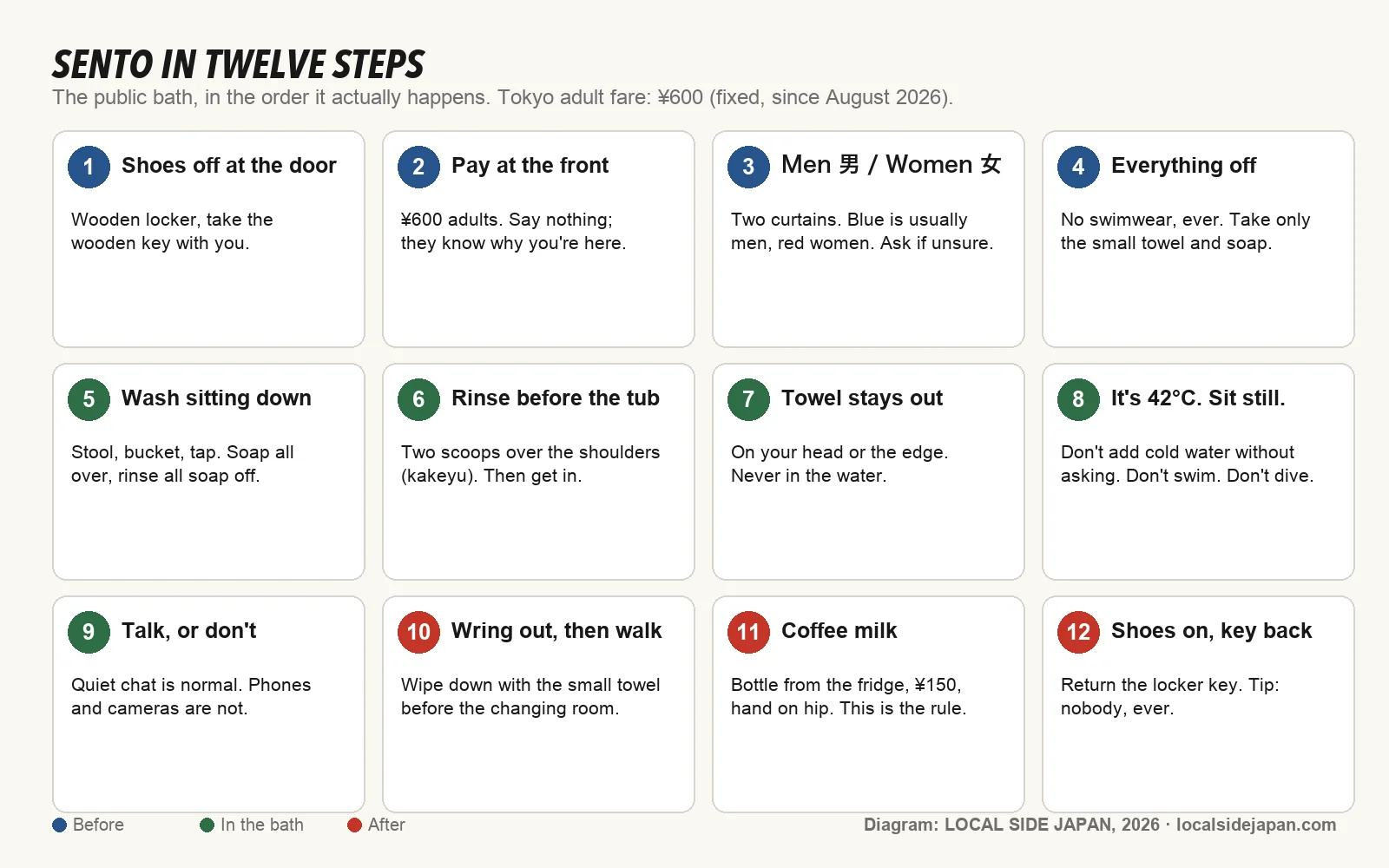
- Shoes. Off at the entrance, into a small wooden locker; the wooden key on a string comes with you. This is where you will be if you lose it, so put it in the same place every time.
- Pay. Either at a front desk with a counter or, in old baths, at a bandai, a raised seat between the two changing rooms where one person, usually the owner’s mother, sees everything. In Tokyo the adult price is fixed by the metropolitan government at ¥600 (from August 1, 2026); children pay less. Say nothing. Hand over the coins. If you need a towel, say “taoru”, and a small one costs ¥100 to ¥200, a rental big one about the same. Many baths sell a ¥50 sachet of shampoo and body soap; many now provide them free at the taps.
- The curtain. Two: 男 (men) and 女 (women). The colors are usually blue and red but not always, so read the character. Some baths swap the two sides on alternate days; if in doubt, ask, and nobody will mind.
- The changing room. Lockers or open baskets. Everything off: there is no swimwear, no underwear, no cover-up, and the first ten seconds of that are the whole of the difficulty. After that nobody is looking, because nobody is. Take the small towel, your soap, and nothing else through the glass door.
In the bath
- Wash first, sitting down. Take a plastic stool and bucket from the stack, sit at a tap with a shower head, and wash everything with soap, then rinse until no soap is left. Standing showers exist in newer baths and nobody minds if you use them. Do not stand at the tap and spray the person next to you. When you are done, rinse the stool and bucket and put them back where you found them, or leave them tidy at the tap if that is what the regulars do.
- Kakeyu. Before getting in, scoop bath water over your shoulders two or three times with the bucket. It rinses the last of the soap and warns your body about what is coming.
- The towel. Folded on your head, or on the edge of the tub. Never in the water. This is the second thing everyone watches for.
- The heat. Tokyo sento water is 42 to 44 degrees, hotter than anywhere else in Japan, and the old men in it will look at you pleasantly while you fail to get in. Go in slowly, sit still, get out after five minutes, and go back. Do not turn on the cold tap to cool the tub without asking: it is a communal bath and someone has just got it to the temperature they like. There is usually a cooler tub, a medicinal bath (the brown or green one), a jet bath, sometimes an electric bath that makes your legs twitch, and in the good ones a cold plunge and a sauna, which costs a few hundred yen extra and needs its own etiquette: sweat off before the plunge.
- Talking. Allowed. Regulars have been meeting in this tub for thirty years. A nod, a “konnichiwa”, a comment on the heat (“atsui desu ne”) will get you a conversation if you want one and a smile if you do not. What is not done: raised voices, groups talking across the room, and anything with a screen. Phones stay in the locker, cameras stay at home.
After
- Wring out the small towel and wipe yourself down before you go through the door. The changing-room floor is meant to stay dry, and a foreigner dripping across it is the one thing that will get a word said.
- Coffee milk. In the lobby fridge: kohii gyunyu, coffee-flavored milk in a small glass bottle, about ¥150, drunk standing with one hand on your hip. Fruit milk is the alternative. This is not in any rule and it is the most important part.
- Key back, shoes on. Give the locker key back if the desk asks for it, collect your shoes, and leave. There is no tipping and there is nothing to say; “arigato gozaimashita” on the way out is enough and is more than most locals manage.
The questions people actually have
What if I have a tattoo? Read the door. A sign with a crossed-out tattoo means no. No sign, at a neighborhood sento, usually means nobody cares, and a growing number say so in writing; three on the east side are listed here with their policies quoted. Large bathing complexes and hot-spring resorts are the ones that enforce it. Covering a small tattoo with a waterproof plaster is accepted almost everywhere.
Can I go with my partner? Not into the same bath. Sento are separated by sex at the curtain and there is no mixed bathing; the way couples do it is to go in at the same time and meet in the lobby afterwards. Private baths that can be rented by two people are rare in Tokyo and mostly in hotels; what exists on the east side is here.
Can I take children? Yes, and it is the best way to do it. Small children go in with either parent; the age at which a child must use the bath of their own sex is set by the prefecture and in Tokyo is seven. They will be told off for swimming, gently, by strangers, and they will love it.
Do I have to be naked? Yes. There is no version of this with a swimsuit. The good news is that the discomfort lasts about as long as it takes to walk from the locker to the door, after which you are one of a dozen naked people in a steamy room and the most invisible you will be in Japan.
How long do people stay? Thirty to sixty minutes, in and out of the water. There is no time limit and nobody is waiting for your seat.
Sento or onsen? A sento is a public bath with heated tap or well water, in the neighborhood, ¥600. An onsen is natural hot-spring water, and some Tokyo sento are onsen (the black water in Sumida and Koto is a real spring). The etiquette is the same; the price and the setting are not.
Why the rules are the way they are
Edo had public baths from the 1590s because it was a city of wooden houses that burned, and a fire in a private bath could take the district with it; the shogunate licensed the bathhouses and, for most of the period, forbade baths at home. So the sento was where everyone went, daily, samurai and shopkeepers in the same water, and the rules that came out of that (wash first, towel out, keep the floor dry, do not disturb the temperature) are the rules of sharing a scarce thing among strangers. The east side, rebuilt after 1923 and 1945 with tenements that still had no baths, kept the habit longer than anywhere: Sumida and Koto have more sento per square kilometer than any other part of Tokyo, and the ones that survive are the ones whose regulars kept coming. That is the room you are walking into. The rules are not a test. They are what keeps it open.
Where this joins the rest of the east side
Put it into practice at the tattoo-friendly baths of Sumida and Asakusa, or at Takara-yu’s garden in Kita-Senju. This is the second explainer in the How Japan Works series; the first is how pachinko is legal, which is the same story of a written rule and a real one.
Quick answers
What is the most important rule of sento etiquette?
Wash thoroughly with soap, sitting at a tap, and rinse off all the soap before you get into the shared bath. Everything else is secondary. Second is keeping your towel out of the water.
How much does a sento cost in Tokyo?
¥600 for adults, a fixed price set by the Tokyo Metropolitan Government from August 1, 2026, at every licensed sento in the city. Children pay less. Saunas cost a few hundred yen extra; towels and soap ¥50 to ¥200 if you need them.
Can you talk in a sento?
Yes. Quiet conversation is normal and regulars chat every day. Shouting, talking across the room and using a phone are not done. Photography is never allowed.
Are tattoos allowed in sento?
It depends on the bath. Many neighborhood sento do not enforce a ban and some state that tattoos are welcome; large bathing complexes and onsen resorts usually refuse them. Look for a sign at the door, or choose a bath that publishes its policy.
Do you have to be naked in a Japanese sento?
Yes. Swimwear is not allowed in any sento or onsen bath. Baths are separated by sex, and you take only a small towel into the bathing area, which stays out of the water.
What is the difference between a sento and an onsen?
A sento is a neighborhood public bath using heated tap or well water, ¥600 in Tokyo. An onsen uses natural hot-spring water and can be a sento, a resort or a hotel bath. The etiquette is identical.
LOCAL SIDE JAPAN checked the Tokyo adult fare against the Tokyo Sento Association (¥600 from August 1, 2026) and the mixed-bathing age limit against the Tokyo Metropolitan Government’s public bath ordinance on September 20, 2026. The rest is what happens in the bath the writer has used for years. The diagram is original and may be reused with a link.