Sento & Onsen

The east side has more neighborhood bathhouses per square kilometer than anywhere else in Tokyo, because the wooden houses that survived here never had baths of their own. Adult fare is fixed by the metropolitan government (¥600 from August 2026), the water is often well water heated with wood, and a few of them, listed here with their policies quoted, say in writing that tattoos are welcome. These guides give prices, hours, closing days and the etiquette that makes the first visit easy. New to public baths? Start with sento etiquette, the written rules and the real ones.

  • Hakone Day Onsen with Tattoos: The Rules, Translated from the Japanese

    This article contains affiliate links to booking sites. If you book through them, LOCAL SIDE JAPAN earns a small commission at no extra cost to you. I have no relationship with any bathhouse on this page. Every tattoo rule below is translated from the operator’s own Japanese-language page, not from an English summary, and was read on 16 October 2026. Rules change — confirm before you travel. How this site is made →

    HAKONE / DAY ONSEN / THE TATTOO RULES, TRANSLATED

    English guides will tell you that Hakone has tattoo-friendly hot springs. That is true and almost useless, because the rules are specific in ways no summary survives. One place will admit you with a tattoo but only if you are the only tattooed person in the building — and if you and a tattooed friend arrive separately and meet inside, you are both asked to leave. Another will let you in if, and only if, two of their cover stickers hide it completely. A third removed its restrictions entirely in 2025 and says so on its front page. All three sentences are on the operators’ own Japanese websites. Here they are in English.

    Fast facts

    • Hakone Yuryo lifted its tattoo restrictions outright — the only large day onsen in Hakone that says so on its own homepage
    • Tenzan admits tattooed bathers, but only one per visit, and bans tour groups and travel agents entirely
    • Yunessun refuses tattoos in principle, including stickers and paint; the swimsuit zone works with a rash guard, the nude bath only with two of their own cover stickers
    • A private open-air room is the reliable answer. Hakone Yuryo has 19 of them — from ¥10,400 for two people for 120 minutes
    • Hakone Freepass: ¥7,100 for two days from Shinjuku — the Romancecar limited-express ticket is extra
    • Tenzan is cash only and there is no ATM nearby
    • Yunessun may be free if your hotel in the area includes it — one reviewer bought a ticket and could not get a refund

    Can you get in with a tattoo?

    It depends entirely on which building you walk into, and the three big names in Hakone sit at three different points on the scale. This table is translated from their own Japanese pages.

    FacilityOfficial position on tattoosPractical reading
    Hakone Yuryo
    (Hakone-Yumoto)
    States on its front page that it is promoting tattoo-friendliness and has lifted its bathing restrictions for tattoosWalk in. No covering, no conditions, no conversation. The simplest answer in Hakone
    Tenzan Tojikyo
    (Okuyumoto)
    Will not refuse you for a tattoo, but admits only one tattooed person at a time. If two tattooed people are inside, both are asked to leave — even if they arrived separately and met by chance. Asks you to wear something over it in the common areasFine alone. Impossible as a tattooed couple. Also no tour groups, and groups of any kind capped at six
    Yunessun
    (Kowakien)
    Refuses tattoos in principle, including stickers and paint. Swimsuit zone: allowed if covered, e.g. by a rash guard (paid rental available). Nude bath “Mori no Yu”: allowed only if two of the facility’s own paid cover stickers hide it completely. Otherwise, use a private bath (8 rooms, reservation required)Workable, but measure your tattoo first. Two stickers is not very much coverage
    Translated from each operator’s own Japanese-language site, 16 October 2026.

    Notice what is not in that table: nobody is “tolerant”. Each has written a precise rule and will apply it at the counter, in Japanese, while a queue forms behind you. Decide which building you are going to before you get on the train.

    The “one tattooed person” rule, in full

    Tenzan is the most atmospheric day onsen in Hakone — a river valley, outdoor pools, a genuinely old-fashioned toji bathing place rather than a leisure facility. It also has the rule most likely to ruin your afternoon, and English write-ups consistently soften it. Here is what its own page actually says, in summary:

    • A tattoo is not in itself a reason for refusal
    • But use is limited to one tattooed person. Regardless of gender, if more than one tattooed guest is present, entry is refused
    • Arriving separately does not help. If you end up inside at the same time, you will be asked to leave, and “we just happened to meet here” is explicitly not accepted
    • While in the building, you are asked to wear something over it out of consideration for others
    • The stated reason is to avoid the impression of intimidation that a group of tattooed guests can create

    Two further rules at Tenzan that catch foreign visitors, both from the same page:

    • Groups are capped at about six adults, and splitting up to get around it does not work
    • Tour groups and travel agents are refused outright. It describes itself as a toji-ba, a curative bathing place, not a leisure facility — which is also why you will never find it bookable on an OTA. Come as an individual or not at all

    If you are a solo traveller with tattoos, Tenzan is arguably the best bath in Hakone and it will take you. If there are two of you, go somewhere else and do not improvise.

    What do cover stickers actually buy you?

    Less than the internet suggests. The widely repeated advice — “small tattoos are fine if you cover them with a sticker” — is not how Yunessun has written its rule. Its FAQ refuses tattoos in principle and specifically includes stickers and paint in that refusal, then carves out two exceptions:

    • The swimsuit zone (the famous wine and coffee baths): wear a rash guard or similar so the tattoo is not visible. Rash guards can be rented for a fee
    • Mori no Yu, the nude bath: permitted only when two of the facility’s own paid cover stickers completely hide the tattoo. Not your stickers. Theirs, and two of them
    • If it cannot be completely covered: the official answer is the private baths — eight rooms, reservation required

    So measure it. Two cover stickers will handle a wrist or an ankle. They will not handle a half-sleeve, and arriving to be told so at the counter is the single most avoidable disappointment in this article.

    The reliable answer: book a private bath

    If your tattoos are large, or there are two of you, or you simply do not want the conversation, a kashikiri — a private open-air room you book by the hour — removes the question entirely. Hakone Yuryo has nineteen of them, which it describes as the largest such collection in the Tokyo area, in three sizes:

    Room typeCapacityWeekday, 120 minWeekend / holiday
    Ichi-no-maki (7 rooms)up to 2¥10,400¥11,400
    Ni-no-maki (8 rooms)up to 4¥12,400¥13,400
    San-no-maki (4 rooms)up to 4¥14,400¥15,400
    Per room, not per person, including tax and bathing tax. Extensions ¥2,600–¥3,850 per 30 minutes. Read from the operator’s price page, 16 October 2026.

    The details that matter, from the same page:

    • Reservations open one month ahead and close at 15:00 the day before online; after that, by telephone only
    • Minimum two hours
    • Using the big public bath as well costs extra — ¥1,000 on weekdays, ¥1,300 at weekends
    • Every room has its own heated and air-conditioned rest area
    • Golden Week, mid-August and new year are charged at weekend rates
    • Guests under 18 may not use the rooms unaccompanied, and guests in nappies cannot bathe

    For two people for two hours, ¥10,400 works out at ¥5,200 each — about three times a public bath ticket, for a private open-air bath in a wooden room with nobody else in it. For a couple where one or both have tattoos, it is the obvious purchase and it is bookable in advance, which almost nothing else here is.

    Which day onsen should you choose?

    Hakone Yuryo — the default, and the tattoo answer

    Three minutes from Hakone-Yumoto station by free shuttle bus, which matters more than it sounds when the alternative is a bus timetable in Japanese. A large wooden satoyama-style complex: indoor baths, open-air baths, pot baths, a sauna, an irori restaurant, a huge rest hall, and the nineteen private rooms. Adults ¥1,700–¥1,800 on weekdays and ¥2,000–¥2,200 at weekends; primary-school children ¥1,000; children below school age are not admitted to the main bathhouse at all — they need a private room. Towels are not included (bath towel ¥550, face towel ¥300, yukata ¥300). Open daily, 10:00–20:00 on weekdays and until 21:00 at weekends.

    from about US$11 · Hakone-Yumoto, free shuttle · no tattoo restrictions · 19 private rooms bookable separately on the operator’s own site · note: this Klook listing is new and has a single review, from a visitor whose voucher showed as already used — keep the confirmation screen and arrive with it open

    Yunessun — only if you want the theme park

    This is two things sold as one: a swimsuit water park with novelty baths, and a conventional nude onsen called Mori no Yu. The water park is a day out with children, not a hot spring experience, and its reviews say so — 4.5 from 417, with the complaints concentrated on crowds and small pools rather than anything being broken.

    from about US$9 · Kowakien · 4.5 from 417 reviews · 2.4% rated 1–2 stars · check whether your hotel already includes entry before buying — one reviewer could not get a refund after discovering it was free with their stay

    Konohana no Yu — if you want Fuji from the bath

    Not in Hakone but at Gotemba, on the far side of the same day trip, and the reason to go is the view: an open-air bath looking straight at Mount Fuji. It pairs naturally with a Fuji day and with the outlet mall next door if someone in your group wants shopping. Check its tattoo policy directly before you commit — it is a separate operator from the three above and I have not verified its rule from a primary source.

    from about US$12 · Gotemba · open-air bath with Mount Fuji view · tattoo policy unverified — ask first

    Tenseien — the quiet one at Hakone-Yumoto

    A ryokan that sells day-use bathing, within walking distance of the station, and the least crowded of the options here simply because it is not famous. Only two reviews on Klook, so treat the rating as meaningless and the price as the information.

    from about US$14 · Hakone-Yumoto · ryokan day-use · only 2 reviews — rating not meaningful

    Tenzan — the best bath, with conditions

    You cannot book it here or anywhere else, because it refuses travel agents. Take a bus or taxi from Hakone-Yumoto, bring cash — almost everything inside is cash only and there is no ATM nearby — and bring a face towel, which is required, not optional. Yukata rental is ¥500. Go alone, and go on a weekday.

    What do the bad reviews say?

    The bookable Hakone onsen tickets have far fewer complaints than the bus tours I have looked at elsewhere, which makes sense: a ticket is a simpler product than a day. Yunessun, the only one with a meaningful sample, has 10 one- or two-star reviews out of 417 — 2.4%. The themes:

    • Crowding. Reviewers describe being packed in, pools too small to enter, and the reality not matching the photographs. This is a weekend and school-holiday problem
    • Paying for something that was free. One reviewer’s hotel in the area included entry; they had already bought a ticket and could not get it refunded. Check your accommodation first
    • Transport delays eating the day. A reviewer delayed by a rail accident missed the lunch buffet included in their ticket and could not recover the cost from either the facility or the platform
    • The naked bath is the good part. Several reviewers who disliked the theme park said Mori no Yu was still worth it — which, if you have tattoos, is the part with the sticker rule

    Is the Hakone Freepass worth it for a day trip?

    The Hakone Freepass costs ¥7,100 for two days from Shinjuku (children ¥1,600) and covers unlimited travel on eight forms of transport in the area — the mountain railway, cable car, ropeway, buses and the pirate ship on Lake Ashi — plus discounts at around seventy facilities. Odakyu has sold over ten million of them.

    The catch that catches everyone: the Romancecar is not included. The pass covers the ordinary train. If you want the limited express, you buy a separate limited-express ticket on top.

    For a day trip whose point is a bath, the pass is usually the wrong purchase. If your plan is Shinjuku to Hakone-Yumoto, a day onsen three minutes from the station, and home, you are using two train journeys and a free shuttle bus, and a return ticket is cheaper. The pass earns its money on the “golden course” — railway, cable car, ropeway over Owakudani, boat across Lake Ashi, bus back — where you ride five different things in a loop. Decide which day you are having, then buy the ticket for that day.

    about US$44 on Klook against ¥7,100 at the counter — close enough that the exchange rate on the day decides it · 2 days from Shinjuku · Romancecar extra

    If you would rather someone else drive, the guided version of the golden course from Tokyo runs about ¥12,000 and includes the Lake Ashi cruise and the ropeway: Mt Fuji and Hakone with cable car and cruise, 4.6 from 524 reviews. Note that the ropeway over Owakudani closes in high wind and for volcanic activity, and no tour refunds you for that.

    Things that will catch you out

    • Towels are rarely included. At Hakone Yuryo a bath towel is ¥550 and a face towel ¥300. Bringing your own saves more than it sounds across a family
    • Tenzan is cash only, with no ATM nearby. Bring more yen than you think
    • Small children may not be allowed in the main bath at all. At Hakone Yuryo, below primary-school age means a private room or nothing
    • Private rooms close for booking at 15:00 the day before. After that it is a phone call in Japanese
    • The ropeway closes in bad weather, and the Owakudani leg is subject to volcanic conditions. If the golden course is your plan, have a second plan
    • The last entry is well before closing — typically an hour. A 19:00 arrival for a 20:00 close does not work
    • Check your hotel first. Some accommodation in the area includes Yunessun entry, and a ticket bought in advance is not refundable once you find out

    Quick answers

    Which hot springs in Hakone allow tattoos?

    Hakone Yuryo is the clearest: it states on its own site that it has lifted bathing restrictions for tattoos, so you can simply walk in. Tenzan admits tattooed bathers but only one at a time — if two tattooed guests are inside, both are asked to leave, even if they arrived separately. Yunessun refuses tattoos in principle but allows the swimsuit zone if you wear a rash guard, and its nude bath if two of its own paid cover stickers hide the tattoo completely.

    Can a tattooed couple bathe together in Hakone?

    Not at Tenzan, which limits entry to one tattooed person and asks both to leave if they meet inside. The reliable answer is a private open-air room: Hakone Yuryo has nineteen, from ¥10,400 for two people for 120 minutes including tax, bookable online until 15:00 the day before. Yunessun also has eight private baths by reservation.

    Do tattoo cover stickers work at Japanese onsen?

    Less often than the internet suggests. Yunessun explicitly includes stickers and paint in its refusal, and then permits its nude bath only when two of the facility’s own paid stickers completely cover the tattoo. Two stickers will cover a wrist or ankle, not a sleeve. Where a facility has lifted its restrictions, such as Hakone Yuryo, no covering is needed at all.

    How much does a day onsen in Hakone cost?

    Around ¥1,700–¥1,800 on a weekday at Hakone Yuryo and ¥2,000–¥2,200 at weekends, with children at ¥1,000. Discounted tickets for several Hakone facilities sell on booking platforms from about US$9–US$14. Towels are usually extra: budget ¥550 for a bath towel and ¥300 for a face towel.

    Is the Hakone Freepass worth it?

    It costs ¥7,100 for two days from Shinjuku and covers eight forms of transport plus discounts at about seventy facilities, but the Romancecar limited express is not included — that ticket is extra. For a simple day trip to a bath near Hakone-Yumoto station, a return ticket is cheaper. The pass pays for itself on the “golden course” loop using the railway, cable car, ropeway, boat and bus.

    Can you visit Tenzan on a tour?

    No. Tenzan states that it refuses visits accompanied by tours or travel agents, describing itself as a curative bathing place rather than a leisure facility, and agents are not admitted. Groups are capped at about six adults. It is also largely cash only with no ATM nearby, and a face towel is required.

    Do you need to book a Hakone day onsen in advance?

    Not for the public baths, which you pay for at the counter, though buying a discounted ticket online saves a little. Private rooms are different: at Hakone Yuryo, online reservations open one month ahead and close at 15:00 the day before, after which you have to telephone. Weekends, Golden Week, mid-August and new year are charged at the higher rate.

    Planning the rest of the trip

    Hakone pairs naturally with a Mount Fuji day trip, and the same warning applies to both: the mountain is visible on far fewer mornings than the photographs imply, and no tour refunds you for cloud. Japan turns people away at the door more often than visitors expect, and almost always over a rule written down somewhere in Japanese: here it is tattoos, and on Tokyo’s street go-kart tours it is the exact format of your driving permit, with no refund either way. If you are doing either as a day trip out of Tokyo with your bags still in tow, the luggage problem is worth solving before you set off, not after.

    Tattoo rules, prices and opening hours were translated from the operators’ own Japanese-language pages on 16 October 2026 — Hakone Yuryo, Tenzan Tojikyo and Yunessun — and the Hakone Freepass fare from Odakyu’s own site. Ticket prices and review counts were read from Klook and Viator the same day. Rules at Japanese bathhouses change without notice and are applied at the counter; confirm with the facility before you travel. Reviews are summarised, not quoted. I have no relationship with any facility or operator on this page.
    Written by Kizuku. I run the Sunamachi Ginza Sumo Stable, a sumo experience in Koto City, and I write about the east side of Tokyo I live and work in. I read these rules in Japanese so you do not have to. More about this site →

  • Sento Etiquette: The Written Rules, the Real Rules, and the Coffee Milk

    Sento Etiquette: The Written Rules, the Real Rules, and the Coffee Milk

    This article contains no affiliate links. The diagram is ours; reuse it with a link back. How this site is made →

    HOW JAPAN WORKS / SENTO

    Every guide to Japanese bath etiquette gives you the same list of rules, and the list is accurate, and it is also the reason most visitors never go: it makes a neighborhood bathhouse sound like an exam. Here is the thing the lists do not say. A sento is a room full of tired people who want to sit in hot water, and the entire etiquette exists to keep that water clean and that room calm. Get those two things right and nobody in Tokyo will care about the rest. This is how it actually works, the rules that are printed on the wall against the rules that people follow, in the order a visit happens, from someone who has been going to the same one in Koto City for years.

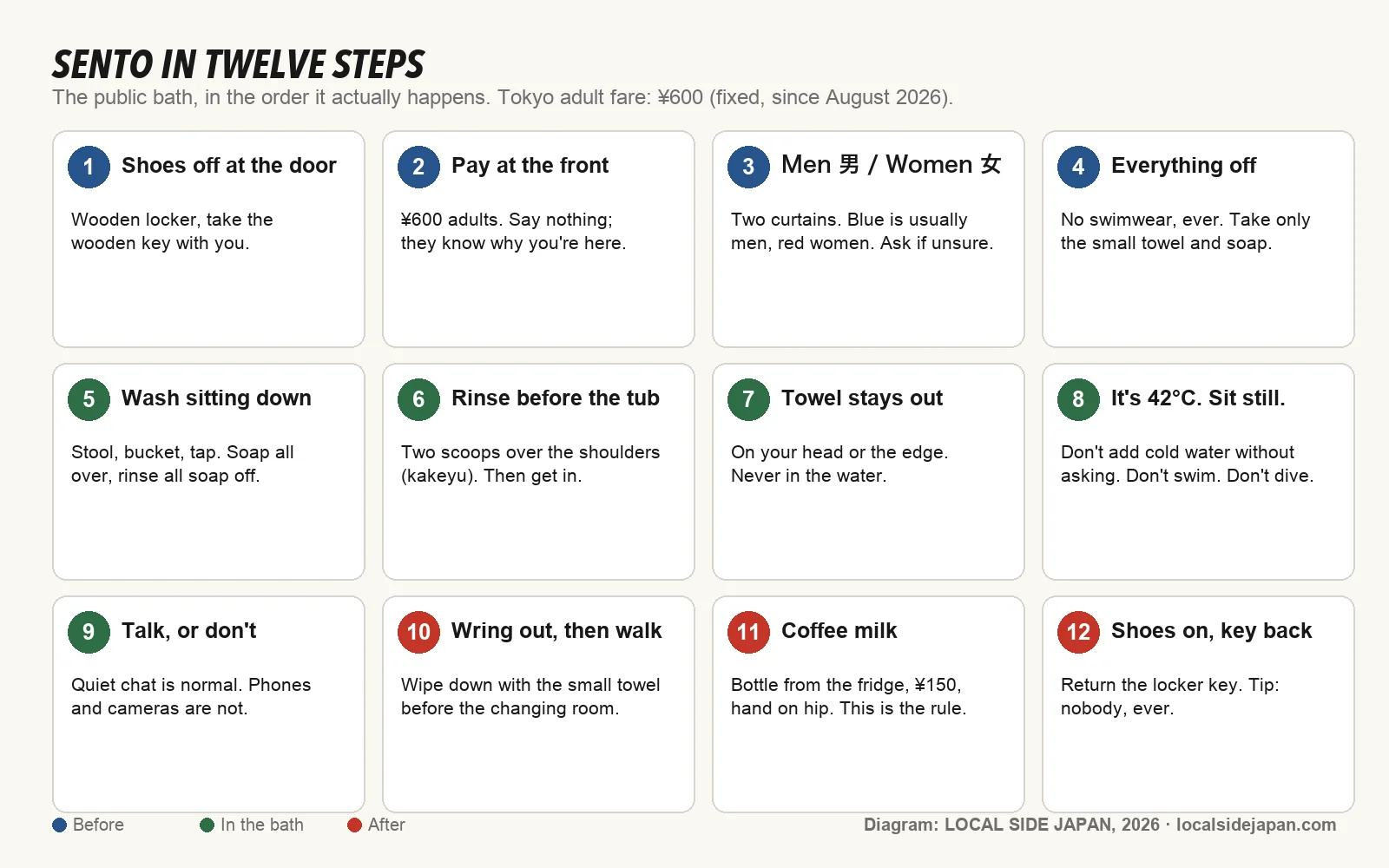
    Sento in twelve steps: a diagram of Japanese public bath etiquette from the shoe locker to the coffee milk
    The whole visit on one card. Save it to your phone.

    The written rules and the real rules

    On the signWhat it means in practice
    Wash before entering the bathThe one rule that is absolute. Soap, rinse, no suds left. Everyone is watching for this and only this.
    No tattoosAt most sento, unenforced or explicitly dropped; at large “super sento” and onsen resorts, enforced. Check the door, or the list of baths that say yes in writing.
    No towels in the bathReal. Fold the small towel on your head or leave it on the edge.
    Tie up long hairReal, and nobody has a hair tie to lend you. Bring one.
    No swimming, no divingReal, and aimed at children; adults do not need telling.
    Be quietNot real. Regulars talk. What is not done is shouting, phones, and conversation across the room.
    No photographyAbsolute, including the changing room and the lobby if anyone is in shot.
    Dry off before the changing roomReal. A wet floor in the changing room is the thing that annoys the owner most.
    No alcoholMeans do not arrive drunk. The beer fridge in the lobby is for afterwards.

    Step by step

    Before the water

    1. Shoes. Off at the entrance, into a small wooden locker; the wooden key on a string comes with you. This is where you will be if you lose it, so put it in the same place every time.
    2. Pay. Either at a front desk with a counter or, in old baths, at a bandai, a raised seat between the two changing rooms where one person, usually the owner’s mother, sees everything. In Tokyo the adult price is fixed by the metropolitan government at ¥600 (from August 1, 2026); children pay less. Say nothing. Hand over the coins. If you need a towel, say “taoru”, and a small one costs ¥100 to ¥200, a rental big one about the same. Many baths sell a ¥50 sachet of shampoo and body soap; many now provide them free at the taps.
    3. The curtain. Two: 男 (men) and 女 (women). The colors are usually blue and red but not always, so read the character. Some baths swap the two sides on alternate days; if in doubt, ask, and nobody will mind.
    4. The changing room. Lockers or open baskets. Everything off: there is no swimwear, no underwear, no cover-up, and the first ten seconds of that are the whole of the difficulty. After that nobody is looking, because nobody is. Take the small towel, your soap, and nothing else through the glass door.

    In the bath

    1. Wash first, sitting down. Take a plastic stool and bucket from the stack, sit at a tap with a shower head, and wash everything with soap, then rinse until no soap is left. Standing showers exist in newer baths and nobody minds if you use them. Do not stand at the tap and spray the person next to you. When you are done, rinse the stool and bucket and put them back where you found them, or leave them tidy at the tap if that is what the regulars do.
    2. Kakeyu. Before getting in, scoop bath water over your shoulders two or three times with the bucket. It rinses the last of the soap and warns your body about what is coming.
    3. The towel. Folded on your head, or on the edge of the tub. Never in the water. This is the second thing everyone watches for.
    4. The heat. Tokyo sento water is 42 to 44 degrees, hotter than anywhere else in Japan, and the old men in it will look at you pleasantly while you fail to get in. Go in slowly, sit still, get out after five minutes, and go back. Do not turn on the cold tap to cool the tub without asking: it is a communal bath and someone has just got it to the temperature they like. There is usually a cooler tub, a medicinal bath (the brown or green one), a jet bath, sometimes an electric bath that makes your legs twitch, and in the good ones a cold plunge and a sauna, which costs a few hundred yen extra and needs its own etiquette: sweat off before the plunge.
    5. Talking. Allowed. Regulars have been meeting in this tub for thirty years. A nod, a “konnichiwa”, a comment on the heat (“atsui desu ne”) will get you a conversation if you want one and a smile if you do not. What is not done: raised voices, groups talking across the room, and anything with a screen. Phones stay in the locker, cameras stay at home.

    After

    1. Wring out the small towel and wipe yourself down before you go through the door. The changing-room floor is meant to stay dry, and a foreigner dripping across it is the one thing that will get a word said.
    2. Coffee milk. In the lobby fridge: kohii gyunyu, coffee-flavored milk in a small glass bottle, about ¥150, drunk standing with one hand on your hip. Fruit milk is the alternative. This is not in any rule and it is the most important part.
    3. Key back, shoes on. Give the locker key back if the desk asks for it, collect your shoes, and leave. There is no tipping and there is nothing to say; “arigato gozaimashita” on the way out is enough and is more than most locals manage.

    The questions people actually have

    What if I have a tattoo? Read the door. A sign with a crossed-out tattoo means no. No sign, at a neighborhood sento, usually means nobody cares, and a growing number say so in writing; three on the east side are listed here with their policies quoted. Large bathing complexes and hot-spring resorts are the ones that enforce it. Covering a small tattoo with a waterproof plaster is accepted almost everywhere.

    Can I go with my partner? Not into the same bath. Sento are separated by sex at the curtain and there is no mixed bathing; the way couples do it is to go in at the same time and meet in the lobby afterwards. Private baths that can be rented by two people are rare in Tokyo and mostly in hotels; what exists on the east side is here.

    Can I take children? Yes, and it is the best way to do it. Small children go in with either parent; the age at which a child must use the bath of their own sex is set by the prefecture and in Tokyo is seven. They will be told off for swimming, gently, by strangers, and they will love it.

    Do I have to be naked? Yes. There is no version of this with a swimsuit. The good news is that the discomfort lasts about as long as it takes to walk from the locker to the door, after which you are one of a dozen naked people in a steamy room and the most invisible you will be in Japan.

    How long do people stay? Thirty to sixty minutes, in and out of the water. There is no time limit and nobody is waiting for your seat.

    Sento or onsen? A sento is a public bath with heated tap or well water, in the neighborhood, ¥600. An onsen is natural hot-spring water, and some Tokyo sento are onsen (the black water in Sumida and Koto is a real spring). The etiquette is the same; the price and the setting are not.

    Why the rules are the way they are

    Edo had public baths from the 1590s because it was a city of wooden houses that burned, and a fire in a private bath could take the district with it; the shogunate licensed the bathhouses and, for most of the period, forbade baths at home. So the sento was where everyone went, daily, samurai and shopkeepers in the same water, and the rules that came out of that (wash first, towel out, keep the floor dry, do not disturb the temperature) are the rules of sharing a scarce thing among strangers. The east side, rebuilt after 1923 and 1945 with tenements that still had no baths, kept the habit longer than anywhere: Sumida and Koto have more sento per square kilometer than any other part of Tokyo, and the ones that survive are the ones whose regulars kept coming. That is the room you are walking into. The rules are not a test. They are what keeps it open.

    Where this joins the rest of the east side

    Put it into practice at the tattoo-friendly baths of Sumida and Asakusa, or at Takara-yu’s garden in Kita-Senju. This is the second explainer in the How Japan Works series; the first is how pachinko is legal, which is the same story of a written rule and a real one.

    Quick answers

    What is the most important rule of sento etiquette?

    Wash thoroughly with soap, sitting at a tap, and rinse off all the soap before you get into the shared bath. Everything else is secondary. Second is keeping your towel out of the water.

    How much does a sento cost in Tokyo?

    ¥600 for adults, a fixed price set by the Tokyo Metropolitan Government from August 1, 2026, at every licensed sento in the city. Children pay less. Saunas cost a few hundred yen extra; towels and soap ¥50 to ¥200 if you need them.

    Can you talk in a sento?

    Yes. Quiet conversation is normal and regulars chat every day. Shouting, talking across the room and using a phone are not done. Photography is never allowed.

    Are tattoos allowed in sento?

    It depends on the bath. Many neighborhood sento do not enforce a ban and some state that tattoos are welcome; large bathing complexes and onsen resorts usually refuse them. Look for a sign at the door, or choose a bath that publishes its policy.

    Do you have to be naked in a Japanese sento?

    Yes. Swimwear is not allowed in any sento or onsen bath. Baths are separated by sex, and you take only a small towel into the bathing area, which stays out of the water.

    What is the difference between a sento and an onsen?

    A sento is a neighborhood public bath using heated tap or well water, ¥600 in Tokyo. An onsen uses natural hot-spring water and can be a sento, a resort or a hotel bath. The etiquette is identical.


    LOCAL SIDE JAPAN checked the Tokyo adult fare against the Tokyo Sento Association (¥600 from August 1, 2026) and the mixed-bathing age limit against the Tokyo Metropolitan Government’s public bath ordinance on September 20, 2026. The rest is what happens in the bath the writer has used for years. The diagram is original and may be reused with a link.

    Written by Kizuku. I run the Sunamachi Ginza Sumo Stable, a sumo experience in Koto City, and I write about the east side of Tokyo I live and work in. More about this site →

  • Tattoo-Friendly Sento on Tokyo’s East Side: Three Baths That Say So in Writing

    Tattoo-Friendly Sento on Tokyo’s East Side: Three Baths That Say So in Writing

    This article contains affiliate links to booking sites. If you book through them, LOCAL SIDE JAPAN earns a small commission at no extra cost to you. Every bathhouse listed here can be visited on your own for ¥600; the tours are optional. How this site is made →

    TOKYO / SUMIDA & TAITO / SENTO

    Most guides to “tattoo-friendly onsen in Tokyo” send you to a hotel spa in Shinjuku or a resort bath by the bay. That is the wrong answer to the wrong question. The right question is: where can a person with tattoos take a proper Japanese bath, in a neighborhood, for the price of a coffee? The answer is a sento, the public bathhouse, and the east side of Tokyo has the best ones in the city, several of which have written “tattoos welcome” on their own websites.

    Since August 1, 2026, the fixed adult price at every sento in Tokyo is ¥600. Children are ¥200. Here is how it works, and three baths east of the river that will not look twice at your arms.

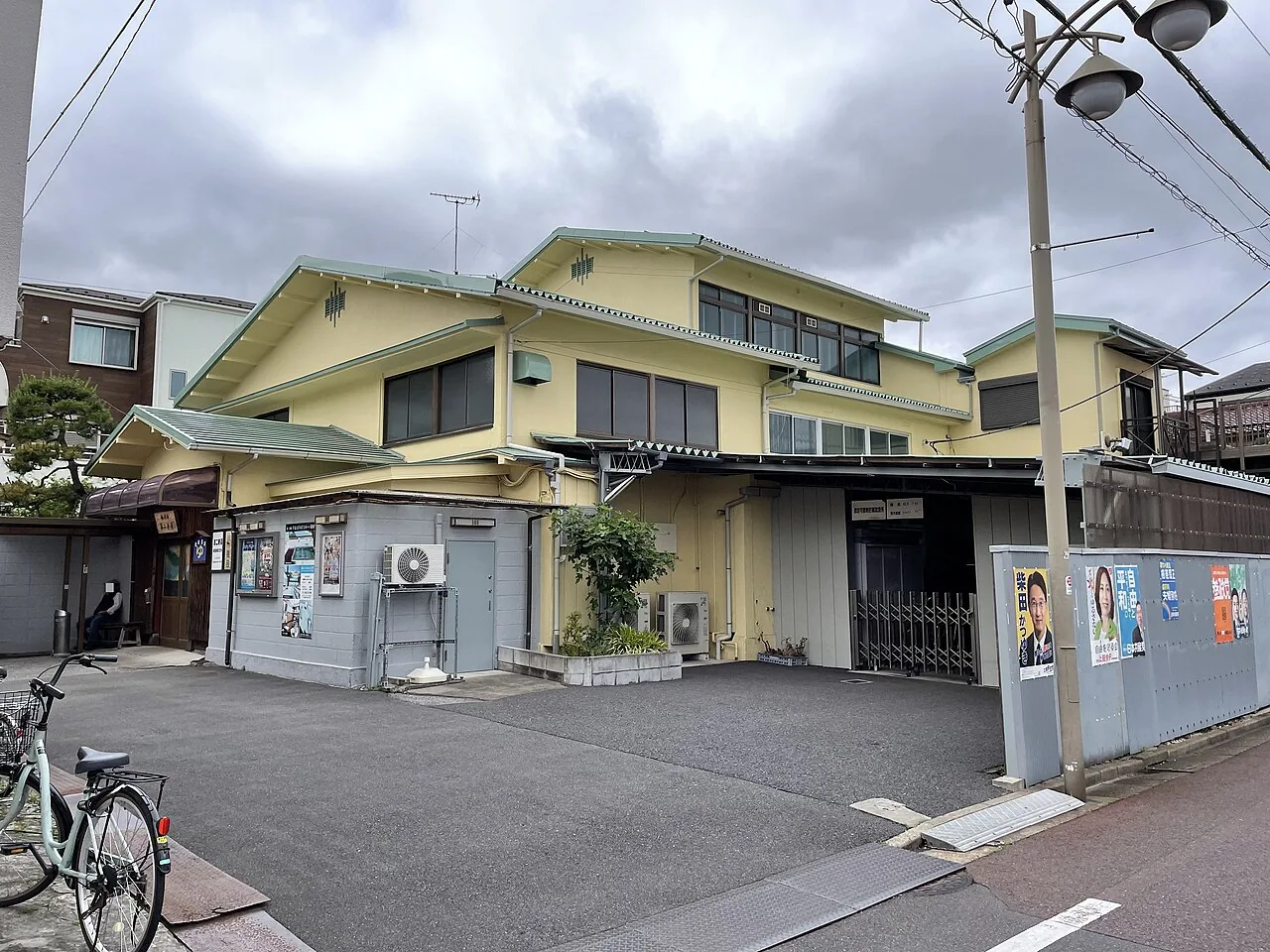
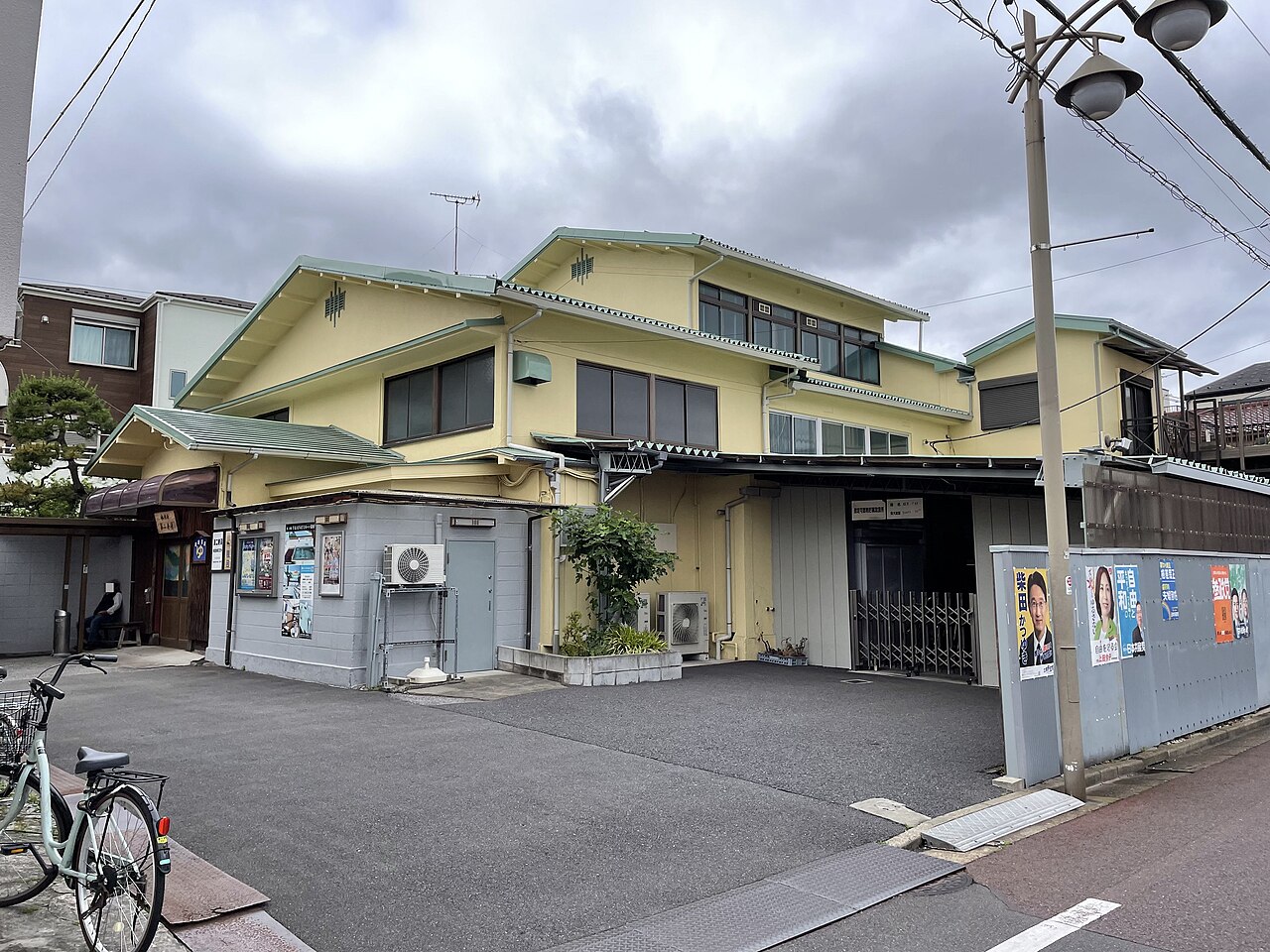
    The front of a neighborhood sento bathhouse in Edogawa, Tokyo
    A neighborhood sento on the east side. Photo: Higa4 / Wikimedia Commons, CC0.

    Sento, onsen, and why the tattoo rule is different

    An onsen is a bath fed by a natural hot spring; a sento is a bath fed by a boiler. The bathing is the same. The difference that matters to you is legal and cultural: sento are regulated as public hygiene facilities with a price fixed by the prefecture, and they grew up serving working neighborhoods where nobody had a bathtub at home. A tattoo in a sento in Sumida is a much smaller event than a tattoo in a resort onsen in Hakone. Many sento simply never had a rule. The ones below have gone further and said so in public.

    Three baths that say it on their own website

    Koganeyu (黄金湯), Kinshicho, Sumida

    A 1930s bathhouse rebuilt in 2020 by a couple who also run two other baths and a brewery, with a DJ booth and a beer tap at the front desk, a bathing hall behind, and one of the more serious saunas in east Tokyo behind that. Its FAQ answers the tattoo question in three words: you can bathe. Six minutes from the north exit of Kinshicho Station.

    • Hours: 6:00–9:00 and 11:00–24:30 every day. Closed the 2nd and 4th Monday. Wednesday is the swap day (men’s and women’s sides switch).
    • Price: ¥600 for 90 minutes. Sauna extra: women ¥350–400, men ¥550–600 for two hours (walk-in or web reservation; it fills on weekends). Towel set ¥200. Shampoo, soap and dryers free.
    • Pay: cash or PayPay for the bath; cards accepted at the bar.
    • Also: dormitory rooms upstairs if you want to sleep at a bathhouse, and their own craft beer after.

    Daikokuyu (大黒湯), Oshiage, Sumida

    Koganeyu’s older sister, founded 1949, six minutes from Oshiage Station and ten from the base of Skytree. A real hot-spring source (the water is mildly alkaline), a large rooftop outdoor bath from which you can see the tower, a painted Fuji on the wall, and the first sento in the 23 wards to run all night. If you land late and want a bath before a bed, this is the one.

    • Hours: weekdays 15:00 to 10:00 the next morning; Saturday from 14:00; Sunday and holidays from 13:00. Closed Tuesday (open if Tuesday is a holiday, then closed Wednesday).
    • Price: ¥600; sauna and late-night surcharges apply, check the board.
    • Tattoos: same owners, same policy as Koganeyu; widely and repeatedly confirmed by visitors with visible work.

    Kotobuki-yu (寿湯), Higashi-Ueno, Taito

    The old-school option. A temple-roofed miya-zukuri bathhouse two minutes from Inaricho Station on the Ginza Line, one stop from Ueno, with what it claims is the largest outdoor bath of any sento in Tokyo on the men’s side, an electric bath (a mild current through the water; try it once), and a different themed bath almost every day of the month. No design studio touched it. Tattooed regulars have been bathing here for years and the staff do not react.

    • Where: 5-4-17 Higashi-Ueno, Taito. Inaricho Station, 2 minutes.
    • Price: ¥600. Check the monthly holiday calendar on the door or the website before you go; the rest day moves.

    How to not embarrass yourself (it is easy)

    1. Shoes go in the locker at the entrance. Take the wooden key.
    2. Pay at the front desk (¥600, cash is safest). Say “sauna” if you want it. Buy or bring a small towel; you carry it in, you do not put it in the bath.
    3. Undress completely in the changing room. Everything in the locker. There is no swimwear in a sento, ever.
    4. Sit at a tap, wash your whole body with soap, rinse. Then get in. This is the one rule everyone will notice if you skip it.
    5. Hair up or out of the water. Voices low. No phones past the changing room, no photos anywhere inside.
    6. Wring your towel out and pat yourself down before walking back into the changing room, so you do not drip on the mats.
    7. Drink something cold on the way out. That is the entire point.

    If you want someone to walk you in

    You do not need a tour for any of the above. But the first time in a sento, with the shoe locker and the ticket machine and the etiquette, is the one that stops people going at all, and a guided first visit fixes that permanently. Two that are honest about being for tattooed guests:

    After one guided visit, you will never need another. Go to Koganeyu on your own the next night.

    Make it an evening

    Koganeyu and Daikokuyu are fifteen minutes’ walk apart, either side of the Edo Kiriko museum in Kinshicho. Cut a glass in the afternoon, bathe at six, drink the house beer at Koganeyu, and if you are still awake, Daikokuyu’s rooftop bath is open until ten the next morning. That is a Sumida day nobody sells as a package, and it costs about ¥6,000 including the glass.

    Tattoo-friendly baths near Asakusa

    Two more, for people staying in Asakusa who do not want to cross the river. Both are listed as tattoo-friendly on the Japanese bath directories; neither prints a policy on its own site, so if you are heavily inked, a polite question at the counter costs nothing.

    • Hinode-yu, Moto-Asakusa: a natural hot-spring sento on the ground floor of an apartment block, three minutes from Inaricho Station on the Ginza line and fifteen on foot from Senso-ji. Ancient-cypress tub, steam sauna, a ¥100 carbonated shower, and a small café at the front desk. 14:00 to 22:40, closed Wednesdays. ¥600.
    • Mikokuyu, Ishihara (Sumida): the best bath within walking distance of Asakusa, eight minutes over the Kuramae bridge. Five floors of black natural hot spring with a rooftop open-air bath that looks straight at the Skytree, a different medicinal bath each day, and a reputation for being easy for foreigners and for tattoos. 15:30 to 2:00, closed Mondays (Tuesday if Monday is a holiday). ¥600.

    Private baths, and bathing as a couple

    Every sento on this page is separated by sex at the changing-room door; there is no mixed bathing and no swimwear. If you want to bathe together, you need a private bath, and on the east side the honest answer is that there are very few. Mikokuyu has one, a “welfare-type family bath” with rails and a lift, ¥1,500 per person for 90 minutes, reservation required, and it is meant for people who need help bathing and their carers; do not book it as a date. Daikokuyu’s rooftop has a small open-air tub for one that is not bookable. Beyond that, a private bath in this part of Tokyo means a hotel room with one, or the private sauna rooms that have opened around Sumida and Ginza at ¥5,000 to ¥30,000 an hour, which allow tattoos because nobody else is there. For a couple with tattoos, the practical plan is: go to the same sento at the same time, meet in the lobby afterwards with a bottle of milk, and walk to Mikokuyu’s rooftop on a different night for the view. If you would rather someone else had the conversation at the counter, there is now a guided tattoo-friendly bathhouse and ramen evening that meets at Kinshicho and ends at Daikokuyu, listed in the ramen classes and tours comparison — about ¥9,000 for what you can do yourself for ¥1,500.

    Quick answers

    Are there tattoo-friendly bathhouses in Tokyo?

    Yes. On the east side, Koganeyu in Kinshicho states on its own website that guests with tattoos may bathe; its sister bath Daikokuyu in Oshiage has the same owners and policy; Kotobuki-yu in Higashi-Ueno has long admitted tattooed bathers. All are sento, the public bathhouses, and cost ¥600.

    How much does a sento in Tokyo cost?

    Since August 1, 2026 the fixed adult price at every sento in Tokyo is ¥600. Children aged 6 to 11 pay ¥200 and under-6s ¥100. Saunas are extra, typically ¥350 to ¥600.

    What are Koganeyu’s opening hours?

    Koganeyu (Taihei 4-14-6, Sumida City, six minutes from Kinshicho Station north exit) is open 6:00–9:00 and 11:00–24:30 every day, closed on the second and fourth Monday. Entry is ¥600 for 90 minutes; sauna is ¥350–600 extra.

    What is the etiquette at a Japanese sento?

    Shoes in the entrance locker, pay at the front desk, undress completely (no swimwear), wash thoroughly at a tap before entering any bath, keep your towel and hair out of the water, no phones or photos inside, and dry off before returning to the changing room.

    Further north, Takara-yu in Kita-Senju has the best bathhouse garden in Tokyo; it does not publish a tattoo policy, so it is not on this list, but it is worth knowing about.


    Practical notes

    • Price: ¥600 adults, ¥200 children (6–11), ¥100 under 6, fixed across Tokyo since August 1, 2026. Sauna is extra.
    • Bring: a small towel (or buy one for ¥200–300), coins, nothing else. Soap and shampoo are usually provided at the baths above; at older sento, bring your own.
    • Tattoos: Koganeyu states it in writing; Daikokuyu is the same owners; Kotobuki-yu is long established as tattoo-tolerant. Elsewhere, look for a sign at the door; no sign usually means no rule.
    • Do not: wear swimwear, get in without washing, put your towel in the water, take a phone into the bathing hall, or bathe drunk (Koganeyu will turn you away).

    LOCAL SIDE JAPAN checked prices, hours and tattoo policies against the bathhouses’ own websites (Koganeyu, Daikokuyu, Kotobuki-yu) and the Tokyo Metropolitan Government’s August 2026 price notice on September 14, 2026. Rest days and sauna surcharges change monthly; check the door.

    Written by Kizuku. I run the Sunamachi Ginza Sumo Stable, a sumo experience in Koto City, and I write about the east side of Tokyo I live and work in. More about this site →

    If the etiquette section above still feels like an exam, the long version, with the rules on the wall set against the rules people actually follow, is Sento Etiquette: The Written Rules, the Real Rules.