This article contains one affiliate link to a booking site. If you book through it, LOCAL SIDE JAPAN earns a small commission at no extra cost to you. The museum itself is ¥400 and needs no booking. How this site is made →
TOKYO / KOTO CITY / FUKAGAWA
The Fukagawa Edo Museum is a hangar with a town inside it. Walk through the lobby, down a staircase, and you are standing in a street of 1840s Fukagawa, at full size, with the roofs a few meters below the ceiling and a cat on one of them: a rice shop, a greengrocer, a boat landing with a boat in it, a fire tower, and a row of one-room tenements you can go into and sit on the floor of, each one furnished for the person who lived there. The lights dim to evening, a rooster crows, a vendor’s call comes from somewhere, and it is morning again. Tickets are ¥400, it is three minutes from Kiyosumi-Shirakawa Station, and it is the single best thing on Tokyo’s east side for anyone under twelve or over sixty. Everything below was checked on September 20, 2026.
Fast facts
- Price: ¥400 adults, ¥50 school students. Cash only
- Hours: 9:30–17:00, last entry 16:30
- Closed: 2nd and 4th Monday of the month, and New Year
- Address: 1-3-28 Shirakawa, Koto City, Tokyo
- Nearest station: Kiyosumi-Shirakawa, exit A3, 3 minutes
- Time needed: 1 hour, 90 minutes with the free volunteer guide
- Booking: none. Cash at the counter, same day only
- Guides: free volunteer guides at the door, some with good English
On this page
- How much are Fukagawa Edo Museum tickets, and when is it open?
- What is inside the Fukagawa Edo Museum?
- Is the Fukagawa Edo Museum worth it?
- Fukagawa Edo Museum or the Edo-Tokyo Museum?
- How do you get to the Fukagawa Edo Museum?
- What else is near the Fukagawa Edo Museum?
- Do you need a guide at the Fukagawa Edo Museum?
- Where does this fit on Tokyo’s east side?
- Quick answers
How much are Fukagawa Edo Museum tickets, and when is it open?
- Admission: ¥400 for adults; ¥50 for elementary, junior-high and high-school students; ¥300 and ¥30 for groups of twenty or more; ¥200 and ¥20 with a disability certificate. Tickets are sold at the counter, valid that day only; bring cash. No advance booking exists or is needed.
- Hours: 9:30 to 17:00, last entry 16:30.
- Closed: the second and fourth Monday of each month (open if that Monday is a public holiday), and the New Year holiday. Not closed every Monday, unlike most Tokyo museums.
- Joint ticket: a combined ticket covers this museum and Koto City’s two other history museums, the Basho Memorial Museum by the Sumida and the Nakagawa Funabansho Museum by the Arakawa. Ask at the counter; it is worth it only if you will do all three, which is a full day.
- Address and access: 1-3-28 Shirakawa, Koto City. Kiyosumi-Shirakawa Station (Hanzomon and Oedo lines), exit A3, three minutes, past the wall of Kiyosumi Garden. Monzen-Nakacho Station is fifteen minutes on foot.
- Time needed: an hour is enough; ninety minutes if you take the volunteer guide.
What is inside the Fukagawa Edo Museum?
The permanent exhibit is one large room and one idea: a block of Saga-cho, the riverside district of Fukagawa, as it stood in the Tenpo era at the end of the 1830s, rebuilt at full scale from records and from the buildings that survived into the twentieth century. There is a street with a rice wholesaler and a vegetable shop, a canal-side landing with a boathouse and a choki-bune, the narrow fast boat that took customers to the pleasure quarters, a fire lookout tower, a shrine, a public toilet, and behind them the nagaya, the wooden tenement rows where most of Edo actually lived, in single rooms of four and a half or six tatami mats.
The rooms are the reason to come. Each tenement is furnished as a specific person’s home: a clam seller with his baskets, a woodblock carver with his tools, a widow who teaches the shamisen, a young clerk with almost nothing. You take your shoes off and go in, open the cupboards, lift the lids of the pots, sit at the low desk. Nothing is behind glass. The museum’s volunteer guides, retired locals, some with good English, will walk with you and tell you whose room it is and what they ate; accept the offer, it is free and it turns the set into a neighborhood.
Overhead the lighting runs through a whole day in well under an hour, dawn to noon to a lantern-lit evening and a thunderstorm, with the sounds to match, so stay long enough to see the street change. On the entrance floor there is a smaller gallery on the history of the district, the canals and the lumber trade, and the Fukagawa festival’s portable shrines. Since April 2026 the museum has been staging regular rakugo and storytelling performances inside the reconstructed town, in Japanese; the schedule is on its site, and even without the language, a storyteller kneeling on a stage in an Edo street at dusk is worth timing a visit for.
Is the Fukagawa Edo Museum worth it?
For ¥400, yes, and the price is not really the question. The question is the hour. This is one room. You will have seen the whole street in fifteen minutes and the exhibit does not get bigger after that, so if you measure a museum by how much of it is left to walk, you will think you have been short-changed and leave.
What you are paying for is the second half of the hour, when you stop reading and start opening things. Sit on the floor of the clam seller’s room, look at how little is in it, work out where he slept and where the baskets went, and wait for the lights to go to evening. People who do that come out saying it was the best ¥400 they spent in Tokyo. People who walk the street once and look for the next gallery come out puzzled. It is the same museum.
Skip it if you only want Edo in the abstract, with timelines and big models — that is the Edo-Tokyo Museum, and it costs ¥800. Skip it if you are travelling with nobody under twelve and have exactly one morning in east Tokyo. Take it if you have children, if you are over sixty, if you are already in Kiyosumi-Shirakawa for the garden, or if you have ever wondered what the inside of an ordinary Edo house looked like and found that no book shows you.
Fukagawa Edo Museum or the Edo-Tokyo Museum?
Cost is the smallest difference between them: ¥400 here, ¥800 there. The big Edo-Tokyo Museum in Ryogoku, which reopened on March 31, 2026 after four years closed and raised its adult ticket from ¥600 to ¥800 that day, is the museum of the whole city: the Nihonbashi bridge, the daimyo mansions, the kabuki theater, Meiji and the war and the Olympics, with English throughout and half a day needed; it opens 9:30 to 17:30, to 19:30 on Saturdays, and closes on Mondays rather than on two of them. Seniors 65 and over pay ¥400, university students ¥480, high-school students ¥300, and junior high and under go free. Fukagawa is the museum of one street and the people who could not afford a house on it, and you are in it rather than looking at it. If you have one museum morning in east Tokyo, take the big one; if you have children, take this one; if you are already in Kiyosumi-Shirakawa for the garden and the coffee, this one is three minutes away and the choice makes itself.
How do you get to the Fukagawa Edo Museum?
Kiyosumi-Shirakawa Station, exit A3, then three minutes on foot with the wall of Kiyosumi Garden on your left. The station is on two lines, which is why the museum is easier to reach than its address suggests.
- From Tokyo Station: walk to Otemachi and take the Hanzomon line four stops. About fifteen minutes door to door.
- From Ryogoku: two stops on the Oedo line, via Morishita. This is the one to know if you are doing the Edo-Tokyo Museum and this on the same day.
- From Shibuya: the Hanzomon line runs straight through, no change.
- On foot: fifteen minutes from Monzen-Nakacho, which is the walk to do if you are also going to Fukagawa Fudo-do.
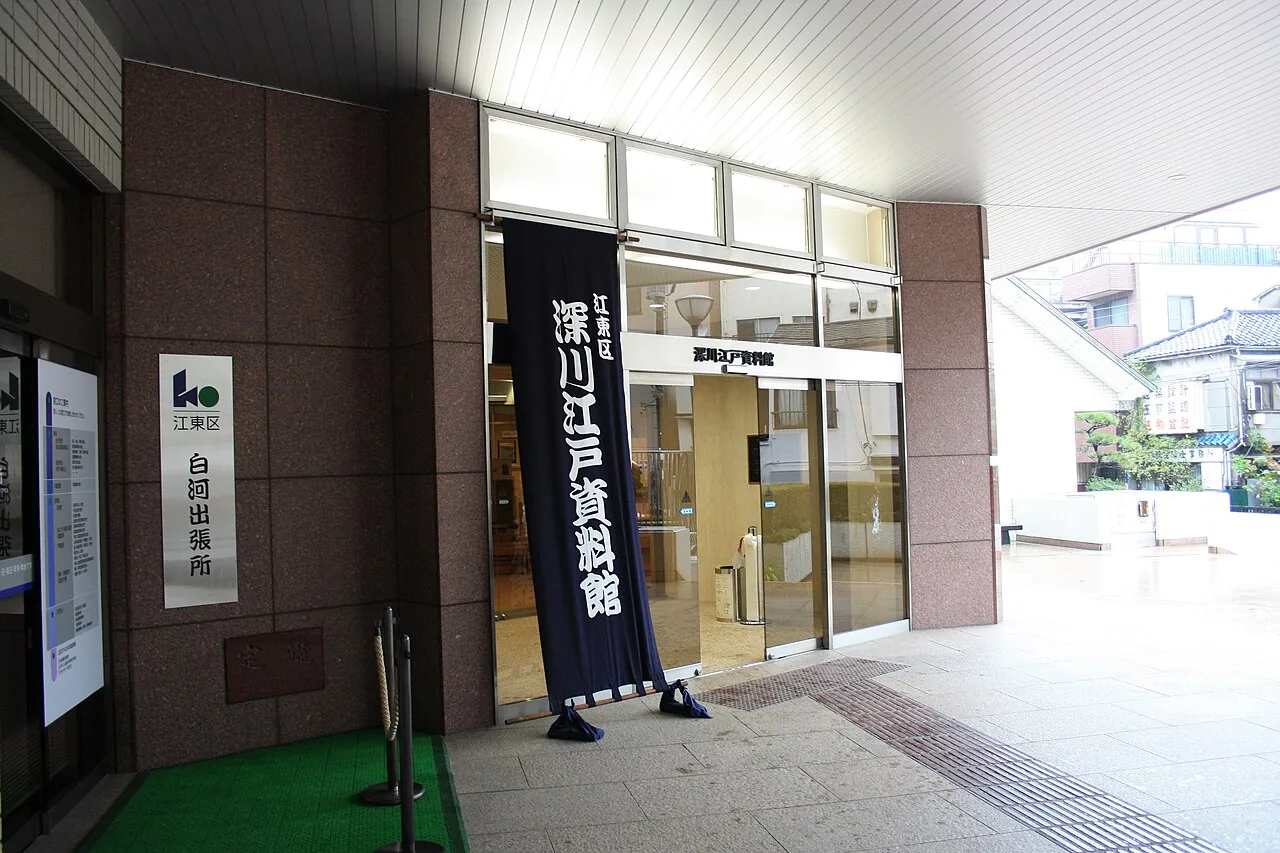
There is no museum car park worth using and no need for one. The building is the low grey one with an indigo noren at the door, set back from Kiyosumi-dori; the sign at street level is small and in Japanese, so look for the banner rather than the name.
What else is near the Fukagawa Edo Museum?
- Kiyosumi Garden, ¥150, across the road: the stroll garden the founder of Mitsubishi built in the 1880s. Do it first, at 9:00, before the museum opens. The full Kiyosumi-Shirakawa morning →
- Fukagawa-meshi: the district’s dish, clams in miso over rice, at the restaurants around the museum for ¥1,000 to ¥1,500. Fukagawa Kamasho, a minute away, is the well-known one.
- Fukagawa Fudo-do, fifteen minutes south: the free fire ritual with taiko drums at 9:00, 11:00, 13:00, 15:00 and 17:00. The 13:00 one fits after lunch.
- Basho Memorial Museum, ¥200, twenty minutes’ walk north-west by the river, where the poet lived in the 1680s before setting off from Senju; the second museum on the joint ticket.
- If you want to make something after looking at it: when we went through every listing in the city, Koto had no kintsugi workshop and no tea ceremony — the whole east side has neither. The nearest tea ceremony is in Kuramae, three stops up the Oedo line, which is also where the best one in Tokyo is; for kintsugi the nearest is Asakusa, which is where the cheapest and the most-reviewed ones are. Both are a short enough hop to do in the same afternoon as this. Tea ceremonies by area → / Kintsugi workshops by area, with the prices →
- The Fukagawa Hachiman Festival, mid-August, when the portable shrines the museum shows come out and the crowd throws water over them; the full version every third year, next in 2029.
Do you need a guide at the Fukagawa Edo Museum?
Without, for almost everyone: the museum’s own volunteers are the best guides it could have and they are free. The one packaged tour that includes it is a three-hour Kiyosumi-Shirakawa morning on Viator (about ¥10,000, garden and coffee included) that is really about the neighborhood, with the museum as an option; good on your first days in Japan if you want the area explained, unnecessary otherwise.
Where does this fit on Tokyo’s east side?
The museum is stop three on the twelve things to do in Koto City, and the boat landing inside it is the small version of the real one at the Nakagawa checkpoint down the Onagi River. The tenements it rebuilds are what burned in 1923 and 1945 and what the Shirahige-Higashi firewall was built to protect the survivors of. For the city-scale version, the Edo-Tokyo Museum in Ryogoku is two stops away.
Quick answers
How much are Fukagawa Edo Museum tickets?
¥400 for adults and ¥50 for elementary to high-school students, bought at the counter on the day; no advance booking. Groups of 20 or more pay ¥300 and ¥30. A joint ticket with the Basho Memorial Museum and the Nakagawa Funabansho Museum is available at the counter.
What are the Fukagawa Edo Museum’s opening hours?
9:30 to 17:00, last entry 16:30. Closed on the second and fourth Monday of the month (open when that Monday is a public holiday) and over the New Year holiday.
How do I get to the Fukagawa Edo Museum?
Kiyosumi-Shirakawa Station on the Hanzomon or Oedo subway line, exit A3, then three minutes on foot past Kiyosumi Garden. The address is 1-3-28 Shirakawa, Koto City. From Tokyo Station it is about 15 minutes via Otemachi.
Is the Fukagawa Edo Museum good for children?
Yes, the best museum on Tokyo’s east side for them: a full-size 1840s street with houses you can enter, cupboards you can open and a day-to-night lighting cycle with sound. Children’s tickets are ¥50. Allow an hour.
Fukagawa Edo Museum or Edo-Tokyo Museum?
The Edo-Tokyo Museum in Ryogoku (reopened March 31, 2026) costs ¥800 and covers the whole city’s history over half a day with full English; the Fukagawa Edo Museum costs ¥400 and is one rebuilt street you walk through in an hour. Take the big one for history, this one for children or if you are already in Kiyosumi-Shirakawa.
LOCAL SIDE JAPAN checked admission, hours and closing days against the Koto City Cultural Community Foundation’s museum pages and Koto City’s tourism page on September 20, 2026, and the tour price on Viator the same day. Fukagawa Kamasho and the other restaurants are mentioned as landmarks, not reviewed.