This article contains affiliate links to booking sites. If you book through them, LOCAL SIDE JAPAN earns a small commission at no extra cost to you. The workshops are ranked by what you get for the money, not by what pays; the cheapest one is also the best reviewed. How this site is made →
TOKYO / EXPERIENCES / KINTSUGI, BY AREA
Kintsugi, the repair of broken pottery with lacquer and gold, has become the workshop everyone in Tokyo wants to book, and there are now a dozen places to do it, from a ¥1,500 hour above a whisky shop in Kabukicho to a ¥23,000 afternoon with a master in Aoyama. They are not the same thing. Real kintsugi takes months, because natural lacquer cures slowly; every workshop that sends you home the same day with a finished piece is using a fast version, and the price mostly buys the setting, the group size and how honest the teacher is about that. Here are the workshops in Tokyo by area, what each actually does, and which to book depending on what you want out of the hour. Prices and reviews were read on the booking sites on September 21, 2026.
Fast facts
- Cheapest: ¥1,500, Kabukicho, Shinjuku — one hour
- Most reviewed: Asakusa, 4.9 from over 1,200 reviews, from ¥2,400
- Real urushi and real gold: Minami-Aoyama, ¥9,900 for an hour or ¥23,000 for two with the master
- Dearest: ¥27,800, Dogenzaka, Shibuya — two hours, with matcha
- Duration: one to two hours. You take the piece home the same day
- On the east side: none. The nearest to Sumida and Koto is Asakusa
- Booking: in advance. These are studios of six to twelve people, not drop-in shops
On this page
- What is kintsugi?
- Is a one-hour kintsugi workshop real kintsugi?
- How much does a kintsugi workshop cost in Tokyo?
- Which kintsugi workshop is nearest to me?
- Where can I do a kintsugi workshop in Tokyo?
- Which kintsugi workshop in Tokyo is best?
- Can you eat off a kintsugi plate you made in a workshop?
- Questions worth asking before you book
- What the reviews say, and what they mean
- Where this joins the rest of the east side
- Quick answers
What is kintsugi?
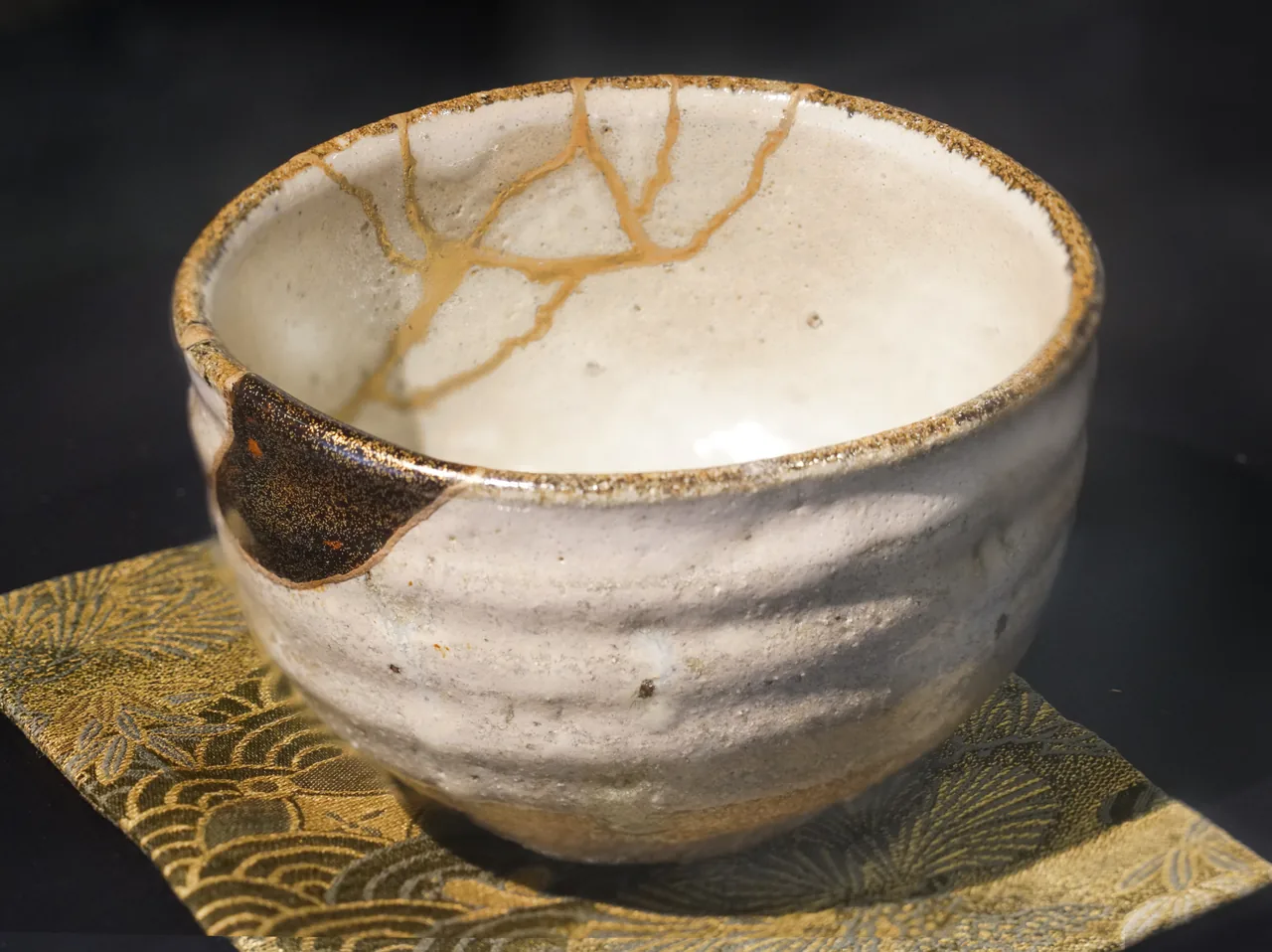
Kintsugi is the Japanese craft of repairing broken pottery with lacquer and gold, so that the break is highlighted rather than hidden. The name means “golden joinery”. Traditionally the pieces are glued, filled and built up with urushi, the sap of the lacquer tree, each layer curing for days in a humid box, and gold powder is dusted onto the final wet layer. A full traditional repair takes six weeks to three months.
The idea behind it is the reason people want to do it: a repaired bowl is not a damaged bowl, it is a bowl with a history, and the repair is made the most visible thing about it.
Is a one-hour kintsugi workshop real kintsugi?
Traditional kintsugi uses urushi, the sap of the lacquer tree, to glue the pieces, fill the gaps and build the seam, with each layer curing for days in a humid box before the next; the gold powder goes on last, onto wet lacquer, and the whole repair takes six weeks to three months. Nobody can do that in an hour. What the workshops do is kan’i kintsugi, “simplified kintsugi”: the pieces are joined with a fast-curing adhesive or a synthetic lacquer, the seam is painted, and brass or gold powder is dusted on. It looks the same across a table, it is food-safe or not depending on the materials (ask), and it teaches you the hand movements and the idea. A few workshops use real urushi for one stage and real gold for the finish, and charge accordingly. None of this makes the cheap ones a con; it makes them an introduction, which is what most people want. The honest question is whether the teacher tells you. The good ones do, unprompted.
How much does a kintsugi workshop cost in Tokyo?
- ¥1,500–¥2,400 — one hour, simplified method, a small provided plate. Shinjuku and Asakusa. Budget another ¥2,000–¥5,000 if you want a piece worth keeping.
- ¥4,900–¥6,600 — an hour making a gold-seamed pendant or earrings instead of a plate. The better souvenir if you would never use a repaired dish.
- ¥9,900–¥12,000 — one to one and a half hours in a studio or a café, Aoyama or Ginza. Still the simplified method.
- ¥18,000–¥23,000 — two hours, small groups, tea or sake included, and in the Aoyama case the master teaching with pure gold on the finish. This is as close to the real craft as a single afternoon gets.
For comparison, a Japanese-language studio charges about ¥8,800 for the same simplified method over two to two and a half hours — and lets you bring your own broken piece. The full price comparison is below. Real urushi is not sold as a workshop at any price: Japanese studios teach it as a course of four or five sessions over months, because each lacquer layer has to cure.
Which kintsugi workshop is nearest to me?
Ten studios, and they are not spread evenly: six of the ten sit in a line from Shibuya through Aoyama to Shirokanedai, and the whole east half of the city has none. Addresses below are the operators’ own meeting points, checked on October 11, 2026.
| Area | Studio and address | From | Time |
|---|---|---|---|
| Asakusa | ZEN Craft Studio, Tosei Building 10F, 1-27-2 Asakusa, Taito City | ¥2,400 | 1 h |
| Asakusa | Tsugutsugu Asakusa, 1-1-2 Kaminarimon, Taito City — ground floor on Asakusa-dori, a short walk from Tawaramachi or Asakusa Station | ¥6,600 | 1 h |
| Shinjuku | Chopsticks Studio, 1-5-4 Kabukicho, 8F (liquor shop on the ground floor, take the lift) | ¥1,500 | 1 h |
| Shibuya | mon cadeau, Nishinaya Building 4F, 1-18-8 Dogenzaka — up Dogenzaka from Shibuya | ¥22,000 | 2 h |
| Shibuya | Zoniya Torii, B1, 2-8 Uguisudanicho (accessory version) | ¥4,900 | 1 h |
| Aoyama | TNCA Minami-Aoyama Studio, 3-8-2 Minamiaoyama, Minato City — basement of the OG building | ¥9,900 | 1 h |
| Aoyama | Same studio, with Master Taku and pure gold | ¥23,000 | 2 h |
| Ginza | Cafe AOU Ginza Forest, Daiwa Ginza Building ground floor, 6-2 Ginza, Chuo City | ¥12,000 | 1 h 30 |
| Shirokanedai | Sunview Heights 104, 5-4-3 Shirokanedai, Minato City — about 10 minutes on foot from Shirokanedai Station | ¥18,000 | 2 h |
| Ebisu | Tsugutsugu Ebisu, 2-21-2 Ebisu, Shibuya City — just off Meiji-dori, across the river (accessory version) | ¥6,600 | 1 h |
If you are staying in Asakusa, Ueno, Sumida or Koto, Asakusa is your answer and the only one that is not a train ride. If you are on the Yamanote west side, Shibuya, Aoyama, Shirokanedai and Ebisu are within a few stops of each other and the decision is about price and whether you want real gold, not distance. Kabukicho is the cheapest in the city by a wide margin and the one to take if the price is what is stopping you.
Where can I do a kintsugi workshop in Tokyo?
Asakusa: the cheapest and the most reviewed
Traditional Kintsugi Workshop in Asakusa, at ZEN Craft Studio on the tenth floor of a building a few minutes from Senso-ji: one hour, about ¥2,400, bilingual staff, 4.9 from 1,214 reviews, which makes it the most-booked kintsugi workshop in Japan. It is a simplified-kintsugi class in a busy studio that also runs the chopstick and calligraphy hours, and it is the right first one on price. Two things its reviewers say that the listing does not: the piece included is one of two small mass-produced dishes that the studio has broken in advance, and a larger one is a ¥5,000 upgrade; and much of the hour goes on filing the crack wider before you fill it, which staff confirmed to one guest is not how it is traditionally done. Both are set out below. If you are doing Asakusa anyway, this is the pick, and it is why kintsugi is also in the Asakusa workshops ranking. The same operator runs a ¥3,000 version; the difference is the piece. For children, a kid-friendly accessory version makes a gold-seamed pendant instead of a plate, about ¥6,600.
Shinjuku (Kabukicho): the cheapest in the city
Japanese Gold Repair Kintsugi Workshop in Shinjuku: one hour, about ¥1,500, on the eighth floor above a whisky shop in Kabukicho, from the operator that runs the ¥1,000 chopstick classes. A premium plate is ¥2,000 extra. 5.0 from a small number of reviews; the same simplified method as Asakusa, in a less atmospheric room, for less money. Right if you are staying in Shinjuku and want the hour without the trip east.
Shibuya: the relaxing one, and the accessory one
Kintsugi and Matcha at mon cadeau, Shibuya: two hours, about ¥22,000, a maximum of six people in a small studio up Dogenzaka, with matcha and a sweet during the lacquer’s setting time and a choice of your own piece from the shelf. 5.0 from over a hundred reviews. This is the one people describe as the calmest two hours of their trip, and it is priced like it; the technique is still simplified kintsugi, so you are paying for the room, the tea and the attention. There is a version with sake tasting at about ¥27,800. For something cheaper in the same area, the Kintsugi Accessory Workshop in Shibuya makes a pendant or earrings with gold seams in an hour for about ¥4,900, 5.0 from 110 reviews, and is the better souvenir if you would never use a repaired plate.
Aoyama: the master, and the real gold
Two workshops at the same studio in Minami-Aoyama, in the basement of a building near Omotesando. Authentic Kintsugi Workshop in Tokyo: one hour, about ¥9,900, you put on a samue work jacket, repair a provided plate, and there is “a chance” the master, Taku, is in that day — but the studio has stated in public that the owner teaches only its advanced workshops and that this one is “an introductory class guided by trained staff”; 4.9 from 501 reviews. It also allows no date changes and no refunds, with no exceptions, which the studio confirms in writing. Read this one’s reviews before booking. Pure Gold Kintsugi Workshop with Master Taku: two hours, about ¥23,000, the same studio with the master teaching and pure gold powder on the finish, 5.0 from over 200 reviews. Between the two, the expensive one is the one to take if you want the closest thing to the real craft you can get in an afternoon; the cheap one is the Asakusa hour at four times the price with a nicer address. Personal pieces are not accepted at either.
Ginza: in a café, on the way to somewhere
Discover the Art of Kintsugi in Ginza: ninety minutes, about ¥12,000, held at a café on the ground floor of a Ginza office building, private groups, 5.0 from about 40 reviews. The listing itself notes that authentic kintsugi takes weeks and that this is the simplified method, which is the right kind of honesty. It is the workshop for people whose day is in Ginza and who want it between a department store and dinner.
Shirokanedai and Ebisu: quiet, residential, new
Kintsugi Experience in Shirokanedai: two hours in a private studio in a residential building ten minutes from Shirokanedai Station, about ¥18,000, Japanese tea and snacks, a chopstick rest as a second piece. New, so few reviews. It reads as a quieter, more personal version of the Shibuya format at a lower price, in a neighborhood no visitor otherwise sees, and it is the one I would watch. In Ebisu, the accessory operator runs the same 60-minute kintsugi-style accessory workshop as in Asakusa, about ¥6,600.
The east side: none yet, and the reason
There is no bookable kintsugi workshop in Sumida, Koto or the wards north of them; Asakusa, across the river, is the closest. The craft the east side does have, and does better than anywhere, is glass: the Edo Kiriko cutting workshop in Kinshicho is ¥4,400 booked direct, and it is a real technique done in real time rather than a simplified one, which is worth knowing when you are choosing where an afternoon goes.
Which kintsugi workshop in Tokyo is best?
| If you want | Book | Area | About |
|---|---|---|---|
| The best value, full stop | Traditional Kintsugi Workshop (ZEN Craft) | Asakusa | ¥2,400 · 1 h · 4.9 (1,214) |
| The cheapest hour | Gold Repair Kintsugi Workshop | Shinjuku | ¥1,500 · 1 h · 5.0 (18) |
| The calmest two hours | Kintsugi & Matcha at mon cadeau | Shibuya | ¥22,000 · 2 h · max 6 · 5.0 (113) |
| Closest to the real craft | Pure Gold Kintsugi with Master Taku | Aoyama | ¥23,000 · 2 h · 5.0 (227) |
| A wearable souvenir | Kintsugi Accessory Workshop | Shibuya | ¥4,900 · 1 h · 5.0 (116) |
| With children | Kintsugi-Style Accessory, kid friendly | Asakusa / Ebisu | ¥6,600 · 1 h |
| A quiet private studio | Kintsugi Experience, Shirokanedai | Shirokanedai | ¥18,000 · 2 h · new |
| Between shopping and dinner | Discover the Art of Kintsugi | Ginza | ¥12,000 · 1.5 h · 5.0 (44) |
Can you eat off a kintsugi plate you made in a workshop?
Usually no, and you should assume not unless the studio says otherwise in writing. The one-hour workshops join the pieces with a fast-curing adhesive or a synthetic lacquer rather than urushi, and those repairs should not meet food, hot liquid or a dishwasher. Treat what you make as an object to look at.
This is not a secret the studios keep — it is a price tier. One Aoyama operator states in its public review replies that food-safe repairs and more advanced restoration are offered in its higher-level classes, not in the introductory hour. If you want a bowl you will actually eat from, ask before you book, and expect to pay for a longer course.
Questions worth asking before you book
- Real urushi or synthetic? Only matters if it matters to you; but the answer tells you how honest the listing is.
- Can I use the piece for food afterwards? Synthetic-lacquer repairs often should not touch food or hot liquid. Decorative is the safe assumption.
- Can I bring my own broken piece? Usually not; the Aoyama studio says so explicitly. Some smaller studios allow it by arrangement.
- Can I carry it home? Yes; it is dry when you leave. Wrap it in a shirt in the suitcase; hand baggage is fine too.
- Do I need Japanese? No. Every workshop above lists English instruction.
What the reviews say, and what they mean
The ten listings on this page carry about 2,241 reviews, and 1,715 of those sit on the two biggest workshops. On 3 October 2026 I read every review rated three stars or below on both, plus the operators’ replies — which in this category are more useful than the reviews, because both studios answer in detail and both concede things their listings do not say.
Where the low reviews are
| Listing | Reviews | Rated 3★ or below |
|---|---|---|
| Asakusa, ZEN Craft Studio | 1,214 | 13 (1.1%) |
| Aoyama, “Authentic Kintsugi” | 501 | 11 (2.2%) |
| Aoyama, Pure Gold with Master Taku | 227 | 1 (0.4%) |
| Shibuya, accessory workshop | 116 | 1 (0.9%) |
| Shibuya, mon cadeau | 113 | 0 |
| Ginza | 44 | 0 |
| Shinjuku, Kabukicho | 18 | 0 |
| Kid-friendly accessory / Shirokanedai / Ebisu | 0 | — |
Three of the ten have no reviews at all. The pattern below comes entirely from the two with real records.
Asakusa: the plate is pre-broken, and the good one costs ¥5,000 more
Five of the six low reviews I read say the same thing, in four languages. The ¥2,400 includes one of two small mass-produced dishes — one reviewer calls it a soy-sauce dish — which the studio has broken in advance, in the same place each time, and anything larger is an upgrade quoted at ¥5,000. “The choice of plates is limited and most are extra,” as one put it (a reviewer on Viator, March 2026).
Two reviewers also describe spending most of the hour filing the crack wider before filling it, and one reports asking whether that was traditional and being told by staff that it was not (May 2026). Three say they were given little or no explanation of what kintsugi is or where it comes from.
None of that makes it a bad hour — 1,167 of 1,214 reviewers gave it five stars and the complaint rate is 1.1%. But the honest question this page opens with is whether the teacher tells you what you are doing, and at this one the answer from its unhappy minority is no. Budget ¥2,400 plus ¥5,000 if you want to repair something you would keep. The studio is on the tenth floor and one reviewer missed it entirely; take the building name, not the address.
Aoyama: the operator has told us what the ¥9,900 is not
The cheaper of the two Minami-Aoyama workshops has the worst record on this page — 11 low reviews in 501, six of them single stars — and its replies are the most informative text in this whole comparison, because the studio states plainly what the listing leaves vague:
- It is not food-safe, and that is by design. Reviewers report joining the piece with superglue rather than lacquer. The studio’s reply: “Tableware suitable for food use, as well as more advanced restoration methods, are offered in our higher-level classes.”
- The master does not teach it. The studio’s reply: “Direct instruction by the owner is available only in our advanced workshops; this experience is an introductory class guided by trained staff.” Two reviewers describe the owner present but working on his own pieces.
- There are no refunds and no date changes, at all. The studio’s reply: “our confirmation message clearly states that date or time changes and refunds are not possible, and unfortunately we are unable to make exceptions.” Two of the six single stars are from people who booked the wrong date and paid twice.
- It is in a basement and people cannot find it. Two reviewers; one missed the class having flown from the United States for it.
The two-hour Pure Gold class with the master in the same studio has one low review in 227. If you are going to Aoyama, that is the one the numbers point at — and it is the one this page already recommended.
Where no complaint repeats
mon cadeau in Shibuya (113 reviews, one four-star and nothing lower), the Ginza café (44, all five), the Shibuya accessory workshop (116, one three-star) and the Shinjuku hour (18, all five). The Ginza listing is also the one that states in its own description that authentic kintsugi takes weeks and that this is the simplified method. On the evidence, saying so costs it nothing.
Which of these are made for foreigners
The simplified workshop is cheaper for visitors than for Japanese customers — and the reason it is cheaper is the thing reviewers are complaining about.
Kintsugi Kurashi, a Japanese-language studio, sells a one-day simplified-kintsugi workshop at ¥8,800 including tax for two to two and a half hours (checked 3 October 2026). That is three and a half times the Asakusa price for the same method. The difference is not the gold powder. It is this: the Japanese workshop expects you to bring your own broken thing — pottery, porcelain, glass, a wooden piece, a snapped handle — and the tourist workshops hand you a pre-broken dish, because visitors do not travel with the bowl that broke.
Which is the whole point of kintsugi, and it is the one part that cannot be sold to someone on a ten-day trip. A repaired soy-sauce dish you were given is a craft lesson. A repaired bowl you already owned is the thing the craft is actually about. If you live here, or you are coming back, bring the bowl and pay the ¥8,800.
And real urushi is not a workshop at all, at any price. Japanese studios sell it as a course: around ¥6,600 a session, four to five sessions minimum because each lacquer layer has to cure for days, plus a joining fee of about ¥11,000 — roughly ¥38,000 to ¥44,000 spread over months. This page says at the top that nobody can do that in an hour, and the Japanese price list is the proof. The ¥23,000 Pure Gold class in Aoyama is the closest thing anyone sells in a single afternoon, and it is priced honestly against that.
Where this joins the rest of the east side
The same by-area comparison exists for tea ceremony and sushi classes, the kimono shops are compared by what each price includes, and the other quiet hours — calligraphy, ikebana, wagashi, washi and pottery — are sorted by what you actually take home. Kintsugi is one of the seven hours ranked in Asakusa Workshops: Which Hour Is Worth ¥7,000. The east side’s own crafts are Edo Kiriko glass in Sumida and knife sharpening on Kappabashi, and everything bookable on this side of the river is on the Experiences page.
Quick answers
Is there a kintsugi workshop near me in Tokyo?
Probably, if you are west of the Sumida. Asakusa has two (from ¥2,400), Kabukicho in Shinjuku has the cheapest in the city at about ¥1,500, and Shibuya, Minami-Aoyama, Ginza, Shirokanedai and Ebisu have one each. There is no kintsugi workshop anywhere on the east side — not in Sumida, Koto, Taito east of Asakusa, Arakawa or Adachi — so from those wards Asakusa is the nearest, and it is the only one you can reach on foot from Senso-ji.
Where can I do a kintsugi workshop in Tokyo?
Asakusa (ZEN Craft Studio, about ¥2,400), Shinjuku/Kabukicho (about ¥1,500), Shibuya (mon cadeau, about ¥22,000 with matcha; accessory workshop about ¥4,900), Minami-Aoyama (TNCA studio, ¥9,900 to ¥23,000 with a master), Ginza (about ¥12,000) and Shirokanedai (about ¥18,000). All are bookable online with English instruction.
How much does a kintsugi workshop cost in Tokyo?
From about ¥1,500 (Shinjuku) and ¥2,400 (Asakusa) for a one-hour simplified class, ¥4,900 to ¥6,600 for accessory-making versions, ¥9,900 to ¥12,000 for a nicer studio, and ¥18,000 to ¥23,000 for two hours with a master or with tea and a small group.
Is a one-hour kintsugi workshop real kintsugi?
No. Traditional kintsugi uses natural urushi lacquer and takes weeks to months to cure. One-hour workshops use simplified kintsugi with fast-setting adhesive or synthetic lacquer and brass or gold powder, so you can take a finished piece home. A few studios use real urushi for one stage and pure gold for the finish and charge more.
Which is the best kintsugi workshop in Tokyo?
For value, the Asakusa workshop at ZEN Craft Studio: about ¥2,400, 4.9 from nearly 1,200 reviews. For the closest thing to the real craft, the Pure Gold workshop with Master Taku in Aoyama, about ¥23,000. For the most relaxing, mon cadeau in Shibuya with matcha, about ¥22,000, maximum six people.
Can I bring my own broken pottery to a kintsugi workshop?
Usually not. Most Tokyo workshops provide the piece, and the Aoyama studio states that personal items are not allowed. Ask in advance if it matters; some small studios accept them by arrangement.
Is there a kintsugi workshop in Sumida or east Tokyo?
Not yet. Asakusa, across the Sumida River, is the closest. The east side’s own bookable craft is the Edo Kiriko glass-cutting workshop in Kinshicho, ¥4,400 booked directly.
LOCAL SIDE JAPAN read the prices, durations, meeting points, inclusions and review counts of every workshop above on Viator on September 21, 2026. Prices are approximate and move with the exchange rate; group-size pricing applies at several. This is a researched comparison of the listings and their reviews, not a firsthand report on each studio, and the article says so here rather than pretending otherwise. Nothing was provided free by an operator.