This article contains one affiliate link to a booking site, for the only guided version that exists. Everything else here costs ¥1,000 and needs no booking. How this site is made →
HOW JAPAN WORKS / SENBERO
Senbero is a Japanese word made of two others: sen, a thousand yen, and bero-bero, the sound of being drunk. Together they mean getting pleasantly drunk for ¥1,000, and they describe a whole kind of bar, a whole kind of evening, and, on the east side of Tokyo, a whole kind of neighborhood. The word is not old. The novelist Nakajima Ramo used it among friends in the 1980s and put it on the cover of a book in 2003, The Senbero Detective Goes Forth, a tour of the cheapest bars in Japan, and the bars took it up as a badge. Now a “senbero set” is a menu item: one drink and two or three small plates for a thousand-yen note, standing, no reservation, no tip, no second round expected. This is what it is, where it is best, and how not to embarrass yourself in a room of people who have been doing it since before you were born.
On this page
- What does senbero mean?
- Where is the best senbero in Tokyo?
- What are the rules at a Japanese standing bar?
- How much does a senbero evening actually cost?
- What do you order at a senbero bar?
- Do I need a guide for a senbero crawl?
- Why it exists here
- Where this joins the rest of the east side
- Quick answers
Fast facts
- What it means: “A thousand yen, hammered” — a bar where one drink and a couple of plates come to about ¥1,000.
- Prices: beer ¥400–500, chuhai ¥300–400, plates ¥150–300.
- An evening: three or four bars, 40 minutes each, ¥3,000–¥4,000 in total.
- Cash only, almost everywhere. No English menus. They close early.
- Best stations: Kita-Senju and Akabane. Ueno’s Ameyoko is the easiest first one.
- The rule that matters: order a drink first, then food. Pay at the counter. Do not linger after you finish. No tipping.
What does senbero mean?
Literally, “a thousand yen, hammered”. In practice, a thousand yen does not get anyone hammered in Tokyo in 2026; a beer is ¥400 to ¥500, a chuhai (shochu and soda) ¥300 to ¥400, and the plates are ¥150 to ¥300. What the word describes is the ratio: a place where a drink and a couple of things to eat come to about ¥1,000, where you stand or perch, where you are in and out in forty minutes, and where the next place is a hundred meters away. The evening is three or four of these in a row. That is the culture: not one bar for four hours, but four bars for one hour each, and a total bill that would not cover the cover charge at a cocktail bar in Ginza.
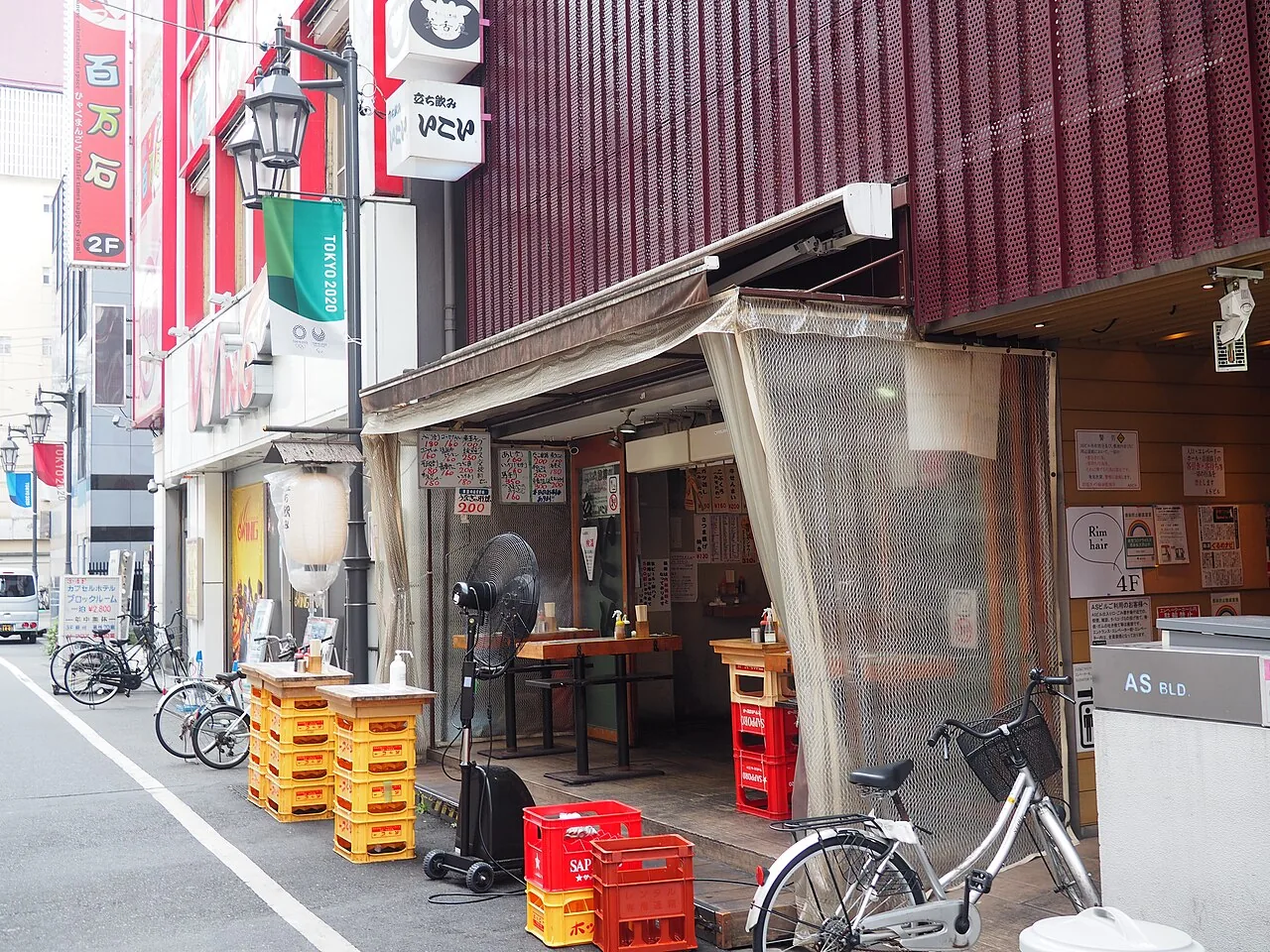
Three kinds of place do it. Tachinomi, standing bars, the purest form: a counter, no chairs, a chalkboard. Kakuuchi, drinking inside a liquor shop: you buy a can or a cup of sake at retail price and drink it at a shelf by the door, with a bag of snacks from the same shop. And the old izakaya with a counter where the standing section is at the front and the regulars have had the same stools since the Showa era. All three are cash, all three close early, and none of them has an English menu, which is the point.
Where is the best senbero in Tokyo?
- Kita-Senju (Adachi): the capital. The alleys west of the station have the densest run of standing bars in the eastern half of Tokyo, with Ohashi (1877, niku-dofu) and Tenshichi (standing kushi-katsu) as the two you queue for. The full Kita-Senju evening →
- Akabane (Kita): the other capital, and the one with the earliest opening hours in the city. The bars along the arcade south of the station open at 9:00 in the morning for people coming off night shifts, and Marukensuisan, the oden stand, sells a cup of sake topped up with oden broth for a few hundred yen, which is the most famous single drink in senbero. Akabane’s other attraction →
- Tateishi (Katsushika): the sad one. Nonbe Yokocho, the alley of tin-roofed bars beside Keisei Tateishi Station that was the most photographed senbero street in Japan, was cleared in 2023 for a station redevelopment that will put a ward office and towers on the site. The bars on the south side of the tracks survive for now, including the motsu-yaki counter that opens at ten in the morning and closes when the offal runs out; go before the second phase.
- Kameido (Koto): gyoza and a beer under the tracks, the gyoza shop that serves nothing but gyoza, and the standing bars along the shopping street toward Kameido Tenjin.
- Ueno (Taito): Ameyoko’s outdoor tables, where the ¥1,000 is spent on a highball and a plate of whatever is being grilled, and where the crowd is half tourists and half men who have not been home yet. Loud, easy, and the right first senbero if you are nervous.
- Monzen-Nakacho (Koto): the izakaya street beside Fukagawa Fudo-do, the after-work version for people who live nearby, quieter and a little dearer.
What are the rules at a Japanese standing bar?
| Rule | What it means |
|---|---|
| One drink per person | The real one. Everyone orders a drink first, before food, and keeps one going. Sitting on one beer for an hour at a standing bar is the one thing that will get a look. |
| Order a drink before you order food | Say the drink first (“nama” for draft beer, “chuhai”, “highball”), then point at plates. The food comes when it comes. |
| Do not spread out | Bags on the hook under the counter or between your feet. A standing bar’s capacity is its counter length. |
| Forty minutes | Not a rule anyone states; the length of a senbero visit by custom. When you are done, you are done; the next place is the point. |
| Pay when you leave | Cash, at the counter, no tip, and the bill is often just the owner counting the empty plates in front of you. |
| No groups of six | Two or three is right. Four is the limit. A party of six at a standing bar is a party the bar cannot serve. |
| Talk to strangers | Allowed and expected. The man next to you will ask where you are from. Answer, and buy nobody a drink; that is not done here. |
| Photos | Of your plate, fine. Of the counter, ask. Of the regulars, no. |
How much does a senbero evening actually cost?
About ¥3,000 to ¥4,000, not ¥1,000. The name describes one bar, not the night. A thousand yen buys a drink and two small plates at one counter; the culture is to do that three or four times in a row, walking a hundred metres between each. Four stops at ¥800 to ¥1,000 each is the normal shape of a senbero evening.
That is still the cheapest real night out in Tokyo. For the same money you get one cocktail and a cover charge in Ginza. And unlike a set menu, you can stop after two bars and go home having spent ¥1,800.
Budget ¥5,000 in cash per person and you will come home with change. Almost none of these places take cards, and several do not have a machine at all.
What do you order at a senbero bar?
The classic senbero plate is motsu-yaki, grilled offal on skewers, ¥100 to ¥150 each, ordered by part (heart, liver, intestine, cartilage) and by sauce (tare, sweet soy; shio, salt). Then niku-dofu, beef and tofu simmered in soy, ¥300 to ¥400. Then oden in winter, ¥100 to ¥200 a piece. Then whatever the chalkboard says is today’s. The drinks: nama (draft beer, ¥450), hoppy (a beer-flavored soft drink you pour over a glass of shochu, ¥400 for the set, the definitive senbero drink), chuhai or lemon sour (¥350), nihonshu in a glass filled to overflowing into a saucer (¥400). A thousand yen buys a drink and two skewers and a niku-dofu at most of the places above. Two thousand buys the whole evening at three of them.
Do I need a guide for a senbero crawl?
Without, on the east side: there is no guided senbero crawl in Kita-Senju, Akabane or Tateishi, and the bars are small enough that a group with a guide would fill one. Go alone or in a pair, point at the chalkboard, and let the man next to you explain hoppy. If you want the training-wheels version first, the Shinjuku local bar and izakaya crawl on Viator does three standing bars in three hours for about ¥6,000 plus what you drink, 4.9 from over 1,300 reviews; it is in the wrong part of town for this site but it teaches the ordering, and you can take that east the next night.
Related: If you go into Shinjuku without a guide, Golden Gai charges a seat fee and most bars ban photographs — both are where visitors get caught, and neither is printed in English at the door.
The east-side version of a guided crawl is a ramen crawl, not a senbero one. Hidden Taverns and Ramen in Ueno runs three hours from Ueno Station through a standing bar and a tavern and finishes on ramen — which is what a senbero night does anyway, in the right order. It is the closest thing to this page that you can actually book, and it is about ¥16,500. The ramen crawls and classes in Tokyo, compared →
Why it exists here
Senbero is a working man’s institution and the east side was where the working men lived: the lumber yards of Koto, the factories of Sumida and Adachi, the freight yards at Akabane and the market at Senju. A standing bar is what you build when your customers have an hour between the shift and the last train and ¥1,000 in their pocket, and the ones that survive from the 1950s are the ones whose customers kept coming after the factories closed. That is also why they are going: the land under a tin-roofed bar beside a station is worth more as a tower, and Tateishi’s alley is the latest to find that out. The senbero districts that are left are the ones on this list, and they are a reason to cross the river that no guidebook gives.
Where this joins the rest of the east side
Start in Kita-Senju, where the post town, the fish market and a bath with a garden fill the afternoon before the bars open. This is the third explainer in How Japan Works, after pachinko and sento etiquette; the bath before the bar is the correct order. If you would rather someone else ordered for you, the guided version of this — Shinjuku’s bar crawl at ¥6,000, Ueno’s nine-dish evening at ¥16,000 — is compared in food tours by area, along with the finding that nobody runs one east of the river.
Quick answers
What does senbero mean?
Sen (¥1,000) plus bero-bero (drunk): getting pleasantly drunk for a thousand yen. It describes cheap standing bars and old izakaya where a drink and two or three small plates cost about ¥1,000, and the habit of visiting several in one evening. The word spread from Nakajima Ramo’s 2003 book The Senbero Detective Goes Forth.
Where is the best senbero in Tokyo?
On the east side: Kita-Senju (Adachi) and Akabane (Kita) are the two capitals, with Ueno’s Ameyoko for a first try, Kameido and Monzen-Nakacho for quieter versions, and what remains of Tateishi in Katsushika after its Nonbe Yokocho alley was cleared in 2023.
How much does a senbero evening cost?
About ¥1,000 per bar for a drink and two or three plates, and most people do three or four bars, so ¥3,000 to ¥4,000 for the evening. Drinks are ¥350 to ¥500, skewers ¥100 to ¥150, niku-dofu ¥300 to ¥400. Cash only.
What are the rules at a Japanese standing bar?
Order a drink first and keep one going, keep your bag off the counter, stay about 40 minutes, pay in cash at the counter when you leave, no tipping, groups of two or three, and no photos of other customers. Talking to the person next to you is normal.
What is hoppy?
A beer-flavored, almost alcohol-free malt drink you pour over a glass of shochu on ice, sold as a set for about ¥400. It was invented in 1948 as a cheap substitute for beer and is the definitive senbero drink; order a second bottle of hoppy or a second shot of shochu separately.
LOCAL SIDE JAPAN checked the origin of the word against the Japanese-language references on Nakajima Ramo’s 2003 book, the Tateishi redevelopment against Katsushika City’s project pages and 2023 press coverage of the Nonbe Yokocho closure, and the tour price on Viator, on September 21, 2026. Prices in the bars are typical ranges from the writer’s own evenings, not a menu.