This article contains affiliate links to booking sites. If you book through them, LOCAL SIDE JAPAN earns a small commission at no extra cost to you. The boat recommended first costs ¥1,000, is public transport, and pays this site nothing. How this site is made →
TOKYO / EXPERIENCES / BOATS ON THE SUMIDA AND THE BAY
Tokyo is a city built on water and almost nobody gets on it. The reason is that the best boat here is not sold as an experience: it is a scheduled water bus, it costs ¥1,000 from Asakusa to Hinode Pier, and you buy the ticket at a window like a train. Meanwhile a “Tokyo Bay cruise” on a booking site is ¥5,323 for thirty to forty minutes, and a yakatabune dinner boat is ¥11,800. All three are legitimate; they are just not the same product, and the listings do not tell you that the ¥1,000 one exists. Here is every boat you can get on in Tokyo, sorted by what it actually is, with fares checked on the operators’ own pages on September 26, 2026 — including one service that is currently suspended and still turns up in guidebooks.
On this page
- What is the Tokyo water bus?
- How much is the Tokyo water bus?
- Can I take a boat from Asakusa to Odaiba?
- Is there a Tokyo water taxi?
- What happened to the Tokyo Mizube Line?
- How much does a yakatabune dinner cruise cost?
- Are there cheaper boats in Tokyo?
- Which Tokyo river cruise should I take?
- What the reviews say, and what they mean
- Where this joins the rest of the east side
What is the Tokyo water bus?
TOKYO CRUISE — the Tokyo Cruise Ship Company, running since long before anyone called this an experience — operates scheduled boats down the Sumida from Asakusa, out to Hinode Pier on the bay, and on to Odaiba. Asakusa to Hinode is ¥1,000 and takes about forty minutes, and it passes under twelve bridges, each one a different colour and shape, with the Skytree behind you the whole way.
That is the best value on this page by a distance, and it is also the single best way to understand the geography of the east side: the river is why Koto and Sumida exist, and forty minutes on it explains more than any museum. Buy at the pier window at Asakusa, ten metres from the end of the river walk.
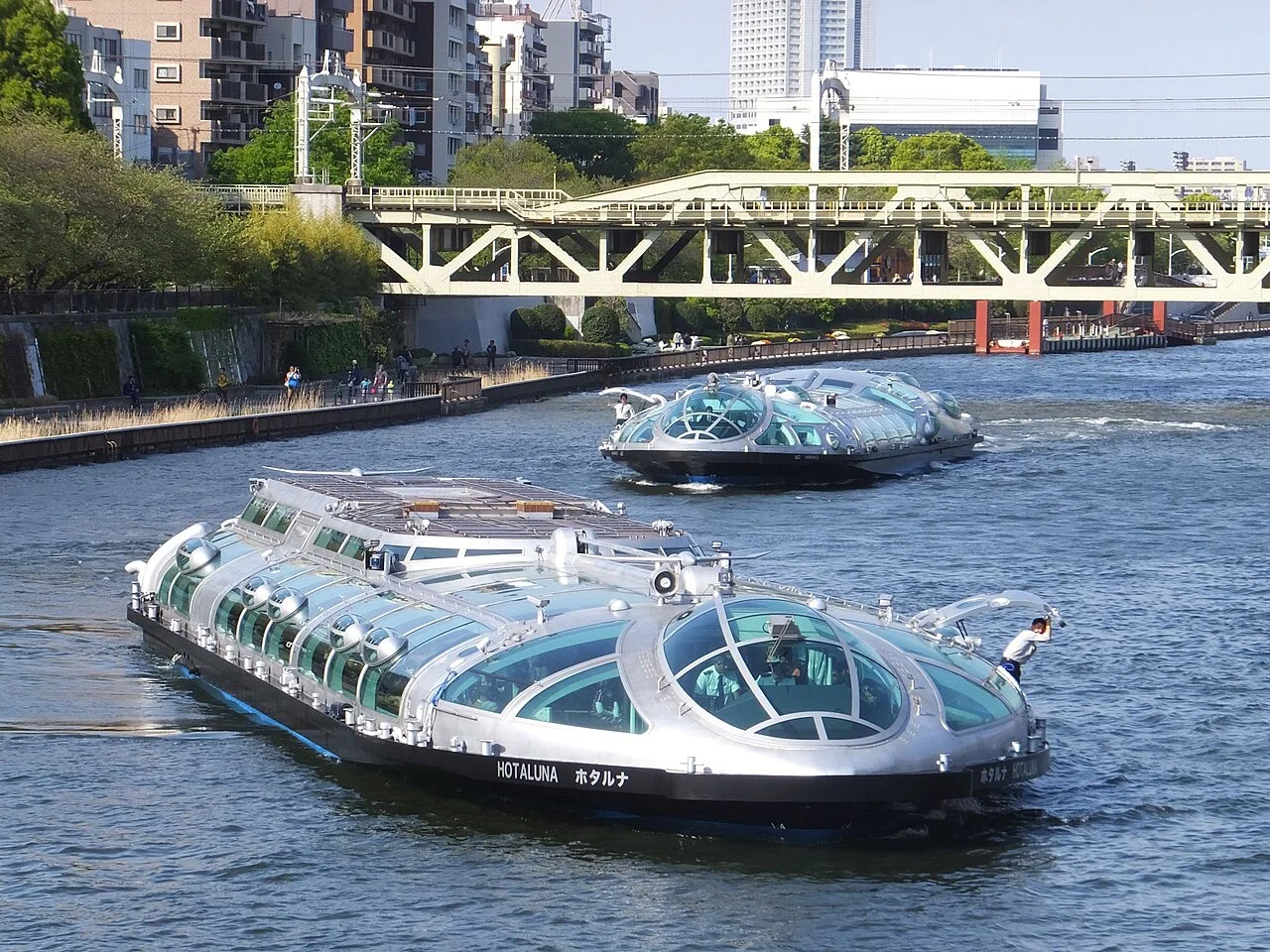
The famous boats — Himiko, Hotaluna and Emeraldas, the ones that look like something that landed rather than docked — are the same service at a premium. They were designed by the studio of Leiji Matsumoto, the manga artist behind Galaxy Express 999 and Space Pirate Captain Harlock, which is why Emeraldas is named after one of his characters. Children ask to go on these; adults are usually happier on the ordinary boat with the open deck.
How much is the Tokyo water bus?
| Route | Boat | Adult, one way | Time |
|---|---|---|---|
| Asakusa → Hinode Pier | standard | ¥1,000 | about 40 min |
| Asakusa → Hinode Pier | HOTALUNA | ¥1,400 | about 40 min |
| Hinode Pier → Odaiba Seaside Park | standard | ¥520 | about 20 min |
| Hinode Pier → Odaiba Seaside Park | HOTALUNA | ¥860 | about 20 min |
| Asakusa → Odaiba Seaside Park | standard, with a transfer | ¥1,600 | about 70 min |
| Asakusa → Odaiba Seaside Park | HIMIKO / HOTALUNA / EMERALDAS, direct | ¥2,000 | 50–60 min |
Children are generally half fare. Note the arithmetic in the middle of that table: Asakusa to Odaiba the slow way, with a change at Hinode, is ¥1,520 in two legs or ¥1,600 as a through ticket — against ¥5,323 for a bookable “bay cruise adventure” that lasts thirty to forty minutes and starts at the same Hinode Pier. That listing is rated 4.0 from six reviews. The water bus is not a secret; it is simply not marketed.
Two practical things. The boats stop running earlier than you expect — this is a daytime service, and the last departures are in the late afternoon or early evening depending on season, so check the day’s timetable at the pier rather than assuming an evening crossing. And they fill on spring weekends, when the riverbank cherry blossom makes this the most popular forty minutes in Tokyo.
Can I take a boat from Asakusa to Odaiba?
Yes, two ways, and they cost almost the same. The slow way is the standard boat to Hinode Pier and a second boat on to Odaiba Seaside Park: ¥1,000 plus ¥520, about an hour in total with the change, or ¥1,600 as a single through ticket. The direct way is HIMIKO, HOTALUNA or EMERALDAS straight through for ¥2,000 in 50 to 60 minutes, no change.
Take the slow one. The change at Hinode costs you twenty minutes and buys you the open deck twice, and the stretch from Hinode out into the bay is the part worth being outside for. The direct boats are enclosed and designed to be looked at rather than looked out of.
Is there a Tokyo water taxi?
There is, and it is a different thing from the water bus. Tokyo Water Taxi is a private charter: you book the whole boat rather than a seat. Its published entry price is ¥7,000 per boat for a fifteen-minute run, Shinagawa to Odaiba, with a maximum of eight passengers — which the operator itself points out works out at about ¥875 each if you fill it (Tokyo Water Taxi, checked 5 October 2026). Longer custom routes are quoted separately, and the piers are sent to you after booking.
For two people it is expensive; for six or eight it is competitive with the scheduled boat and goes where the scheduled boat does not. But it is a booking, not a service you can walk up to, and it is not what people usually mean when they ask about the Tokyo water bus. If you want to get on a boat today without planning, the ¥1,000 fare at the top of this page is still the answer.
What happened to the Tokyo Mizube Line?
The Tokyo Mizube Line, the Metropolitan Government’s own water bus from Ryogoku and Asakusa Nitenmon, is the cheaper and more local alternative, and it is suspended. Its operator’s site states that operations have been paused since 19 January 2026 for the time being, with resumption targeted around summer 2026; as of the end of September 2026 the suspension notice is still up and no schedule has been published.
This matters because the Mizube Line’s Ryogoku pier is in every printed guide to Sumida, and people are still walking to it. If you had it on a list, take it off and check the operator’s site before you plan around it. The TOKYO CRUISE boats above are unaffected and running normally.
How much does a yakatabune dinner cruise cost?
A yakatabune is a roofed, tatami-floored party boat, a genuinely Edo thing, and the modern ones run dinner cruises around the bay. The main one sold in English is about ¥11,800 for an hour and forty minutes — a sukiyaki meal, unlimited soft drinks, a live shamisen performance and a pass by the Tokyo Tower, 4.5 from over 600 reviews. The same operator runs a sukiyaki-and-show version and a cherry-blossom seasonal sailing at the same price.
Worth knowing before you compare that to ¥1,000: they board at Etchūjima in Koto City, on this side of the river, not in central Tokyo — a fact the listings bury and which makes the boat much easier to reach from Kiyosumi or Monzen-nakacho than from Shinjuku. And ¥11,800 is a dinner, a drinks package and a two-hour show, so the honest comparison is with a restaurant, not with a ferry. How the whole category works — the group minimums, the shoes-off tatami, the cheaper Japanese-language operators that will take two people — is in the yakatabune booking guide.
For a group, the quietly sensible option is a private charter from the same Etchūjima pier at about ¥8,000 for the whole boat for two hours — air-conditioned cabin, toilet, Bluetooth speaker, fuel and docking included, bring your own food. It is new and unreviewed, so treat it as a punt; but for six people that is ¥1,300 each for a private boat on Tokyo Bay, which is less than the dinner cruise charges one person.
Are there cheaper boats in Tokyo?
- ¥100, Yokojukken River Water Park, Koto. Rowing boats and pedal boats on a canal in a residential ward, for the price of a vending machine coffee. The full guide is here and it remains the best-value water in the city.
- The Yagiri no Watashi ferry, Katsushika. A rowed ferry across the Edogawa that has been running since the Edo period and is the last of its kind in Tokyo, a few hundred yen. It is the end point of the Shibamata walk.
- The Onagi River and the Ogibashi lock, Koto. No passenger service, but the boat checkpoint on the Onagi and the buried lock at Komatsugawa are where you go to see how the water actually worked. Free.
Which Tokyo river cruise should I take?
| If you want | Take | From | Cost |
|---|---|---|---|
| The best hour on the water | TOKYO CRUISE water bus | Asakusa pier | ¥1,000 to Hinode |
| To reach Odaiba by boat | Water bus, change at Hinode | Asakusa | ¥1,600, or ¥2,000 direct |
| Twenty minutes on the bay | Water bus, Hinode → Odaiba | Hinode Pier | ¥520 |
| A boat children will remember | HIMIKO or HOTALUNA | Asakusa | ¥1,400–¥2,000 |
| Dinner and a shamisen | Yakatabune dinner cruise | Etchūjima, Koto | ¥11,800 · 4.5 (610) |
| A boat to yourselves | Private charter | Etchūjima, Koto | ¥8,000 per group, 2 h |
| To row it yourself | Yokojukken River Water Park | Koto | ¥100 |
| A ferry older than the city | Yagiri no Watashi | Shibamata, Katsushika | a few hundred yen |
What not to book: a short “bay cruise” at around ¥5,300 that departs from Hinode Pier, when the scheduled boat from the same pier to Odaiba is ¥520 and the one from Asakusa is ¥1,000. Unless it includes a meal or a guide, a boat ticket in Tokyo should not cost five figures’ worth of yen per hour.
What the reviews say, and what they mean
The bookable boats on this page carry about 719 reviews, nearly all of them on one operator. On 3 October 2026 I read the single-star reviews on the main listing and the operator’s replies, which are detailed and, on two points, confirm what the reviewers say.
Where the low reviews are
| Listing | Reviews | Rated 3★ or below |
|---|---|---|
| Yakatabune dinner cruise, ¥11,800 | 599 | 55 (9.2%) |
| Same operator, sukiyaki-and-show version | 81 | 10 (12.3%) |
| Same operator, seasonal sailing | 33 | 2 (6.1%) |
| Bay cruise adventure, ¥5,323 | 6 | — |
| TOKYO CRUISE water bus, ¥1,000 | Not sold through a booking site. Buy at the pier window. | |
9.2% is high. For scale, the craft and cooking pages in this series run between 0.2% and 1%, and the only thing worse on this site is the resold attraction tickets. The yakatabune is a good evening when it works. Four things go wrong often enough to plan around.
1. People cannot find the pier, and the boat leaves without them
This is the most common single-star story and it appears four times in eleven. One reviewer who deliberately arrived forty minutes early still ended up “in a dark boarded up construction site by following the address” and found the boat only by asking strangers (April 2025); the same reviewer notes they had received so many warnings about the address that it was clearly a known problem. Another was a minute late and watched the boat go (April 2025). A third missed it entirely after five unanswered calls and ten messages to the guide (July 2026).
The operator’s position is consistent and not unreasonable: it is a public dock, the boat leaves on time, arrive fifteen minutes early. But a scheduled departure from an unmarked industrial pier is a harder thing to find than the listings suggest — and remember that these boats board at Etchūjima in Koto City, not in central Tokyo. Go to the pier in daylight hours earlier in the day if you can, or budget thirty minutes of slack and do not rely on a taxi driver knowing it.
2. It is floor seating, and that is a real accessibility question
Two reviewers describe this in detail and both are worth taking seriously. A guest in August 2025 found the boarding and the floor-level seating impossible, left before the boat sailed, and received no refund — and the operator’s reply confirms both halves: the description does note the cruise may not suit guests with back or mobility issues, and no refund was given because the meal and seating were already prepared. A May 2025 reviewer adds the specifics: a low table at floor level, shoes off with no slippers provided, a low ceiling, heat from the cooking burners, and stepping unassisted between the dock and the boat.
If anyone in your party cannot sit on the floor for ninety minutes or step across a gap onto a moving boat, book something else. This is the clearest case on this site of a listing whose fine print matters more than its rating.
3. The food, and 4. no refunds for weather
Four of the eleven are about the meal — fatty beef, pre-wrapped portions, a replacement that arrived after everyone else had finished, an empty drinks dispenser. One reviewer in April 2025 was served another guest’s meal while that guest, who had an allergy, was served theirs. The operator apologised in each case and in one said the kitchen had been understaffed.
And the cancellation window is 24 hours with no weather exception. An October 2025 reviewer spent the cruise on an open deck in the rain and was refused a same-day cancellation; their own advice is the right advice — look at the forecast before the 24-hour line, not after it.
Which of these are made for foreigners
For once, no — and that makes the answer more interesting.
Shared-boat yakatabune sold to Japanese customers in 2026 run from about ¥7,900 to ¥20,900 per person, with typical evening cruises around ¥12,000 to ¥13,800 (Japanese yakatabune booking comparison, checked 3 October 2026; the cheapest listed is a ¥7,900 lunch sailing from Shinkiba with all-you-can-eat monja and unlimited drinks). The English listing at ¥11,800 sits inside that range, just under the typical evening price. You are not being charged a visitor premium for the boat.
What you are buying for the difference is an English-speaking guide on board and a booking you can make from abroad. What the reviews suggest you are not buying is a smoother arrival, and the Japanese boats depart from the same kind of pier with the same punctuality.
The genuinely unbeatable number on this page is still the one nobody sells you. TOKYO CRUISE charges ¥1,000 from Asakusa to Hinode, and that is the fare for everyone, Japanese or not, bought at a window with no booking, no QR code, no meeting point and nothing to miss. It is forty minutes rather than a hundred, and there is no dinner in it. But when a ¥11,800 evening fails, it fails at the pier — and the ¥1,000 boat has no pier to fail at, because you buy the ticket standing in front of it.
Where this joins the rest of the east side
The obvious day: walk the Sumida from the Skytree to Senso-ji, then get on the water bus at Asakusa and ride back down the same river you just walked. Everything the river built is in Koto City and Sumida beyond the Skytree; the dinner boats are in the yakatabune guide; and the tickets for the tower you will be looking at are at their official price in the Skytree and teamLab ticket guide. Everything bookable is on the Experiences page, and the area is in the east side guide.
Quick answers
How much is the Sumida River water bus in Tokyo?
Asakusa to Hinode Pier is ¥1,000 for an adult on the standard boat and takes about 40 minutes. Hinode to Odaiba Seaside Park is ¥520 for about 20 minutes. Asakusa straight through to Odaiba is ¥1,600 with a transfer, or ¥2,000 direct on the Himiko, Hotaluna or Emeraldas. Children are generally half fare, and you buy at the pier.
Is the Tokyo water bus worth it?
It is the best value of anything on the water in Tokyo. Forty minutes from Asakusa to the bay for ¥1,000, under twelve bridges with the Skytree behind you, on a scheduled service rather than a tour. Compare that with the bookable bay cruises at around ¥5,300 for thirty to forty minutes from Hinode Pier.
Is the Tokyo Mizube Line running?
No. The Metropolitan Government’s Tokyo Mizube Line water bus, which ran from Ryogoku and Asakusa Nitenmon, has been suspended since 19 January 2026, with resumption targeted around summer 2026. As of late September 2026 the suspension notice is still posted and no schedule has been published. The separate TOKYO CRUISE boats from Asakusa are running normally.
What is a yakatabune and how much does it cost?
A roofed, tatami-floored Edo-style party boat serving dinner on Tokyo Bay. The main English-language booking is about ¥11,800 for an hour and forty minutes with a sukiyaki meal, unlimited soft drinks and live shamisen, rated 4.5 from over 600 reviews. It boards at Etchūjima in Koto City. At that price the fair comparison is a restaurant with a view, not a ferry.
What are the futuristic boats on the Sumida River?
Himiko, Hotaluna and Emeraldas, operated by TOKYO CRUISE and designed by the studio of manga artist Leiji Matsumoto — Emeraldas is named after one of his characters. They run the same routes as the standard water buses at a premium: ¥1,400 Asakusa to Hinode, ¥2,000 Asakusa direct to Odaiba.
Can you take a boat from Asakusa to Odaiba?
Yes. TOKYO CRUISE runs it either as a through service on the Himiko, Hotaluna or Emeraldas, about 50 to 60 minutes for ¥2,000, or on standard boats with a change at Hinode Pier, about 70 minutes for ¥1,600. Services are daytime only and finish earlier than most people expect, so check the day’s timetable at the pier.
What is the cheapest boat in Tokyo?
¥100 for a rowing or pedal boat at the Yokojukken River Water Park in Koto City, on a canal in a residential neighbourhood. After that, the Yagiri no Watashi rowed ferry across the Edogawa at Shibamata, the last of its kind in Tokyo, for a few hundred yen, and then the ¥520 water bus leg from Hinode Pier to Odaiba.
LOCAL SIDE JAPAN read TOKYO CRUISE’s own fare pages, the Tokyo Mizube Line operator’s service notice and the third-party listings quoted on September 26, 2026. Water bus timetables change with the season and services can be suspended at short notice for weather or river conditions, so check the operator’s page on the day. This is a researched comparison, not a firsthand report on every sailing, and the article says so here rather than pretending otherwise. Nothing was provided free by an operator.