This article contains affiliate links to booking sites. If you book through them, LOCAL SIDE JAPAN earns a small commission at no extra cost to you. One of the nine places below is mine: I run the Sunamachi Ginza Sumo Stable. Treat that as an interest declared, not a neutral recommendation, and read the section on where it loses. How this site is made →
TOKYO / SUMO / THE COMPARISON
There are about nine ways to see sumo in Tokyo and the listings for them look almost identical: ninety minutes, retired wrestlers, a photo, around ¥12,000. What the listings do not tell you is the part that decides whether you enjoy it. At three of them, getting into the ring is a lottery. At one, you are handed an inflatable suit. At another you may be seated at a table with strangers. And the cheapest option in the city has a better review record than anything else on this page. Everything below was read off the operators’ own booking pages and review histograms on October 10, 2026.
Fast facts
- Cheapest: Shibuya Sumo Club, ¥8,000, no food
- Dearest: Hirakuza Ginza, ¥19,000, kaiseki dinner
- Everyone gets in the ring: Sunamachi Ginza Sumo Stable only
- A real mawashi, not a costume: Sunamachi only
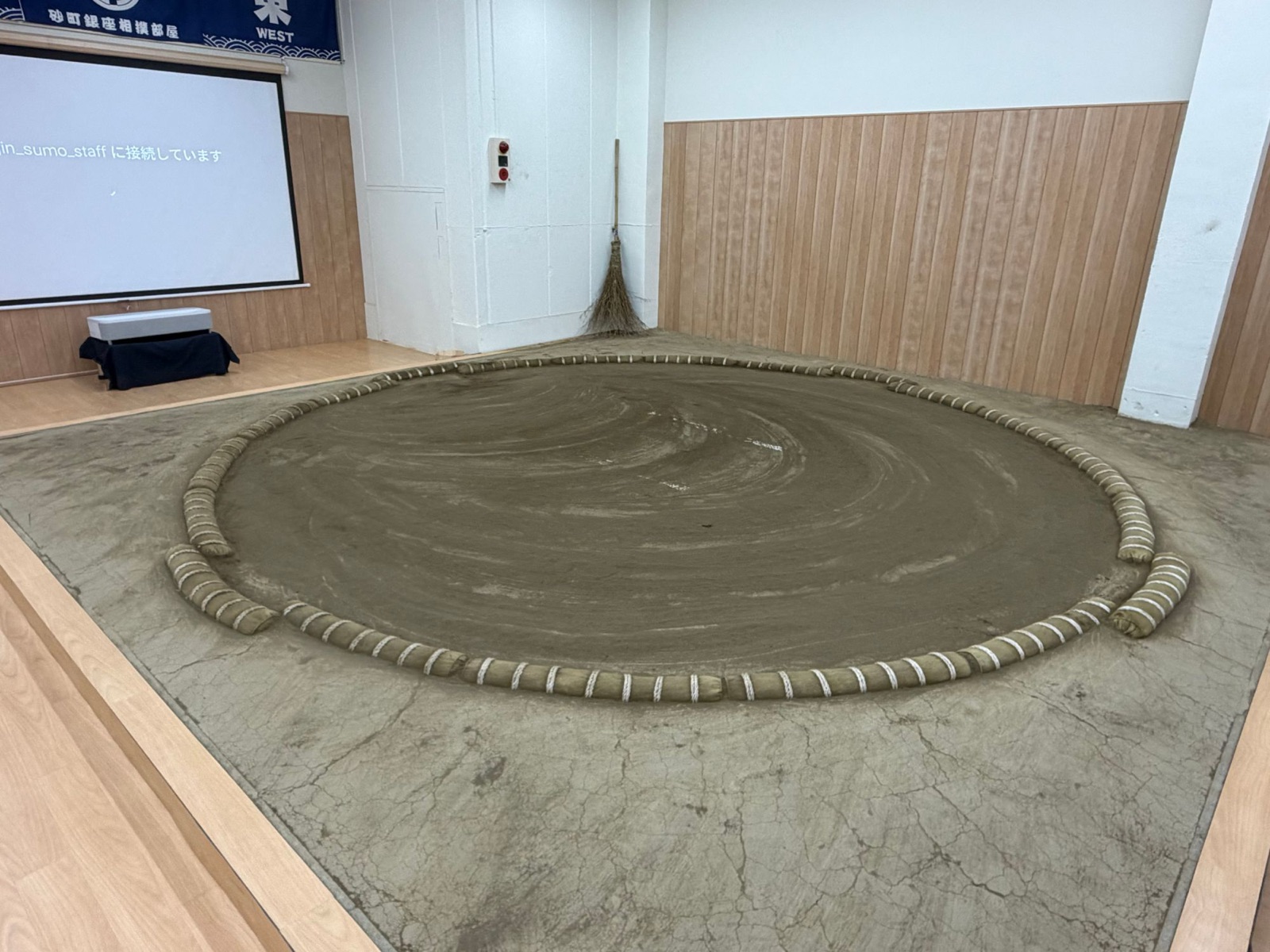
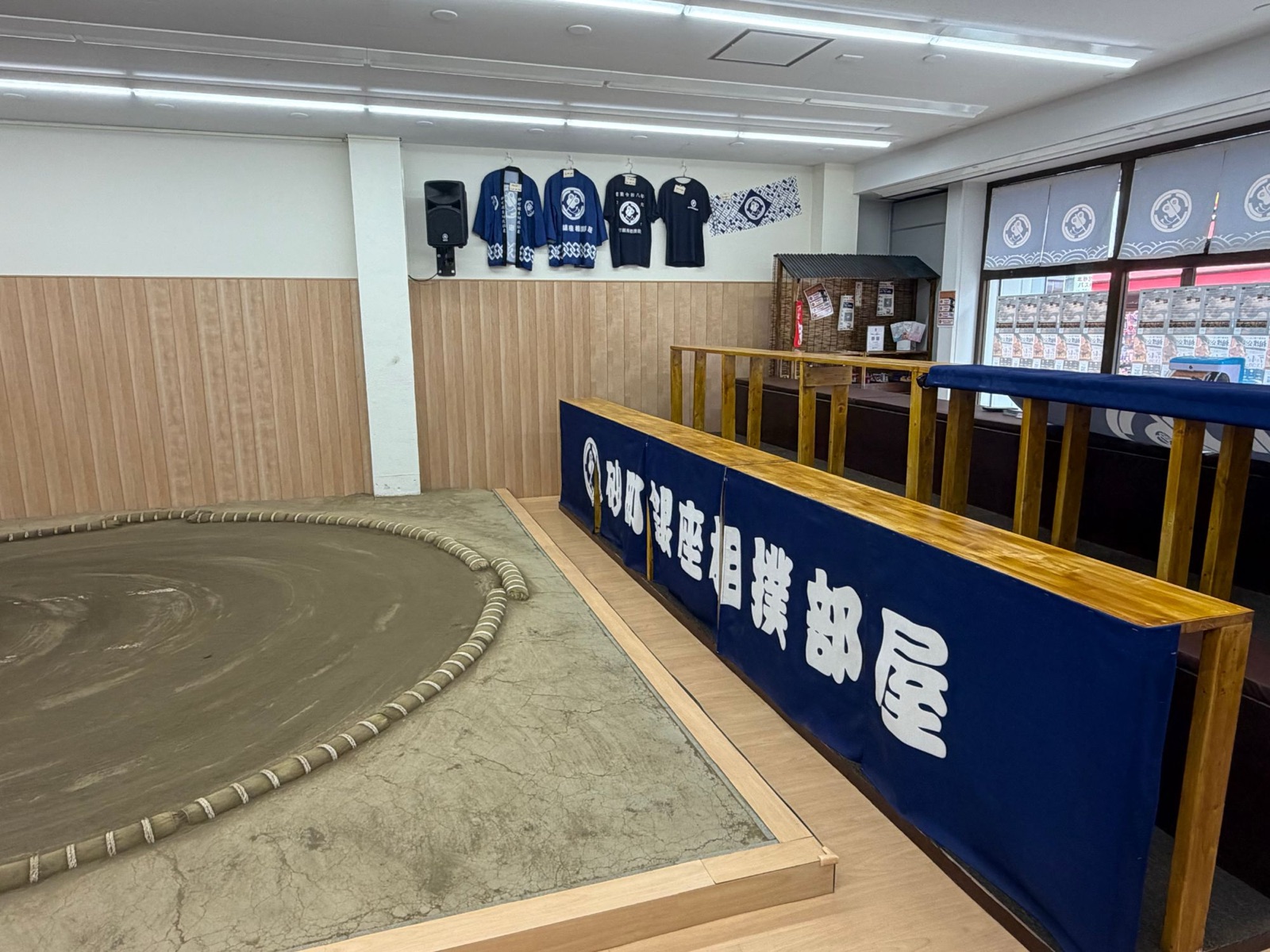
- No seat grades, no shared tables: Sunamachi only — see the photograph below
- Getting in the ring is a lottery at: Shinjuku, Shibuya and Asakusa Sumo Club
- With children: a hands-on venue guarantees them a turn; a lottery venue cannot
- Best review record: Shibuya — 1,338 reviews, not one below three stars
- Worst: Asakusa — 2.00% of 1,597 reviews are one or two stars
- Tournament: January, May and September only. ¥3,500 and up, plus ¥2,000 per ticket in fees
On this page
- What kinds of sumo experience are there in Tokyo?
- Can you actually get in the ring?
- What do you wear for a sumo experience?
- How close do you sit to the ring?
- Is food included, and does it matter?
- What the reviews say, and what they mean
- How authentic is each one?
- Which Tokyo sumo experience should you book?
- Do you need a tournament ticket?
- Where this joins the rest of the east side
- Quick answers
What kinds of sumo experience are there in Tokyo?
Five, and the booking sites file them all under the same heading, which is why people end up at the wrong one.
- The tournament. The sport itself, at the Kokugikan in Ryogoku, in January, May and September only. You watch from a seat. ¥3,500 and up.
- Morning practice at a stable. Real training, in silence, from the floor of the room. Around ¥14,000. You watch; you do not take part.
- The Sumo Club chain. Three venues — Shinjuku, Shibuya and Asakusa — running the same show in three locations. Their own booking pages name them SHINJUKU SUMO CLUB, Shibuya Sumo Club and ASAKUSA SUMO CLUB, and all three carry the same clause about getting in the ring, which is the subject of the next section.
- The restaurant shows. Dosukoi Tanaka in Tatekawa, SUMO LAND in Ryogoku, Hirakuza in Ginza. A meal with a show around it. These sell seats in tiers.
- A stable that is not a restaurant and not a chain. One of these, and it is mine, so read the rest with that in mind.
If all you want is the difference between watching the sport, watching training and watching a show, that is a separate question and we have answered it at length in morning practice vs the sumo show vs the tournament. This page is about the nine individual places and the four things their listings leave out.
Can you actually get in the ring?
This is the question to ask before you book anything, and the answer is not what most people assume.
Three of the nine — the Shinjuku, Shibuya and Asakusa Sumo Clubs — print the same line in their list of what is included:
Opportunity to challenge a sumo wrestler (Limited participants; lottery if too many apply)
Read that twice. You are buying the opportunity to enter a draw. One reviewer puts the number at six people picked out of the room. It is not a lottery when the room is half empty, but the Asakusa reviews describe it as sold out most of the time for walk-ins, so in practice it is a draw more often than not. The clearest description of what that feels like comes from a two-star review of the Asakusa show, which says most of the evening was spent watching eight other tourists take their turn.
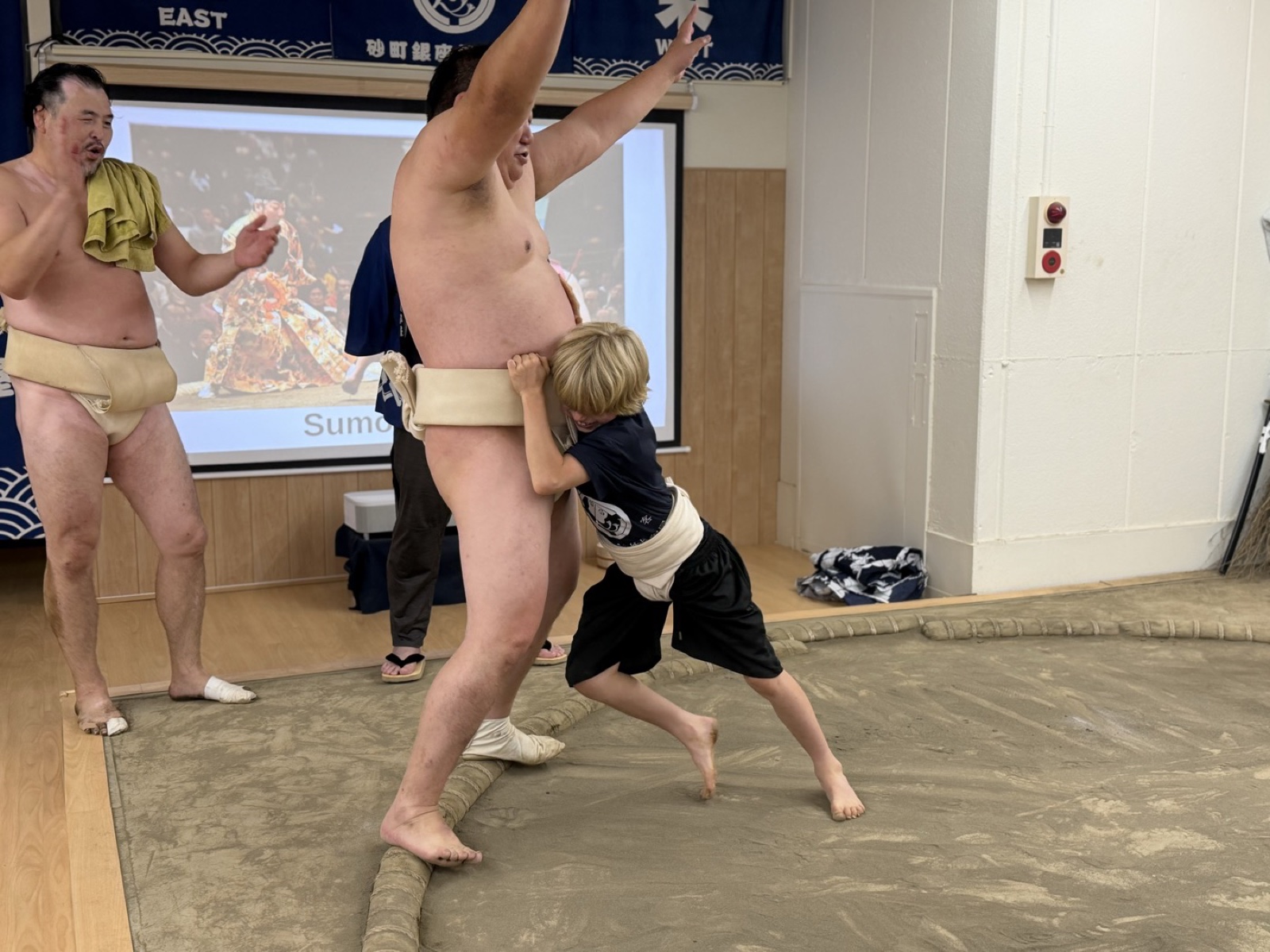
Nobody is being dishonest here. The line is on the page. It is simply in the inclusions list rather than the headline, and almost nobody reads the inclusions list before paying ¥12,000 to ¥16,000.
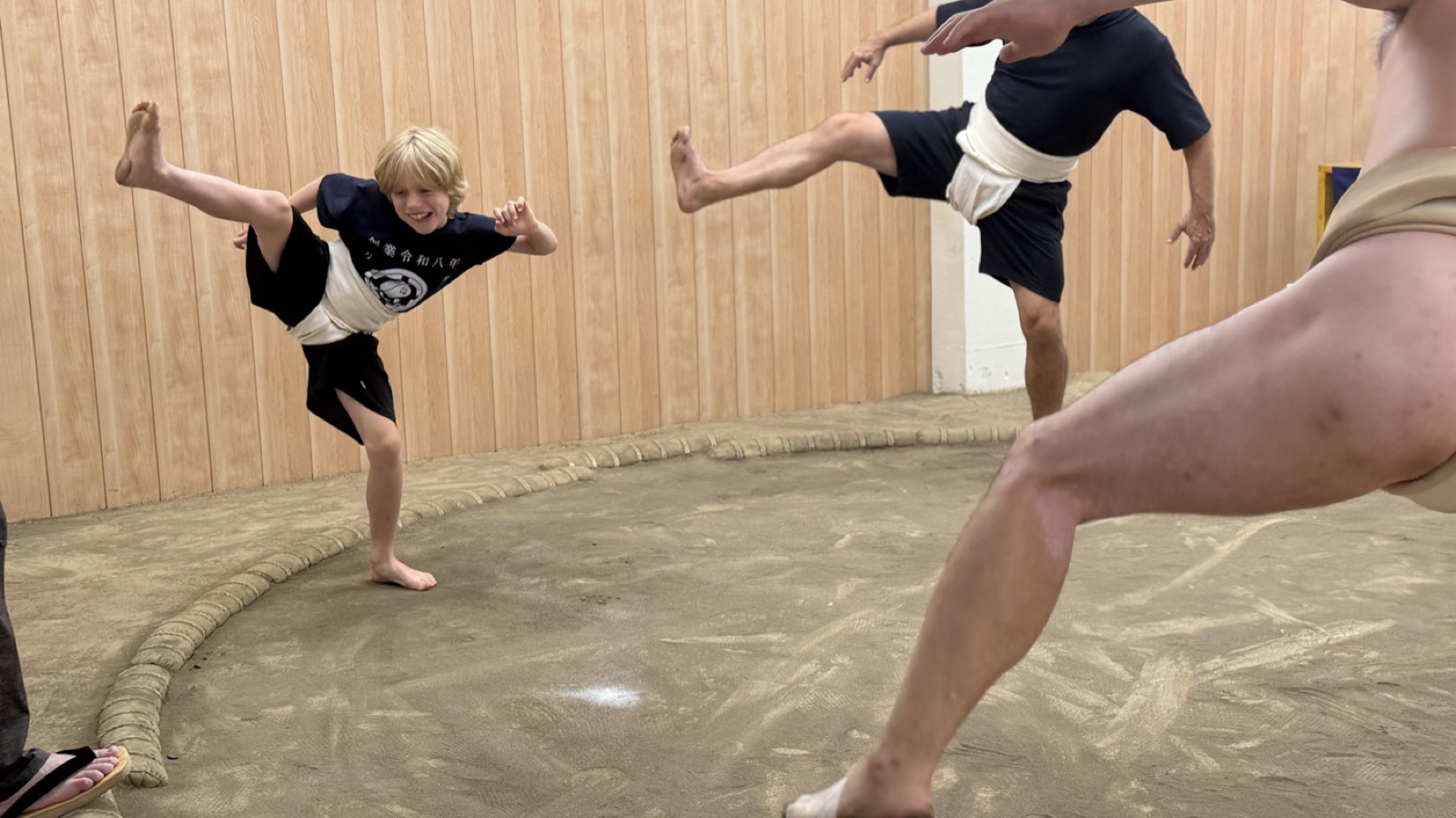
The restaurant shows do not use a lottery; at Dosukoi Tanaka the official description has you step into the ring as part of the hour. And at the stable I run in Koto City, the ninety minutes is built as three thirty-minute blocks — learn, watch, then go in — so there is nothing to be drawn for. If getting in the ring yourself is the reason you are booking, check which of these two models you are buying.
What do you wear for a sumo experience?
Three different things, and the listings almost never say which.
- An inflatable suit. At Hirakuza in Ginza, the ¥19,000 kaiseki evening, a reviewer writes that they “didn’t enjoy the sumo ‘fat suits’ that some folks put on”. If you were picturing yourself in a mawashi, that is worth knowing before you pay nineteen thousand yen.
- A costume. Dosukoi Tanaka’s own inclusions promise photos of yourself “in a traditional sumo costume”, and reviewers describe wrestling “in sumo wrestling outfits”. It is a garment that reads as sumo in a photograph.
- An actual mawashi. At the Sunamachi stable you are given a clean T-shirt and shorts to change into, and then the wrestlers tie a real mawashi on you over them. A reviewer describes it plainly: “then they put the mawashi on for you”, followed by a traditional warm-up sequence. As far as we can find on any of the three booking platforms, this is the only one in Tokyo where that happens, and it is the single biggest difference between these nine places.
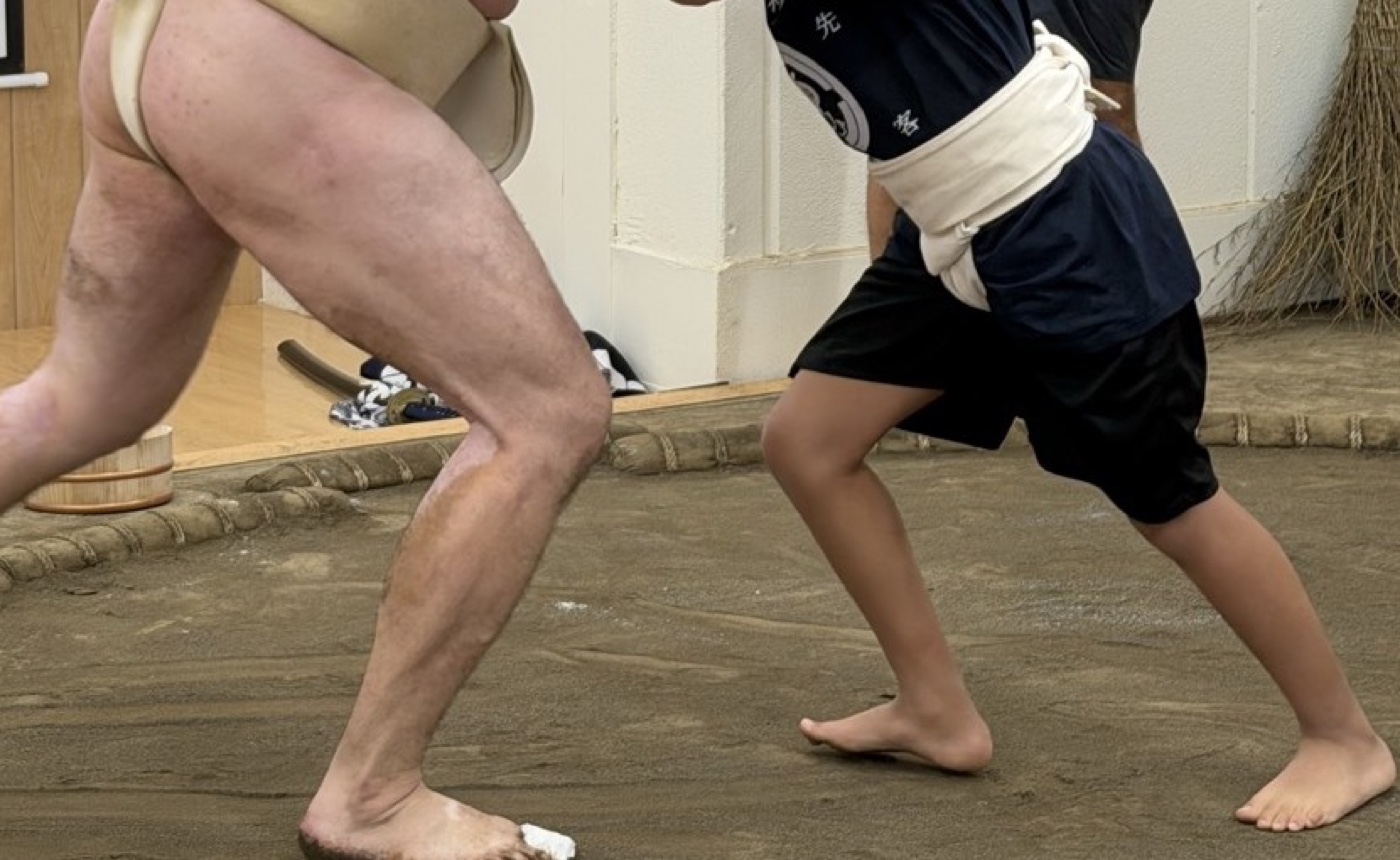
At SUMO LAND reviewers mention getting their feet into the sand rather than any garment. The three Sumo Club venues do not state what you wear, which follows from the previous section: most guests never find out.
How close do you sit to the ring?
Nobody publishes a seating distance, but the booking pages give it away in what they sell.
- Dosukoi Tanaka sells tables, and not all of them are equal. The small print says “you may be asked to share a table with another group”, and a five-star reviewer advises you to “definitely book a ring seat table”. That is a recommendation you only make when the other tables are worse.
- SUMO LAND sells two grades. Standard seats and box seats, and the note explaining the difference is unusually frank: at the standard seats it is dangerous to hold a child on your lap, while the box seats are safe and take up to six.
- Hirakuza sells Premium and Standard. The ¥19,000 is the Standard.
- Shibuya holds about sixty people, by a reviewer’s count. Shinjuku is smaller, and a reviewer there says “it’s a small venue so every seat is a good one” — which is true, and worth saying.
- The Sunamachi stable does not sell seat grades at all, and there is no table to share. It is one room with the dohyo in it, capped at forty people, and the viewing counter is built along the edge of the clay at ring level — the photograph above is the whole seating plan. Forty is a ceiling rather than a target: the venue is a room, not an arena.
The honest summary is that Shinjuku and Sunamachi both avoid the bad-seat problem, for different reasons, and that Sunamachi is the only one of the nine that does not sell a better seat than the one you just bought.
Is food included, and does it matter?
It varies more than the prices suggest, and “no food” is not automatically the cheap option.
- Asakusa, ¥16,000: all-you-can-eat chicken chanko-nabe with a set meal, a drink, a printed group photo, a geisha dance and a souvenir set. The most that is included anywhere.
- Hirakuza, ¥19,000: a kaiseki dinner. A children’s plate for ages three to twelve.
- Dosukoi Tanaka, ¥12,700: tonkatsu and chanko soup, drinks and gratuities included.
- SUMO LAND: chicken chanko you cook at your own table, supervised by the Isegahama stable, with a vegan version available. Note that the ¥9,500 headline price is the “no meals, sumo only” option — the version with the hot pot costs more.
- Shinjuku, ¥12,000, and Shibuya, ¥8,000: no food at all. One bottle of water. At Shibuya, snacks and drinks are sold at the venue.
- Sunamachi, ¥11,000: no food served, and the booking page tells you to bring your own: the venue is on a 1950s shopping street and “you are encouraged to bring food in”. You walk the street first, buy yakitori, croquettes and sweets, and eat it beside the dohyo.
One thing worth knowing before you judge the last one: bringing your own food in is how Japanese people watch sumo. The Kokugikan has chanko stalls and bento inside and still lets you carry in your own food and drink. Eating something you chose yourself is not a cut corner; it is the normal way.
What the reviews say, and what they mean
Everything on this page is rated between 4.8 and 5.0, which tells you nothing. The star distributions tell you a great deal. These are the Viator figures, read on October 10, 2026.
| Venue | Reviews | 1★ | 2★ | One or two stars |
|---|---|---|---|---|
| Shibuya Sumo Club | 1,338 | 0 | 0 | 0% |
| Shinjuku Sumo Club | 4,879 | 10 | 9 | 0.39% |
| Hirakuza Ginza | 219 | 0 | 1 | 0.46% |
| SUMO LAND | 335 | 3 | 0 | 0.90% |
| Dosukoi Tanaka | 2,541 | 18 | 6 | 0.94% |
| Asakusa Sumo Club | 1,597 | 20 | 12 | 2.00% |
| Sunamachi stable | 7 | 0 | 0 | 0%, but this is the wrong column for us — see below |
The best record on this page belongs to the cheapest option. Shibuya has 1,338 reviews and not one of them is below three stars. That is a far harder thing to achieve than a clean sheet across seven, and it deserves saying plainly on a page where one of the entries is mine.
One correction to the table above, about my own entry. The seven is a Viator count, and Viator is not where we are reviewed. The Sunamachi stable has 109 Google reviews at 4.9 and 89 GetYourGuide reviews at 5.0 — 198 between them. Almost nobody finds us through Viator or Klook, which is why those columns are nearly empty, and quoting seven as our record understates it by a factor of about twenty-eight. I am leaving the seven in the table because the table compares Viator against Viator and swapping in a number from a different platform would break it. But do not read that row as our review history.
Where the low reviews are, and what they have in common
We read every one- and two-star review on the worst-scoring listing, the Asakusa show, and the complaint does not vary. One says “actual sumo wrestling only about 10% of the entire show”. Another calls it “more of a gimmick rather than traditional. And very Americanized”. Others describe a touristy skit, forced comedy, forced clapping, and an evening spent watching other guests.
Hirakuza’s small number of low reviews say the same thing from the other end of the price range: “the actual sumo matches seemed mostly staged”, and the demonstrations are “comical”. Shinjuku’s include “probably not worth $80 bucks”.
Nobody who leaves a low review is complaining that the show was bad at being a show. They are all saying the same sentence in different words: I came for sumo and I was given an entertainment act. The operators answer these reviews honestly — the Asakusa host’s replies say the programme is built with entertainment elements for a broad audience, which is exactly true.
That is the whole basis of the ranking in the next section. It is not our opinion about which is better. It is the one thing the unhappy minority agrees on, used as a scale.
How authentic is each one?
Five stars here does not mean better. It means closer to the sport. If you want an entertaining night out with a geisha dance and all-you-can-eat hot pot, a one-star rating on this scale is exactly what you should book.
| Venue | Authenticity | Why |
|---|---|---|
| Kokugikan tournament | ★★★★★ | The sport itself. You cannot take part. |
| Morning practice at a stable | ★★★★★ | Real training. You watch in silence. |
| Sunamachi Ginza Sumo Stable | ★★★★★ | Former professionals, a regulation dohyo, a real mawashi, no staging — and you go in |
| SUMO LAND | ★★★ | A restaurant, but the chanko is supervised by the Isegahama stable |
| Dosukoi Tanaka | ★★ | Retired wrestlers in a tonkatsu restaurant. Costume, not mawashi. |
| Hirakuza Ginza | ★★ | Kaiseki and a live show. Inflatable suits. |
| Shinjuku / Shibuya / Asakusa | ★ | A hosted entertainment show. Taking part is a draw. |
The tournament, morning practice and the stable all sit at five stars, and the difference between them is simple: the first two you watch, and the third you do.
Which Tokyo sumo experience should you book?
| If you want | Book | Price | Times |
|---|---|---|---|
| The lowest price, and a spotless record | Shibuya Sumo Club | ¥8,000 | 12:00 / 17:00 / 19:30 |
| To wear a real mawashi and go in the ring | Sunamachi Ginza Sumo Stable, direct — or on GetYourGuide, Viator or Klook | ¥11,000 | 11:00 / 15:30, closed Wed & Thu |
| Children who want a turn, not a draw | Sunamachi Ginza Sumo Stable, or Dosukoi Tanaka | ¥7,700 child / ¥11,000 adult | Daytime only |
| A dinner and a show, with children | Asakusa Sumo Club | ¥16,000 | Evening |
| Lunch in sumo’s own neighbourhood | Dosukoi Tanaka, Tatekawa | ¥12,700 | 13:00 only |
| Chanko you cook yourself, or vegan chanko | SUMO LAND, Ryogoku | ¥9,500 without food | Afternoon and evening |
| A formal dinner in Ginza | Hirakuza Ginza | ¥19,000 | From 17:00 |
| Real training, and you are happy to only watch | Morning practice at a stable | From ¥14,000 | Early morning |
| The sport, and your trip hits a tournament | Tournament with chair seats, or buy direct | ¥3,500 and up | Jan, May, Sep |
Where the one I run loses
Since I am asking you to trust a table with my own business at the top of it, here is the other side, and none of it is small.
- Volume. Our full record is 109 Google reviews at 4.9 and 89 GetYourGuide reviews at 5.0, 198 in total — against Shinjuku’s 4,879 and Dosukoi’s 2,541 on Viator alone. We are still the smallest sample on this page by a wide margin. Two hundred reviews is enough to be a real record and nowhere near enough to be the strongest one here.
- The clean sheet. Shibuya’s zero low reviews out of 1,338 is a stronger result than a 4.9 across our 109, and anyone comparing the two should prefer the bigger sample. A 4.9 is not a clean sheet: it means some people did not give us five stars.
- Price. ¥11,000 is more than Shibuya at ¥8,000 and more than SUMO LAND’s sumo-only ticket.
- Evenings. There are none. 11:00 and 15:30, and we are closed on Wednesdays and Thursdays. If you want sumo after dinner, book Shibuya at 19:30 or Hirakuza at 17:00.
- Location. Kitasuna, in Koto City. It is not Shinjuku, Shibuya or Ginza, and nobody is passing by.
- Nobody cooks for you. If you want a kaiseki dinner or an all-you-can-eat hot pot brought to the table, we are the wrong place.
- The tournament’s atmosphere. Several thousand people in the Kokugikan is a thing a room of forty cannot reproduce.
If none of that rules it out, the booking page is the stable’s own. Booking direct costs you the same ¥11,000 as the agencies charge and keeps the commission out of it, which is the only reason I am pointing you there rather than at a listing.
¥11,000 adults · ¥7,700 children 4–12 · under 4 free · 11:00 and 15:30 · 90 minutes · closed Wednesdays and Thursdays · Kitasuna, Koto City. Also on GetYourGuide if you prefer to keep everything in one account.
Do you need a tournament ticket?
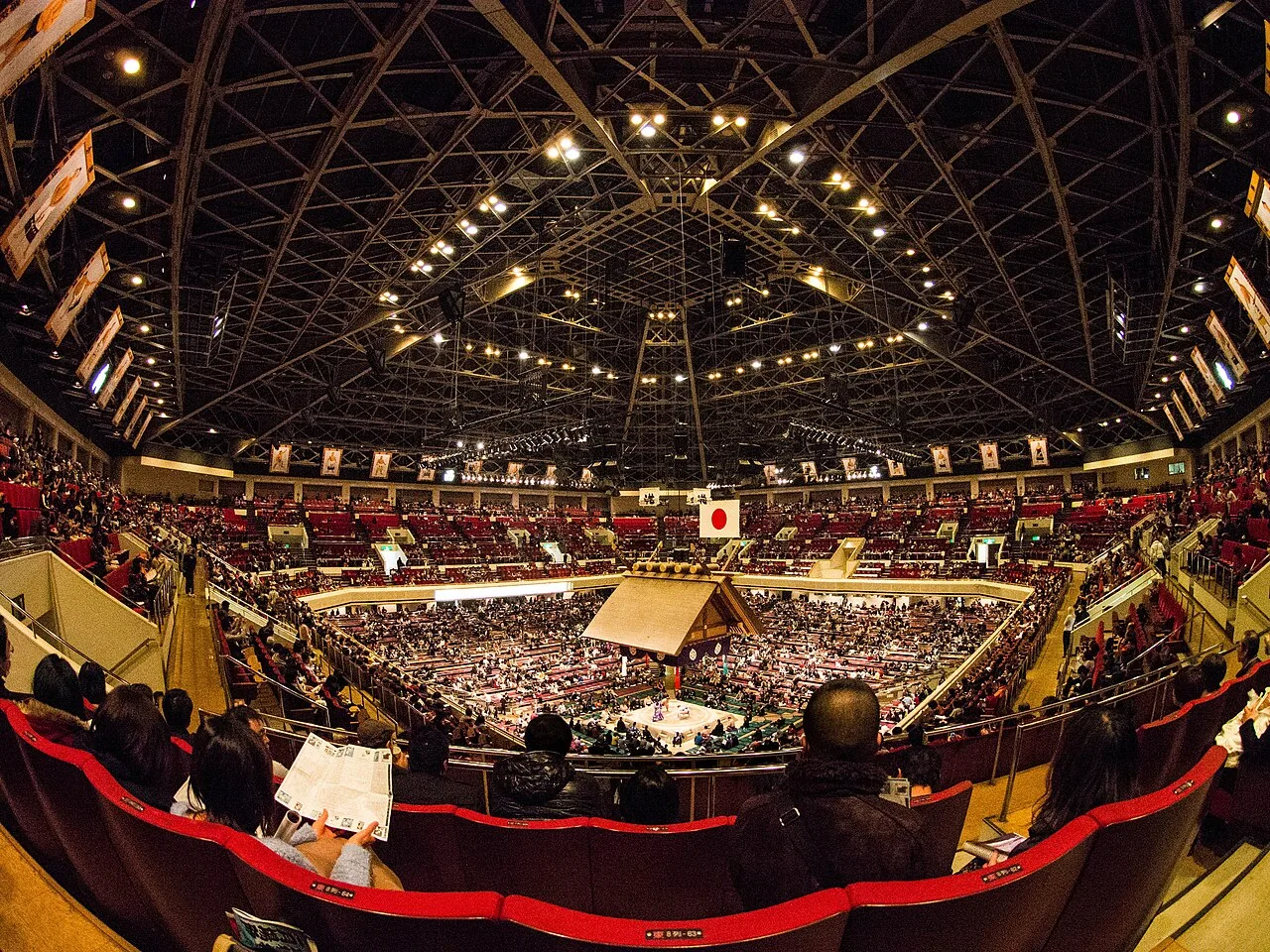
If your trip lands in January, May or September, go. Nothing on this page replaces the sport. The thing to understand is that a tournament seat does not get you close.
| Seat | Weekday | What it is |
|---|---|---|
| Chair C | ¥3,500 | Upper tier, back rows. The wrestlers are small. |
| Chair B | ¥5,000 | Upper tier, middle. The sensible choice. |
| Chair S | ¥9,000 | The closest chair you can buy in English. |
| Box C, four people | ¥34,000 | Lower tier, floor cushions, shoes off. |
| Ringside | ¥20,000 | Floor level — not sold on the English site. |
So the closest seat a visitor can actually buy in English is ¥9,000, and the ring itself is off limits at any price. Tickets are also printed at a 7-Eleven in Japan rather than at home or at the arena, and the day runs from 8:00 to 18:00 with the part worth seeing starting around 14:00. The full ¥3,500 ticket guide, and how to actually get one →
One practical note on booking a tournament through a third party: between tournaments these listings show as sold out, because there is nothing to sell until the next basho. That is not a dead product. The next Tokyo tournament is in January.
Where this joins the rest of the east side
Five of the nine are in Sumida and Koto, within a few stops of each other. The Kokugikan, Dosukoi Tanaka and SUMO LAND are all in Sumida City, where the free Sumo Museum sits inside the arena itself; the Sunamachi stable is in Koto City, on the shopping street. For the difference between the three kinds rather than the nine places, read morning practice vs the show vs the tournament. And if what you actually want is to hold a sword rather than wrestle, the four things Tokyo sells as a samurai experience has the same problem and the same kind of answer.
Quick answers
Can you get in the ring at a Tokyo sumo experience?
At some of them. The Shinjuku, Shibuya and Asakusa Sumo Clubs state that participation is limited and decided by lottery if too many guests apply. The restaurant shows at Dosukoi Tanaka and SUMO LAND include a turn in the ring, and the Sunamachi Ginza Sumo Stable in Koto City builds its 90 minutes around everyone going in.
What do you wear for a sumo experience in Tokyo?
It depends where you book. Hirakuza in Ginza uses inflatable suits, according to its own reviewers. Dosukoi Tanaka provides a sumo costume for photographs. The Sunamachi Ginza Sumo Stable lends a T-shirt and shorts and then ties a real mawashi on over them, which appears to be the only place in Tokyo where that happens.
What is the cheapest sumo experience in Tokyo?
The Shibuya Sumo Club at about ¥8,000 for 90 minutes, with a drink and a photo but no food. It also has the best review record of any show in the city: 1,338 reviews on Viator with none below three stars, as of October 2026.
Is a sumo show in Tokyo worth it?
Yes, if you want an entertaining evening with retired professionals, and the ratings of 4.8 to 5.0 reflect that. The one- and two-star reviews all make the same complaint: that the sumo itself is a small part of a hosted comedy show. If that would bother you, book a tournament seat, a morning practice visit, or a stable where you get in the ring yourself.
Which Tokyo sumo experience is closest to the ring?
At the Kokugikan tournament the closest seat sold on the English-language site is a ¥9,000 Chair S, and ringside is Japanese-language sales only. Among the experiences, Dosukoi Tanaka, SUMO LAND and Hirakuza all sell seats in grades, while the Sunamachi Ginza Sumo Stable sells none: it is one room with the ring in it, capped at forty people.
Is food included in a Tokyo sumo experience?
Asakusa (¥16,000) includes all-you-can-eat chanko-nabe and a geisha dance; Hirakuza (¥19,000) a kaiseki dinner; Dosukoi Tanaka (¥12,700) tonkatsu and chanko. Shinjuku and Shibuya include no food at all. SUMO LAND’s ¥9,500 price is its no-meal option. At the Sunamachi stable you buy food on the shopping street and bring it in, which is also allowed at the Kokugikan.
When are the sumo tournaments in Tokyo?
January, May and September. Outside those months the only ways to see sumo in Tokyo are a morning practice visit at a stable, a show, or an experience where you get in the ring yourself.
Prices, start times, inclusions, seating notes and review histograms were read from the operators’ own Viator, GetYourGuide and Klook listings on October 10, 2026, and tournament prices from the official English ticket site. Review quotations are short extracts, attributed by platform and star rating, with no reviewer names. The photographs of the dohyo and the ringside counter were taken by the author at the Sunamachi Ginza Sumo Stable; the Kokugikan interior is a Wikimedia Commons image, credited in its caption. Sunamachi Ginza Sumo Stable is operated by the author; its entry is marked as such throughout.