This article may contain affiliate links to booking sites. If you book through them, LOCAL SIDE JAPAN earns a small commission at no extra cost to you. How this site is made →
HIDDEN HISTORY · MINOWA, TOKYO
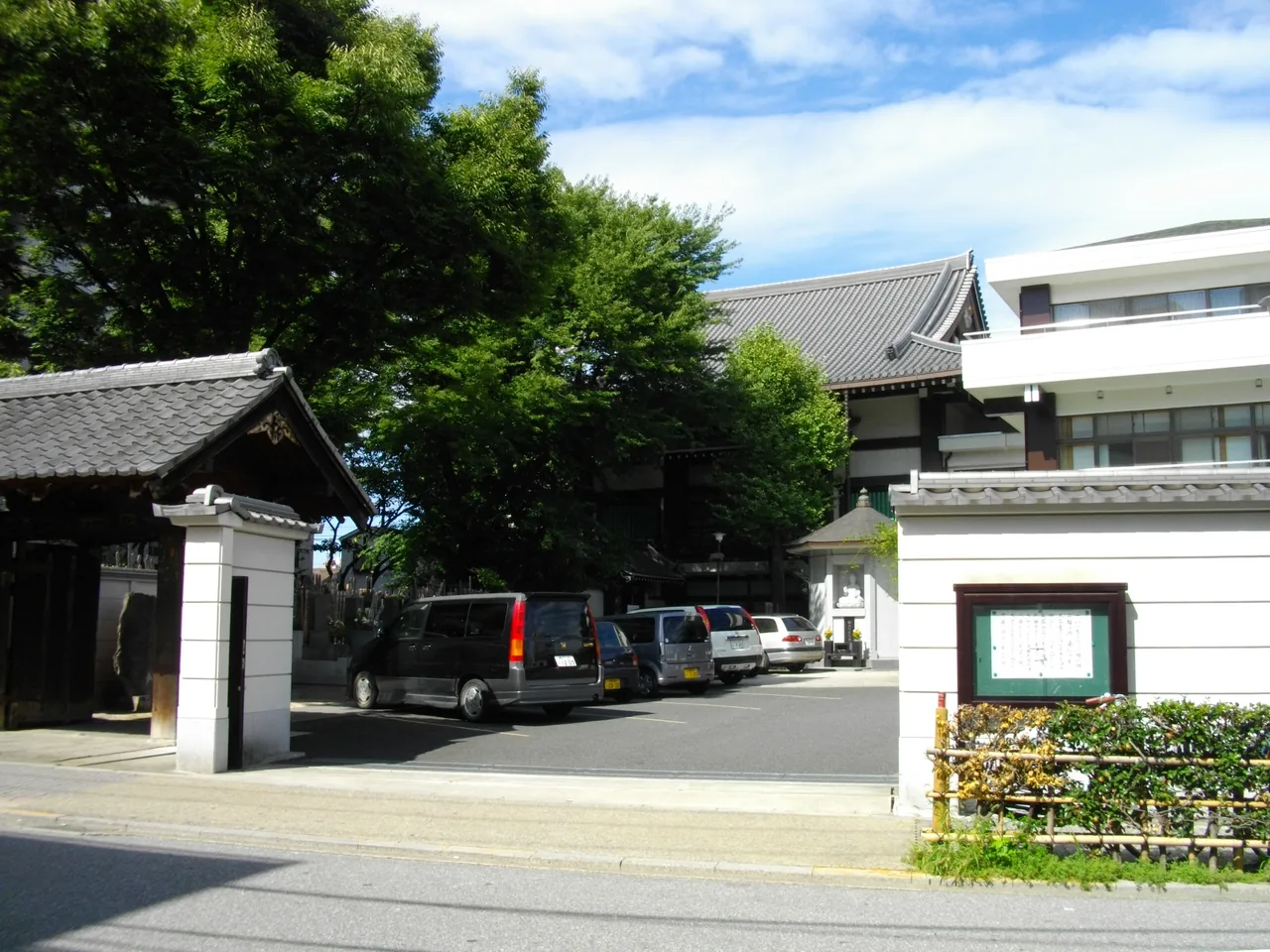
One minute from Minowa Station stands a temple with a brutal nickname: Nagekomi-dera, the “Throw-in Temple.” Behind that name are the women of Yoshiwara—workers sold into contracts, victims of fire, earthquake and disease, and people whose lives were often reduced to entertainment for someone else. Jōkanji is where Tokyo remembers them.
On this page
- The temple outside Yoshiwara’s walls
- Why was it called the “Throw-in Temple”?
- “Born into suffering, dead at Jōkanji”
- Yoshiwara survived into the age of photography
- The writer who asked to be buried here
- A respectful walk from Minowa to old Yoshiwara
- Before you go
- Where this joins the rest of the east side
- Quick answers
Fast facts
- Admission: Free. No entrance fee for the publicly accessible areas; the grounds are open in daytime
- Where: Minamisenju, Arakawa City, Tokyo, just north of the former Yoshiwara district
- Nearest: Minowa Station (Hibiya line), about 1 minute on foot
- Note: Some cemetery sections may be closed. Keep voices low and do not photograph mourners
The temple outside Yoshiwara’s walls
Jōkanji was founded in 1655, only two years before the licensed pleasure district moved from central Edo to Shin-Yoshiwara. The new district occupied what is now Senzoku in Taitō City. Jōkanji stood beyond its northern side, close enough to become inseparable from the lives and deaths inside.
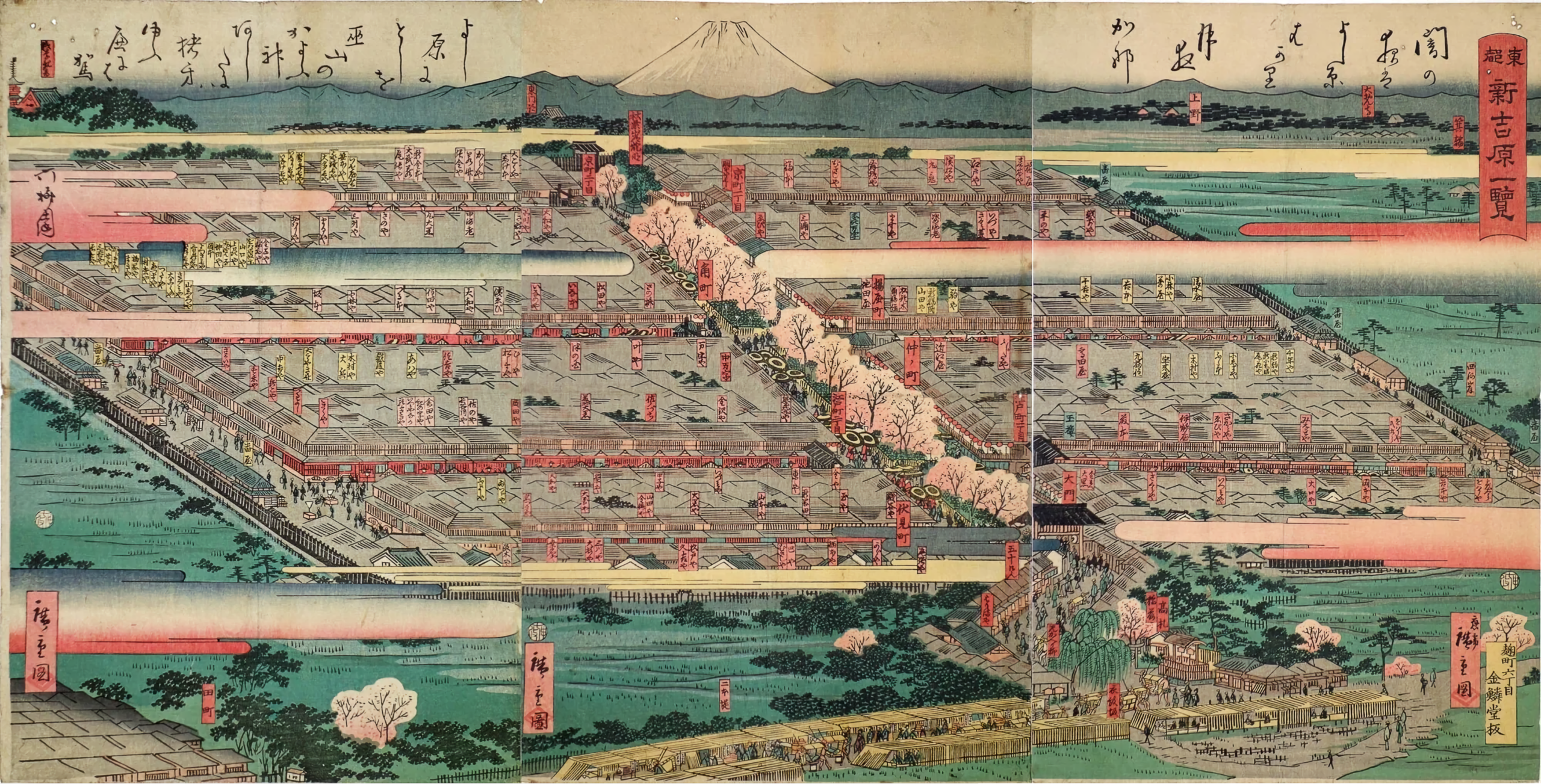
Yoshiwara is often sold to modern audiences as a world of elaborate courtesan fashion, cherry blossoms and ukiyo-e beauty. It was also a controlled compound. A wall and moat separated it from surrounding fields, and entry was channelled through a principal gate. Many women had been sold into years of service through poverty and debt. Their movement was restricted, their earnings absorbed by contracts, and disease or fire could end a life long before freedom arrived.
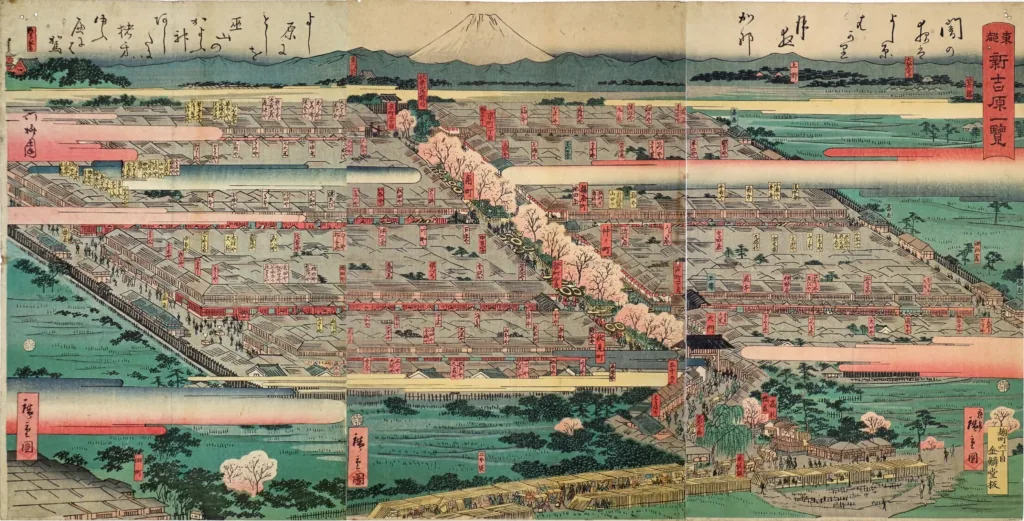
The print above is seductive from a distance: an orderly square floating among rice fields. Look again and its geometry becomes the story. Yoshiwara was not simply a colourful neighbourhood. It was a bounded commercial system in which female bodies, labour and time were tightly managed.
Why was it called the “Throw-in Temple”?
The nickname became associated with Jōkanji after the Ansei Edo earthquake of 1855. The disaster devastated Yoshiwara, and the bodies of women killed there were buried at the temple in a manner described by local history as resembling being “thrown in.” The phrase is shocking because the treatment was shocking.
But the nickname can produce a false villain. Jōkanji was not the institution exploiting these women; it became a place that received and memorialised people whom the licensed district and wider society had left without secure family graves. The temple’s role was remembrance.
Over the centuries, women and others connected with Yoshiwara continued to be buried here. A commonly cited estimate places the number at roughly 25,000, though it should be read as an estimate rather than a complete modern census. More concrete evidence survives in Jōkanji’s historical death registers, which record courtesans and their children across generations.
“Born into suffering, dead at Jōkanji”
The emotional centre of the grounds is the Shin-Yoshiwara Sōreitō, the collective memorial tower. Set into it is a line by the poet Hanamata Kasui:
Umarete wa kugai, shishite wa Jōkanji.
“Born into a world of suffering; dead, they came to Jōkanji.”
Kugai literally evokes a sea or world of suffering, a Buddhist expression that also became inseparable from the hardship of women in licensed prostitution. The inscription refuses the glamorous Yoshiwara of souvenir imagery. It compresses an entire economic system into one life trajectory: hardship first, an anonymous temple burial last.
Do not visit looking for a spectacle. The memorial contains no visual trick capable of representing thousands of individual lives. Its force comes from repetition—the knowledge that each name in a register once belonged to someone with habits, fears and plans beyond the identity assigned to her by a brothel.
Yoshiwara survived into the age of photography
The licensed district did not vanish with the shogunate. It was rebuilt after repeated fires and disasters, changed its legal form, and continued into the twentieth century. A photograph from 1932 shows a district more modern in architecture but still shaped by controlled sexual commerce.
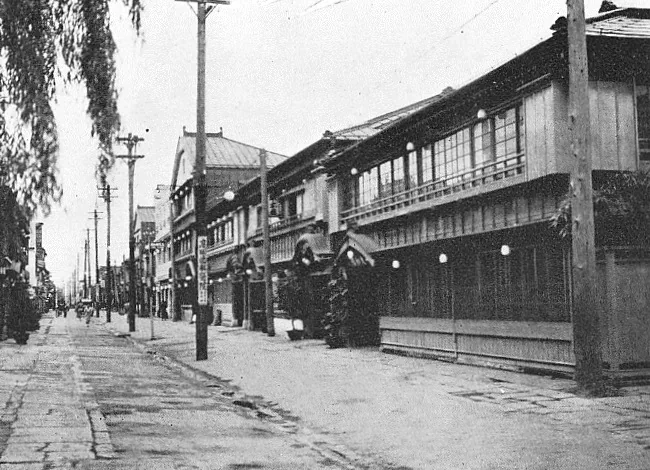
Japan’s Anti-Prostitution Law was enacted in 1956 and fully implemented in 1958, ending the licensed system. Yet the old map remains legible in present-day streets, and parts of the area continue as an adult-entertainment district. The historical Yoshiwara is therefore neither a vanished Edo fantasy nor a simple preserved attraction. It is a place where historical coercion, commercial nostalgia and current working lives overlap.
The writer who asked to be buried here
Novelist and essayist Nagai Kafū repeatedly visited Jōkanji. He spent much of his writing life walking Tokyo’s pleasure quarters and marginal neighbourhoods, recording the urban worlds that official modernisation preferred to erase.
Kafū felt such attachment to the forgotten women memorialised here that he wished to be buried at Jōkanji. That request was not realised, but friends and admirers later established a poetry monument and a mound containing his writing brushes. The temple holds a memorial service for him, Kafū-ki, each year on April 30.
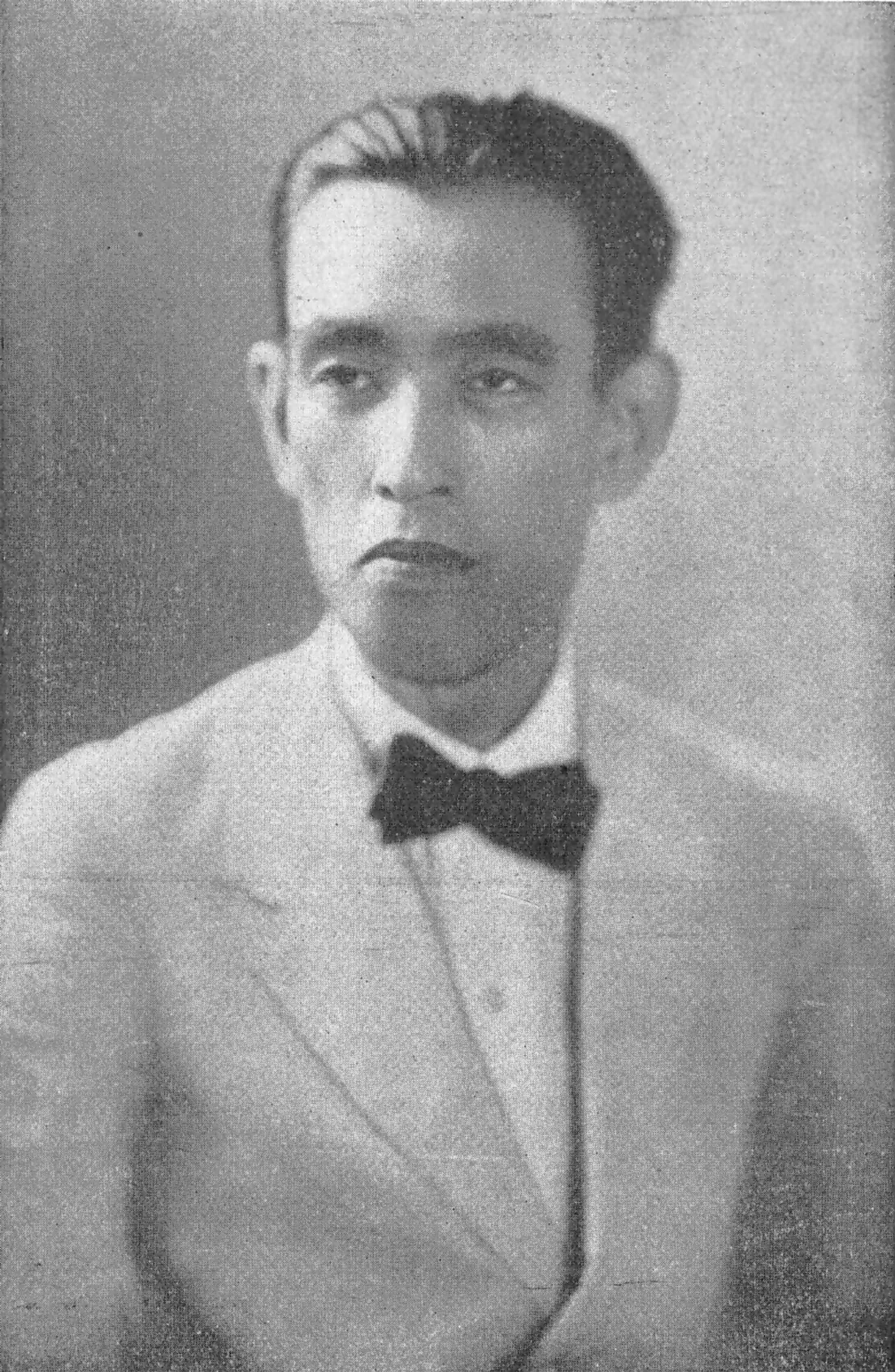
His presence changes the tone of the site. Jōkanji is not only a cemetery of social history; it is also a place about who gets remembered in literature. Kafū recognised that the women excluded from respectable civic narratives were part of Tokyo’s story, not a footnote outside it.
A respectful walk from Minowa to old Yoshiwara
- Begin at Tokyo Metro Minowa Station. Jōkanji is about one minute away, before the modern city has time to become scenic.
- Visit the main temple area first. Read the signs and remember that some cultural properties or cemetery sections may not always be open.
- Pay respects at the Shin-Yoshiwara collective memorial. Avoid posed or “haunted Tokyo” photography.
- Look for the Kafū monuments. They connect the cemetery to the literature of Tokyo’s disappearing backstreets.
- Walk south toward the former Yoshiwara. The old district’s rectangular outline can still be sensed in the street pattern; the former Great Gate area and Mikaeri Yanagi mark the historic approach.
Be especially careful with photography after leaving the temple. The former Yoshiwara remains a working adult-entertainment area. Do not photograph workers, customers, entrances, private businesses or local residents without clear permission. History does not cancel anyone’s present-day privacy.
Jōkanji also fits naturally into a deeper walk through northern Edo’s buried boundary. Continue to the nearby Kozukappara execution ground and Kubikiri Jizō, where another quiet temple landscape preserves people excluded from ordinary records.
Before you go
- Name: Jōkanji (浄閑寺), also known as Nagekomi-dera
- Address: 2-1-12 Minamisenju, Arakawa-ku, Tokyo
- Nearest station: Tokyo Metro Hibiya Line, Minowa Station
- Walking time: About one minute from Minowa Station; about five minutes from Minowabashi on the Tokyo Sakura Tram
- Suggested visit: About 20–30 minutes at the temple; 60–90 minutes with a respectful walk toward former Yoshiwara
- Closing time: 4:30 p.m. from December through February; 5:00 p.m. from March through November
- Admission: No standard entrance fee for publicly accessible areas
- Etiquette: Keep voices low, do not enter closed sections, and never treat graves as horror-film props
Related: Kappabashi, fifteen minutes south: how to buy a Japanese knife without getting it wrong.
Related: Yanaka on a weekday: the free loop from Nippori to Nezu.
Where this joins the rest of the east side
Jokanji sits between two of the east side’s darker sites: the Kozukappara execution ground is a ten-minute walk away at Minamisenju, and the Yoshiwara quarter itself is fifteen minutes south, on the way to Asakusa. North across the Senju Ohashi is Kita-Senju, the old post town where the highway out of Edo began.
Quick answers
Where is Jokanji temple?
In Minamisenju, Arakawa City, about one minute from Minowa Station on the Hibiya subway line, just north of the former Yoshiwara district in Taito City. The grounds are free and open in daytime.
Why is Jokanji called the Throw-in Temple?
The nickname Nagekomi-dera dates from the Ansei earthquake of 1855, when the bodies of Yoshiwara women killed in the disaster were buried at the temple in a manner local history describes as ‘thrown in’. The temple received and memorialized women whom the licensed district left without family graves.
How many Yoshiwara women are buried at Jokanji?
A commonly cited estimate is around 25,000 over the centuries, based on the temple’s death registers, which record courtesans and their children across generations. The figure is an estimate rather than a modern count.
Can visitors go inside Jokanji?
The grounds, the Shin-Yoshiwara memorial tower and the Nagai Kafu monument are open to visitors. It is an active temple and a burial ground: no tripods, quiet voices, and a small bow at the memorial are appropriate.
LOCAL SIDE JAPAN checked historical, location and access information against Jōkanji and Arakawa City materials on September 12, 2026. The often-repeated total of roughly 25,000 burials is presented as an estimate. Opening conditions may change for ceremonies, maintenance or temple circumstances.