This article contains affiliate links to booking sites. If you book through them, LOCAL SIDE JAPAN earns a small commission at no extra cost to you. The tour recommended first at Tsukiji costs ¥2,000 and the most expensive one in the same alley costs ¥15,000. How this site is made →
TOKYO / EXPERIENCES / FOOD TOURS, BY AREA
Eight different companies will walk you down the same four hundred metres of the Tsukiji outer market, and they charge between ¥2,000 and ¥15,000 to do it. The market is free to enter and open to anyone. So the only question that matters is the one no listing puts in its title: how much of the food is in the price? One ¥4,000 tour states plainly that the food is not included and the guide will only point at it; one ¥2,000 tour is the guide alone, and the food is ¥200 to ¥500 a stall on top. This page sorts every food tour in Tokyo by area and by that question, and says where a guide is genuinely worth the money and where you are paying someone to walk beside you. Prices, inclusions, meeting points and review counts were read on the booking sites on September 25, 2026.
On this page
- The only question that matters
- Tsukiji: the same alley, eight prices
- Toyosu and the tuna auction
- Asakusa, Ueno and Yanaka
- Shinjuku and Shibuya: the big evening tours
- The east side has none, and how to do it anyway
- Which one to book
- What the reviews say, and what they mean
- Where this joins the rest of the east side
The only question that matters
Read the inclusions line before the price. Food tours split into three kinds and the titles do not distinguish them:
- Guide only. You pay for the walk and the explanation; every bite is your own money on top. One Tsukiji listing says so in as many words: the foods are not included in the tour fee. At ¥4,000 that is a reasonable price for two hours of a person’s time, as long as you knew.
- Guide plus tastings. The normal product: five to fifteen small plates paid for by the operator. This is where ¥11,000 to ¥15,000 goes, and per plate it is usually fair.
- Guide plus a full meal and drinks. The evening izakaya tours: nine dishes at four places with five drinks is dinner, and comparing its price to a lunchtime market walk is comparing dinner to a walk.
One more thing to hold on to: at Tsukiji and Ameyoko, admission is not a thing that exists. A few listings put “Entry/Admission — Tsukiji Fish Market” in their inclusions. The outer market is a public street. What you are buying is the ordering, the language, and someone who knows which of two identical-looking stalls is the good one — which is a real service, just not an entry ticket.
Tsukiji: the same alley, eight prices
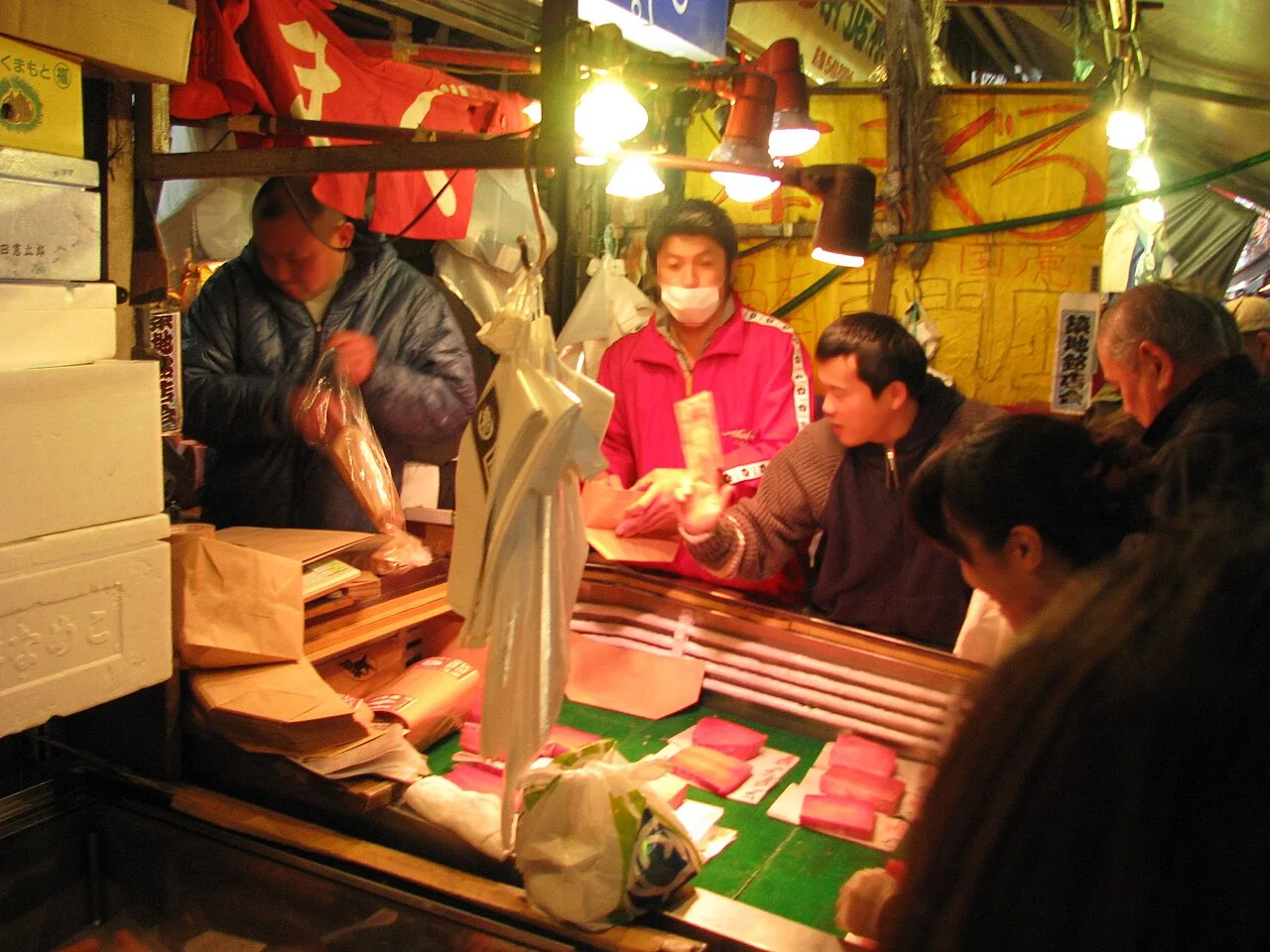
Tsukiji Street Food and Culture Walking Tour is the one to book: about ¥2,000 for ninety minutes, 5.0 from over 1,350 reviews, meeting at Tsukiji Hongwanji. The inclusions line says Meals, but the reviews describe something plainer and better value: the guide takes you to the stalls and you buy what you want, at stall prices of ¥200 to ¥500. That makes it a fraction of what the others charge for the same street, and its review record is among the deepest in the category. The ¥2,000 is the guide; bring cash for the food (what the reviews say).
Above it, in order of what you actually get:
- Tsukiji Food and Walking Tour — about ¥2,500 on offer from ¥5,000, two hours, 4.9 from over 2,000 reviews, the deepest review record at Tsukiji. Hongwanji temple plus the outer market with vendors the guide picks.
- A two-hour guided walk at about ¥3,200 with photographs taken for you — food and drinks are not in this one.
- Walking tour with sashimi tasting — about ¥5,500 for an hour and three quarters, meals included, 4.9 from about 155 (it was ¥3,800 when this page was first written).
- Food and Culture Walking Tour — about ¥4,000, and the listing states the food is not included and the guide will tell you where to buy it. Honest, and worth knowing before you compare it to the ¥2,000 one.
- Behind the Scenes with 10 seafood tastings — about ¥12,760, 4.9 from over 900, five different cuts of tuna, uni and ikura, and a sixty-year-old restaurant. This is the one to pick if the tuna is the reason you came.
- A small-group tour billed as brunch — about ¥14,590, 5.0 from about 500: bluefin sushi, wagyu cutlet, oyster and sea bream sashimi, tamagoyaki, conger eel, dashi. A meal, not a tasting.
- The ¥15,000 five-tasting tour — 4.9 from over 3,700 reviews, the most-booked at Tsukiji, capped at six to eight guests. You are paying for the small group and the reliability, not for more food than the ¥12,760 one.
Go before 10am whatever you book. Tsukiji’s outer market is a morning trade; by early afternoon the good stalls have sold out and closed, and a tour at 2pm is a tour of shutters.
Toyosu and the tuna auction
The wholesale market moved from Tsukiji to Toyosu, in Koto City, in 2018, and the tuna auction goes with it — this is the one part of the category that is genuinely on the east side. You can visit the observation decks yourself for nothing, but the lower viewing floor, where you are close enough to see the auctioneer’s hand signals, is a lottery you have to apply for; a guide who holds slots removes that problem.
The complete tuna auction and Toyosu market tour is about ¥19,000 for four to five hours, 5.0 from about 55 reviews, with a government-licensed guide of ten years, hotel pickup, and — the actual reason to book it — a held reservation at Daiwa Sushi or Ichiba Sushi, where the queue otherwise starts before dawn. A three-hour version pairing the auction with Tsukiji runs about ¥25,000, 4.8 from over 210. Both start around 5am. Nothing about this is a lie-in.
Asakusa, Ueno and Yanaka
Asakusa. Twelve dishes at four local eateries with two drinks, about ¥11,250 for two and a half hours, 4.9 from about 230, meeting at the Kaminarimon police box — the best value per plate in the district. The street food crawl, about ¥11,500 for two hours, 5.0 from about 280, starts at a standing sushi bar and is a full lunch across five-plus vendors. If you want a short one, a private two-hour Asakusa and Senso-ji walk with three food stops is about ¥8,000 and takes in Kappabashi, which pairs with the knife street guide.
Ueno. The food is under and around Ameyoko, the market strip beside the tracks, and it is the most atmospheric eating in this article. The small-group evening tour — about ¥16,000, often discounted, 4.9 from about 50 — is nine dishes at three or four places plus ramen and around five drinks: that is a full night out, and priced as one. The private version with sushi, gyoza and yakitori runs about ¥17,500, 4.9 from about 330. There is also the taverns-and-ramen tour covered in the ramen comparison, which at ¥16,500 and 4.9 from over 1,170 reviews has by far the deepest record in Ueno.
Yanaka. A private two-hour walk with two food stops from Nezu is about ¥7,000 — cheap, but note that the listing counts only two selections and lists additional food as your own expense. Private home cooking in Yanaka, about ¥18,500 and 5.0 from about 180 reviews, is the better use of the neighbourhood: someone’s kitchen, ingredients provided, lunch afterwards. Either way, the Yanaka walk is free and Yanaka Ginza’s croquettes cost ¥200.
Shinjuku and Shibuya: the big evening tours
The two largest operations in Tokyo are both west, both in the evening, and both genuinely good — the review counts are not the kind you can fake. The Shinjuku food tour: three hours, 13 dishes at four eateries with two drinks, about ¥13,000, 4.9 from over 9,800 reviews, the most-reviewed food tour in the city by a distance. The izakaya tour: three and a half hours, 14-plus tastings at three or four izakaya, about ¥14,000, 5.0 from over 3,380.
Cheaper and rowdier, the Shinjuku bar and izakaya crawl is about ¥6,000 for three hours, 4.9 from nearly 1,400 — a drinking tour where you buy your own, and the closest thing in the west to a senbero night. Shibuya’s 13-dish tour is about ¥13,000, 4.9 from about 1,275. For dietary restrictions, a vegan-friendly Shibuya night tour runs about ¥18,600, 4.9 from about 130, and is the only listing in this article built around them.
Related: The unguided version of the same night is Golden Gai, where the seat charge and the photo rules are the whole problem.
The east side has none, and how to do it anyway
Searched every way it can be searched: there is no bookable food tour in Sumida, Koto, Katsushika, Adachi or Edogawa. Toyosu’s auction tours are the only thing east of the river, and they are about a wholesale market rather than a neighbourhood. This is a gap in the market and, for a visitor, an invitation, because the two best eating streets on this side of the city need no guide at all:
- Sunamachi Ginza in Koto: 670 metres, about 180 shops, and a shotengai where the custom is to eat as you go. Croquettes, grilled fish, oden by the piece, tempura, all in the ¥100–¥300 range. Two thousand yen is a large lunch. No guide exists and none is needed; the shopkeepers will hand you things.
- Kita-Senju in Adachi: the old post town’s standing bars, where senbero — getting drunk for ¥1,000 — was more or less invented. The Shinjuku crawl above costs ¥6,000 to do a tidier version of this.
If you want a guide on this side anyway, the closest thing is the Ueno evening tours, which are fifteen minutes from Asakusa, or a yakatabune dinner boat, which is the east side’s own way of eating in company.
Which one to book
| If you want | Book | Area | About |
|---|---|---|---|
| Best value, full stop | Tsukiji Street Food and Culture Walk | Tsukiji | ¥2,000 + stall food · 90 min · 5.0 (1,368) |
| The deepest record at Tsukiji | Tsukiji Food and Walking Tour | Tsukiji | ¥2,500 on offer · 4.9 (2,066) |
| Tuna, seriously | Behind the Scenes, 10 tastings | Tsukiji | ¥12,760 · 5 cuts of tuna · 4.9 (917) |
| The tuna auction | Complete Tuna Auction and Toyosu | Toyosu, Koto | ¥19,000 · sushi reservation held · 5.0 (55) |
| Most dishes per yen | Asakusa, 12 dishes at 4 eateries | Asakusa | ¥11,250 · 2.5 h · 4.9 (229) |
| An evening out, east | Ueno small-group foodie evening | Ueno | ¥16,000 · 9 dishes, 5 drinks · 4.9 (51) |
| The safest booking in Tokyo | Shinjuku food tour | Shinjuku | ¥13,000 · 4.9 (9,843) |
| Izakaya, done properly | Best of Shinjuku izakaya tour | Shinjuku | ¥14,000 · 14+ tastings · 5.0 (3,383) |
| Drinking, cheap | Shinjuku bar and izakaya crawl | Shinjuku | ¥6,000 · buy your own · 4.9 (1,388) |
| Vegan | Vegan-friendly Shibuya night tour | Shibuya | ¥18,600 · 4.9 (132) |
| Someone’s kitchen | Yanaka private home cooking | Yanaka | ¥18,500 · 5.0 (181) |
| No guide at all | Sunamachi Ginza, eat as you walk | Koto | about ¥2,000 · free · no booking |
Four things worth knowing
- Market tours are morning, izakaya tours are night. They are not interchangeable, and a market tour after noon is a tour of closed shutters.
- “Entry/Admission” to a market means nothing. Tsukiji’s outer market and Ameyoko are public streets, free at all hours.
- Do not book a restaurant afterwards. On the evening tours, twelve to fifteen tastings is a meal.
- Allergies and vegetarianism need naming at booking. A tasting tour is a fixed route through other people’s kitchens; the guide cannot improvise at the third stop.
What the reviews say, and what they mean
A 4.9 average tells you almost nothing when every tour in the table has one. So on September 29, 2026 I read the low end instead: every one-, two- and three-star review Viator would show for the five most-reviewed tours in this article, plus the most recent page of top ratings for each — 125 reviews in all. What follows is my summary in my own words. A complaint that appeared once is left out; a complaint that kept coming back is in. Where a tour has no complaint that repeats, this says so rather than inventing one.
| Tour | Reviews | One to three stars | Repeated complaint? |
|---|---|---|---|
| Shinjuku food tour, 13 dishes | 9,916 | 124 (1.3%) | Yes — see below |
| Tsukiji five-tasting tour, ¥15,000 | 3,779 | 103 (2.7%) | Yes — see below |
| Best of Shinjuku izakaya tour | 3,438 | 13 (0.4%) | None found |
| Tsukiji street food walk, ¥2,000 | 1,368 | 6 (0.4%) | None found |
| Ueno taverns and ramen | 1,176 | 10 (0.9%) | None found |
The Shinjuku food tour: good guides, ordinary rooms, a lot of standing
The praise is almost always about the guide by name, the pace, and the other people in the group. The complaints, across thirty low reviews, come back to three things: the food is ordinary for ¥13,000; a good part of it is eaten standing in the street from a tray or a shared plate; and “13 dishes” turns out to mean thirteen tastes. A fourth thread, in four reviews, is that the guide was not Japanese and said little about what was being eaten. One reviewer put the first point better than I can: “it felt like the restaurants were chosen more for their capacity to handle tour groups than for the quality” (a reviewer on Viator, May 2026).
What that means from here. The standing is not the operator cutting corners; it is the size of Shinjuku. Omoide Yokocho, the first stop, is about eighty shops packed onto roughly 2,000 square metres, and many of them are a single counter with eight seats. A group of twelve does not fit through the door, so a tour either feeds you on the pavement or takes you to the bigger, plainer restaurants that can seat twelve — which is exactly the trade the reviews describe. The listing promises a “professional expert guide”, not a Japanese one. What to do: if sitting at a yokocho counter is the point, go on your own, as a pair, early in the evening while the counters still have room; if the guide’s background matters to you, ask before you book.
The ¥15,000 Tsukiji tour: Japanese guides, closed shutters on the wrong day
The praise is for guides who know the stallholders personally and for the finish, where a chef fillets a fish and you build your own sashimi bowl. The complaints, across thirty low reviews, are that you could walk the same alley yourself, that the tastings are small for the price, and — in four reviews — that the guide’s English was limited, so not much got explained. Three more people booked a Sunday or a Wednesday and found much of the market shut.
What that means from here. Two things are Japanese rather than the tour’s. First, “tour in English” on a Japanese-run tour means the tour is conducted in English, not that the guide is fluent; what you get instead is someone who has bought from these stalls for years. The Shinjuku tour above is the opposite trade — fluent English, less local knowledge — and the reviews of each complain about exactly what the other does better. Second, the wholesale market left Tsukiji for Toyosu in 2018, and the outer market that remains follows the wholesale calendar: Sundays, public holidays and designated Wednesdays are market holidays, and many shops close on them. What to do: check the outer market’s own calendar before you pick a date, and book a Monday, Tuesday, Thursday, Friday or Saturday.
The other three: no complaint that repeats
The Shinjuku izakaya tour has thirteen low ratings out of 3,438, dated between 2019 and 2025, and they do not agree with each other. The praise that repeats is that the portions are generous — several groups were too full for the last stop — and that there is a drink at each one. The Ueno taverns-and-ramen tour has ten out of 1,176, scattered: a cancellation dispute, one person who found the food too unusual, one who found it mediocre. The ¥2,000 Tsukiji walk has six out of 1,368, and no two say the same thing.
What the ¥2,000 walk’s reviews do say, repeatedly and without complaining, is how the eating works: the guide takes you to the stalls and you decide what to buy — “buying food or not was your own decision” (a Tripadvisor reviewer, shown on Viator, September 2026). So despite the Meals line in the inclusions, treat the ¥2,000 as the guide and bring cash for the food. At the stalls that is cheap: a tamagoyaki skewer is about ¥200 and grilled tuna about ¥300.
Which of these are made for foreigners
All of them, and that is not an accusation — a tour that orders for you in English is a foreigner’s product by definition, and on a first night in Tokyo that is worth paying for. The useful question is what a Japanese person pays for the same evening, and how honest each listing is about the gap.
- An izakaya night. The average spend per person at an izakaya in the Tokyo area was ¥4,052 in May 2026, according to Hot Pepper Gourmet’s monthly dining survey. The Shinjuku tours charge ¥13,000 to ¥14,000. The difference buys three hours of a guide, a table that takes a group, and the booking site’s commission. It is worth it if you have never ordered in an izakaya; it is not if you have, which is what the low reviews from people who had already spent time in Japan say.
- A standing-bar crawl. The Ueno tour is ¥16,500 for five dishes and five drinks. The Japanese version is senbero — about ¥1,000 at a standing bar — followed by a bowl of ramen, which averaged ¥1,341 in the same survey. The listing says plainly that what it sells is the translating, and the reviews say it delivers that. Honest foreigner pricing.
- Tsukiji. A Japanese visitor eats down the outer market at ¥200 to ¥500 a stall. The ¥15,000 tour is five tastings plus a guide and a chef’s demonstration, and it says so. The ¥2,000 walk is the one surprise in the other direction: the same company runs the same walk, from the same temple steps, as a pay-what-you-like tour on GuruWalk, where the suggested tip is €15 to €50 a person — more than the fixed ¥2,000 on Viator.
- Where the word “local” is doing the most work. The 13-dish Shinjuku tour is sold as a shortcut to the best places to eat, and it is the only one of the five where “touristy” and “geared for tourists” recur in the reviews. It is still 1.3% of its reviews, and the other 98.7% are right that the evening is fun. Book it as a friendly first night out, not as a list of where Tokyo eats.
Where this joins the rest of the east side
The east side’s answer to a food tour is doing it yourself in Sunamachi Ginza or Kita-Senju, with senbero as the operating manual. To cook rather than eat, the classes compared by area are ramen, sushi and Japanese home cooking; for the Toyosu end of the day there is also teamLab Planets, whose official ticket is ¥4,200; the crafts are kintsugi, Edo Kiriko and Kappabashi knives; and the rest are tea ceremony, kimono rental and samurai and ninja. Everything bookable is on the Experiences page, and the area is in the east side guide.
Quick answers
What is the best food tour in Tokyo?
For value, the Tsukiji street food and culture walk: about ¥2,000 for 90 minutes plus ¥200 to ¥500 a stall for whatever you choose to eat, 5.0 from over 1,350 reviews. For the safest booking, the Shinjuku food tour, 13 dishes at four eateries for about ¥13,000, rated 4.9 from over 9,800 reviews — the most-reviewed food tour in the city. For tuna, the Tsukiji behind-the-scenes tour with ten seafood tastings at about ¥12,760.
How much does a food tour in Tokyo cost?
From about ¥2,000 for a 90-minute market walk with tastings included, ¥11,000 to ¥15,000 for a two to three hour tour with 10 to 15 dishes, ¥16,000 to ¥19,000 for an evening tour that is a full dinner with drinks, and about ¥19,000 to ¥25,000 for a pre-dawn Toyosu tuna auction tour.
Is the food included in a Tokyo food tour?
Not always, and it is the thing to check. Several Tsukiji listings include meals; at least one at about ¥4,000 states that the food is not in the fee and the guide will only point you to it. Read the inclusions line rather than the title, because the price gap between the cheapest and dearest tour of the same street is mostly this.
Do you need a guide for Tsukiji fish market?
No. The outer market is a public street, free to walk at any hour, and the listings that put “Entry/Admission — Tsukiji Fish Market” in their inclusions are describing something that does not exist. A guide buys you the ordering, the language and knowing which of two similar stalls is the good one. Go before 10am either way; the market closes through the early afternoon.
Can you see the tuna auction at Toyosu?
Yes. The upper observation deck is free and open to anyone, and the lower viewing floor, close enough to see the hand signals, is allocated by application. Guided tours hold slots and start around 5am; the complete auction and market tour runs about ¥19,000 and includes a held reservation at one of the market’s sushi counters, where the queue otherwise begins before dawn.
Is there a food tour in Sumida, Koto or the east side of Tokyo?
No bookable neighbourhood food tour exists in Sumida, Koto, Katsushika, Adachi or Edogawa; the Toyosu auction tours in Koto are the only thing east of the river. The east side’s eating streets need no guide: Sunamachi Ginza in Koto is 670 metres of shops where ¥2,000 is a large lunch, and Kita-Senju in Adachi is where the ¥1,000 drinking night was invented.
Should I eat before a Tokyo food tour?
No, and do not book dinner afterwards either. A 12 to 15 dish tour is a full meal, and the evening izakaya tours include around five drinks as well. Eat a light breakfast before a morning market tour and nothing before an evening one.
LOCAL SIDE JAPAN read the price, inclusions, exclusions, duration, meeting point and review record of every listing above on Viator on September 25, 2026. Prices are approximate, move with the exchange rate, and several use group pricing or were on temporary offer. This is a researched comparison of the listings and their reviews, not a firsthand report on each tour, and the article says so here rather than pretending otherwise. Nothing was provided free by an operator.