Kizuku

  • Rickshaw or Guide in Asakusa: ¥5,500 for Thirty Minutes, ¥2,000 for Two Hours

    Rickshaw or Guide in Asakusa: ¥5,500 for Thirty Minutes, ¥2,000 for Two Hours

    This article contains affiliate links to booking sites. If you book through them, LOCAL SIDE JAPAN earns a small commission at no extra cost to you. The option recommended to most readers costs ¥2,000 and the one that pays most costs twelve times that. How this site is made →

    TOKYO / EXPERIENCES / ASAKUSA: RICKSHAW OR GUIDE

    Two things are sold on the same fifty metres of pavement outside Kaminarimon. One is a rickshaw: ¥5,500 for thirty minutes. The other is a guided walk: ¥2,000 for two hours, rated 5.0 from nearly a thousand reviews. People compare them and conclude the rickshaw is a rip-off, which is the wrong conclusion from the right numbers — they are not the same product. The walk buys you a guide. The rickshaw buys you a seat, a photograph and a young person running through back streets telling you what is down them. This page prices both honestly, says which back streets the rickshaw actually goes down, and gives the free version. Prices and review counts were read on the booking sites on September 26, 2026.
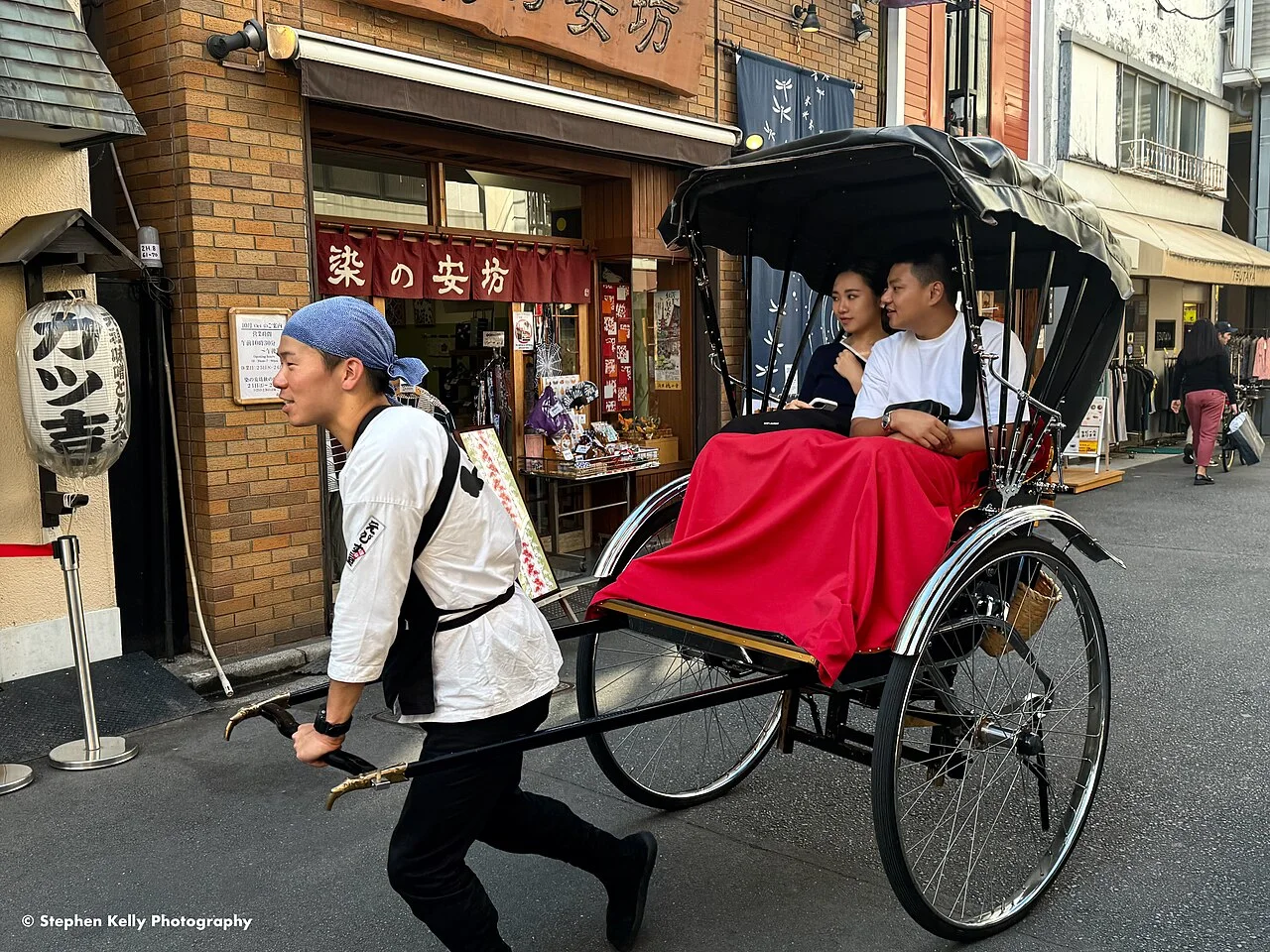
    A rickshaw puller running a couple along a narrow shopping street in Asakusa
    A rickshaw on an Asakusa side street. Note where it is: not the temple approach, but a back lane with a dye shop on the corner — which is the actual argument for taking one. Photo: Stephen Kelly / Wikimedia Commons, CC BY 2.0.

    The two prices

    TimePriceReviews
    Guided walk, Senso-ji and Nakamise2 hours¥2,0005.0 (974)
    Rickshaw, short course30 minutes¥5,5005.0 (43)
    Rickshaw, full course60 minutes¥11,0005.0 (43)

    Per hour that is ¥1,000 against ¥11,000. Stated like that the rickshaw looks absurd, and if what you want is to be told about Asakusa, it is: book the walk. But the walk cannot do the two things the rickshaw exists for, which are covered next.

    What a rickshaw is actually for

    The back streets. Look at the photograph at the top of this page: that is not the temple approach, it is a lane behind it. Rickshaws spend most of their route in the narrow streets north and west of Senso-ji — Asakusa’s old craftsmen’s blocks — precisely because Nakamise is too crowded to pull a cart down. You end up on streets you would not have found, moving at the speed the district was built for. That is a genuine thing to buy, and no walking tour with twelve people in it goes there.

    Not walking. Unglamorous and the real reason many people book: it is a seat. For anyone with a knee, a pushchair-free hour, a very hot August afternoon, or grandparents who want to see the district without three kilometres of paving, ¥5,500 for thirty minutes is transport, not entertainment.

    The photograph. The pullers take it, they know every angle in the district, and they are very good at it. If the photograph is the point, this is cheaper than the ¥19,000 photographers in the kimono rental comparison — and pairing a ¥2,000 kimono with a thirty-minute rickshaw is the best-value version of the Asakusa photo day, at about ¥7,500 all in.

    What it is not: a way of covering ground. Thirty minutes is a loop, not a transfer, and you come back to where you started.

    The rickshaws, by length

    The main Asakusa rickshaw tour is the one with the record: 5.0 from over 1,400 reviews, the deepest of any rickshaw listing in Japan, from about ¥6,000 with the price set by group size, and courses from thirty minutes to three hours. Meeting at 1-1-3 Asakusa by the station. If you book one rickshaw, book this.

    The clearest pricing comes from a smaller operator running out of the Asakusa Town Hotel: thirty minutes at about ¥5,500 covering the history, the sights and the Skytree view, or sixty minutes at about ¥11,000 for the complete circuit including the smaller shrines. Both 5.0 from about 40 reviews, both with the fee, the guiding and the tax stated in one number, which is rarer than it should be.

    Two combinations, if you want the ride inside something longer. A two-and-a-half-hour package at about ¥7,500 per group puts the rickshaw together with kimono rental and a tea ceremony — priced per group rather than per person, which for two people makes it the best-value thing on this page; it is new, with only a handful of reviews. And a sushi class with a rickshaw ride runs three and a half hours at about ¥24,000 with hotel pickup — a whole morning, and priced as one.

    One thing to settle before you get in: ask whether the price is per person or per rickshaw. A rickshaw seats two, and operators differ. The listings that say “price varies by group size” mean the first, and the ¥7,500 package above says “per group”, which is a ¥15,000 difference for a couple.

    The walking tours, from ¥2,000

    Asakusa and Senso-ji, the oldest temple: two hours, about ¥2,000, 5.0 from nearly 1,000 reviews, meeting at the Kaminarimon police box. This is the best-value guided anything in this entire experiences series. Two hours of a local guide for the price of two coffees.

    Close behind, a small-group version at about ¥2,250, 5.0 from over 330. Paying more mostly buys a smaller group rather than more content: about ¥4,300, 5.0 from over 1,090, and about ¥4,825, 5.0 from over 1,070 — the two deepest review records in the district. The averages are the same to one decimal place, but they are not equally safe bookings: the ¥4,825 tour carries eight times the proportion of low ratings that the other three do, and for a reason that repeats. That is in what the reviews say below, and it is the single most useful thing on this page.

    The one genuinely different walk is the small-group night walk, about ¥5,720 with a drink included, 5.0 from about 20 reviews, built around photo spots after dark. Senso-ji is lit until 11pm and almost empty, and nobody does this.

    The free version

    Senso-ji’s grounds never close. Go at 6:30 in the morning: the main hall opens at six, the incense is lit, the shutters on the Nakamise stalls are down and painted with murals nobody sees in daylight, and there are more people sweeping than visiting. It costs nothing and it is better than any of the above. That morning is the opening argument of the Asakusa workshops ranking, and it has not changed.

    Then, in daylight, walk it yourself: Kaminarimon, Nakamise, the main hall, and then turn left — into Denboin-dori and the streets behind, which is where the rickshaws go and where the district still works. Kappabashi is fifteen minutes further west and free to wander.

    Which to book

    If you wantBookPriceAbout
    To be told about AsakusaSenso-ji oldest temple walk¥2,0002 h · 5.0 (974)
    The same, smaller groupAsakusa history and culture walk¥4,8395.0 (1,074)
    The rickshaw, best recordTokyo Asakusa Rickshaw Tourfrom ¥6,00030 min–3 h · 5.0 (1,421)
    The rickshaw, clearest price30-minute course from Asakusa Town Hotel¥5,500fee and tax included
    Rickshaw, kimono and teaAsakusa with Rickshaw Guide¥7,500 per group2.5 h · priced per group
    Photographs, cheapest route¥2,000 kimono + 30-minute rickshawabout ¥7,500see the kimono guide
    Something nobody else doesAsakusa night walk with a drink¥5,7202 h · 5.0 (21)
    Nothing at allSenso-ji at 6:30amfreethe best hour in Asakusa

    What the reviews say, and what they mean

    Every tour on this page averages 5.0, which makes the average useless for choosing. So on September 29, 2026 I read the bottom instead: 26 of the 41 one-, two- and three-star reviews Viator will display across the four biggest listings, plus the top-rated page for each. What follows is my summary in my own words. A complaint that appeared once is left out; one that kept coming back is in. Where nothing repeats, this says so.

    ListingReviewsOne to three starsRepeated complaint?
    Asakusa rickshaw tour1,4225 (0.4%)None found
    Walking tour, ¥2,0009873 (0.3%)One, about food
    Walking tour, ¥4,3001,0914 (0.4%)None found
    Walking tour, ¥4,8251,07729 (2.7%)Yes — two of them
    Star breakdowns as shown on Viator (Viator and Tripadvisor combined) on September 29, 2026.

    The ¥4,825 tour: people cannot find the guide

    Of its fifteen one-star reviews, most are not about the tour at all — they are from people who never found it. The meeting point is the left side of Kaminarimon, and one reviewer explains the problem better than any complaint could: the area “had about 25 different guides and no way to figure which was ours”, and they had asked in advance for a flag colour or a shirt colour and been told the guide’s details could not be given out (a reviewer on Viator, September 2025). Others describe arriving five or ten minutes late and finding nobody, or losing the group in the crowd on Nakamise within minutes of starting.

    The second repeated complaint, across one, two and three stars, is the honest one: that the temple is free, the area is easy, the pace was rushed, and you could have done it yourself. Several say the guide was pleasant but that an hour of content was stretched over two.

    What that means from here. Kaminarimon is probably the hardest meeting point in Tokyo. It is one gate, it is the photograph everybody takes, and on a spring weekend there are thousands of people in front of it at any moment — along with, as that reviewer counted, roughly twenty-five other guides holding signs. The operators’ own replies set out the rule that catches people: the guide waits about ten to fifteen minutes and then leaves, and a no-show is not refunded. That is not sharpness; a tour that waits for one late arrival is late for everyone else, and in a city where the trains run to the minute nobody builds slack into a schedule. What to do: arrive fifteen minutes early, not five; message the operator the day before and ask what the guide will be holding and wearing; and note that the meeting points differ between these tours — Kaminarimon police box for two of them, the left side of the gate by the Tokiwado kaminari-okoshi shop for another. Check which one you booked.

    The ¥2,000 tour: the street food is pointed at, not eaten

    Three low reviews out of 987, and two of them say the same thing: the description led them to expect tasting, and what happened was the guide naming foods as the group passed them. One reviewer noted that the itinerary does say “pass by”, and that the guide seemed surprised anyone wanted to stop and buy. The operator replied publicly that it would review the wording of the listing. That is a fair response, and it is also the answer: book this as two hours of guiding for ¥2,000, and eat before or after. At that price it is still the best value on this page.

    The rickshaw: the cleanest review record on this site

    Five ratings below four stars out of 1,422 — 0.4%, and lower than anything else compared anywhere on this website. The one two-star review says the ride was too long and did not show enough. There is no second complaint to report.

    What repeats in the praise is worth reading, because it is not what you would guess. People name their puller. They mention his English, unprompted and often. They mention the photographs he took — this comes up more than the ride does. Several mention practical care: rain covers and blankets in April rain, and one family whose wheelchair user was got aboard and round the route. “Best way to see Asakusa and save your feet” (a reviewer on Viator, May 2026) is the most honest summary of the product anybody has written, including this article.

    Which of these are made for foreigners

    This is the question this site asks of every bookable thing in Tokyo: what does a Japanese person pay for the same afternoon? On this page the answer is unusual, and it goes both ways.

    • The rickshaw is not foreigner-priced. It is cheaper than the Japanese rate. Ebisuya is the large, Japanese-language rickshaw company and its Asakusa branch publishes its prices openly: ¥10,000 for thirty minutes for two people, or ¥9,000 for one, rising to ¥17,000 for forty-five minutes and ¥23,000 for seventy. The listings in this article are about ¥5,500 for thirty minutes and ¥11,000 for sixty. Whatever else is going on in Asakusa, the English-language rickshaw is at or below what the Japanese-facing operator charges — so if you have been assuming a foreigner premium here, drop it, and ask instead whether the price is per person or per rickshaw, which is where the real difference lies.
    • The walking tours have a free Japanese counterpart, and it is a hundred metres away. Taito City runs free volunteer-guided walks of Senso-ji: Saturdays and Sundays, starting 10:00 and 12:00, about an hour, no booking, leave whenever you like. They set off from the ground floor of the Asakusa Culture Tourist Information Center at 2-18-9 Kaminarimon — the building across the road from the gate where the paid tours lose people, and the same building the ¥5,720 night walk meets at. The council’s page does not say which languages the volunteers speak, and the centre’s own multilingual service is a separate thing, so this is worth a phone call rather than a gamble. But if you are in Asakusa on a weekend morning and your plans are loose, the honest order is: try the free one first, and book a paid tour if it does not suit.
    • What the ¥2,000 to ¥4,825 actually buys, then. A guaranteed slot on a weekday, in English, with a group size the listing states. That is a real product and ¥2,000 for two hours of it is cheap. What it is not is access — Senso-ji is free and open all night, which is why “we could have done this ourselves” keeps appearing in the low reviews of the dearest tour and almost never in the cheapest.

    Where this joins the rest of the east side

    This completes the set. Everything bookable in and around Asakusa now has a comparison on this site: kimono rental by price, the seven workshops ranked, calligraphy, ikebana and wagashi, tea ceremony, kintsugi, ramen and soba, sushi, home cooking, food tours, samurai and ninja, Skytree and teamLab tickets and the boats. Walk out of the district on foot along the Sumida River, and the rest of the area is in the east side guide. Everything is listed on the Experiences page.

    Quick answers

    How much is a rickshaw ride in Asakusa?

    About ¥5,500 for thirty minutes and ¥11,000 for an hour from the clearest-priced operator, with fee, guiding and tax included. The most-reviewed rickshaw tour in Asakusa starts from about ¥6,000 with the price set by group size and runs courses from thirty minutes to three hours. Always confirm whether the quote is per person or per rickshaw — a rickshaw seats two and operators differ.

    Is a rickshaw in Asakusa worth it?

    It depends what you are buying. Per hour it is ¥11,000 against ¥1,000 for a guided walk, so if you want to be told about Asakusa, book the walk. The rickshaw is worth it for three other things: it goes down the back streets behind Senso-ji that crowds and walking tours do not reach, it is a seat for anyone who cannot walk the district, and the pullers take very good photographs.

    What is the best walking tour in Asakusa?

    The two-hour Senso-ji and Asakusa walk at about ¥2,000, rated 5.0 from nearly 1,000 reviews, meeting at the Kaminarimon police box — the best value guided anything in Tokyo. Paying ¥4,300 to ¥4,839 buys a smaller group rather than more content, and those tours have the two deepest review records in the district.

    How long does a rickshaw tour in Asakusa take?

    Thirty minutes is the standard short course and covers the temple surroundings, the back streets and a Skytree viewpoint. Sixty minutes adds the smaller shrines and the wider district. Longer courses up to three hours exist. Thirty minutes is a loop that returns to where you started, not a transfer to somewhere else.

    What is the cheapest way to see Asakusa with a guide?

    ¥2,000 for the two-hour Senso-ji walking tour. Free if you go yourself: the temple grounds never close, the main hall opens at six, and at 6:30 in the morning the Nakamise shutters are down and painted with murals, with more people sweeping than visiting.

    Can you combine a rickshaw with kimono rental in Asakusa?

    Yes, and it is the best-value photo day in the district. A package combining rickshaw, kimono rental and a tea ceremony runs about ¥7,500 priced per group for two and a half hours. Booking separately, a ¥2,000 kimono with hair and make-up plus a thirty-minute rickshaw comes to roughly ¥7,500 as well — against ¥19,000 for a professional kimono photoshoot.

    When is Asakusa least crowded?

    Before 9:30 in the morning and after about 7 in the evening. Senso-ji’s grounds are open all night and lit, the main hall opens at six, and the crowd builds from about 10:30 and stays until dusk. A night walking tour at about ¥5,720, built around photo spots after dark, is the one guided option that uses the quiet half of the day.


    LOCAL SIDE JAPAN read the price, inclusions, duration, meeting point and review record of every listing above on Viator on September 26, 2026. Prices are approximate, move with the exchange rate, and several are set by group size rather than per person — confirm which before you board. This is a researched comparison of the listings and their reviews, not a firsthand report on each operator, and the article says so here rather than pretending otherwise. Nothing was provided free by an operator.
    Written by Kizuku. I run the Sunamachi Ginza Sumo Stable, a sumo experience in Koto City, and I write about the east side of Tokyo I live and work in. More about this site →

  • Boats in Tokyo: The ¥1,000 Water Bus, the ¥11,800 Dinner Cruise, and the One That Is Suspended

    Boats in Tokyo: The ¥1,000 Water Bus, the ¥11,800 Dinner Cruise, and the One That Is Suspended

    This article contains affiliate links to booking sites. If you book through them, LOCAL SIDE JAPAN earns a small commission at no extra cost to you. The boat recommended first costs ¥1,000, is public transport, and pays this site nothing. How this site is made →

    TOKYO / EXPERIENCES / BOATS ON THE SUMIDA AND THE BAY

    Tokyo is a city built on water and almost nobody gets on it. The reason is that the best boat here is not sold as an experience: it is a scheduled water bus, it costs ¥1,000 from Asakusa to Hinode Pier, and you buy the ticket at a window like a train. Meanwhile a “Tokyo Bay cruise” on a booking site is ¥5,323 for thirty to forty minutes, and a yakatabune dinner boat is ¥11,800. All three are legitimate; they are just not the same product, and the listings do not tell you that the ¥1,000 one exists. Here is every boat you can get on in Tokyo, sorted by what it actually is, with fares checked on the operators’ own pages on September 26, 2026 — including one service that is currently suspended and still turns up in guidebooks.

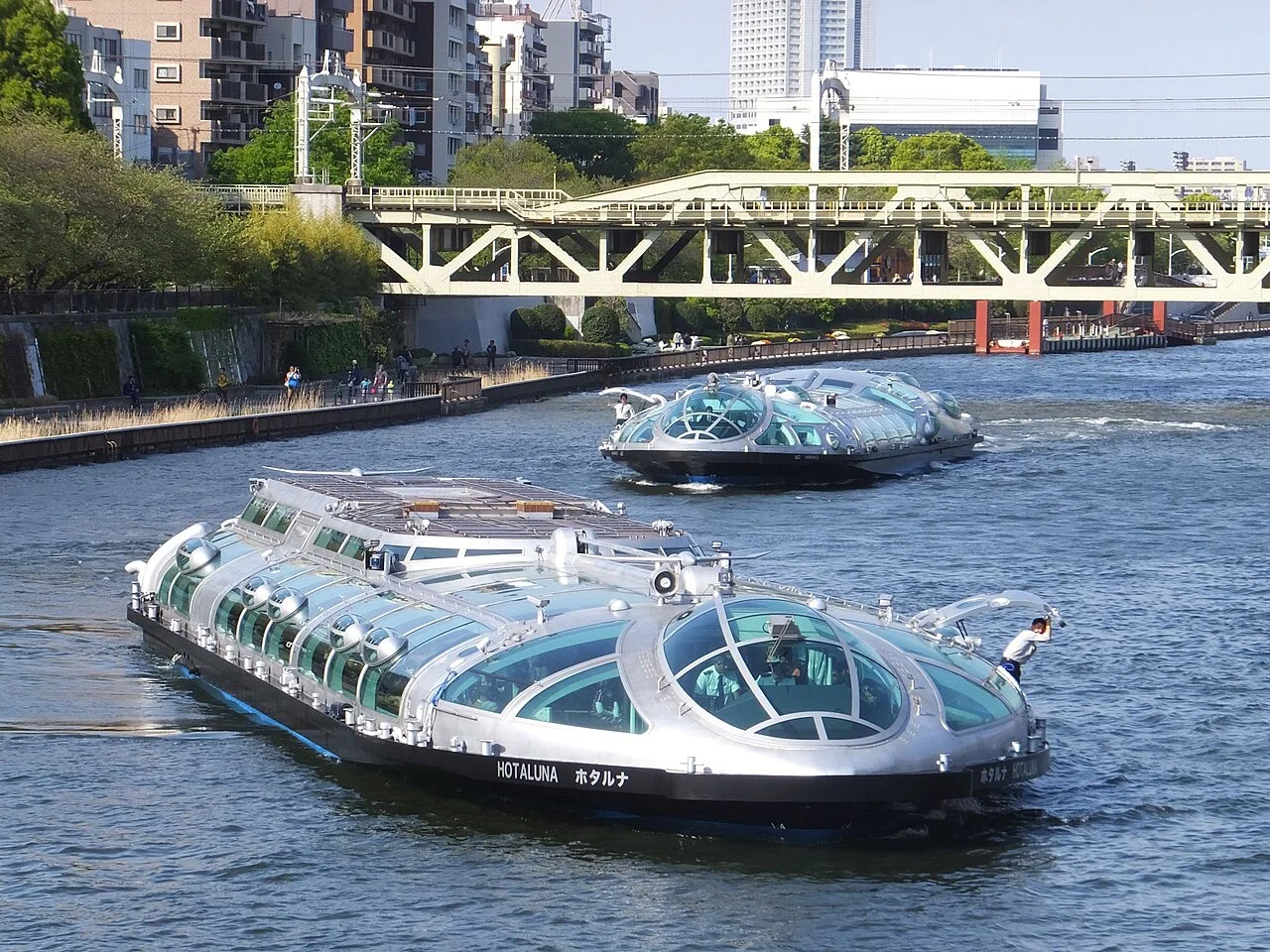
    The Hotaluna and Himiko water buses passing on the Sumida River
    Hotaluna and Himiko on the Sumida. They are scheduled water buses, not cruises, and they were designed by the manga artist Leiji Matsumoto’s studio to look like this. Photo: Tak1701d / Wikimedia Commons, CC BY-SA 3.0.

    What is the Tokyo water bus?

    TOKYO CRUISE — the Tokyo Cruise Ship Company, running since long before anyone called this an experience — operates scheduled boats down the Sumida from Asakusa, out to Hinode Pier on the bay, and on to Odaiba. Asakusa to Hinode is ¥1,000 and takes about forty minutes, and it passes under twelve bridges, each one a different colour and shape, with the Skytree behind you the whole way.

    That is the best value on this page by a distance, and it is also the single best way to understand the geography of the east side: the river is why Koto and Sumida exist, and forty minutes on it explains more than any museum. Buy at the pier window at Asakusa, ten metres from the end of the river walk.

    The famous boats — Himiko, Hotaluna and Emeraldas, the ones that look like something that landed rather than docked — are the same service at a premium. They were designed by the studio of Leiji Matsumoto, the manga artist behind Galaxy Express 999 and Space Pirate Captain Harlock, which is why Emeraldas is named after one of his characters. Children ask to go on these; adults are usually happier on the ordinary boat with the open deck.

    How much is the Tokyo water bus?

    RouteBoatAdult, one wayTime
    Asakusa → Hinode Pierstandard¥1,000about 40 min
    Asakusa → Hinode PierHOTALUNA¥1,400about 40 min
    Hinode Pier → Odaiba Seaside Parkstandard¥520about 20 min
    Hinode Pier → Odaiba Seaside ParkHOTALUNA¥860about 20 min
    Asakusa → Odaiba Seaside Parkstandard, with a transfer¥1,600about 70 min
    Asakusa → Odaiba Seaside ParkHIMIKO / HOTALUNA / EMERALDAS, direct¥2,00050–60 min

    Children are generally half fare. Note the arithmetic in the middle of that table: Asakusa to Odaiba the slow way, with a change at Hinode, is ¥1,520 in two legs or ¥1,600 as a through ticket — against ¥5,323 for a bookable “bay cruise adventure” that lasts thirty to forty minutes and starts at the same Hinode Pier. That listing is rated 4.0 from six reviews. The water bus is not a secret; it is simply not marketed.

    Two practical things. The boats stop running earlier than you expect — this is a daytime service, and the last departures are in the late afternoon or early evening depending on season, so check the day’s timetable at the pier rather than assuming an evening crossing. And they fill on spring weekends, when the riverbank cherry blossom makes this the most popular forty minutes in Tokyo.

    Can I take a boat from Asakusa to Odaiba?

    Yes, two ways, and they cost almost the same. The slow way is the standard boat to Hinode Pier and a second boat on to Odaiba Seaside Park: ¥1,000 plus ¥520, about an hour in total with the change, or ¥1,600 as a single through ticket. The direct way is HIMIKO, HOTALUNA or EMERALDAS straight through for ¥2,000 in 50 to 60 minutes, no change.

    Take the slow one. The change at Hinode costs you twenty minutes and buys you the open deck twice, and the stretch from Hinode out into the bay is the part worth being outside for. The direct boats are enclosed and designed to be looked at rather than looked out of.

    Is there a Tokyo water taxi?

    There is, and it is a different thing from the water bus. Tokyo Water Taxi is a private charter: you book the whole boat rather than a seat. Its published entry price is ¥7,000 per boat for a fifteen-minute run, Shinagawa to Odaiba, with a maximum of eight passengers — which the operator itself points out works out at about ¥875 each if you fill it (Tokyo Water Taxi, checked 5 October 2026). Longer custom routes are quoted separately, and the piers are sent to you after booking.

    For two people it is expensive; for six or eight it is competitive with the scheduled boat and goes where the scheduled boat does not. But it is a booking, not a service you can walk up to, and it is not what people usually mean when they ask about the Tokyo water bus. If you want to get on a boat today without planning, the ¥1,000 fare at the top of this page is still the answer.

    What happened to the Tokyo Mizube Line?

    The Tokyo Mizube Line, the Metropolitan Government’s own water bus from Ryogoku and Asakusa Nitenmon, is the cheaper and more local alternative, and it is suspended. Its operator’s site states that operations have been paused since 19 January 2026 for the time being, with resumption targeted around summer 2026; as of the end of September 2026 the suspension notice is still up and no schedule has been published.

    This matters because the Mizube Line’s Ryogoku pier is in every printed guide to Sumida, and people are still walking to it. If you had it on a list, take it off and check the operator’s site before you plan around it. The TOKYO CRUISE boats above are unaffected and running normally.

    How much does a yakatabune dinner cruise cost?

    A yakatabune is a roofed, tatami-floored party boat, a genuinely Edo thing, and the modern ones run dinner cruises around the bay. The main one sold in English is about ¥11,800 for an hour and forty minutes — a sukiyaki meal, unlimited soft drinks, a live shamisen performance and a pass by the Tokyo Tower, 4.5 from over 600 reviews. The same operator runs a sukiyaki-and-show version and a cherry-blossom seasonal sailing at the same price.

    Worth knowing before you compare that to ¥1,000: they board at Etchūjima in Koto City, on this side of the river, not in central Tokyo — a fact the listings bury and which makes the boat much easier to reach from Kiyosumi or Monzen-nakacho than from Shinjuku. And ¥11,800 is a dinner, a drinks package and a two-hour show, so the honest comparison is with a restaurant, not with a ferry. How the whole category works — the group minimums, the shoes-off tatami, the cheaper Japanese-language operators that will take two people — is in the yakatabune booking guide.

    For a group, the quietly sensible option is a private charter from the same Etchūjima pier at about ¥8,000 for the whole boat for two hours — air-conditioned cabin, toilet, Bluetooth speaker, fuel and docking included, bring your own food. It is new and unreviewed, so treat it as a punt; but for six people that is ¥1,300 each for a private boat on Tokyo Bay, which is less than the dinner cruise charges one person.

    Are there cheaper boats in Tokyo?

    • ¥100, Yokojukken River Water Park, Koto. Rowing boats and pedal boats on a canal in a residential ward, for the price of a vending machine coffee. The full guide is here and it remains the best-value water in the city.
    • The Yagiri no Watashi ferry, Katsushika. A rowed ferry across the Edogawa that has been running since the Edo period and is the last of its kind in Tokyo, a few hundred yen. It is the end point of the Shibamata walk.
    • The Onagi River and the Ogibashi lock, Koto. No passenger service, but the boat checkpoint on the Onagi and the buried lock at Komatsugawa are where you go to see how the water actually worked. Free.

    Which Tokyo river cruise should I take?

    If you wantTakeFromCost
    The best hour on the waterTOKYO CRUISE water busAsakusa pier¥1,000 to Hinode
    To reach Odaiba by boatWater bus, change at HinodeAsakusa¥1,600, or ¥2,000 direct
    Twenty minutes on the bayWater bus, Hinode → OdaibaHinode Pier¥520
    A boat children will rememberHIMIKO or HOTALUNAAsakusa¥1,400–¥2,000
    Dinner and a shamisenYakatabune dinner cruiseEtchūjima, Koto¥11,800 · 4.5 (610)
    A boat to yourselvesPrivate charterEtchūjima, Koto¥8,000 per group, 2 h
    To row it yourselfYokojukken River Water ParkKoto¥100
    A ferry older than the cityYagiri no WatashiShibamata, Katsushikaa few hundred yen

    What not to book: a short “bay cruise” at around ¥5,300 that departs from Hinode Pier, when the scheduled boat from the same pier to Odaiba is ¥520 and the one from Asakusa is ¥1,000. Unless it includes a meal or a guide, a boat ticket in Tokyo should not cost five figures’ worth of yen per hour.

    What the reviews say, and what they mean

    The bookable boats on this page carry about 719 reviews, nearly all of them on one operator. On 3 October 2026 I read the single-star reviews on the main listing and the operator’s replies, which are detailed and, on two points, confirm what the reviewers say.

    Where the low reviews are

    ListingReviewsRated 3★ or below
    Yakatabune dinner cruise, ¥11,80059955 (9.2%)
    Same operator, sukiyaki-and-show version8110 (12.3%)
    Same operator, seasonal sailing332 (6.1%)
    Bay cruise adventure, ¥5,3236—
    TOKYO CRUISE water bus, ¥1,000Not sold through a booking site. Buy at the pier window.

    9.2% is high. For scale, the craft and cooking pages in this series run between 0.2% and 1%, and the only thing worse on this site is the resold attraction tickets. The yakatabune is a good evening when it works. Four things go wrong often enough to plan around.

    1. People cannot find the pier, and the boat leaves without them

    This is the most common single-star story and it appears four times in eleven. One reviewer who deliberately arrived forty minutes early still ended up “in a dark boarded up construction site by following the address” and found the boat only by asking strangers (April 2025); the same reviewer notes they had received so many warnings about the address that it was clearly a known problem. Another was a minute late and watched the boat go (April 2025). A third missed it entirely after five unanswered calls and ten messages to the guide (July 2026).

    The operator’s position is consistent and not unreasonable: it is a public dock, the boat leaves on time, arrive fifteen minutes early. But a scheduled departure from an unmarked industrial pier is a harder thing to find than the listings suggest — and remember that these boats board at Etchūjima in Koto City, not in central Tokyo. Go to the pier in daylight hours earlier in the day if you can, or budget thirty minutes of slack and do not rely on a taxi driver knowing it.

    2. It is floor seating, and that is a real accessibility question

    Two reviewers describe this in detail and both are worth taking seriously. A guest in August 2025 found the boarding and the floor-level seating impossible, left before the boat sailed, and received no refund — and the operator’s reply confirms both halves: the description does note the cruise may not suit guests with back or mobility issues, and no refund was given because the meal and seating were already prepared. A May 2025 reviewer adds the specifics: a low table at floor level, shoes off with no slippers provided, a low ceiling, heat from the cooking burners, and stepping unassisted between the dock and the boat.

    If anyone in your party cannot sit on the floor for ninety minutes or step across a gap onto a moving boat, book something else. This is the clearest case on this site of a listing whose fine print matters more than its rating.

    3. The food, and 4. no refunds for weather

    Four of the eleven are about the meal — fatty beef, pre-wrapped portions, a replacement that arrived after everyone else had finished, an empty drinks dispenser. One reviewer in April 2025 was served another guest’s meal while that guest, who had an allergy, was served theirs. The operator apologised in each case and in one said the kitchen had been understaffed.

    And the cancellation window is 24 hours with no weather exception. An October 2025 reviewer spent the cruise on an open deck in the rain and was refused a same-day cancellation; their own advice is the right advice — look at the forecast before the 24-hour line, not after it.

    Which of these are made for foreigners

    For once, no — and that makes the answer more interesting.

    Shared-boat yakatabune sold to Japanese customers in 2026 run from about ¥7,900 to ¥20,900 per person, with typical evening cruises around ¥12,000 to ¥13,800 (Japanese yakatabune booking comparison, checked 3 October 2026; the cheapest listed is a ¥7,900 lunch sailing from Shinkiba with all-you-can-eat monja and unlimited drinks). The English listing at ¥11,800 sits inside that range, just under the typical evening price. You are not being charged a visitor premium for the boat.

    What you are buying for the difference is an English-speaking guide on board and a booking you can make from abroad. What the reviews suggest you are not buying is a smoother arrival, and the Japanese boats depart from the same kind of pier with the same punctuality.

    The genuinely unbeatable number on this page is still the one nobody sells you. TOKYO CRUISE charges ¥1,000 from Asakusa to Hinode, and that is the fare for everyone, Japanese or not, bought at a window with no booking, no QR code, no meeting point and nothing to miss. It is forty minutes rather than a hundred, and there is no dinner in it. But when a ¥11,800 evening fails, it fails at the pier — and the ¥1,000 boat has no pier to fail at, because you buy the ticket standing in front of it.

    Where this joins the rest of the east side

    The obvious day: walk the Sumida from the Skytree to Senso-ji, then get on the water bus at Asakusa and ride back down the same river you just walked. Everything the river built is in Koto City and Sumida beyond the Skytree; the dinner boats are in the yakatabune guide; and the tickets for the tower you will be looking at are at their official price in the Skytree and teamLab ticket guide. Everything bookable is on the Experiences page, and the area is in the east side guide.

    Quick answers

    How much is the Sumida River water bus in Tokyo?

    Asakusa to Hinode Pier is ¥1,000 for an adult on the standard boat and takes about 40 minutes. Hinode to Odaiba Seaside Park is ¥520 for about 20 minutes. Asakusa straight through to Odaiba is ¥1,600 with a transfer, or ¥2,000 direct on the Himiko, Hotaluna or Emeraldas. Children are generally half fare, and you buy at the pier.

    Is the Tokyo water bus worth it?

    It is the best value of anything on the water in Tokyo. Forty minutes from Asakusa to the bay for ¥1,000, under twelve bridges with the Skytree behind you, on a scheduled service rather than a tour. Compare that with the bookable bay cruises at around ¥5,300 for thirty to forty minutes from Hinode Pier.

    Is the Tokyo Mizube Line running?

    No. The Metropolitan Government’s Tokyo Mizube Line water bus, which ran from Ryogoku and Asakusa Nitenmon, has been suspended since 19 January 2026, with resumption targeted around summer 2026. As of late September 2026 the suspension notice is still posted and no schedule has been published. The separate TOKYO CRUISE boats from Asakusa are running normally.

    What is a yakatabune and how much does it cost?

    A roofed, tatami-floored Edo-style party boat serving dinner on Tokyo Bay. The main English-language booking is about ¥11,800 for an hour and forty minutes with a sukiyaki meal, unlimited soft drinks and live shamisen, rated 4.5 from over 600 reviews. It boards at Etchūjima in Koto City. At that price the fair comparison is a restaurant with a view, not a ferry.

    What are the futuristic boats on the Sumida River?

    Himiko, Hotaluna and Emeraldas, operated by TOKYO CRUISE and designed by the studio of manga artist Leiji Matsumoto — Emeraldas is named after one of his characters. They run the same routes as the standard water buses at a premium: ¥1,400 Asakusa to Hinode, ¥2,000 Asakusa direct to Odaiba.

    Can you take a boat from Asakusa to Odaiba?

    Yes. TOKYO CRUISE runs it either as a through service on the Himiko, Hotaluna or Emeraldas, about 50 to 60 minutes for ¥2,000, or on standard boats with a change at Hinode Pier, about 70 minutes for ¥1,600. Services are daytime only and finish earlier than most people expect, so check the day’s timetable at the pier.

    What is the cheapest boat in Tokyo?

    ¥100 for a rowing or pedal boat at the Yokojukken River Water Park in Koto City, on a canal in a residential neighbourhood. After that, the Yagiri no Watashi rowed ferry across the Edogawa at Shibamata, the last of its kind in Tokyo, for a few hundred yen, and then the ¥520 water bus leg from Hinode Pier to Odaiba.


    LOCAL SIDE JAPAN read TOKYO CRUISE’s own fare pages, the Tokyo Mizube Line operator’s service notice and the third-party listings quoted on September 26, 2026. Water bus timetables change with the season and services can be suspended at short notice for weather or river conditions, so check the operator’s page on the day. This is a researched comparison, not a firsthand report on every sailing, and the article says so here rather than pretending otherwise. Nothing was provided free by an operator.
    Written by Kizuku. I run the Sunamachi Ginza Sumo Stable, a sumo experience in Koto City, and I write about the east side of Tokyo I live and work in. More about this site →

  • Skytree and teamLab Tickets: The Official Prices, and What the Resellers Charge

    Skytree and teamLab Tickets: The Official Prices, and What the Resellers Charge

    This article contains affiliate links to booking sites. If you book through them, LOCAL SIDE JAPAN earns a small commission at no extra cost to you. It also tells you, repeatedly, to buy directly from the official sites instead, which pays this site nothing — because on this particular page the marketplaces are charging up to double. How this site is made →

    TOKYO / EXPERIENCES / SKYTREE AND TEAMLAB TICKETS

    This is the one category on this site where the honest advice is: do not book through a marketplace. An adult ticket to teamLab Planets costs ¥4,200 from the museum’s own shop. On a big tour marketplace the same admission is listed at ¥8,425 and ¥7,967. The Tokyo Skytree’s Tembo Deck starts at ¥1,800 booked in advance on the official site; the resellers want ¥2,539 to ¥4,190. Nobody is doing anything illegal — these are ordinary resale margins — but you should know you are paying them. Below: the official prices, checked on the operators’ own ticket pages on September 26, 2026, what the third parties charge, and the two cases where paying a middleman is genuinely the right call.

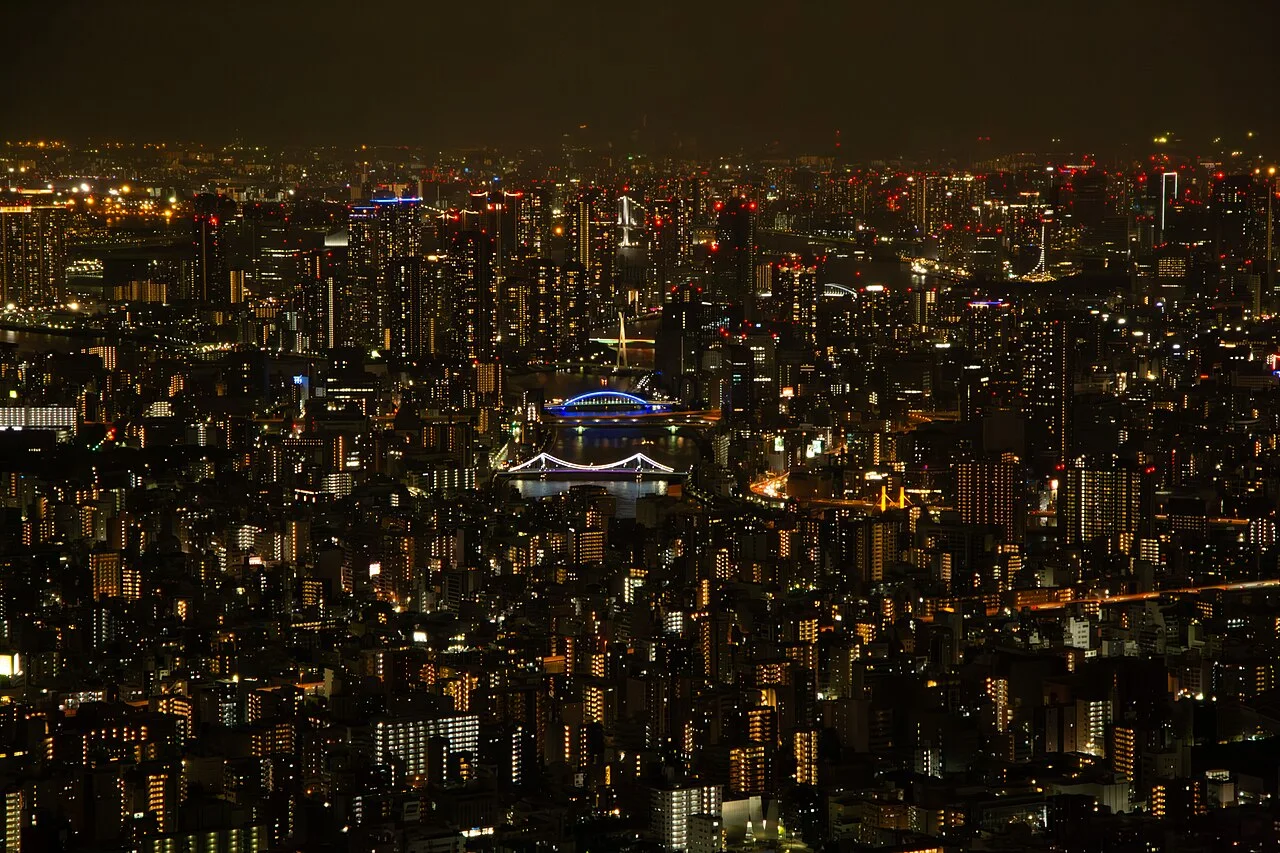
    Night view south-west from the Tokyo Skytree showing the lit bridges over the Sumida River
    What ¥1,800 buys: the view south-west from the Skytree at night, with Kiyosu-bashi and Eitai-bashi lit over the Sumida. Photo: Ian G Shingler / Wikimedia Commons, CC BY-SA 4.0.

    Fast facts

    • Cheapest view: Skytree Tembo Deck, from ¥1,800 advance
    • Open-air view: Shibuya Sky, ¥2,700 advance before 15:00, ¥3,400 after
    • teamLab Planets: ¥4,200, Toyosu — and the run ends at the end of 2027
    • Sells out: Shibuya Sky, routinely. Skytree does not
    • Buy at the counter: possible at the Skytree (+¥500). Impossible at teamLab Planets
    • Resellers: charge up to twice the official price. Every figure below is the official one

    The prices, side by side

    Adult ticketOfficialMarketplace listings
    teamLab Planets, Toyosu¥4,200 (dynamic; ¥4,200–¥4,800 over the next two months)¥8,425 · ¥7,967
    teamLab Borderless, Azabudai¥3,600 (dynamic, +¥200 if bought on site)¥9,300
    Skytree Tembo Deck, 350mfrom ¥1,800 advance (+¥500 at the counter)¥2,539 · ¥4,190
    Skytree Deck + Galleria, 450mfrom ¥3,000 advance, or add the Galleria inside for ¥1,400bundled into guided tours from ¥13,000

    Children are cheaper everywhere and free below a certain age: under 3 at both teamLab venues, under 6 at the Skytree. Both teamLab sites also sell a discounted ticket to holders of a disability certificate — ¥2,100 at Planets, ¥1,800 at Borderless, each valid for one companion as well.

    teamLab Planets, Toyosu — and it closes at the end of 2027

    Planets is at 6-1-16 Toyosu in Koto City, which makes it the single biggest visitor attraction on this side of the river. You walk barefoot through water. It is worth the money and the crowd.

    Four things from the official site that change how you book it:

    • The run ends at the end of 2027. The site’s own header reads “July 7, 2018 – End of 2027”. If you are planning a trip for 2028, this is not in it.
    • Tickets are not sold on site at all. There is no window and no machine. Turning up without a timed ticket means not getting in.
    • Resale is prohibited in the museum’s own terms, which state that visitors cannot enter with a ticket bought through resale and that the museum takes no responsibility in that case. Buy from the official store or a named distributor, not from a person.
    • It is open 08:00 to 22:00, last entry 21:00 — far longer hours than any other attraction in this article. An 08:00 slot on a weekday is a different museum from a Saturday afternoon.

    Book at the official teamLab Planets ticket store, where the calendar shows the price per date and lets you change the date up to three times. If you would rather book where the rest of your trip is, Klook sells the same admission at around the official price — US$27.75 at the time of writing, 4.7 from over 21,000 reviews — and is the one third party this article will recommend. The ¥8,425 marketplace listing, rated 4.5 from about ten reviews, and its ¥7,967 sibling, rated 3.5 from 46, are the same ticket at nearly double — and that 3.5 is the lowest rating of any listing on this website.

    Two genuinely useful add-ons do exist. A shuttle bus from Tokyo Station and Ginza saves the Yurikamome change, and if you drive, showing a same-day Planets ticket at LaLaport Toyosu gets you an hour of free weekday parking.

    teamLab Borderless, Azabudai

    The other one, in Azabudai Hills in Minato — a museum without a map, permanent rather than time-limited, and currently showing a special exhibition. Adults ¥3,600 under dynamic pricing, 13–17 ¥2,800, 4–12 ¥1,500, under 3 free, and +¥200 if you buy at the venue. Same-day tickets are available when it has not sold out.

    The important line is in teamLab’s own ticket section: official sales are the official ticket website and Klook, and nowhere else. That makes the Klook listing — from about US$28.05, 4.7 from over 23,000 reviews — the only third party the operator itself recognises. A ¥9,300 listing elsewhere is more than two and a half times the official price for the same entry.

    Planets or Borderless? Planets is water, barefoot, bigger sensations, about two hours, and on the east side. Borderless is denser, drier, more of a maze, and easier to combine with central Tokyo. If you are doing one and you are staying anywhere near the river, do Planets.

    Tokyo Skytree, and the ¥500 nobody mentions

    634 metres, in Oshiage, Sumida. The official structure is simple once you see it written down:

    • Tembo Deck (350m): adults from ¥1,800, children 6–14 from ¥900, under 6 free.
    • Deck + Tembo Galleria (450m): adults from ¥3,000, children from ¥1,500.
    • Buying at the 4th-floor counter or machines adds ¥500 per ticket. This is the single most avoidable cost in Tokyo sightseeing: book the same ticket online before you arrive and it is not charged.
    • The Galleria can be added inside for ¥1,400 adults, ¥700 children, at machines on the Deck, with no surcharge and subject to capacity. So the low-risk play is to buy the ¥1,800 deck ticket, look at the weather from 350m, and pay the extra only if it is clear.

    Prices move with the date under dynamic pricing, so the ¥1,800 is a floor rather than a promise. Buy at the official ticket page. If you want it on the same platform as everything else, Klook’s Skytree ticket is the most-booked version anywhere, 4.7 from nearly 25,000 reviews, from about US$19.65 — above the official floor, so compare on the day. The marketplace listings at ¥2,539 (4.0 from over 740 reviews, the weakest score of any Skytree option) and ¥4,190 exist, and the second has no reviews at all at more than twice the official floor.

    And the local heresy, which this site will keep repeating: the Skytree is the best thing to look at in east Tokyo and one of the less interesting things to look from. The view is enormous and flat, and the tower itself is missing from it. The free alternative is five minutes away and almost nobody uses it: Sumida City Office, where the lift halls are open to the public up to the 14th floor and look straight at the tower — the 13th is the one to get out at, and the building stays open until about 7pm on weekdays, so you can catch it lit. Or skip height altogether and take the walk along the water in the Sumida River guide, where the tower is above you the whole way.

    Skytree or Shibuya Sky?

    This is an east-side site and the Skytree is ours, so take the following as an argument against our own tower where it is warranted.

    The Skytree is higher and cheaper. Shibuya Sky is lower, dearer, outdoors, and has the thing you actually came to look at in the frame. At 350 metres you are above Tokyo looking at a grey plain; at Shibuya’s 229 metres you are low enough to see streets, and the rooftop is open to the sky with no glass in the photograph.

    Tokyo SkytreeShibuya Sky
    Height350 m deck, 450 m with the Galleria229 m
    Adult, advancefrom ¥1,800 (350 m) · ¥3,000 (450 m)¥2,700 before 15:00 · ¥3,400 from 15:00
    At the counter+¥500¥3,000 / ¥3,700 — and only if the web has not sold out
    Childrenfree under 6¥1,200, counter only; preschoolers free
    Indoor or outdoorEnclosed, glassOpen-air rooftop, plus an indoor gallery
    HoursSee the section above10:00–22:30, last entry 21:20
    Booking windowOpen well aheadTwo weeks only, from 00:00 JST
    Shibuya Sky figures from its official ticket page, read on October 11, 2026 — on which the day’s tickets were already sold out.

    The rooftop rules nobody mentions until you are at the gate

    The open rooftop is the reason to go, and it is also the part with a list of rules that catches people out. From the operator’s own page: you cannot take a bag of any kind onto the roof — not a rucksack, not a pouch — and you leave it in the lockers on the 46th floor. Also banned up there: tripods, monopods and selfie sticks; earphones and headphones; hats of any kind; food and drink; and strollers except the venue’s own loan ones. What you may carry is a phone, and a camera or binoculars either pocket-sized or on a neck strap. If what you are wearing has no pockets, the information desk will lend you a small bag to carry things in.

    Two more that decide the day. The rooftop closes without notice in strong wind, rain, snow, approaching thunder, smog or extreme heat — you are then paying for the indoor gallery. And if you are late for your timed slot you may be refused entry. Large luggage is not allowed in the building at all, so use the station lockers before you come.

    Which to book

    One view, and you want the photograph everyone means by “Tokyo”: Shibuya Sky, booked the moment the two-week window opens, for a slot about forty minutes before sunset. Klook sells it at the official price — about US$17 for the before-15:00 adult ticket, 4.7 from over 46,000 reviews — which is worth knowing because almost everything else resold on this page is marked up.

    One view, on a budget, or with small children, or on a day with weather: the Skytree. It is ¥900 cheaper at the bottom, free under six, enclosed so the weather cannot cancel it, and you can still buy at the counter. It is also the only one of the two you can walk to from the rest of this site.

    When a middleman is worth it

    Two cases, and only two.

    • When the third party is an official channel. teamLab names Klook as an official sales site for Borderless; the Skytree and Planets both work with the big platforms as distributors. At the same price, buying where your other bookings live is a real convenience, and the cancellation terms are often softer than the operators’ own — Planets does not refund at all once you have bought.
    • When the product is not a ticket. Planets plus the Toyosu fish market with a guide, about ¥22,000 for three hours, is a guided morning that happens to include admission, and the guiding is the thing you are buying. Same for the guided Skytree visit with 450m tickets included at about ¥13,000. Judge these as tours, not as tickets.

    Everything else on the marketplaces in this category is the same admission with a margin on it. The tell is the listing title: if it says “Admission Ticket” and nothing else, there is nothing else.

    A day that uses both

    Both of the big ones are on this side of the river, so they make one day rather than two half-days.

    1. 08:00, teamLab Planets, Toyosu. The first slot of the day, when the water rooms are quiet. Ninety minutes to two hours.
    2. 10:30, Toyosu market for sushi at the counters, or the Yurikamome three stops back to Koto.
    3. Afternoon, the river. Kiyosumi-Shirakawa for the garden and the coffee, then the Sumida walk up to the tower.
    4. Dusk, the Skytree. Book a slot about forty minutes before sunset so you get the city in daylight and then lit. This is the only time the ticket is unambiguously worth ¥1,800.

    What the reviews say, and what they mean

    This page has the worst-reviewed products on this entire website, and it is not close. Across nine other comparisons — sushi, ramen, kintsugi, tea, crafts, kimono, food tours, workshops, rickshaws — the share of reviewers rating a listing three stars or below runs between 0.2% and 4%. Here it runs to 29% and 32%. Read on 3 October 2026, with the low reviews and the operators’ replies.

    How bad the resale listings actually are

    ListingReviewsRated 3★ or below
    Skytree admission, Deck + Galleria745219 (29.4%)
    teamLab resale listing4715 (31.9%)
    Another Skytree reseller133 (23%)
    A third reseller90
    Two more listings0–1—
    For comparison, from the other articles in this series: chopstick making 2,157 reviews, 4 low (0.19%) · sushi classes 9,040 reviews, under 1% · cooking classes 2,967 reviews, 0.3%

    Nearly one reviewer in three. Ninety-five people have given the Skytree listing a single star. This page already argued that buying admission through a marketplace is a bad deal on price alone. The reviews say it is also a bad deal on whether you get in.

    Why: you are not buying a ticket, you are buying a voucher

    The failure that recurs is mechanical. The Skytree gate needs a QR code. What the marketplace sends is a booking that has to become a QR code, and when it does not, you are standing at a turnstile with a receipt.

    One April 2026 reviewer had proof of purchase for four tickets refused at the entrance, could not retrieve the code through chat support, and received it after the timed slot had passed. An August 2025 reviewer: “There is no QR Code in the order as well as in the ticket details.” Another from April 2026 simply warns not to buy on the day because the tickets do not arrive straight away.

    The second recurring failure is that the slot is immovable and nothing is refunded. A September 2025 reviewer whose flight was late was refused entry and refused a refund. An April 2026 reviewer held up in traffic asked to move to the next day and was told there was no availability.

    And a third, which is a labelling problem rather than a failure: three of the ten low reviews I read expected a guide. “Never saw or met up the guide, so we did it on our own,” one wrote (August 2026). There is no guide. It is an admission ticket sold in a marketplace full of tours, and people book it thinking they have bought a tour.

    What this means in practice

    • Buy from the operator. The official stores issue the code directly and the price is lower. For teamLab this is not merely advice: the museum’s own terms refuse entry to resold tickets, and teamLab names its official site and Klook as the only authorised sellers.
    • If you have already booked through a marketplace, get the QR code into your phone the day before — not on the way to the gate. Most of the one-star reviews are people who found out at the turnstile.
    • Treat the timed slot as a flight. Late is forfeited, at every seller, official included.

    Which of these are made for foreigners

    All of them, and that is the whole point of this page. This is the one category in this series where the gap is not a judgement call: the attraction publishes one price, in yen, that any Japanese resident pays, and the resale listings charge roughly double it to people who do not know the official store exists.

    teamLab Planets is ¥4,200 official and ¥8,425 resold. Borderless is ¥3,600 and ¥9,300. The Skytree Tembo Deck is ¥1,800 in advance and ¥2,539 to ¥4,190 resold. Nobody buying in Japanese pays those numbers, because the official pages are the first result in Japanese.

    There is no service inside the markup. No guide, no skip-the-queue, no transfer, no cancellation flexibility — the reviews above are the evidence of what the extra money buys, which is an additional point of failure between you and the gate. The only third party worth using is the one the operator itself names, and it sells at about the official price.

    Is teamLab Planets worth the ticket price?

    At the official ¥4,200, yes. At the ¥8,425 a marketplace charges, no. That is the whole answer, and it is why this page exists. The museum itself is worth two hours of anyone’s trip — you walk barefoot through water, and there is nothing else like it in Tokyo. What is not worth it is paying twice for the same ticket to a reseller who adds nothing.

    And the risk is not only the money. Nearly one reviewer in three rates the resold tickets three stars or below, overwhelmingly because the QR code does not arrive in time and they are turned away at the gate. teamLab’s own terms refuse entry to resold tickets. Buy from the official store, or from Klook, which teamLab names as its only authorised third party.

    Skytree is a closer call. ¥1,800 in advance for the Tembo Deck is fair for the view, and the Galleria at ¥3,000 is worth it only on a clear day — check the weather before you book a timed slot you cannot move. If it is hazy, the free observation floors at the Tokyo Metropolitan Government Building in Shinjuku show you the same city for nothing.

    Where this joins the rest of the east side

    Both attractions sit inside the area this site covers: Koto City for Planets and Toyosu, Sumida beyond the Skytree for the tower and the ten places around it. The walk between them is the Sumida River on foot. Guided versions of the Toyosu morning are in food tours by area, the boats on the river below the tower are in the water bus and cruises guide, and the rest of what is bookable here is compared in cooking classes, the quiet crafts, kimono rental and samurai and ninja. Everything is on the Experiences page, and the area is in the east side guide.

    Quick answers

    Skytree or Shibuya Sky — which is better?

    The Skytree is higher and cheaper (from ¥1,800 advance for the 350 m deck, free under 6, enclosed so weather cannot cancel it, and you can buy at the counter for ¥500 more). Shibuya Sky is lower at 229 m and dearer (¥2,700 advance before 15:00, ¥3,400 after) but the rooftop is open-air with no glass, and the crossing is in the frame. Shibuya Sky sells out routinely and only sells two weeks ahead; if the website is sold out, so is the counter. Note that no bags, hats, earphones or tripods are allowed on its rooftop.

    How much is a teamLab Planets ticket?

    ¥4,200 for an adult from the museum’s own ticket store, rising to ¥4,800 on busier dates under dynamic pricing. Junior high and high school ¥2,800, children 4–12 ¥1,500, under 3 free, disability ticket ¥2,100. Third-party marketplace listings for the same admission were ¥8,425 and ¥7,967 when re-checked on 28 September 2026 — the first of those has risen from ¥7,350 in two days, which is how much these resale prices move.

    Where should I buy teamLab tickets?

    The official ticket store, or Klook — teamLab’s own ticket section names the official website and Klook as its official sales sites for Borderless. Tickets are not sold at the Planets venue at all, and the museum’s terms prohibit resale and say you cannot enter on a resold ticket. General tour marketplaces list the same admission at up to two and a half times the official price.

    Is teamLab Planets closing?

    Yes. The official site gives the run as July 7, 2018 to the end of 2027. teamLab Borderless in Azabudai Hills is described as permanent, so if you are planning a trip beyond 2027, Borderless is the one that will still be there.

    How much is a Tokyo Skytree ticket?

    Adults from ¥1,800 for the Tembo Deck at 350m and from ¥3,000 for the combo with the Tembo Galleria at 450m, both booked in advance and both subject to dynamic pricing. Children 6–14 are from ¥900 and ¥1,500; under 6 free. Buying at the 4th-floor counter or machines adds ¥500 per ticket.

    Should I buy the Skytree 450m ticket in advance?

    Not necessarily. The Galleria can be added once you are up on the Tembo Deck, at machines there, for ¥1,400 adults and ¥700 children with no surcharge, subject to capacity. Buying the ¥1,800 deck ticket first and deciding at 350m — when you can see what the weather is actually doing — costs the same and risks less.

    teamLab Planets or teamLab Borderless?

    Planets, in Toyosu in Koto City, is walked barefoot through water, takes about two hours, and closes at the end of 2027. Borderless, in Azabudai Hills, is a denser dry maze and is permanent. Planets is on the east side and pairs with Toyosu market and the Sumida River; Borderless is easier to fit into a central Tokyo day.

    Do you need to book teamLab Planets in advance?

    Yes, and there is no alternative: the official FAQ states that tickets are not sold at the entrance or at machines on site. Entry is by timed slot. Tickets bought from the official store can have their date and time changed up to three times, no later than two hours before admission, but cannot be refunded.


    LOCAL SIDE JAPAN read the official ticket pages of teamLab Planets TOKYO, teamLab Borderless and the Tokyo Skytree, and the third-party listings quoted, on September 26, 2026, and re-checked the third-party prices on September 28, 2026. All three operators use dynamic pricing, so the figures given as “from” are floors that move with the date; check the day you want before booking. Klook prices were shown in US dollars and are quoted as displayed. Nothing was provided free by an operator.

    Written by Kizuku. I run the Sunamachi Ginza Sumo Stable, a sumo experience in Koto City, and I write about the east side of Tokyo I live and work in. More about this site →

  • Calligraphy, Ikebana and Wagashi in Tokyo: What You Actually Walk Out Holding

    Calligraphy, Ikebana and Wagashi in Tokyo: What You Actually Walk Out Holding

    This article contains affiliate links to booking sites. If you book through them, LOCAL SIDE JAPAN earns a small commission at no extra cost to you. The workshop recommended first costs ¥5,300 and the most expensive one here costs three times that. How this site is made →

    TOKYO / EXPERIENCES / CALLIGRAPHY, IKEBANA AND SWEETS, BY AREA

    Calligraphy, flower arranging, wagashi, papermaking, pottery: the quiet hour. They all run sixty to ninety minutes and most cost between ¥4,000 and ¥16,500, which makes the price nearly useless for choosing between them. The question that actually sorts them is the one no listing answers: what do you walk out holding? Calligraphy gives you a sheet of paper. Papermaking gives you paper you made. Pottery gives you nothing that day — the firing takes weeks and shipping is extra. Ikebana gives you a photograph, because the flowers stay behind. None of that is a reason not to book; it is a reason to know first. This page sorts every quiet craft in Tokyo by that question and by area. Prices, inclusions, meeting points and review counts were read on the booking sites on September 25, 2026.

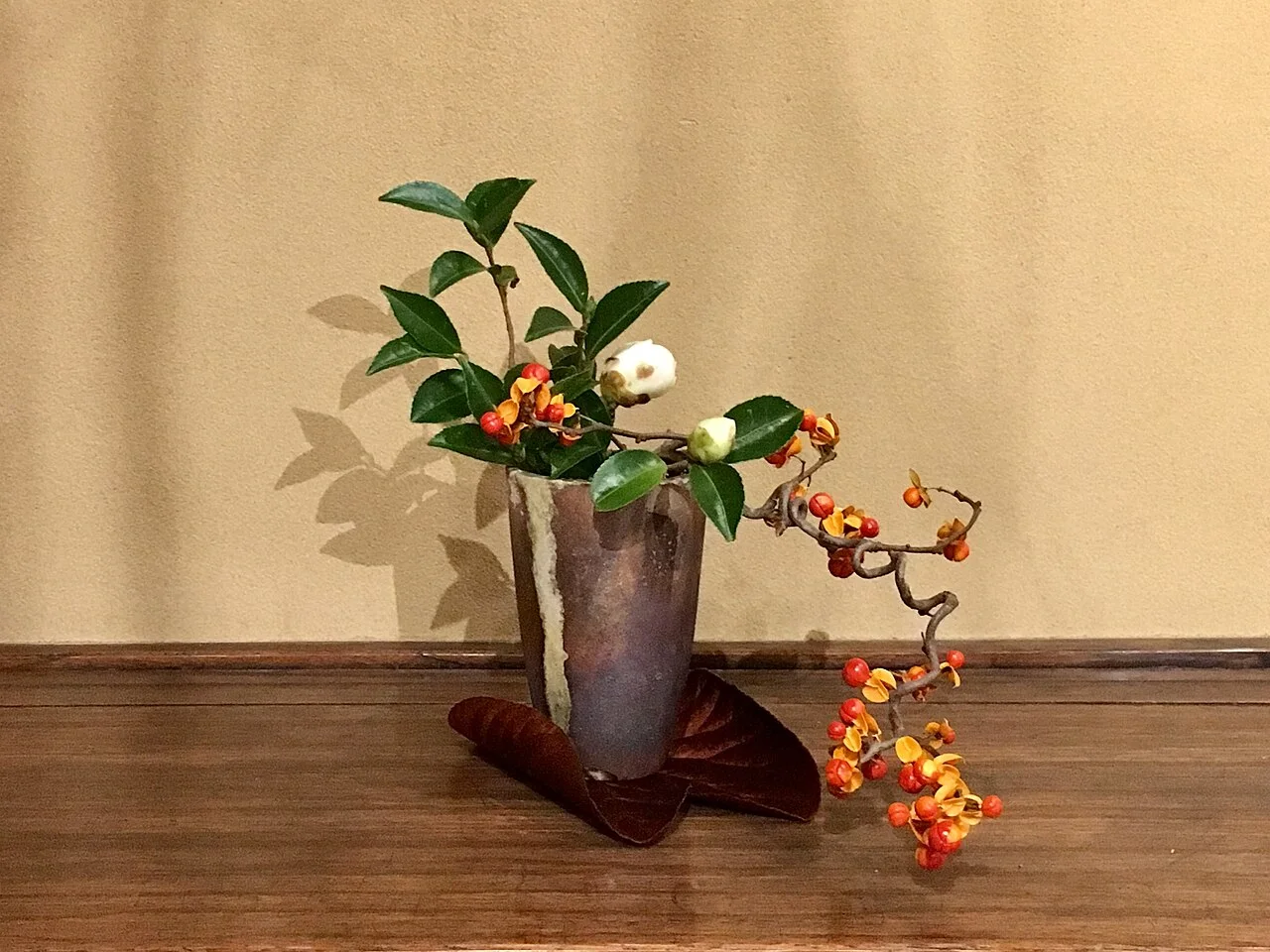
    A small ikebana arrangement of camellia and bittersweet berries in a dark ceramic vase
    A small Shūhō-ryū arrangement, photographed at an ikebana exhibition in Tokyo. You will make something like this, and then you will leave it there. Photo: Gryffindor / Wikimedia Commons, CC0.

    What you walk out holding

    • A finished object, same day: calligraphy (a sheet, sometimes mounted), washi paper, a coin ring, an origami lamp, a mizuhiki belt.
    • Something you eat there: wagashi, mochi, nerikiri. Most include matcha with it.
    • Nothing you can carry: ikebana. The arrangement stays in the studio’s vase. One listing near Shinjuku gets around this with a paper vase you take away, and one in Shirokanedai gives a beginner’s certificate; the rest give you photographs, which is fine as long as you expected it.
    • Something posted to you later: pottery. The ¥4,047 class in Shiba includes the firing fee, but EMS shipping is an optional extra and the piece follows you home weeks afterwards. Ask the cost before you throw a large bowl.

    The second question worth asking: is the person teaching you a practitioner or a host? Some of these are run by clubs and studios where people train every week, some by tourist lounges that run six activities a day. Both can be good hours. Only one of them will correct your grip.

    Calligraphy: the ¥5,300 one, and the room it happens in

    The shodo workshop at Tokyo Iriya Shodo Club is the cheapest taught calligraphy on the booking sites: about ¥5,300 for ninety minutes, 5.0 from 73 reviews, in Iriya in Taito, one stop from Ueno and fifteen minutes’ walk from Senso-ji. Brush grip, ink, stroke order, and the correct order matters more than the shape. Reviewers are unanimous about the teaching. Be clear about the setting before you book: the class is held on the second floor of Hostel Bedgasm at 2-29-2 Iriya, in shared space, and two reviewers describe hostel residents cooking and passing through during the lesson. There are stairs and the listing is marked not wheelchair accessible. The reviews are broken down below.

    The alternatives are all decent and all cost more. The Asakusa workshop at the Tokyo Tourist Lounge, five floors above Kaminarimon, is about ¥8,100, 5.0 from about 180 reviews — the best-reviewed in the city and the easiest to slot into a Senso-ji morning. A private hour in Shibuya is about ¥5,000, 5.0 from about 65, and grinds the ink on a real inkstone rather than pouring it from a bottle, which is a small thing that turns out to matter. A private class by Tsukiji Hongwanji, about ¥7,800, pairs neatly with a morning at the market (see food tours).

    And the one with an actual souvenir: calligraphy plus a printed T-shirt in Nishi-Asakusa, about ¥8,800, 5.0 from about 65 — you write the characters and wear them home. Slightly daft, genuinely popular, and the only listing here where the object is not made of paper.

    Ikebana, and the thing about the flowers

    The private ikebana workshop in Yanaka is the best version of this in Tokyo, and the reason is the shopping: you choose your own flowers at a Yanaka flower shop before the lesson, then arrange them with a master. About ¥16,500 for ninety minutes, 5.0 from about 70 reviews, meeting at the Yanesen information centre. Note that the flowers are not in the price — the listing asks you to bring ¥1,000 to ¥2,000 in cash for them. Budget ¥18,000 and do the Yanaka walk afterwards; it is the one part of Tokyo where buying flowers on a shopping street is still a normal thing to do.

    Cheaper and further out: a two-hour class at Mitsugon-in temple in Ota City, about ¥12,500, 5.0 from about 40 reviews, flowers and tools provided, in an actual temple. The Nakano “wellness” session, about ¥15,000 (it was ¥11,000 when this page was first written in September 2026), 5.0 from about 25, is ninety minutes in a tatami room and is the only one that solves the souvenir problem: a paper mini vase you take away with the arrangement in it. An ikebana hour at a shrine in Shirokanedai is about ¥9,000, often discounted to ¥7,200, new and unreviewed, and includes a beginner’s certificate.

    Wagashi and mochi

    Two different sweets. Nerikiri is the sculpted, seasonal, tea-ceremony kind — white bean paste coloured and shaped into a camellia or a maple leaf, and the reason wagashi classes photograph well. Mochi is pounded rice, chewier and more everyday. Most classes do one or both and finish with matcha.

    The Ginza wagashi class is the cheap way in: fifty minutes, about ¥5,400, ingredients and matcha included, two minutes from Ginza Station. It is new with few reviews. Mochi making in a chef’s own home in Meguro, about ¥13,000 for two hours, 5.0 from about 80 reviews, is the best-reviewed sweets class and a home rather than a studio. A private mochi and nerikiri class in Ota, about ¥12,500 and 5.0 from about 35, makes three kinds of mochi in someone’s house fifteen minutes from the centre. The Komaba wagashi class at about ¥15,000 is the expensive one and includes an English recipe and hotel pickup, but it is new and unreviewed, which at that price is worth weighing.

    Cheaper again, and covered in the cooking classes comparison: the ¥2,500 matcha-making hour in Asakusa comes with wagashi, and a private mochi and dango class in Sangenjaya runs about ¥10,000.

    Paper, clay and metal

    Washi papermaking, Asakusa. An hour at “watashino” at 1-32-11 Asakusa, about ¥5,900, 4.9 from 205 reviews. You pull sheets of paper out of a vat by hand and take them with you. Per yen and per hour this is the most object-for-money on the page, and it is five minutes from Senso-ji. Not wheelchair accessible.

    Origami, two ways, both in Taito. Taro’s Origami Studio in Asakusa is about ¥4,500 for 45 minutes, 4.8 from 49, maximum six people — bring socks, the studio asks for them. It is self-guided: you are given paper and a tablet to follow, and the operator states plainly in its review replies that the session “isn’t taught by a staff member”. Taught private lessons exist but are arranged separately by email. Worth knowing before you book it for a child who wants to be shown. At the other end, Washi Lab Tokyo near Okachimachi is a two-and-a-half-hour private workshop making a folded washi lampshade and a mizuhiki knot belt, about ¥16,500 — the most ambitious object in this article and the only one you will still be using in five years.

    Pottery, Shiba. A one-hour trial class at about ¥4,047, 5.0 from about 60 reviews, wheelchair accessible, firing fee included. Remember that the piece is fired afterwards and EMS shipping is charged separately, so this is a class you finish by email.

    Rings from old coins, Asakusa. The coin ring workshop — about ¥2,500 for an hour, 5.0 from over 930 reviews — hammers a Japanese coin into a ring you wear out of the door. It is the cheapest craft in Tokyo and among the most reviewed of anything in this series. Rarer coins, a polished finish and special shapes are all charged extra, so the real price is ¥3,000–¥5,000 once you are in the room.

    Which one to book

    If you wantBookAreaYou leave with
    Calligraphy, taught properlyIriya Shodo ClubIriya, Taito¥5,300 · your sheet · 5.0 (73)
    Calligraphy, easiest to slot inAsakusa calligraphy workshopKaminarimon¥8,106 · your sheet · 5.0 (179) · no review under 4★
    Ikebana, the best versionPrivate workshop in YanakaYanaka¥16,500 + ¥1–2,000 flowers · photos
    Ikebana you can take awayNakano wellness sessionNakano¥15,000 · paper vase · 5.0 (27)
    Most object per yenWashi papermaking at watashinoAsakusa¥5,900 · paper you made · 4.9 (205)
    The cheapest craft in TokyoVintage coin ring workshopAsakusa¥2,500 + coin extras · 5.0 (959)
    Sweets, best reviewedMochi making in a chef’s homeMeguro¥13,000 · you eat it · 5.0 (79)
    Sweets, cheapestWagashi class in GinzaGinza¥5,400 · 50 min · with matcha
    Something to use for yearsOrigami lamp and mizuhiki beltTaito¥16,500 · a lampshade
    ChildrenTaro’s Origami StudioAsakusa¥4,500 · 45 min · self-guided
    PotteryTrial class in ShibaMinato¥4,047 · posted later, EMS extra

    Three things to check

    • The extras. Flowers at the Yanaka ikebana, shipping at the pottery, better coins and polishing at the ring workshop. All three are stated in the listings and all three are missed.
    • Whether the ink is ground. A calligraphy class that grinds ink on a suzuri is teaching the whole thing; one that pours it from a bottle is teaching half.
    • Group size. These are hours where being one of four rather than one of twelve changes everything. The private listings say so; the lounges do not.

    What the reviews say, and what they mean

    This page compares eighteen listings. Between them they carry about 1,690 reviews on Viator, and the reviews are not spread evenly: three listings hold 1,343 of them, eight have fewer than forty, and one has none at all. On 29 September 2026 I read every review rated three stars or below across all eighteen — ten reviews — plus most of the four-star reviews on the two with the deepest records, and the operators’ public replies. Two of the things I found contradict what this page said before today. Both are corrected above, and both are set out below.

    How much the ratings are actually worth

    ListingReviewsRated 3★ or below
    Coin ring, Asakusa9591 (0.1%)
    Washi at watashino2051 (0.5%)
    Calligraphy at the Asakusa lounge1790
    Mochi in a chef’s home, Meguro790
    Calligraphy at Iriya732 (2.7%)
    Ikebana in Yanaka710
    Pottery in Shiba613 (4.9%)
    Origami at Taro’s493 (6.1%)
    The other ten listings0–40 each—

    Almost everything here shows 5.0, which is worth less than it looks. Two of the listings in this article have two reviews each and one has none. They may be excellent — nobody knows yet, including us. A 5.0 from two people is not a rating, it is two people.

    The complaint that repeats: the coin is the extra

    The coin ring workshop has the cleanest record of anything this site has looked at — one review below four stars in 959. But of the twenty-three four-star reviews, eight say the same thing: ¥2,500 buys the workshop and a coin from one of a hundred-odd countries, and the Japanese coins cost more. “The free ones are all foreign coins,” as the single one-star review puts it (a reviewer on Viator, September 2026). One four-star reviewer reports that ring prices changed partway through the session (June 2026); another that the extra fees for a Japanese coin and for polishing were not visible beforehand (May 2026).

    Eight out of twenty-three is a pattern, and it means the honest figure for what most people actually want is ¥3,000–¥5,000, not ¥2,500. Whether that is unreasonable is a separate question, and the answer is below.

    Iriya: everyone praises the teacher, nobody likes the room

    This is a correction. Until today this page recommended the Iriya workshop as the one that is “in a club, not a lounge”, taught in a room where people practise on the other days of the week. Its two sub-four-star reviews say otherwise, and they are right. “The class is in the kitchen of an hostel,” one wrote (a reviewer on Viator, October 2025), with residents eating and coming through; the other (May 2024) describes being constantly interrupted by people who live in the space, cooking and doing laundry. Both praise the teacher without reservation.

    Viator’s own meeting-point text confirms the setting: the address is 2-29-2 Iriya, “the second floor of Hostel Bedgasm”. There are stairs, and the listing is marked not wheelchair accessible.

    Seventy-one of seventy-three reviewers still gave it five stars and nobody criticised the instruction. It remains the cheapest taught calligraphy on the booking sites and the teaching is the reason to go. But book it for the teacher, not the room — and not at all if stairs are a problem. The section above has been rewritten to say so.

    Taro’s Origami: there is no teacher

    The second correction. All three sub-four-star reviews say the studio gives you paper and a tablet and leaves you to it, and the operator confirms it in its public replies in as many words: the session “isn’t taught by a staff member”, and is “a self-guided, tablet software origami activity”. Taught private lessons exist but are arranged separately by email.

    That is a fair thing to sell for ¥4,500, and reviewers who knew what they were buying enjoyed it. It is not what our “Children” recommendation implied. This article opens by asking whether the person teaching you is a practitioner or a host; here there is a third answer, and the listing above now says so.

    Washi: an hour with a wait in the middle of it

    One review below four stars in 205, and it is about time: thirty-five minutes, fifteen of them spent waiting for the paper to dry (May 2025). The operator replied that a drying period is unavoidable in handmade washi and that its handling of that time needed improving. Two of the seven four-star reviews separately say the class felt short for the price, and one that adding a colour design costs a small extra.

    It is listed as one hour. Expect a real interval inside it.

    Where no complaint repeats

    Ikebana in Yanaka: seventy-one reviews, every one of them five stars. Mochi in a chef’s home in Meguro: seventy-nine, three fours, nothing lower. The calligraphy workshop at the Asakusa lounge: 179 reviews, one four-star and nothing at all below it — the best record of any listing this site has examined. Pottery in Shiba has three low reviews and they say three unrelated things. There is no pattern to report in any of these, and we are not going to invent one.

    Which of these are made for foreigners

    Ikebana is the clearest case, because the school publishes both prices itself. The Ichiyo School of Ikebana, whose headquarters is in Nakano, charges ¥3,500 for a one-hour trial lesson with the flowers included — ¥2,500 on a Tuesday afternoon — and ¥8,000 for the same hour billed as a tourist experience, with an English-speaking instructor at no extra charge (一葉式いけ花, checked 29 September 2026). The listings on this page start at ¥15,000, and the one recommended above is ¥16,500 plus the ¥1,000–¥2,000 you hand over for the stems.

    The gap buys a private lesson rather than a class, a booking you can make in English from abroad, and in the Yanaka case the flower-shopping, which is genuinely the best part of it. That is a real product. But if what you want is to arrange flowers once in Tokyo under a teacher, a Japanese school will do it for ¥3,500 — and even the same school’s own tourist rate is less than half the Viator price.

    Calligraphy is a smaller gap and an easier one to defend. A calligraphy school in Shinjuku publishes a ¥2,000 trial lesson, and ¥13,750 a month for four seventy-five-minute lessons with all materials — about ¥3,400 a lesson (宮崎書道教室, checked 29 September 2026). The Asakusa lounge is ¥8,106 for ninety minutes. But the ¥2,000 is a recruiting price: the school expects a ¥5,000 enrolment fee and then months of attendance, which is no use on a ten-day trip, and the lesson is conducted in Japanese. What the extra buys is English and a one-off.

    The coin ring runs the other way entirely. A Japanese-language coin ring workshop a few streets away in Asakusa, sold to Japanese customers, charges ¥6,500 for a ring and ¥7,500 for a ring plus a charm, sixty to ninety minutes (RAGTIME COIN FACTORY, checked 29 September 2026). The Viator listing is ¥2,500 before extras and ¥3,000–¥5,000 after them. Even at the top of that range it undercuts the Japanese-market price.

    Which puts the coin complaint in its proper light. The ¥6,500 is roughly what this craft costs to deliver; the ¥2,500 is an entry price with the coin unbundled from it. That is a pricing decision people are entitled to dislike, and eight reviewers did — but it is not a tourist markup. It is the reverse of one.

    And the buildings. Three of the listings above sit on an upper floor of a multi-tenant building with nothing on the street to tell you: the coin ring on the eighth floor, the lounge calligraphy on the fifth, the washi studio on the second. This is ordinary in Tokyo and it is the most common way visitors lose fifteen minutes, because Japanese addresses number blocks rather than streets and the tenant board is usually inside the lobby rather than outside it. Take the building name and the floor number from your confirmation email before you set off, and search the building name in Google Maps rather than the address.

    Where this joins the rest of the east side

    Four of the best of these — calligraphy in Iriya, papermaking and origami and coin rings in Asakusa — are inside a twenty-minute walk of each other, and the seven hours ranked head to head are in Asakusa Workshops: Which Hour Is Worth ¥7,000. The crafts with their own comparisons are kintsugi and Edo Kiriko cut glass in Sumida, and the knives are on Kappabashi. To cook instead, see Japanese cooking classes, ramen and sushi; to sit still, tea ceremony. Everything bookable is on the Experiences page, and the area is in the east side guide.

    Quick answers

    Where can you try Japanese calligraphy in Tokyo?

    The cheapest and most serious is Tokyo Iriya Shodo Club in Taito, about ¥5,300 for 90 minutes, 5.0 from about 70 reviews — a calligraphy club rather than a tourist attraction, one stop from Ueno. The best-reviewed is the Asakusa workshop at the Tokyo Tourist Lounge above Kaminarimon, about ¥8,100, 5.0 from about 180.

    How much does a calligraphy or ikebana class in Tokyo cost?

    Calligraphy runs ¥5,000 to ¥8,800 for 60 to 90 minutes. Ikebana runs ¥9,000 to ¥16,500 for 90 minutes, and at the Yanaka workshop the flowers are extra — the listing asks you to bring ¥1,000 to ¥2,000 in cash. Wagashi and mochi classes are ¥5,400 to ¥15,000, papermaking about ¥5,900, pottery about ¥4,047 and a coin ring about ¥2,500.

    Do you keep what you make in an ikebana class?

    Usually not. The arrangement stays in the studio’s vase and you leave with photographs. Two exceptions: the Nakano session includes a paper mini vase you take away with the arrangement, and the Shirokanedai shrine class gives a beginner’s certificate. Everything else on this page — calligraphy, washi paper, a coin ring, an origami lamp — you carry out.

    Can you take your pottery home the same day in Tokyo?

    No. The one-hour trial class in Shiba includes the firing fee, but the piece has to be fired after you leave and EMS shipping is charged as an optional extra, so it reaches you weeks later. Ask the shipping cost before you make anything large.

    What is the cheapest craft workshop in Tokyo?

    The vintage coin ring workshop in Asakusa, about ¥2,500 for an hour and rated 5.0 from over 930 reviews, where a Japanese coin is hammered into a ring you wear out of the shop. Rarer coins, polishing and special shapes cost extra, so budget ¥3,000 to ¥5,000. Washi papermaking nearby at ¥5,900 is the best value if you want something handmade rather than struck.

    What is the difference between wagashi and mochi?

    Nerikiri wagashi are sculpted seasonal sweets made from white bean paste, shaped into flowers or leaves and served with matcha at tea ceremonies. Mochi is pounded glutinous rice, chewier and eaten year round, often filled with red bean. Most Tokyo classes teach one or both and finish with a bowl of matcha.

    Are there craft workshops on the east side of Tokyo?

    Most of the good ones are. Calligraphy at the Iriya shodo club in Taito, washi papermaking and origami and coin rings in Asakusa, ikebana in Yanaka, an origami lamp workshop near Okachimachi, plus kintsugi and Edo Kiriko cut glass which have their own guides. Four of them are within a twenty-minute walk of each other.


    LOCAL SIDE JAPAN read the price, inclusions, exclusions, duration, meeting point and review record of every listing above on Viator on September 25, 2026. Prices are approximate, move with the exchange rate, and several use group pricing or were on temporary offer. This is a researched comparison of the listings and their reviews, not a firsthand report on each studio, and the article says so here rather than pretending otherwise. Nothing was provided free by an operator.
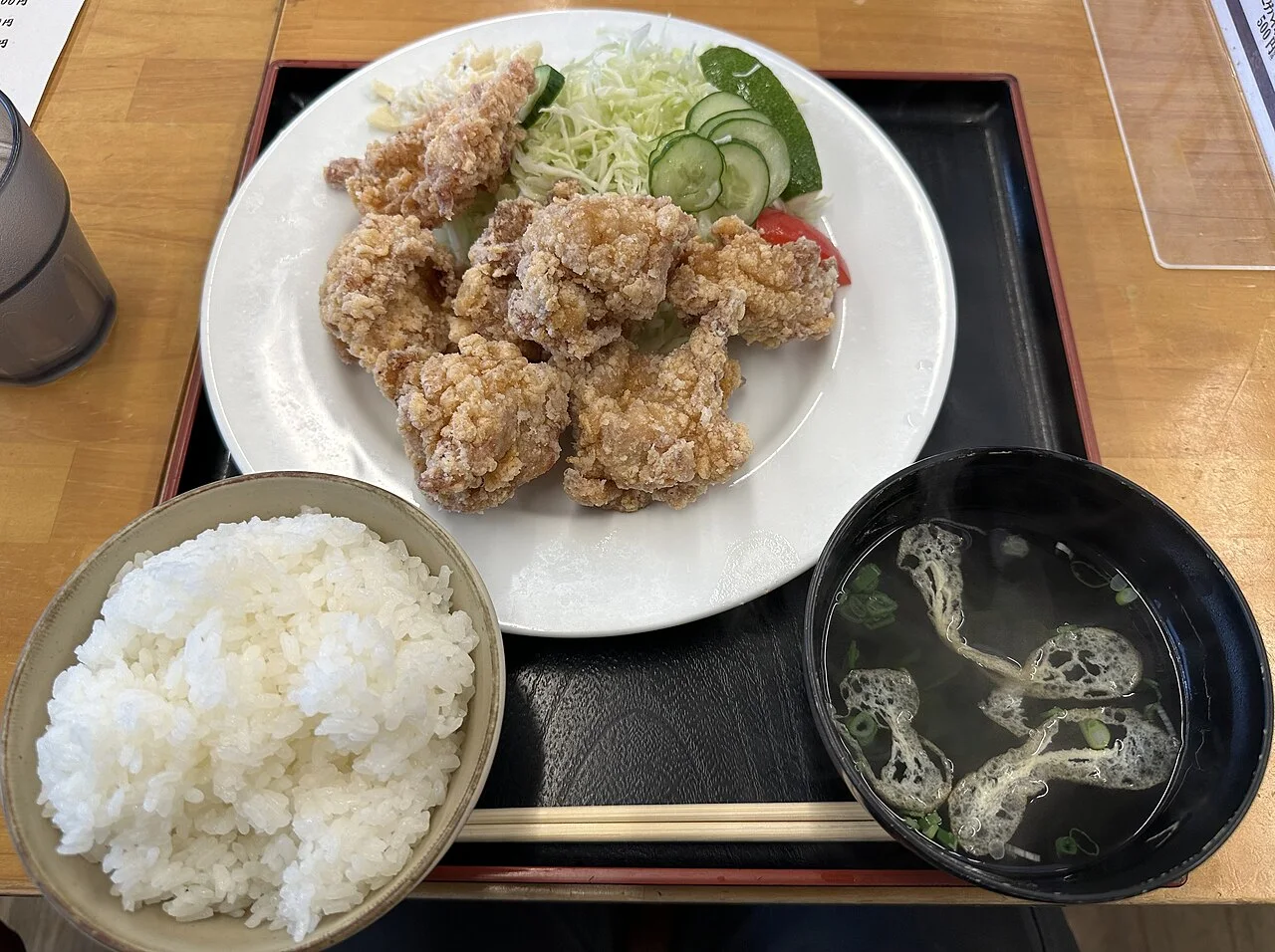
    Written by Kizuku. I run the Sunamachi Ginza Sumo Stable, a sumo experience in Koto City, and I write about the east side of Tokyo I live and work in. More about this site →

  • Japanese Cooking Classes in Tokyo by Area: You Are Choosing a Kitchen, Not a Dish

    Japanese Cooking Classes in Tokyo by Area: You Are Choosing a Kitchen, Not a Dish

    This article contains affiliate links to booking sites. If you book through them, LOCAL SIDE JAPAN earns a small commission at no extra cost to you. The class recommended first costs ¥2,500 and the most expensive one here costs ten times that. How this site is made →

    TOKYO / EXPERIENCES / JAPANESE COOKING CLASSES, BY AREA

    Japanese cooking classes in Tokyo run from ¥2,500 to ¥24,000, and the dish in the title is the least useful thing to choose on. Karaage is karaage. What the price actually buys is the kitchen you stand in: a commercial studio near a station, a professional chef’s classroom, or somebody’s actual flat in Nerima or Adachi with their own knives and their own kettle. Those are three different afternoons, and only one of them tells you anything about how people here really eat. This page sorts every general Japanese cooking class in Tokyo by kind and by area, with what each includes. Prices, inclusions, meeting points and review counts were read on the booking sites on September 25, 2026.

    A karaage set meal on a tray with a bowl of rice and a bowl of clear soup
    The shape almost every class teaches: a main, a bowl of rice, a bowl of soup, something green. Learn the shape and the individual dishes take care of themselves. Photo: ノボホショコロトソ / Wikimedia Commons, CC BY 4.0.

    Fast facts

    • Price: ¥8,000–¥14,500 in a studio, ¥12,000–¥13,000 with a supermarket run, more in a private home
    • What you cook: a whole meal — a main, rice, soup and a vegetable side — not a single dish
    • The technique that matters: dashi. Ask whether the class makes it from kombu and bonito or opens a packet
    • On the east side: three — Iriya (Taito), Nishi-Nippori (Arakawa) and Senju (Adachi)
    • Language: English throughout at the studios
    • For groups: a rented studio takes a party; somebody’s flat does not

    You are choosing a kitchen, not a dish

    • The studio, ¥8,000–¥14,500. A rented kitchen near a station with eight induction hobs and matching aprons. Efficient, reliably good, English throughout, and the same room whether you are making bento or kaiseki. Best for a group, for children, and for anyone short on time.
    • The teaching studio with a market run, ¥12,000–¥13,000. The same thing with a supermarket walk bolted on the front, and the supermarket walk is consistently the part people remember. Knowing what is in a Japanese shop aisle, and what to do with it, is the only part of any of this that survives the flight home.
    • Someone’s home, ¥13,780–¥24,155. A host, a domestic kitchen, four people maximum, their pots. This is where a cooking class becomes a visit. It is also a journey into residential Tokyo — Nerima, Adachi, Setagaya — so add forty minutes each way to the price in your head.

    A note on the ¥20,000 classes: two of them make katsu curry and a seven-dish home meal respectively, and katsu curry is a ¥900 lunch anywhere in Tokyo. That is not a criticism — you are buying a private studio, hotel pickup and an instructor’s whole afternoon — but be clear that the price is for the setting and not for the difficulty of the food.

    What dishes are taught in a Tokyo cooking class?

    Almost none of them teach one dish. They teach the shape of a Japanese meal: a main, rice, a soup and a vegetable side, cooked together so you see how the parts are timed. That is the single most useful thing about them, and it is also why the menu on the listing matters less than people think.

    What comes up again and again, across the classes on this page:

    • Dashi — stock from kombu and dried bonito. Everything else rests on it, and it is the one thing worth checking before you book: a class that makes it from scratch teaches more than one that opens a packet.
    • Miso soup, built on that dashi. Nearly universal.
    • A rolled omelette (tamagoyaki) — the technique test, and the dish most people get wrong at home.
    • Rice, washed and cooked properly, often with a seasoned dish built on it.
    • One recognisable main: karaage, gyoza, teriyaki, tonkatsu or a simmered dish, depending on the kitchen.
    • A vegetable side — an ohitashi or a dressed salad, which is where seasonal produce shows up.
    • Noodles, where the class is built around them: the Senju class makes udon from flour, by hand.

    If you are booking for a group, the dish list is the wrong thing to compare. Compare the kitchen: a rented studio with eight hobs will take your party and run to time; somebody’s flat will not, however good the food is. The seven-dish class in Nishi-Nippori is the most food for the money on this page, and it reaches dashi through the rolled omelette, which is the right way round.

    The cheapest hour worth having

    The matcha-making class in Asakusa costs about ¥2,500 for an hour and is rated 5.0 from over 1,350 reviews — the best value of anything in this whole experiences series. Two minutes from Kaminarimon at 2-17-9, you learn to whisk matcha properly and eat wagashi with it. It is not a meal and it does not pretend to be; it is the one thing on this page that costs less than lunch and teaches a skill you will use.

    If you want the ceremony around the tea rather than the whisking, that is a different product and it is compared in tea ceremony by area. And for sweets, a private mochi and dango class in a home in Sangenjaya is about ¥10,000, often discounted to ¥8,500, 5.0 from about 110 reviews, two hours with tea at the end.

    The east side: Iriya, Nishi-Nippori, Senju

    Iriya, Taito: the supermarket class

    The four-hour washoku class from market to table is the best all-rounder on the east side: about ¥13,000, 5.0 from about 370 reviews, meeting at a FamilyMart in Shitaya by Iriya Station, one stop from Ueno. You shop a local supermarket with the guide first — how to read a Japanese shelf, which soy sauce, which miso — then make sushi rolls, miso soup and tamagoyaki, with sake tasting at the end. Four hours is long, and it is the listing where the length is clearly doing something.

    The same kitchen runs an evening izakaya-style class — about ¥12,000, three hours, 5.0 from about 170 — where you cook a multi-course tavern meal: sushi rolls, chicken meatballs with shiso, aubergine with miso. If you have already eaten in an izakaya and wondered how the aubergine is done, this is the answer, and it pairs with the senbero explainer.

    Nishi-Nippori, Arakawa: the private studio

    YUZU WASHOKU STUDIO at 1-58-4 Nishi-Nippori runs two classes, both about ¥20,000 and both including hotel pickup. The seven-dish home meal class is the one to take: onigiri, miso soup, tonkatsu, teriyaki fish, dashimaki tamago made with real dashi, and a seasonal vegetable side. That is the actual architecture of a Japanese meal rather than one photogenic dish, and dashimaki tamago alone is worth a lesson. The katsu curry class, 5.0 from about 35 reviews, is the crowd-pleaser version. Both are a few minutes from the Yanaka walk, which is the right way to spend the rest of the day.

    Senju, Adachi: udon in a house behind a temple

    A private home cooking and udon class with Masako is the most unusual booking in this article and the one furthest into the real city: two and a half hours, about ¥24,155, 5.0 from about 35 reviews, at a house by Chouenji temple at 4-27-5 Senju — Kita-Senju, the old post town at the top of the east side. You knead and cut udon by hand and eat everything you make. It is the most expensive class here and the only one where the address itself is the reason to go: nobody runs anything for visitors in Senju, and this is someone’s home in a neighbourhood that has never been on a tour bus. Do the standing bars afterwards.

    The studios: Shinanomachi, Yoyogi, Akasaka

    Cooking Sun Tokyo in Shinanomachi is the most polished operation in the city: three hours of kaiseki-style cooking built around wagyu beef, Japanese vegetables and traditional seasonings, seven dishes, about ¥11,000, 5.0 from about 200 reviews. For the money this is the most food and the most technique on the page, and it is the class to book if you cook at home already.

    A home-style class in a Yoyogi kitchen studio makes three or four everyday dishes in two and a half hours for about ¥14,500, 5.0 from about 20 — the emphasis is on things Japanese households actually cook on a Tuesday. The character bento class in Akasaka — two hours, about ¥8,000 and frequently discounted, 5.0 from about 160 — is the one to book with children: you build a panda out of rice and take the box away. Nobody needs this skill and everybody enjoys it.

    Further out, a class in Todoroki pairs an appetiser, main and dessert with a walk through the only river gorge inside the Tokyo city limits: about ¥17,800 for two and a half hours, 5.0 from about 100, main chosen in advance so the ingredients are there. And adjacent but worth knowing: a sake masterclass in Shinjuku, eight-plus varieties with a certified sommelier and food pairings, about ¥10,900, 5.0 from about 390.

    Somebody else’s flat

    Emi’s private class in Nerima — three hours, about ¥13,780, 5.0 from about 135 reviews — is the best-reviewed home class in Tokyo and the cheapest private one: three home-cooked dishes, tailored to what your group wants and can eat, at your own pace in a domestic kitchen. Nerima is forty minutes from the east side, which is the real cost.

    Private home cooking in Yanaka, about ¥18,500 and 5.0 from about 180 reviews, is the closest version to the east side, two hours, ingredients and tools provided, lunch afterwards, meeting at the Yanesen information centre. Between the two, Emi’s is better value and Yanaka’s is in a better neighbourhood; pick on that rather than on the menu, which both will adjust.

    Which one to book

    If you wantBookAreaAbout
    The cheapest thing worth doingMatcha-making classAsakusa¥2,500 · 1 h · 5.0 (1,350)
    The best all-rounder, east sideWashoku, market to tableIriya, Taito¥13,000 · 4 h · 5.0 (373)
    The most technique for the moneyCooking Sun, wagyu and 7 dishesShinanomachi¥11,000 · 3 h · 5.0 (201)
    How a Japanese meal is builtSeven-dish home meal, YUZUNishi-Nippori, Arakawa¥20,000 · pickup included
    A private home, best valueEmi’s classNerima¥13,780 · 3 h · 5.0 (134)
    A private home, best locatedHome cooking in YanakaYanaka¥18,500 · 2 h · 5.0 (181)
    Somewhere nobody goesUdon with MasakoSenju, Adachi¥24,155 · 2.5 h · 5.0 (36)
    ChildrenCharacter bento classAkasaka¥8,000 · 2 h · 5.0 (162)
    An evening, not a lessonIzakaya-style dinner classIriya, Taito¥12,000 · 3 h · 5.0 (172)
    SweetsPrivate mochi and dango classSangenjaya¥10,000 · 2 h · 5.0 (113)
    To drink, not cookSake masterclass, 8+ varietiesShinjuku¥10,900 · 2 h · 5.0 (393)
    Gluten freeGluten-free gyoza and karaageSetagaya¥16,000 · rice-flour wrappers

    Before you book

    • Check whether the supermarket visit is included. It is the most transferable hour of any cooking class in Tokyo and only a few listings have it.
    • Home classes are in residential Tokyo. Nerima, Adachi and Setagaya are thirty to fifty minutes from the sightseeing. Look the meeting point up on a map before you book, not after.
    • Dashi is the lesson. If a listing mentions making dashi from kombu and katsuobushi — the YUZU seven-dish class does, through its dashimaki tamago — that is the technique everything else in Japanese home cooking rests on. A class that opens a packet of granules is teaching you less.
    • You eat what you cook, and it is lunch or dinner. Three hours and seven dishes is a meal. Do not book a restaurant either side of it.

    What the reviews say, and what they mean

    This is the safest category on this website. The fifteen listings above carry about 2,967 reviews between them and, across all of them, roughly nine are rated three stars or below. That is about 0.3%, and nine of the fifteen listings have no low review at all. Checked 3 October 2026.

    The numbers, listing by listing

    ListingReviewsRated 3★ or below
    Matcha and wagashi, Asakusa1,3653 (0.22%)
    Izakaya cooking, Shinjuku3972 (0.5%)
    Home cooking with a Tokyo family3750
    Cooking Sun, three hours2011 (0.5%)
    Private class in Yanaka1811 (0.6%)
    Home cooking, second plan1761 (0.6%)
    Washoku class1670
    Bento class1360
    Mochi making near Shibuya1130
    Small-group home class980
    Four smaller listings14–36 each0
    One 20-review listing201 (5%)

    There is no repeated complaint to report, because there is no complaint that repeats. Nine low reviews spread across fifteen businesses and three thousand bookings is noise, not a pattern, and it would be dishonest to shape it into one.

    Why this category is different

    It is worth asking why, because the contrast with the rest of this series is stark. Resold attraction tickets run at 29%. Dinner boats run at 9%. Cooking classes run at 0.3%.

    The difference is that almost nothing sits between you and the thing you booked. There is no gate with a QR code, no timed slot you can miss by a minute, no pier on an industrial quay, no resale middleman. Most of these classes are someone’s kitchen or a small studio, with a host who meets you, a group of six or fewer, and a meal at the end that you eat sitting down. The failure modes that wreck other categories do not have anywhere to happen.

    The practical consequence: on this page you can book largely on what you want to cook and where you will be that day, rather than on the rating. That is not true anywhere else in this series.

    Which of these are made for foreigners

    Yes, clearly — and this is the category where that is easiest to defend.

    ABC Cooking Studio, the largest cooking school chain in Japan, charges ¥1,870 including tax for a 150-minute trial lesson — a demonstration, hands-on cooking in groups of four, and a tasting (checked 3 October 2026). Its twelve-lesson basics course works out around ¥6,300 a lesson. The classes on this page run roughly ¥10,000 to ¥20,000 for two to three hours.

    So the headline gap is five to ten times. But these are genuinely different products, more so than anywhere else in this series:

    • ABC teaches in Japanese, in a mall studio, to members who come back every month. It is a hobby subscription, not an afternoon.
    • What this page sells is a private or six-person class in a Japanese home, in English, including the food, often with a market or supermarket walk attached — and for a visitor the kitchen and the host are most of the value. There is no Japanese-market equivalent, because Japanese people do not pay to visit a Japanese kitchen.
    • The one directly comparable number is the matcha and wagashi hour in Asakusa at about ¥2,500, which is in the same bracket as the ABC trial and has 1,365 reviews with three low ones. If what you want is a cheap, well-run hour rather than a day in someone’s home, that is the honest pick.

    The conclusion for this page is unusually simple: you are paying a lot more than a Japanese person would, you are getting something a Japanese person cannot buy, and the delivery is more reliable than anything else on this site. Of all the categories compared here, this is the one where the money is hardest to argue with.

    Is a Tokyo cooking class worth it?

    Of everything compared on this site, this is the category where the money is hardest to argue with. You pay five to ten times what a Japanese person pays for a cooking lesson — and you are buying something a Japanese person cannot buy: two or three hours in someone’s kitchen, in English, with the food included and often a market walk attached. There is no domestic equivalent, because Japanese people do not pay to visit a Japanese home.

    It is also the safest booking in Tokyo. Nine low reviews across 2,967, and nine of the fifteen listings have none at all. Nothing sits between you and the thing you booked: no gate, no timed slot, no pier, no reseller.

    When it is not worth it: if what you want is to understand matcha or a single dish rather than to spend an afternoon with a host, the ¥2,500 matcha and wagashi hour in Asakusa teaches you the same amount for a fifth of the money. Book the home kitchen for the kitchen, not for the recipe.

    Where this joins the rest of the east side

    The single-dish classes have their own comparisons: ramen and soba and sushi. To eat rather than cook, see food tours by area and, without a guide, Sunamachi Ginza and senbero. The knives are on Kappabashi, fifteen minutes from the Iriya class. The wagashi and mochi classes sit in the quiet crafts comparison along with calligraphy and ikebana. The other experiences compared by area are tea ceremony, kintsugi, kimono rental and samurai and ninja. Everything bookable is on the Experiences page, and the area is in the east side guide.

    Quick answers

    What is the best Japanese cooking class in Tokyo?

    For value, the ¥2,500 matcha-making class in Asakusa, 5.0 from over 1,350 reviews. For a full lesson, the four-hour washoku class from market to table near Iriya, about ¥13,000, which includes a supermarket walk. For the most technique, Cooking Sun in Shinanomachi, seven kaiseki-style dishes around wagyu for about ¥11,000. For a private home, Emi’s class in Nerima, about ¥13,780.

    How much does a cooking class in Tokyo cost?

    About ¥2,500 for a one-hour matcha class, ¥8,000 to ¥14,500 for a two to three hour class in a commercial kitchen studio, ¥12,000 to ¥13,000 if a supermarket visit is included, and ¥13,780 to ¥24,155 for a private class in someone’s home. The dish being taught barely affects the price; the kind of kitchen does.

    Are Japanese cooking classes in Tokyo in English?

    Yes, essentially all of the ones sold to visitors are taught in English, including the home-based private classes. The listings compared here all state English instruction, and several send a digital recipe afterwards so the measurements come home with you.

    Which Tokyo cooking class includes a supermarket visit?

    The four-hour washoku class from market to table near Iriya Station in Taito, about ¥13,000, and YUCa’s ramen and gyoza class in Nishiogu, Arakawa, about ¥18,500. The supermarket hour — reading a Japanese shelf, choosing soy sauce and miso — is the part most people say they use again at home.

    Is a private cooking class in a Japanese home worth it?

    If you want a visit rather than a lesson, yes. Four people maximum, a domestic kitchen and a host who adjusts the menu to you. The trade-off is location: the home classes are in Nerima, Adachi and Setagaya, thirty to fifty minutes from central Tokyo, so budget the travel as part of the cost.

    What do you actually learn in a Japanese cooking class?

    Most teach the shape of a meal rather than one dish: a main, rice, soup and a vegetable side. The technique that matters most is dashi — stock from kombu and dried bonito — because everything else rests on it. A class that makes dashi from scratch, as the seven-dish class in Nishi-Nippori does through its rolled omelette, teaches more than one that opens a packet.

    Is there a cooking class on the east side of Tokyo?

    Yes, three good ones. The four-hour washoku class near Iriya in Taito, about ¥13,000. YUZU Washoku Studio in Nishi-Nippori, Arakawa, about ¥20,000 with hotel pickup, teaching a seven-dish home meal. And a private udon class in a house by a temple in Senju, Adachi, about ¥24,155 — the only visitor experience of any kind in that neighbourhood.


    LOCAL SIDE JAPAN read the price, inclusions, duration, meeting point and review record of every listing above on Viator on September 25, 2026. Prices are approximate, move with the exchange rate, and several use group pricing or were on temporary offer. This is a researched comparison of the listings and their reviews, not a firsthand report on each kitchen, and the article says so here rather than pretending otherwise. Nothing was provided free by an operator.
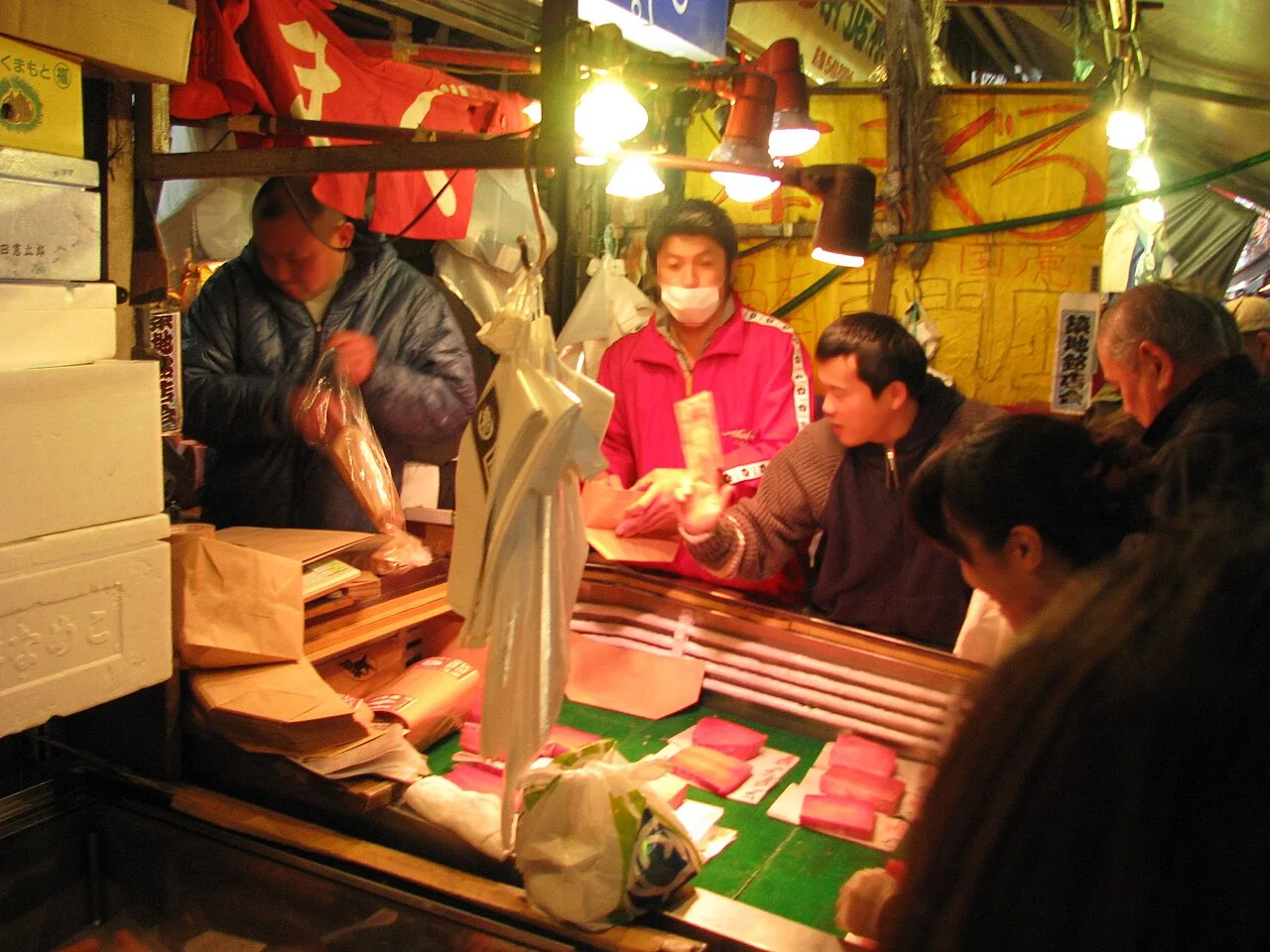
    Written by Kizuku. I run the Sunamachi Ginza Sumo Stable, a sumo experience in Koto City, and I write about the east side of Tokyo I live and work in. More about this site →

  • Food Tours in Tokyo by Area: How Much of the Food Is Actually in the Price

    Food Tours in Tokyo by Area: How Much of the Food Is Actually in the Price

    This article contains affiliate links to booking sites. If you book through them, LOCAL SIDE JAPAN earns a small commission at no extra cost to you. The tour recommended first at Tsukiji costs ¥2,000 and the most expensive one in the same alley costs ¥15,000. How this site is made →

    TOKYO / EXPERIENCES / FOOD TOURS, BY AREA

    Eight different companies will walk you down the same four hundred metres of the Tsukiji outer market, and they charge between ¥2,000 and ¥15,000 to do it. The market is free to enter and open to anyone. So the only question that matters is the one no listing puts in its title: how much of the food is in the price? One ¥4,000 tour states plainly that the food is not included and the guide will only point at it; one ¥2,000 tour is the guide alone, and the food is ¥200 to ¥500 a stall on top. This page sorts every food tour in Tokyo by area and by that question, and says where a guide is genuinely worth the money and where you are paying someone to walk beside you. Prices, inclusions, meeting points and review counts were read on the booking sites on September 25, 2026.

    A tuna stall in the Tsukiji outer market with customers being served across the counter
    A stall in the Tsukiji outer market. Eight companies charge between ¥2,000 and ¥15,000 to bring you here, and the street itself costs nothing. Photo: Aimaimyi / Wikimedia Commons, CC BY-SA 3.0.

    The only question that matters

    Read the inclusions line before the price. Food tours split into three kinds and the titles do not distinguish them:

    • Guide only. You pay for the walk and the explanation; every bite is your own money on top. One Tsukiji listing says so in as many words: the foods are not included in the tour fee. At ¥4,000 that is a reasonable price for two hours of a person’s time, as long as you knew.
    • Guide plus tastings. The normal product: five to fifteen small plates paid for by the operator. This is where ¥11,000 to ¥15,000 goes, and per plate it is usually fair.
    • Guide plus a full meal and drinks. The evening izakaya tours: nine dishes at four places with five drinks is dinner, and comparing its price to a lunchtime market walk is comparing dinner to a walk.

    One more thing to hold on to: at Tsukiji and Ameyoko, admission is not a thing that exists. A few listings put “Entry/Admission — Tsukiji Fish Market” in their inclusions. The outer market is a public street. What you are buying is the ordering, the language, and someone who knows which of two identical-looking stalls is the good one — which is a real service, just not an entry ticket.

    Tsukiji: the same alley, eight prices

    Tsukiji Street Food and Culture Walking Tour is the one to book: about ¥2,000 for ninety minutes, 5.0 from over 1,350 reviews, meeting at Tsukiji Hongwanji. The inclusions line says Meals, but the reviews describe something plainer and better value: the guide takes you to the stalls and you buy what you want, at stall prices of ¥200 to ¥500. That makes it a fraction of what the others charge for the same street, and its review record is among the deepest in the category. The ¥2,000 is the guide; bring cash for the food (what the reviews say).

    Above it, in order of what you actually get:

    • Tsukiji Food and Walking Tour — about ¥2,500 on offer from ¥5,000, two hours, 4.9 from over 2,000 reviews, the deepest review record at Tsukiji. Hongwanji temple plus the outer market with vendors the guide picks.
    • A two-hour guided walk at about ¥3,200 with photographs taken for you — food and drinks are not in this one.
    • Walking tour with sashimi tasting — about ¥5,500 for an hour and three quarters, meals included, 4.9 from about 155 (it was ¥3,800 when this page was first written).
    • Food and Culture Walking Tour — about ¥4,000, and the listing states the food is not included and the guide will tell you where to buy it. Honest, and worth knowing before you compare it to the ¥2,000 one.
    • Behind the Scenes with 10 seafood tastings — about ¥12,760, 4.9 from over 900, five different cuts of tuna, uni and ikura, and a sixty-year-old restaurant. This is the one to pick if the tuna is the reason you came.
    • A small-group tour billed as brunch — about ¥14,590, 5.0 from about 500: bluefin sushi, wagyu cutlet, oyster and sea bream sashimi, tamagoyaki, conger eel, dashi. A meal, not a tasting.
    • The ¥15,000 five-tasting tour — 4.9 from over 3,700 reviews, the most-booked at Tsukiji, capped at six to eight guests. You are paying for the small group and the reliability, not for more food than the ¥12,760 one.

    Go before 10am whatever you book. Tsukiji’s outer market is a morning trade; by early afternoon the good stalls have sold out and closed, and a tour at 2pm is a tour of shutters.

    Toyosu and the tuna auction

    The wholesale market moved from Tsukiji to Toyosu, in Koto City, in 2018, and the tuna auction goes with it — this is the one part of the category that is genuinely on the east side. You can visit the observation decks yourself for nothing, but the lower viewing floor, where you are close enough to see the auctioneer’s hand signals, is a lottery you have to apply for; a guide who holds slots removes that problem.

    The complete tuna auction and Toyosu market tour is about ¥19,000 for four to five hours, 5.0 from about 55 reviews, with a government-licensed guide of ten years, hotel pickup, and — the actual reason to book it — a held reservation at Daiwa Sushi or Ichiba Sushi, where the queue otherwise starts before dawn. A three-hour version pairing the auction with Tsukiji runs about ¥25,000, 4.8 from over 210. Both start around 5am. Nothing about this is a lie-in.

    Asakusa, Ueno and Yanaka

    Asakusa. Twelve dishes at four local eateries with two drinks, about ¥11,250 for two and a half hours, 4.9 from about 230, meeting at the Kaminarimon police box — the best value per plate in the district. The street food crawl, about ¥11,500 for two hours, 5.0 from about 280, starts at a standing sushi bar and is a full lunch across five-plus vendors. If you want a short one, a private two-hour Asakusa and Senso-ji walk with three food stops is about ¥8,000 and takes in Kappabashi, which pairs with the knife street guide.

    Ueno. The food is under and around Ameyoko, the market strip beside the tracks, and it is the most atmospheric eating in this article. The small-group evening tour — about ¥16,000, often discounted, 4.9 from about 50 — is nine dishes at three or four places plus ramen and around five drinks: that is a full night out, and priced as one. The private version with sushi, gyoza and yakitori runs about ¥17,500, 4.9 from about 330. There is also the taverns-and-ramen tour covered in the ramen comparison, which at ¥16,500 and 4.9 from over 1,170 reviews has by far the deepest record in Ueno.

    Yanaka. A private two-hour walk with two food stops from Nezu is about ¥7,000 — cheap, but note that the listing counts only two selections and lists additional food as your own expense. Private home cooking in Yanaka, about ¥18,500 and 5.0 from about 180 reviews, is the better use of the neighbourhood: someone’s kitchen, ingredients provided, lunch afterwards. Either way, the Yanaka walk is free and Yanaka Ginza’s croquettes cost ¥200.

    Shinjuku and Shibuya: the big evening tours

    The two largest operations in Tokyo are both west, both in the evening, and both genuinely good — the review counts are not the kind you can fake. The Shinjuku food tour: three hours, 13 dishes at four eateries with two drinks, about ¥13,000, 4.9 from over 9,800 reviews, the most-reviewed food tour in the city by a distance. The izakaya tour: three and a half hours, 14-plus tastings at three or four izakaya, about ¥14,000, 5.0 from over 3,380.

    Cheaper and rowdier, the Shinjuku bar and izakaya crawl is about ¥6,000 for three hours, 4.9 from nearly 1,400 — a drinking tour where you buy your own, and the closest thing in the west to a senbero night. Shibuya’s 13-dish tour is about ¥13,000, 4.9 from about 1,275. For dietary restrictions, a vegan-friendly Shibuya night tour runs about ¥18,600, 4.9 from about 130, and is the only listing in this article built around them.

    Related: The unguided version of the same night is Golden Gai, where the seat charge and the photo rules are the whole problem.

    The east side has none, and how to do it anyway

    Searched every way it can be searched: there is no bookable food tour in Sumida, Koto, Katsushika, Adachi or Edogawa. Toyosu’s auction tours are the only thing east of the river, and they are about a wholesale market rather than a neighbourhood. This is a gap in the market and, for a visitor, an invitation, because the two best eating streets on this side of the city need no guide at all:

    • Sunamachi Ginza in Koto: 670 metres, about 180 shops, and a shotengai where the custom is to eat as you go. Croquettes, grilled fish, oden by the piece, tempura, all in the ¥100–¥300 range. Two thousand yen is a large lunch. No guide exists and none is needed; the shopkeepers will hand you things.
    • Kita-Senju in Adachi: the old post town’s standing bars, where senbero — getting drunk for ¥1,000 — was more or less invented. The Shinjuku crawl above costs ¥6,000 to do a tidier version of this.

    If you want a guide on this side anyway, the closest thing is the Ueno evening tours, which are fifteen minutes from Asakusa, or a yakatabune dinner boat, which is the east side’s own way of eating in company.

    Which one to book

    If you want Book Area About
    Best value, full stop Tsukiji Street Food and Culture Walk Tsukiji ¥2,000 + stall food · 90 min · 5.0 (1,368)
    The deepest record at Tsukiji Tsukiji Food and Walking Tour Tsukiji ¥2,500 on offer · 4.9 (2,066)
    Tuna, seriously Behind the Scenes, 10 tastings Tsukiji ¥12,760 · 5 cuts of tuna · 4.9 (917)
    The tuna auction Complete Tuna Auction and Toyosu Toyosu, Koto ¥19,000 · sushi reservation held · 5.0 (55)
    Most dishes per yen Asakusa, 12 dishes at 4 eateries Asakusa ¥11,250 · 2.5 h · 4.9 (229)
    An evening out, east Ueno small-group foodie evening Ueno ¥16,000 · 9 dishes, 5 drinks · 4.9 (51)
    The safest booking in Tokyo Shinjuku food tour Shinjuku ¥13,000 · 4.9 (9,843)
    Izakaya, done properly Best of Shinjuku izakaya tour Shinjuku ¥14,000 · 14+ tastings · 5.0 (3,383)
    Drinking, cheap Shinjuku bar and izakaya crawl Shinjuku ¥6,000 · buy your own · 4.9 (1,388)
    Vegan Vegan-friendly Shibuya night tour Shibuya ¥18,600 · 4.9 (132)
    Someone’s kitchen Yanaka private home cooking Yanaka ¥18,500 · 5.0 (181)
    No guide at all Sunamachi Ginza, eat as you walk Koto about ¥2,000 · free · no booking

    Four things worth knowing

    • Market tours are morning, izakaya tours are night. They are not interchangeable, and a market tour after noon is a tour of closed shutters.
    • “Entry/Admission” to a market means nothing. Tsukiji’s outer market and Ameyoko are public streets, free at all hours.
    • Do not book a restaurant afterwards. On the evening tours, twelve to fifteen tastings is a meal.
    • Allergies and vegetarianism need naming at booking. A tasting tour is a fixed route through other people’s kitchens; the guide cannot improvise at the third stop.

    What the reviews say, and what they mean

    A 4.9 average tells you almost nothing when every tour in the table has one. So on September 29, 2026 I read the low end instead: every one-, two- and three-star review Viator would show for the five most-reviewed tours in this article, plus the most recent page of top ratings for each — 125 reviews in all. What follows is my summary in my own words. A complaint that appeared once is left out; a complaint that kept coming back is in. Where a tour has no complaint that repeats, this says so rather than inventing one.

    Tour Reviews One to three stars Repeated complaint?
    Shinjuku food tour, 13 dishes 9,916 124 (1.3%) Yes — see below
    Tsukiji five-tasting tour, ¥15,000 3,779 103 (2.7%) Yes — see below
    Best of Shinjuku izakaya tour 3,438 13 (0.4%) None found
    Tsukiji street food walk, ¥2,000 1,368 6 (0.4%) None found
    Ueno taverns and ramen 1,176 10 (0.9%) None found
    Totals are Viator and Tripadvisor combined, as shown on Viator on September 29, 2026.

    The Shinjuku food tour: good guides, ordinary rooms, a lot of standing

    The praise is almost always about the guide by name, the pace, and the other people in the group. The complaints, across thirty low reviews, come back to three things: the food is ordinary for ¥13,000; a good part of it is eaten standing in the street from a tray or a shared plate; and “13 dishes” turns out to mean thirteen tastes. A fourth thread, in four reviews, is that the guide was not Japanese and said little about what was being eaten. One reviewer put the first point better than I can: “it felt like the restaurants were chosen more for their capacity to handle tour groups than for the quality” (a reviewer on Viator, May 2026).

    What that means from here. The standing is not the operator cutting corners; it is the size of Shinjuku. Omoide Yokocho, the first stop, is about eighty shops packed onto roughly 2,000 square metres, and many of them are a single counter with eight seats. A group of twelve does not fit through the door, so a tour either feeds you on the pavement or takes you to the bigger, plainer restaurants that can seat twelve — which is exactly the trade the reviews describe. The listing promises a “professional expert guide”, not a Japanese one. What to do: if sitting at a yokocho counter is the point, go on your own, as a pair, early in the evening while the counters still have room; if the guide’s background matters to you, ask before you book.

    The ¥15,000 Tsukiji tour: Japanese guides, closed shutters on the wrong day

    The praise is for guides who know the stallholders personally and for the finish, where a chef fillets a fish and you build your own sashimi bowl. The complaints, across thirty low reviews, are that you could walk the same alley yourself, that the tastings are small for the price, and — in four reviews — that the guide’s English was limited, so not much got explained. Three more people booked a Sunday or a Wednesday and found much of the market shut.

    What that means from here. Two things are Japanese rather than the tour’s. First, “tour in English” on a Japanese-run tour means the tour is conducted in English, not that the guide is fluent; what you get instead is someone who has bought from these stalls for years. The Shinjuku tour above is the opposite trade — fluent English, less local knowledge — and the reviews of each complain about exactly what the other does better. Second, the wholesale market left Tsukiji for Toyosu in 2018, and the outer market that remains follows the wholesale calendar: Sundays, public holidays and designated Wednesdays are market holidays, and many shops close on them. What to do: check the outer market’s own calendar before you pick a date, and book a Monday, Tuesday, Thursday, Friday or Saturday.

    The other three: no complaint that repeats

    The Shinjuku izakaya tour has thirteen low ratings out of 3,438, dated between 2019 and 2025, and they do not agree with each other. The praise that repeats is that the portions are generous — several groups were too full for the last stop — and that there is a drink at each one. The Ueno taverns-and-ramen tour has ten out of 1,176, scattered: a cancellation dispute, one person who found the food too unusual, one who found it mediocre. The ¥2,000 Tsukiji walk has six out of 1,368, and no two say the same thing.

    What the ¥2,000 walk’s reviews do say, repeatedly and without complaining, is how the eating works: the guide takes you to the stalls and you decide what to buy — “buying food or not was your own decision” (a Tripadvisor reviewer, shown on Viator, September 2026). So despite the Meals line in the inclusions, treat the ¥2,000 as the guide and bring cash for the food. At the stalls that is cheap: a tamagoyaki skewer is about ¥200 and grilled tuna about ¥300.

    Which of these are made for foreigners

    All of them, and that is not an accusation — a tour that orders for you in English is a foreigner’s product by definition, and on a first night in Tokyo that is worth paying for. The useful question is what a Japanese person pays for the same evening, and how honest each listing is about the gap.

    • An izakaya night. The average spend per person at an izakaya in the Tokyo area was ¥4,052 in May 2026, according to Hot Pepper Gourmet’s monthly dining survey. The Shinjuku tours charge ¥13,000 to ¥14,000. The difference buys three hours of a guide, a table that takes a group, and the booking site’s commission. It is worth it if you have never ordered in an izakaya; it is not if you have, which is what the low reviews from people who had already spent time in Japan say.
    • A standing-bar crawl. The Ueno tour is ¥16,500 for five dishes and five drinks. The Japanese version is senbero — about ¥1,000 at a standing bar — followed by a bowl of ramen, which averaged ¥1,341 in the same survey. The listing says plainly that what it sells is the translating, and the reviews say it delivers that. Honest foreigner pricing.
    • Tsukiji. A Japanese visitor eats down the outer market at ¥200 to ¥500 a stall. The ¥15,000 tour is five tastings plus a guide and a chef’s demonstration, and it says so. The ¥2,000 walk is the one surprise in the other direction: the same company runs the same walk, from the same temple steps, as a pay-what-you-like tour on GuruWalk, where the suggested tip is €15 to €50 a person — more than the fixed ¥2,000 on Viator.
    • Where the word “local” is doing the most work. The 13-dish Shinjuku tour is sold as a shortcut to the best places to eat, and it is the only one of the five where “touristy” and “geared for tourists” recur in the reviews. It is still 1.3% of its reviews, and the other 98.7% are right that the evening is fun. Book it as a friendly first night out, not as a list of where Tokyo eats.

    Where this joins the rest of the east side

    The east side’s answer to a food tour is doing it yourself in Sunamachi Ginza or Kita-Senju, with senbero as the operating manual. To cook rather than eat, the classes compared by area are ramen, sushi and Japanese home cooking; for the Toyosu end of the day there is also teamLab Planets, whose official ticket is ¥4,200; the crafts are kintsugi, Edo Kiriko and Kappabashi knives; and the rest are tea ceremony, kimono rental and samurai and ninja. Everything bookable is on the Experiences page, and the area is in the east side guide.

    Quick answers

    What is the best food tour in Tokyo?

    For value, the Tsukiji street food and culture walk: about ¥2,000 for 90 minutes plus ¥200 to ¥500 a stall for whatever you choose to eat, 5.0 from over 1,350 reviews. For the safest booking, the Shinjuku food tour, 13 dishes at four eateries for about ¥13,000, rated 4.9 from over 9,800 reviews — the most-reviewed food tour in the city. For tuna, the Tsukiji behind-the-scenes tour with ten seafood tastings at about ¥12,760.

    How much does a food tour in Tokyo cost?

    From about ¥2,000 for a 90-minute market walk with tastings included, ¥11,000 to ¥15,000 for a two to three hour tour with 10 to 15 dishes, ¥16,000 to ¥19,000 for an evening tour that is a full dinner with drinks, and about ¥19,000 to ¥25,000 for a pre-dawn Toyosu tuna auction tour.

    Is the food included in a Tokyo food tour?

    Not always, and it is the thing to check. Several Tsukiji listings include meals; at least one at about ¥4,000 states that the food is not in the fee and the guide will only point you to it. Read the inclusions line rather than the title, because the price gap between the cheapest and dearest tour of the same street is mostly this.

    Do you need a guide for Tsukiji fish market?

    No. The outer market is a public street, free to walk at any hour, and the listings that put “Entry/Admission — Tsukiji Fish Market” in their inclusions are describing something that does not exist. A guide buys you the ordering, the language and knowing which of two similar stalls is the good one. Go before 10am either way; the market closes through the early afternoon.

    Can you see the tuna auction at Toyosu?

    Yes. The upper observation deck is free and open to anyone, and the lower viewing floor, close enough to see the hand signals, is allocated by application. Guided tours hold slots and start around 5am; the complete auction and market tour runs about ¥19,000 and includes a held reservation at one of the market’s sushi counters, where the queue otherwise begins before dawn.

    Is there a food tour in Sumida, Koto or the east side of Tokyo?

    No bookable neighbourhood food tour exists in Sumida, Koto, Katsushika, Adachi or Edogawa; the Toyosu auction tours in Koto are the only thing east of the river. The east side’s eating streets need no guide: Sunamachi Ginza in Koto is 670 metres of shops where ¥2,000 is a large lunch, and Kita-Senju in Adachi is where the ¥1,000 drinking night was invented.

    Should I eat before a Tokyo food tour?

    No, and do not book dinner afterwards either. A 12 to 15 dish tour is a full meal, and the evening izakaya tours include around five drinks as well. Eat a light breakfast before a morning market tour and nothing before an evening one.


    LOCAL SIDE JAPAN read the price, inclusions, exclusions, duration, meeting point and review record of every listing above on Viator on September 25, 2026. Prices are approximate, move with the exchange rate, and several use group pricing or were on temporary offer. This is a researched comparison of the listings and their reviews, not a firsthand report on each tour, and the article says so here rather than pretending otherwise. Nothing was provided free by an operator.
    Written by Kizuku. I run the Sunamachi Ginza Sumo Stable, a sumo experience in Koto City, and I write about the east side of Tokyo I live and work in. More about this site →

  • Ramen Making Classes in Tokyo by Area: Who Lets You Make the Noodles

    Ramen Making Classes in Tokyo by Area: Who Lets You Make the Noodles

    This article contains affiliate links to booking sites. If you book through them, LOCAL SIDE JAPAN earns a small commission at no extra cost to you. The class recommended first here costs ¥6,900 and the most expensive one on the page costs ¥25,500. How this site is made →

    TOKYO / EXPERIENCES / RAMEN CLASSES, BY AREA

    A bowl of ramen is four things — broth, tare, noodles and toppings — and the broth is the one that takes twelve hours and decides whether the bowl is good. No ninety-minute class makes broth. That is not a scandal; it is arithmetic, and the honest operators say so in their own listings. What the classes actually teach is noodles, and that turns out to be the interesting part, because fresh ramen noodles are the one component you genuinely cannot buy at home. This page sorts every bookable ramen class in Tokyo by area and by whether you make the noodles from flour or start from a packet someone else made, with what each costs. Prices, inclusions, meeting points and review counts were read on the booking sites on September 25, 2026.

    A standing ramen counter in the Tsukiji outer market with staff working behind an open kitchen
    A standing ramen counter by Tsukiji market. The stock in that pot was started before dawn; the class you book will run ninety minutes. Photo: ngader / Wikimedia Commons, CC BY 2.0.

    The question that sorts every class

    Do you make the noodles from flour, or does the class hand you fresh noodles someone else made? Both are common, both are sold as “ramen making from scratch”, and one of the Kappabashi operators is blunt about it in its own listing: many ramen classes start with premade fresh noodles, and theirs does not. Ask, or read the inclusions, before you pay ¥20,000.

    Three more things worth knowing before the list:

    • The broth is pre-made almost everywhere, and that is fine. A tonkotsu takes eight to twelve hours of hard boil. Classes that advertise “prepare a rich broth” mean you finish and season a stock, or make a quick chicken one. The Akihabara Jiro-style class is the rare one that puts the broth and the chashu at the centre of the session — and it runs three and a half hours to do it.
    • Gyoza is the padding. Most classes are “ramen and gyoza”, and gyoza is quick, forgiving and photogenic. If the listing is two hours and covers both, the ramen half is short.
    • Vegan and pork-free is widely available — the Kappabashi studio, the Shibuya dojo and the Shinjuku home kitchen all offer it — but it has to be arranged at booking, not on the day.

    The east side: Kappabashi, Arakawa, Yanaka, Asakusa

    Kappabashi: the one to book

    The ramen noodle class at SOBAGIRI Rakujo, a soba and ramen studio at 3-1-12 Matsugaya just off Kappabashi, is the best value in this article and the clearest about what it is: fifty minutes, about ¥6,900 (it was ¥8,880 when this page was first written — the price has since come down), noodles made from ramen flour rather than handed to you, six flavours to finish the bowl with, vegan and pork-free options, 5.0 from over 120 reviews. It is well under half the price of the Shibuya classes, it is the component you actually cannot replicate at home, and it is a ten-minute walk from Senso-ji.

    The same studio runs a soba class with the big soba knife for the same ¥6,900, 4.9 from about 110 reviews — mixing, kneading, stretching, cutting and eating what you cut. If you are already going to Kappabashi for a knife, doing one of these in the same morning is the single most coherent half-day in this whole experiences series: learn the cut, then buy the blade on the same street.

    Arakawa: the most-reviewed ramen class in Tokyo

    YUCa’s Japanese Cooking in Nishiogu, Arakawa City, holds 5.0 from about 900 reviews — more than any other ramen class in the city, by a wide margin — for about ¥18,500. The listing’s own timetable is 10:00 meeting, a short lecture, then 10:30–12:30 cooking and eating, and 12:30–13:00 a local supermarket tour marked “optional” — so it is a thirty-minute add-on at the end, not the walk-and-then-cook morning this page described until 2 October 2026. It is still the part worth staying for, because a Japanese shop aisle explained by someone who cooks from it is a better souvenir than most souvenirs, but ask for it on the day. Minimum two people per booking, so this one is not for solo travellers. Nishiogu is a residential stretch of Arakawa nobody visits, which is the point.

    Yanaka and Asakusa

    Kujo Tokyo, on a second floor at 1-2-10 Yanaka, is a private class: ninety minutes, about ¥13,000, dough kneaded and gyoza filling mixed, 4.9 from about 70 reviews. It is the cheapest private option in the city and it sits at the top of the Yanaka walk, so it slots into a day rather than eating one.

    Chagohan Tokyo at 2-17-13 Nishi-Asakusa runs three hours at about ¥19,800, 5.0 from about 90 reviews, covering broth and the crisping of the gyoza skirt. It is the most thorough class on the east side and priced accordingly; note that it has no free cancellation, unlike almost everything else here.

    Central and west: Akihabara, Shibuya, Aoyama, Shinjuku

    Akihabara — the one that actually makes broth. Ramen Making from Scratch with an Akihabara tour, three and a half hours from Akihabara Station at about ¥18,700, 5.0 from about 140 reviews, is the only Tokyo listing that puts noodles, broth and Jiro-style chashu pork in one session, with a grocery stop for seasonings. Jiro is the enormous, garlic-heavy, unfashionably beloved school of Tokyo ramen, and learning it rather than a polished shoyu is a choice with some taste behind it.

    Shibuya, or rather Meguro. Both of the heavily marketed “Shibuya ramen” classes are run by Ramen Dojo Tokyo at 2-16-29 Ohashi, which is in Meguro City near Ikejiri-Ohashi, one stop out. The ¥15,000 version is ninety minutes tasting three mini bowls — tonkotsu, shoyu and miso — with an apron, a digital recipe and a vegan option, 5.0 from about 220 reviews. The ¥20,000 version adds making your own noodles on a professional noodle machine, 4.9 from about 400 reviews. If you want the three-flavour comparison, this is where to get it; if you want the noodles, the Kappabashi class does that for ¥6,900.

    Minami-Aoyama — the professional version. Become a Ramen Chef for a Day is three and a half hours at about ¥25,500, 4.8 from 232 reviews, taught by a chef, two broths and hand-made noodles, dietary restrictions accommodated with notice. It is the most expensive class in Tokyo and it does treat you as an apprentice rather than a guest — which is exactly what its unhappy reviewers object to. It also has the weakest review record in this article by some distance: nine reviews of 232 at three stars or below, against nought to one on almost everything else here. Read the breakdown below before you book this one.

    Shinjuku — someone’s kitchen. Ramen and gyoza with a Tokyo mother, near Shinjuku-gyoemmae, is two and a half hours at about ¥21,000, 5.0 from about 70 reviews, vegan on request, with a PDF recipe. You are paying for a home kitchen and a host rather than a studio, which some people want and others do not. A two-hour ramen and dumpling class with an ex-restaurant chef runs about ¥15,500, often discounted to around ¥12,400, 5.0 from about 120.

    Two specialists, for completeness: gyoza from scratch, wrappers included, about ¥14,000 for just under two hours, 5.0 from about 40; and a gluten-free class in Setagaya making gyoza with rice-flour wrappers and karaage with potato starch, about ¥16,000, 5.0 from about 15 — the only genuinely coeliac-safe option in this category, because wheat noodles rule out everything else on this page.

    If you would rather eat than cook

    Defensible, and often the better choice: three hours of eating tells you more about Tokyo ramen than ninety minutes of kneading. The ramen tasting tour with six mini bowls at three shops is about ¥18,500 for three hours, 5.0 from about 150 reviews, and is built so you can actually compare styles instead of filling up on the first one. The same operator’s night crawl from Shibuya to Ebisu is four mini bowls and two drinks for about ¥14,000.

    On the east side, Hidden Taverns and Ramen in Ueno is the giant of the category: three hours from Ueno Station through a standing bar and a tavern and finishing on ramen, about ¥16,500, 4.9 from over 1,170 reviews. It covers the same ground as the senbero article with a guide doing the ordering, which is worth the money the first time and not the second.

    And the one that belongs entirely to this site’s part of the city: a tattoo-friendly bathhouse and ramen tour, about ¥9,000, meeting at Kinshicho PARCO in Sumida, dinner ramen of your choice, then a bath and a post-bath drink, ending at Daikokuyu Oshiage Onsen — the sento at the top of the tattoo-friendly list. It is new and barely reviewed, and you can do the whole thing yourself for about ¥1,500 using that article and the etiquette guide; what the ¥9,000 buys is a guide who has already had the tattoo conversation at the counter for you.

    Which one to book

    If you wantBookAreaAbout
    Noodles from flour, best valueSOBAGIRI Rakujo ramen classKappabashi¥6,900 · 50 min · 5.0 (123)
    The most trusted class in TokyoYUCa’s Japanese CookingNishiogu, Arakawa¥18,500 · 2.5 h · 5.0 (900)
    Broth and chashu tooJiro-style class from AkihabaraAkihabara¥18,700 · 3.5 h · 5.0 (139)
    Three styles comparedRamen Dojo Tokyo, tasting versionOhashi, Meguro¥15,000 · 90 min · 5.0 (223)
    A private class, cheapestKujo TokyoYanaka¥13,000 · 90 min · 4.9 (68)
    The thorough one, east sideChagohan TokyoNishi-Asakusa¥19,800 · 3 h · no free cancellation
    To be treated as an apprenticeBecome a Ramen Chef for a DayMinami-Aoyama¥25,500 · 3.5 h · 4.8 (232) · check the reviews first
    Soba insteadBig soba knife classKappabashi¥6,900 · 50 min · 4.9 (110)
    Gluten freeGluten-free gyoza and karaageSetagaya¥16,000 · 3 h
    To eat, not cookRamen tasting tour, 6 bowlsCentral Tokyo¥18,500 · 3 h · 5.0 (150)
    To eat, on the east sideHidden Taverns and Ramen in UenoUeno¥16,500 · 3 h · 4.9 (1,174)

    Before you book

    • You eat what you make, and it is a full meal. Do not book a class for 11am and a lunch reservation for 1pm.
    • Check whether the recipe comes home with you. The Shibuya, Shinjuku and Akihabara classes send a digital recipe; several of the cheaper ones do not, and without one the knowledge evaporates on the flight.
    • “Shibuya” and “Asakusa” in a listing title are marketing. Two of the Shibuya ramen classes are in Meguro; check the meeting point, which every listing shows on a map.
    • Dietary requirements go in at booking. Vegan, pork-free and halal-adjacent options exist at several studios, but the stock has to be started without pork, which means the day before.

    What the reviews say, and what they mean

    The seventeen listings on this page carry about 3,870 reviews between them on Viator. On 2 October 2026 I read every review rated three stars or below on the listings with a record deep enough to mean anything — and the operators’ replies, which on this page are unusually worth reading. Two things I found contradict what this page said before today. Both are corrected above.

    Where the low reviews actually are

    ListingReviewsRated 3★ or below
    Hidden Taverns and Ramen, Ueno (eating)1,18010 (0.8%)
    YUCa’s, Arakawa9002 (0.2%)
    Ramen Dojo, ¥20,000 noodle version3995 (1.3%)
    Become a Ramen Chef, Minami-Aoyama2329 (3.9%)
    Ramen Dojo, ¥15,000 tasting version2231 (0.4%)
    Ramen tasting tour, six bowls1501 (0.7%)
    Akihabara Jiro-style1400
    Ramen and dumplings, two hours1240
    SOBAGIRI Rakujo, ramen1220
    SOBAGIRI Rakujo, soba1091 (0.9%)
    Chagohan, Nishi-Asakusa900
    Tokyo mother, Shinjuku690
    Kujo Tokyo, Yanaka681 (1.5%)
    Gyoza from scratch450
    Gluten-free, Setagaya14—
    Sento and ramen, Kinshicho3—
    Night crawl, Shibuya to Ebisu1—

    Nine of the seventeen have no review below four stars at all. As a category, ramen classes in Tokyo are about as safe a booking as this site has looked at. The exception is the one at the top of the price list.

    The most expensive class has the worst record

    Become a Ramen Chef for a Day in Minami-Aoyama is ¥25,500, the dearest on this page, and it has nine reviews at three stars or below out of 232 — roughly five times the rate of anything else here. The complaints are not about the food, and almost every one of them praises the chef personally. They are about the structure.

    The repeated one: you are put on a station, so you only see part of the process. It comes up in four of the five low reviews I read. One from November 2023 counted the cost precisely — nine people in the class, so “I only know 1/9 of everything”. Another, from June 2024, put it as plainly as it can be put: “this isn’t a cooking class but more of a working in the kitchen experience” (a reviewer on Viator). That is the same thing our line above called being treated as an apprentice. Whether it is a feature or a fault depends entirely on what you booked it for, which is why it is now flagged rather than praised.

    The second: the recipe book promised at booking does not always arrive. Two reviewers, April and May 2024, say they chased it by email, phone and message and never received it — and for a class whose own defence is that the gaps are filled in afterwards by the written recipes, that matters more than it would elsewhere.

    In fairness, the operator answers every single critical review at length, concedes the points, has said in public that he is “making tweaks both to how we are describing the experience”, and offers full refunds in writing to people who were disappointed. That is rarer than a five-star average. If you book this one, book it knowing you will cook one station of a bowl, and email for the recipes the same week.

    The ¥20,000 Shibuya class: you make the noodles, not the ramen

    The noodle version at Ramen Dojo has five low reviews in 399, and the substantive ones say the same thing: “You only make the noodles. the rest is already prepared”, and the description is misleading for the price (a reviewer on Viator, April 2026). A January 2026 review wanted the broth explained and got noodles and toppings; the operator replied that the basic course focuses on the noodles and the assembly, and said it would look at adding more on the broth.

    This is the article’s opening warning landing in real life: the broth is pre-made almost everywhere, and at ¥6,900 in Kappabashi that is fine, because nobody pretended otherwise. At ¥20,000 the same fact reads differently. One reviewer also found the room crowded for the number booked in.

    Where no complaint repeats

    The Kappabashi ramen class, the Akihabara Jiro-style session, Chagohan, the Shinjuku home kitchen, the two-hour ramen and dumpling class and the gyoza specialist have no review below four stars between them. YUCa’s has two in nine hundred, and one of those is the supermarket-tour mix-up corrected above, which the host answered by explaining the guest had had to leave early. There is no pattern to report in any of them and we are not going to invent one.

    Which of these are made for foreigners

    This is the category where the gap is widest, and the reason is that the best noodle-making class in Japan is free.

    Yamato MFG, the company that builds the noodle machines a large share of Japanese ramen shops actually use, runs a ramen self-made-noodle class for the public. Three to four hours: the theory, deciding what kind of noodle you want, the ingredients, then mixing, rolling and cutting on professional machines, a question session, and you take your noodles home. The published fee is 完全無料 — completely free. The only money involved is the textbook, 究極ラーメン, at ¥3,850, and only if you do not already own it (Yamato MFG event schedule, checked 2 October 2026).

    The honest catches, and there are several. It is conducted in Japanese. It is a manufacturer’s class, so the reason it is free is that some attendees go on to buy a noodle machine. It teaches noodles, not a finished bowl, and it is a lecture-and-workshop rather than a cook-and-eat. And although Yamato’s Tokyo venue, Dream Studio Tokyo, is in Itabashi at 9-17-4 Takashimadaira — on this side of the city — the schedule as of today lists dates in Sendai, Nagoya, Osaka, Fukuoka, Kagawa and Kagoshima and none in Tokyo. So this is not a booking you can make for next Tuesday. It is the number that tells you what the teaching is worth on its own: nothing, if you can read the room it is taught in.

    Against that, the paid classes are selling four things: English, a fixed date you can book from abroad, a finished bowl you eat on the spot, and a studio you can walk to from Asakusa. Those are real, and ¥6,900 for fifty minutes in Kappabashi with noodles made from flour is a defensible price for them. ¥25,500 for a station in a professional kitchen is a different proposition, and it is the one the reviews argue about.

    And the thing that is not a class at all. A bowl of ramen eaten in a shop in Japan averaged ¥746 in August 2026 (小売物価統計調査, Statistics Bureau). The six-bowl tasting tour above is ¥18,500. Nothing is wrong with paying it — you are buying three shops chosen for contrast and someone to do the ordering — but it is worth seeing the two numbers next to each other before you decide that eating is the cheaper option. It is not automatically the cheaper option. Doing it yourself is.

    Where this joins the rest of the east side

    Make noodles on Kappabashi in the morning and buy the knife to cut them on the same street in the afternoon; that is the best food day in this series. The other classes compared by area are sushi making, Japanese home cooking and tea ceremony, the crafts are kintsugi and Edo Kiriko, and the dressing-up is kimono rental and samurai and ninja. The guided eating tours in every district are compared in food tours by area. For eating without a guide, the east side’s own answer is senbero and Kita-Senju. Everything bookable is on the Experiences page, and the area is in the east side guide.

    Quick answers

    What is the best ramen making class in Tokyo?

    For the noodles themselves, the SOBAGIRI Rakujo studio near Kappabashi: 50 minutes, about ¥6,900, noodles made from flour rather than handed to you, 5.0 from over 120 reviews. For the most trusted class overall, YUCa’s Japanese Cooking in Nishiogu, Arakawa, 5.0 from about 900 reviews at ¥18,500 including a supermarket walk. For broth and chashu as well, the Jiro-style class from Akihabara, ¥18,700 over three and a half hours.

    How much does a ramen cooking class in Tokyo cost?

    About ¥6,900 for a 50-minute noodle-making class, ¥13,000 to ¥15,000 for a 90-minute class with a tasting, ¥18,500 to ¥21,000 for two to three hours including gyoza or a market visit, and about ¥25,500 for the professional three-and-a-half-hour version in Minami-Aoyama.

    Do ramen classes teach you to make the broth?

    Rarely, and it is a matter of time rather than secrecy: a tonkotsu broth takes eight to twelve hours of hard boiling. Most classes finish or season a stock that was started earlier. The exception in Tokyo is the three-and-a-half-hour Jiro-style class from Akihabara, which covers broth, chashu pork and noodles in one session.

    Do you make the noodles yourself in a ramen class?

    Depends on the class, and this is the question to ask. Some start from fresh noodles someone else made; the Kappabashi studio states plainly that its class starts from ramen flour, and the ¥20,000 Ramen Dojo class uses a professional noodle machine. The listing’s inclusions line usually says which.

    Is there a vegan or gluten-free ramen class in Tokyo?

    Vegan and pork-free options exist at the Kappabashi studio, the Ramen Dojo classes and the Shinjuku home kitchen, arranged at booking rather than on the day. Gluten free rules out ramen noodles entirely; the alternative is the Setagaya class making gyoza with rice-flour wrappers and karaage with potato starch, about ¥16,000.

    Is a ramen tasting tour better than a cooking class?

    For understanding Tokyo ramen, often yes. Six mini bowls at three shops over three hours, about ¥18,500, lets you compare styles in a way one bowl cannot. The Ueno taverns-and-ramen tour, 4.9 from over 1,170 reviews at ¥16,500, is the east side’s version and the most reviewed of either kind.

    How long does a ramen class in Tokyo take?

    Fifty minutes for a noodle-only class, 90 minutes for the standard class with a tasting, two to two and a half hours if gyoza or a supermarket visit is included, and three to three and a half hours for the classes that make broth. You eat a full bowl at the end, so plan the rest of the day around it.


    LOCAL SIDE JAPAN read the price, inclusions, duration, meeting point and review record of every listing above on Viator on September 25, 2026. Prices are approximate, move with the exchange rate, and several use group pricing. This is a researched comparison of the listings and their reviews, not a firsthand report on each kitchen, and the article says so here rather than pretending otherwise. Nothing was provided free by an operator.
    Written by Kizuku. I run the Sunamachi Ginza Sumo Stable, a sumo experience in Koto City, and I write about the east side of Tokyo I live and work in. More about this site →

  • Samurai and Ninja Experiences in Tokyo: The Four Different Things Being Sold

    Samurai and Ninja Experiences in Tokyo: The Four Different Things Being Sold

    This article contains affiliate links to booking sites. If you book through them, LOCAL SIDE JAPAN earns a small commission at no extra cost to you. The first recommendation on this page is a ¥1,000 museum in Sumida that pays this site nothing. How this site is made →

    TOKYO / EXPERIENCES / SAMURAI AND NINJA, BY KIND AND AREA

    “Samurai experience Tokyo” is sold at every price from ¥3,500 to ¥48,000, and the listings do not make clear that they are four completely different products: a museum ticket, a costumed hour in a photo studio, a genuine martial arts lesson from a licensed teacher, and a professional armour photoshoot. People book the ¥9,800 studio hour expecting the ¥18,000 dojo, and the other way round. This page sorts every bookable option in Tokyo into those four kinds, with the area, the price and what actually happens in the room — and starts with the ¥1,000 museum in Ryogoku that most of these listings are an imitation of. Prices, durations, meeting points and review counts were read on the booking sites on September 24, 2026.

    Kendo practitioners in armour training in a Tokyo dojo during winter kangeiko
    Kangeiko, the midwinter training, in a Tokyo dojo. This is what the ¥18,000 listings are; the ¥9,800 ones are a different thing wearing the same word. Photo: Tasogare / Wikimedia Commons, public domain.

    The four things sold as “a samurai experience”

    • A museum ticket, ¥1,000–¥3,500. Either real swords and armour in a glass case, or a tourist museum where the ticket includes a costume and a throwing-star game.
    • The studio hour, ¥6,500–¥13,000. A room, a hakama to put on, a blunt or soft sword, a set of choreographed cuts taught by a performer, and twenty minutes of photographs. Enjoyable, well reviewed, and closer to a theatre workshop than to a martial art. This is what most listings titled “samurai experience” are.
    • A martial arts lesson, ¥15,000–¥30,000. Kendo in real armour with a bamboo shinai, or iaido — the art of drawing a sword — with a licensed instructor from a named school, in a dojo where people actually train the rest of the week. You will be corrected, you will be worse at it than you expect, and it is the only version that leaves you knowing anything.
    • Armour photography, ¥16,000–¥48,000. A studio, a full set of kacchu armour, a photographer, and a file of images. No sword skills involved; you are buying the portrait.

    None of these is a bad thing to book. The mistake is booking one while imagining another, and the listings rarely say which they are, because “samurai experience” sells better than “choreographed sword posing with costume”.

    Start here: the ¥1,000 room in Ryogoku

    The Japanese Sword Museum (刀剣博物館) is at 1-12-9 Yokoami in Sumida, inside the old Yasuda Garden, a three-minute walk from Ryogoku Station and next door to the sumo stadium. It is run by the foundation that preserves Japanese swords, and the objects in the cases are the real ones — blades by named smiths, several of them designated national treasures or important cultural properties, rotated through changing exhibitions. Admission is ¥1,000 for adults, ¥500 for high-school, university and vocational students, free below that; open 9:30 to 17:00 with last entry at 16:30, closed Mondays, between exhibitions and over the new year. No booking, no costume, no photographs of you.

    Spend an hour there before you decide which of the paid experiences you want, because it answers the question the ¥9,800 ones cannot: what a sword actually is — how short, how heavy, how specific the curve, how much of the value is in the grain of the steel rather than in the drama. Then pick your experience knowing what you are imitating. It is ten minutes from the rest of Sumida and the same walk as the Kokugikan.

    The museums and costume tickets

    Samurai Ninja Museum Asakusa, basic ticket is about ¥3,500 for an hour, 4.9 from 495 reviews, at 1-8-13 Nishi-Asakusa, and includes a guided tour and a throwing-star competition. It is a tourist attraction rather than a collection, it knows it, and for families it is the most reliably enjoyable ¥3,500 in this article. The Shinjuku Samurai Museum ticket is the same operator’s western branch, also about ¥3,500, 4.5 from about 50 reviews.

    The same museum sells the costume upgrades, and these are the best-value studio hours in the city because the museum tour is folded in. The family-friendly sword experience, about ¥8,100 over two hours and 4.9 from 181 reviews, is a hands-on sword lesson in a hakama plus an armour try-on and studio photographs. The version with the museum tour included is about ¥11,900, 4.8 from 317 — and it is the one listing in this article worth reading the fine print on. The sword is an iaito, a blunt zinc-aluminium practice blade that the operator’s own description explains “cannot hold a sharp edge”, and there is no tatami cutting, although the inclusions line still reads “Use a real samurai sword”. The reviews are below. The ninja version — costume, shuriken, a maximum of twenty people — is about ¥7,000 and 4.9 from 452 reviews, the most-reviewed ninja listing in Tokyo and the right one for children.

    The studio hour, area by area

    Shinjuku. Samurai Theater Tokyo at 40 Yokoteramachi, in the grounds of a temple, is the category leader by a wide margin: one hour, about ¥9,800, costume included, 5.0 from 594 reviews — and two low reviews in all 594, the cleanest record in this article by a distance. Booked as a show-and-lesson by performers rather than as training, and the best-run example of the type.

    Asakusa and Kuramae. The archery and katana session at BAC Asakusa, five minutes from Kaminarimon, is the most interesting hour in this tier: a real Japanese bow and arrows, a wooden stick for kendo practice, soft katana for the games and a decorative one for photographs, small group, about ¥11,000 and often discounted, 4.9 from about 95 reviews. Kyudo is genuinely hard and genuinely absorbing, and almost nobody offers it. Samurai Training Asakusa, in an unsigned shop in Hanakawado, is the private photo-heavy version at about ¥13,000 with picture and video footage included, 4.9 from about 80 reviews.

    Tsukishima. Samurai Adventure in Tsukuda, the old fishing quarter across the river from Tsukiji, is the cheapest credible studio hour at about ¥6,500: history, a demonstration, wooden swords, a photo session, small group or private. Worth combining with a walk around Tsukuda’s canal houses, which is the last corner of central Tokyo that still looks like the 1950s.

    Sendagaya. SAMURAI’ve, in a basement near the National Stadium, is a sword-fighting class with costumes and metal replica katana, about ¥11,000, 4.5 from about 15 reviews — the lowest rating among the well-known studios, and priced as though it were higher.

    The real martial arts: kendo and iaido

    The kendo workshop at Seidokan in Higashi-Nippori is the one this site would book. Two hours in a working dojo in Arakawa City, ten to twelve minutes from Uguisudani Station, full kendo armour and a shinai provided, ending in a mock tournament: about ¥18,000, 4.8 from about 130 reviews. It is on the east side, it is a real dojo rather than a studio, and putting the men helmet on and being hit by someone who knows how is an experience of a different order from posing with a blunt blade.

    Bushido through Kendo in Nihonbashi-Kobunacho is the central version, two hours with kendo attire and shinai included, about ¥20,000, 5.0 from about 130 reviews. Samurai Sword Tokyo in Kojimachi sits between the studio hour and the dojo: uniform rental, a live demonstration, an English explanation of sword technique and bushido, and a named certificate scroll at the end, about ¥15,000, 5.0 from about 60 reviews.

    For iaido — drawing the sword, which is the discipline most people mean when they picture a samurai — the Mugai-ryu session in Kuramae is an hour with a named school, an English-speaking instructor, hakama and sword rental, about ¥23,000, 5.0 from about 45 reviews; the dojo is a minute from Kuramae Station and a short walk from the river walk. A private iaido lesson near Kudanshita is about ¥23,500 for ninety minutes, 4.8 from about 15.

    The most serious listing in Tokyo is also the furthest out: three hours of sword and archery training in a Machida dojo taught by a man who describes himself as a samurai descendant, about ¥30,000, 5.0 from over 150 reviews, with a practice uniform, bokken and a real bow, and the instructor asking your height and weight beforehand so the clothes fit. Machida is forty minutes west of Shinjuku, so this is a half-day, not an add-on.

    Ninja, and what it actually is

    Worth saying plainly: shinobi existed as spies and irregular soldiers, mostly in the Iga and Koka areas, and almost nothing about the popular image is contemporary with them. The all-black hooded outfit is generally traced to kabuki stage convention — the black-clad stagehands an audience agrees not to see — rather than to any historical uniform. Everything below is entertainment, and the good ones are open about it.

    NINJA SAMURAI TOKYO in Shiomi, Koto City is the east side’s entry and the best-reviewed serious one: two hours with a Japanese sensei who teaches ninja arts in English, costume rental included, about ¥15,000, 5.0 from about 240 reviews. Their one-hour lesson is about ¥12,500. Shiomi is two stops from Tokyo Station on the Keiyo line and a short walk from the rest of Koto.

    MUSASHI JAPAN on Kappabashi runs an eighty-minute immersion with a black-belt instructor and an online interpreter, about ¥25,300, 4.9 from about 95 reviews — the premium end, and five minutes from the knife street. Ninja Wire Action in Yushima straps you into a film-stunt harness and gives you the video, about ¥16,900, 4.9 from about 35 reviews. It is not remotely historical and it is the most fun on this page.

    Armour photography

    The Yoyogi armour studio is the entry point: an hour, staff who explain the armour and dress you in it, pose direction and composite shots, about ¥16,300, 5.0 from a small number of reviews. The Shibuya studio in Maruyamacho is the established one — full kacchu armour and helmet, a professional photographer, the images handed over on an SD card, a printed “samurai licence” and a frame, about ¥35,000, 5.0 from about 85 reviews. Between them sits the Yoyogi studio’s ninety-minute premium version at about ¥32,800. Armour is heavy and hot; ninety minutes is the ceiling of what is enjoyable.

    Which one to book

    If you wantBookAreaAbout
    The real objects, almost freeJapanese Sword MuseumRyogoku, Sumida¥1,000 · no booking
    The real thing, hands onKendo workshop at SeidokanHigashi-Nippori, Arakawa¥18,000 · 2 h · 4.8 (131)
    The best studio hourSamurai Theater TokyoShinjuku¥9,800 · 1 h · 5.0 (592)
    Something you cannot do elsewhereArchery and katana at BACAsakusa¥11,000 · kyudo included · 4.9 (94)
    The cheapest studio hourSamurai AdventureTsukuda, Tsukishima¥6,500 · 1 h
    ChildrenNinja Experience at the museumNishi-Asakusa¥7,000 · 2 h · 5.0 (452)
    Drawing the sword, properlyMugai-ryu iaidoKuramae¥23,000 · 1 h · 5.0 (45)
    Ninja, taken seriouslyNINJA SAMURAI TOKYOShiomi, Koto¥15,000 · 2 h · 5.0 (238)
    Ninja, not taken seriouslyNinja Wire ActionYushima¥16,900 · video included
    A portrait in armourSamurai Armor Photo StudioShibuya¥35,000 · SD card · 5.0 (86)
    A half-day of actual trainingSword and archery, Machida dojoMachida¥30,000 · 3 h · 5.0 (153)

    Four things nobody tells you

    • You will not cut anything. Beginners handle wooden bokken, soft practice katana or blunt iaito. Tatami-mat cutting with a live blade is a separate, rarer and more expensive thing, and no listing in this article includes it.
    • “Samurai descendant” is not a credential anyone issues. A school name — Mugai-ryu, or a kendo federation grade — is. Look for the school in the listing, not the ancestry.
    • Kendo armour smells, and that is normal. Rental sets are shared. Long socks and a T-shirt under it make the two hours much better.
    • The studio hours photograph better than the dojo ones. If the pictures matter more than the skill, book the studio and spend the difference elsewhere — that is not a criticism of either, just the trade you are making.

    What the reviews say, and what they mean

    The listings on this page carry about 3,293 reviews between them, and roughly 62 of those are rated three stars or below — about 1.9% overall. But the average hides the only thing worth knowing here: the complaints are concentrated in one operator. Read on 4 October 2026, with the operators’ replies and the current listing text.

    Where the low reviews are

    ListingReviewsRated 3★ or below
    Samurai Theater Tokyo, Shinjuku5942 (0.34%)
    Samurai Ninja Museum, basic ticket49515 (3.0%)
    Same museum, ninja version4526 (1.3%)
    Same museum, sword + museum tour31716 (5.0%)
    NINJA SAMURAI TOKYO, Shiomi2402 (0.8%)
    Same museum, family sword experience1814 (2.2%)
    Machida dojo, sword and archery1531 (0.7%)
    Seidokan kendo, Higashi-Nippori1345 (3.7%)
    Bushido through Kendo, Nihonbashi1310
    BAC Asakusa, archery and katana1002 (2.0%)
    MUSASHI JAPAN940
    Shibuya armour studio870
    Samurai Training Asakusa801 (1.3%)
    Samurai Sword Tokyo, Kojimachi620
    Same museum, Shinjuku ticket504 (8.0%)
    Mugai-ryu iaido, Kuramae490
    Six smaller listings10–36 each0–1 each

    The five Samurai Ninja Museum listings hold 1,495 reviews and 45 low ones, a rate of 3.0%. Everything else on this page — the studios, the dojos, the armour photographers, the ninja operators — holds about 1,798 reviews and roughly 17 low ones, under 1%. Three times the complaint rate, from the operator that sells the most listings in the category.

    The sword is a blunt alloy replica, and there is no tatami cutting

    This matters because the ¥11,900 listing is sold on the idea of cutting. Its own product URL still contains the word tameshigiri — test cutting — and its inclusions line still reads “Use a real samurai sword”. But the operator’s own description, lower down the same page, now explains at length that what you hold is an iaito: a practice sword made of zinc-aluminium alloy, deliberately unsharpened, which in the operator’s words “cannot hold a sharp edge, meaning it is not classified as a weapon under Japanese law”. The session is described as learning basic iaido technique “with a replica sword”.

    A July 2024 reviewer put it less diplomatically: “YOU DO NOT GET TO CUT A TATAMI MAT WITH A REAL KATANA”, adding that staff told them a change in the law had ended it, and that it should be removed from the itinerary. Two years later the itinerary still implies otherwise in one line and corrects it in another.

    None of this makes it a bad hour — 288 of 317 reviewers gave it five stars, and an iaito is what almost every beginner anywhere in the world trains with. But if cutting a mat with a live blade is what you are paying ¥11,900 for, you will not get it here, and the dojo listings further down this page are the honest place to spend the money instead.

    The group-size complaint, and the operator fixing it

    Two reviewers describe the opposite of a small group: “at least 40 persons in the museum and 25 with the swordcutting… you have to get in queue for cutting, everybody is watching” (October 2023), and “a lot of waiting around for the rest of the group to have individual turns” (May 2024). The operator replied that it had moved to a larger venue and increased the number of tours.

    It appears to have worked. The listing today states a maximum of four travellers. That is a genuine fix and it is worth saying so, because it means the older low reviews describe a product that no longer exists in that form.

    Check the age rules before you book, not at the door

    A parent in October 2023 arrived with a child and was told the katana session was 18 and over; the booking had been made with the child’s age entered. The operator’s reply said the limit is on its own website and that external booking platforms “may not always relay all specific details”. The current listing states that children under 10 cannot enter the samurai venue.

    For families, the ninja version and the basic museum ticket are the ones built for children, and they have the better records of the five.

    Where no complaint repeats

    Samurai Theater Tokyo: 594 reviews, two below four stars. That is a 0.34% complaint rate, the best in this article and among the best this site has measured anywhere. Bushido through Kendo (131), MUSASHI JAPAN (94), the Shibuya armour studio (87), Samurai Sword Tokyo (62) and the Mugai-ryu iaido session in Kuramae (49) have no review below four stars between them. The Seidokan kendo workshop this page recommends has five in 134, and they do not say the same thing.

    Which of these are made for foreigners

    This is the widest gap in the entire series, and it is not close.

    Taito City — the ward Asakusa is in, where most of these listings are — publishes the membership fees of its community martial arts clubs in its own lifelong-learning guide (Taito City, checked 4 October 2026):

    • Taito Iaido Association: ¥2,000 a month, ¥1,000 to join. Adults, Monday and Thursday evenings, at Ueno and Shinobuoka middle schools.
    • Kuromon Kendo Friends Association: ¥1,000 a month, ¥1,000 to join. Any age, Sunday mornings.
    • Shitaya Makoto Kendo Friends Association: ¥1,000 a month, no joining fee.
    • Hatsune Kenshin Juku: ¥500 a month. Shinobuoka Kendo Club: ¥6,000 a year for working adults.

    A resident of Asakusa can train iaido with a club, weekly, for ¥2,000 a month. A visitor pays ¥11,900 for ninety minutes of iaido technique with a replica sword, or ¥18,000–¥20,000 for a single kendo session. That is roughly six months of club membership for one afternoon.

    And the gap is almost entirely justified, which is the honest part. Those clubs practise in school gymnasiums on weekday evenings, in Japanese, with no English and no equipment for a stranger, and they are built around people who turn up every week for years. None of them is a drop-in. You cannot buy two hours of that on a Tuesday afternoon in English, and the studios exist precisely because you cannot.

    What the numbers do tell you is where the money stops buying anything. The Japanese Sword Museum in Ryogoku is ¥1,000, and that is the same ¥1,000 for everybody; the blades in those cases are better than anything you will hold in a studio. Between a ¥1,000 museum and a ¥2,000-a-month club sits a ¥9,800 costume hour, and knowing that is the difference between buying it on purpose and buying it by accident.

    Where this joins the rest of the east side

    Unusually for a category dominated by Shinjuku and Shibuya, the east side holds the best of this one: the swords themselves in Ryogoku, the kendo dojo in Arakawa, the ninja school in Koto, iaido in Kuramae and the shinobi studio on Kappabashi. The same streets are where the Asakusa workshops are, and the other experiences compared by area are kimono rental, ramen classes, tea ceremony, kintsugi and sushi making. For the other combat tradition the east side is actually famous for, see morning practice versus sumo show versus the tournament. Everything bookable is on the Experiences page, and the area is in the east side guide.

    Quick answers

    What is the best samurai experience in Tokyo?

    It depends which of four things you want. For the real objects, the Japanese Sword Museum in Ryogoku, ¥1,000. For real training, the kendo workshop at a working dojo in Higashi-Nippori, about ¥18,000 for two hours. For the best-run costumed hour, Samurai Theater Tokyo in Shinjuku, about ¥9,800, rated 5.0 from nearly 600 reviews. For photographs, the armour studio in Shibuya, about ¥35,000.

    How much does a samurai experience in Tokyo cost?

    ¥3,500 for a museum ticket with a costume, ¥6,500 to ¥13,000 for a studio hour with a sword lesson and photographs, ¥15,000 to ¥30,000 for a genuine kendo or iaido lesson with a licensed instructor, and ¥16,000 to ¥48,000 for a professional armour photoshoot.

    Are samurai experiences in Tokyo authentic?

    Some are. The kendo and iaido listings are taught in working dojos by instructors from named schools and are as authentic as a two-hour introduction can be. The ¥7,000 to ¥13,000 studio hours are closer to a theatre workshop: a hakama, a blunt or soft sword, choreographed cuts and photographs. Both are worth booking; the listings just rarely say which they are.

    Can you cut a tatami mat with a real katana in Tokyo?

    Not on any of the standard experiences. Beginners use wooden bokken, soft practice katana or blunt iaito. Live-blade cutting, tameshigiri, is a separate and rarer offering that requires more instruction, and none of the listings compared here includes it.

    Where can you see real samurai swords in Tokyo?

    The Japanese Sword Museum at 1-12-9 Yokoami in Sumida, three minutes from Ryogoku Station, run by the sword preservation foundation. Blades by named smiths, several designated national treasures or important cultural properties, in rotating exhibitions. ¥1,000 for adults, ¥500 for students, open 9:30 to 17:00 with last entry 16:30, closed Mondays.

    Is a ninja experience in Tokyo worth it?

    As entertainment, yes. Shinobi existed as spies and irregulars, but the black hooded costume comes from kabuki stage convention rather than history, and every operator is selling a modern invention. The best-reviewed serious one is NINJA SAMURAI TOKYO in Shiomi, Koto, about ¥15,000 for two hours; the best for children is the ¥7,000 ninja session at the Samurai Ninja Museum in Asakusa.

    What should I wear to a kendo or samurai lesson?

    Clothes you can move and sweat in, plus long socks. Kendo armour and the shinai are provided and the sets are shared, so a T-shirt underneath helps. You will be barefoot or in tabi on a wooden floor. Skirts are ruled out at the wire-action and armour studios.


    LOCAL SIDE JAPAN read the price, inclusions, duration, meeting point and review record of every listing above on Viator on September 24, 2026, and checked the Japanese Sword Museum’s hours and admission against the Society for the Preservation of Japanese Art Swords’ own site the same day. Prices are approximate, move with the exchange rate, and several use group pricing. This is a researched comparison of the listings and their reviews, not a firsthand report on each dojo, and the article says so here rather than pretending otherwise. Nothing was provided free by an operator.
    Sumo has exactly the same problem. The shows sell a costume and, at three of them, a lottery for the chance to step into the ring at all. The nine Tokyo sumo experiences, compared on what the listings leave out →

    Written by Kizuku. I run the Sunamachi Ginza Sumo Stable, a sumo experience in Koto City, and I write about the east side of Tokyo I live and work in. More about this site →

  • Kimono Rental in Asakusa: What Each Price Actually Includes

    Kimono Rental in Asakusa: What Each Price Actually Includes

    This article contains affiliate links to booking sites. If you book through them, LOCAL SIDE JAPAN earns a small commission at no extra cost to you. The shops are sorted by what the price actually includes, and the best value on this page costs ¥2,000 while the one that pays this site most costs ten times that. How this site is made →

    TOKYO / EXPERIENCES / KIMONO RENTAL, BY PRICE AND AREA

    Asakusa has well over a hundred kimono rental shops within a ten-minute walk of Senso-ji, and their online prices run from ¥2,000 to ¥20,000 for what all of them call “kimono rental in Asakusa”. Here is the thing nobody tells you: the price does not track what you get. Reading every bookable listing in the district on September 24, 2026, the cheapest one — ¥2,000 — includes hair styling and make-up, and one of the ¥4,800 ones charges extra for hair at the counter. This page sorts the shops by price, says for each one exactly what the fee covers and what is billed on the day, and gives the two rules that decide whether the day works.

    Kimono rental shopfront in Asakusa with a mannequin in a purple kimono and a street price board
    A rental shop on a side street in Asakusa. The yellow board is the whole business model: a full set at a street price, with hair, make-up and luggage storage sold at the counter. Photo: shankar s. / Wikimedia Commons, CC BY 2.0.

    Fast facts

    • Price range: ¥2,000 to ¥20,000 for the thing every shop calls “kimono rental in Asakusa”
    • Best value: ¥2,000 at Ange — and it includes hair and make-up
    • Always included: kimono, obi, nagajuban, tabi, zori, a bag, and a dresser who fits you in about 15 minutes
    • Not always included: hair, make-up, luggage storage, and the time you have to be back
    • Return: same day, usually 17:30–18:00. WARGO allows next-day. Late fees start around ¥1,000 per 10 minutes
    • Booking: in advance for a specific shop; walk-ins exist but the good slots go first
    • Watch out: there are four stations called Asakusa. Check which one your shop means before you set off

    How much is kimono rental in Asakusa?

    Between ¥2,000 and ¥20,000, and the price does not tell you what you get. That is the finding from reading every bookable listing in the district: the cheapest shop on this page includes hair styling and make-up, and one of the ¥4,800 ones charges extra for hair at the counter. So read the band you are in, not the number.

    PriceWhat that band actually buys
    ¥2,000–¥3,500The full set, and at Ange (¥2,000) hair and make-up too. The best value in Asakusa sits at the bottom of the range, not the middle.
    ¥3,500–¥5,000The busy middle, and the band where you must read the inclusions: some include hair, some bill it at the counter.
    ¥5,000–¥7,000Hair, make-up and everything handled, in a private fitting rather than a production line.
    ¥11,000 and upYou are no longer buying a kimono day. You are buying photographs, taken by a photographer.
    Shop-by-shop prices and inclusions are in the table further down. Listings read on September 24, 2026.

    The four things that move between bands are always the same, and they are the subject of the next section: hair, make-up, luggage storage and your return time.

    The four things that are not always included

    Every shop in Asakusa rents the same core product: a washable polyester kimono, an obi, a nagajuban under-layer, tabi socks, zori sandals, a small bag, and a professional dresser who puts it all on you in about fifteen minutes. That part is genuinely the same at ¥2,000 and at ¥7,000. What varies, and what the listings bury, is these four:

    • Hair. The biggest single difference in how the photographs look, and the item most often sold separately. WARGO includes it only if you pick the Deluxe option; the ¥4,800 Kaminarimon listing says plainly that hairstyling is an additional fee at the shop. Meanwhile ¥2,000 at Ange includes it.
    • Make-up. Rarer than hair. Yui at ¥6,500 and AYAKA at ¥4,500 both state that make-up is not included; Ange at ¥2,000 and Yae at ¥6,900 both include it.
    • Luggage storage. You will arrive with a bag and you cannot carry it in a kimono. Some shops store it free; Yui charges ¥550 and RikaWafuku ¥1,000–¥1,500 for a suitcase. Worth ¥1,000 of your comparison, because the alternative is a station coin locker you have to walk back to.
    • The late fee. RikaWafuku adds ¥1,000 for every ten minutes past the return time. That is not unusual and it is the reason the second rule at the bottom of this page exists.

    Two honest notes before the list. You do not have to book at all: the streets around Senso-ji are lined with shops advertising a full set on a board outside, and on a weekday out of season you can walk in and be dressed within half an hour. Booking ahead buys you a guaranteed slot on a Saturday, a holiday or a cherry-blossom weekend, when walking in genuinely does not work, and it buys you a process handled in English. And the kimono is polyester at every price below roughly ¥10,000, including at the shops that photograph best — nobody around you will know, and it is the right fabric for a day of walking in Tokyo weather.

    The shops, by price

    ¥2,000–¥3,500: including the best value in Asakusa

    Asakusa Rental Kimono (Ange, 1-6-3 Asakusa, second floor) is the best-value listing on this page and it is not close: about ¥2,000, and the inclusions line reads kimono and dressing service, hairstyle, shoes, socks, accessories, make-up. It is booked as a private activity, so only your group is in the slot, and it rates 5.0 — but from thirteen reviews, which is not a rating so much as thirteen people. The review depth across this whole page is the problem, and it is set out below. The obvious objection — that a ¥2,000 shop must be cutting something — is answered by shops charging twice as much for a listing whose hair is an extra. Book this one and spend the difference on lunch.

    Rental Kimono and Photoshoot, about ¥2,800 on Kannon-dori, includes hair styling; the “photoshoot” in the title is staff taking pictures on your own phone, which is worth knowing before you expect files. Kimono, Furisode and Yukata Rental at The Room Asakusa, about ¥3,450, is the one to pick if you want a furisode — the long-sleeved formal kind — or a summer yukata rather than a standard komon. Hair design is included, luggage storage is free, there is free “mud insurance” for rain, and make-up and photography are paid add-ons. It is new and unreviewed.

    ¥3,500–¥5,000: the busy middle, where you must read the inclusions

    WARGO, about ¥4,830 and 5.0 from around 30 reviews, is the pick of the tier and the national chain: morning and afternoon slots, the smoothest process for non-Japanese speakers, and the one that handles families best. Two things to know — the hair set comes only with the Deluxe option, and WARGO sells a next-day return for a fee, which is the single most useful add-on in the category.

    Rental Kimono AYAKA, about ¥4,500, puts hair styling with rental ornaments in the price along with a locker and luggage storage, and states that make-up is not. The winter kimono experience at Kaminarimon has the best review record in the district — 5.0 from about 50 — and a shop a minute from the gate, and the staff will arrange a rickshaw or a tea ceremony for you while you are dressed; but hairstyling is an additional fee at the shop, so price it as ¥4,800 plus hair. OSHARE, about ¥3,600 with make-up and a tea ceremony in the title, is the cheapest way into that bundle, on a review record of five, one of which is a single star.

    ¥5,000–¥7,000: hair, make-up, and everything handled

    Yae Kimono Rental is the one to book if you want nothing left to arrange at a counter: about ¥6,900, private, kimono and hair styling and make-up all included, a professional photo session as an optional upgrade, and 5.0 from over 75 reviews — by a distance the deepest review record in this comparison. One minute from Asakusa Station on the Ginza line.

    The others in the tier are thinner. Premier Styling at about ¥5,000 offers a better rack and a simple hair setup; RikaWafuku, also about ¥5,000, is one of the few that styles men’s hair as well as women’s, but bills ¥1,000–¥1,500 for suitcase storage and ¥1,000 for every ten minutes you are late. Yui Kimono on Orange Street is about ¥6,500 with 5.0 from around 25 reviews and includes hair styling and accessories, but its own listing says make-up is not included, obijime cords are ¥550, luggage is ¥550, men’s hair styling is extra, and — despite how some listings for this shop are titled — the rental plans do not include matcha or sweets. If tea is what you are after, the tea ceremony comparison explains why a ¥6,500 Urasenke-licensed session teaches you more than a tea break bolted onto a kimono booking. AYAKA’s fuller plan, about ¥6,600, adds a walking guide to the photo spots and free luggage storage, and lets you decide about photographs on the day.

    ¥11,000 and up: when you are really buying photographs

    Asakusa Kimono Photography Tour, about ¥19,000, 5.0 from about 35 reviews, is the benchmark: an English-speaking photographer, a local guide walking you around the district rather than posing you three times at the gate, kimono and hair set included, and at least 20 edited photographs emailed within three days. A guided photoshoot run out of Yae at about ¥20,000 promises more: 35-plus edited images, the raw files as well, WhatsApp contact beforehand, delivery in about three days. It is new, with only a couple of reviews, and the raw files are the reason to consider it over the established one.

    Plus-size kimono rental with a photoshoot, about ¥11,900 and 4.4 from 14 reviews — two of those fourteen are single stars, and both are about meeting at the wrong Asakusa station, which is explained below — is here for one reason: it states plus sizes up front instead of leaving you to ask at a counter in a shop full of standard racks. Private, meeting at Asakusa Station, full set and snacks included.

    For a couple or a proposal, this tier is worth it. For a solo traveller who just wants good pictures, ¥2,000 of rental and a friend with a phone at 9am gets most of the way there, because at that hour the photographs contain you and the temple rather than you and four hundred other people.

    Outside Asakusa: Shinjuku, Ginza and the east side

    Asakusa has the shops because Asakusa has the backdrop, and almost nowhere else in Tokyo is worth a special trip for this. Two exceptions. Kimono rental inside Shinjuku Gyoen, about ¥7,040 and 5.0 from a handful of reviews, puts you in a garden instead of a temple crowd: full set, dressing and hair for women take 60 to 90 minutes, then free time in the park, with the kimono back by 5:00 PM. Gyoen is quieter than Senso-ji on any day of the year, and it charges its own small admission. Yukata rental in Ginza, about ¥4,400 two minutes from Ginza Station, exists for summer evenings and for people staying centrally who are not going to Asakusa at all; the overtime fee is included in the price, which is unusual enough to mention.

    East of the river there is no rental scene, and no reason to want one: the point of a kimono day is a street that looks like the kimono, and Asakusa is a ten-minute walk over Azumabashi from the Sumida bank. What the east side is good for is the second half of the day, after you change back — the river walk to the Skytree is a far better afternoon in your own shoes than in zori.

    Which one to book

    If you wantBookPriceWhat it includes
    Best value, full stopAsakusa Rental Kimono (Ange)¥2,000Hair, make-up, full set, private
    Everything handled, best recordYae Kimono Rental¥6,900Hair, make-up, private · 5.0 (76)
    The solid middleMakigawa Kimono Asakusa¥4,800Basic hair, props · 5.0 (27)
    Family, children, EnglishWARGO¥4,830Hair with Deluxe only · next-day return
    Furisode or yukataThe Room Asakusa¥3,450Hair, free storage, rain cover
    Men’s hair styled tooRikaWafuku¥5,000Hair both · ¥1,000 per 10 min late
    Plus sizes, stated up frontPlus-Size Kimono and Photoshoot¥11,900Private, photoshoot · 4.5 (14)
    A real photographerAsakusa Kimono Photography Tour¥19,00020+ edited photos · 5.0 (35)
    A garden, not a templeKimono inside Shinjuku Gyoen¥7,040Hair (women) · return by 5pm
    Summer, staying centralYukata Rental in Ginza¥4,400Yukata, overtime fee included

    The two rules that decide the day

    Take the first slot of the morning. Shops open between 9:00 and 9:30. Senso-ji’s grounds are open all night and stay close to empty until about 9:30, fill by 10:30 and stay full until dusk. A 9:00 dressing puts you at the temple in the one hour of the day when the photographs have space in them, and it also means you are not behind twenty people waiting for a hair set at 11am on a Saturday.

    Check the return time, then plan backwards. Most shops want the kimono back by 17:30, some by 17:00, and lateness is charged — RikaWafuku’s ¥1,000 per ten minutes is the published example. That quietly rules out anything you had in mind for the late afternoon on the far side of the city. WARGO and several others sell a next-morning return for an extra fee, and if you want an evening in the kimono that is the box to tick at booking, not a favour to ask at 17:20.

    Three smaller things. Wear something thin and close-fitting underneath, because you will change in a small curtained space and the nagajuban goes over your own layer. Zori are worn with tabi socks and they rub after a few kilometres, so this is a day for one neighbourhood, not a city crossing. And the obi is tied tight enough that a large lunch is a mistake — eat afterwards, which is conveniently when the standing bars under the tracks open anyway.

    What the reviews say, and what they mean

    This is the first page in this series where the honest answer is that there is almost nothing to read. The eighteen listings above carry about 291 reviews between them. The sushi classes page covers fourteen listings and carries 9,040. Kimono rental is probably the single most-booked thing a visitor does in Asakusa, and the booking sites hold roughly three per cent of the evidence they hold for sushi.

    How thin it actually is

    ListingReviewsRated 3★ or below
    Yae Kimono Rental772 four-star, nothing lower
    Kaminarimon, winter kimono521 (1.9%)
    Asakusa Kimono Photography Tour350
    WARGO301 (3.3%)
    Makigawa Kimono Asakusa271 (3.7%)
    Yui Kimono250
    Plus-size rental and photoshoot142 (14%)
    Asakusa Rental Kimono (Ange)130
    Kimono inside Shinjuku Gyoen80
    OSHARE51 (20%)
    Rental Kimono and Photoshoot30
    Guided photoshoot via Yae20
    The Room Asakusa (furisode/yukata)0—
    Rental Kimono AYAKA0—
    AYAKA, fuller plan0—
    Premier Styling0—
    RikaWafuku0—
    Yukata rental, Ginza0—

    Six of the eighteen have no reviews at all. Twelve have fewer than forty. Only one, Yae, has enough of a record to be called a record, and it is a good one: 77 reviews, two at four stars and nothing below. Every other 5.0 on this page is a 5.0 from a number small enough to be one good week.

    I read all six reviews rated three stars or below that exist across the entire category. Six, out of 291. There is no repeated complaint to report, because there is not enough material for anything to repeat.

    Why the evidence is missing, and what it means for you

    The absence is the finding. People do not book kimono rental through a booking site — they walk in off the street, which this page already tells you to do, and a walk-in leaves no review on Viator. The ratings you see are a thin slice of the people who pre-booked in English, not a verdict on the shop.

    So read this page’s price tiers as a comparison of what is in the box — hair, make-up, luggage, the late fee — and not as a comparison of ratings. On this category the inclusions line is worth more than the star count, and that is unusual enough to say out loud.

    The one thing worth knowing from the few low reviews: there are four Asakusa stations

    Both single-star reviews on the plus-size listing are the same story, and it is a story about Tokyo rather than about the shop. A guest and the operator waited at different stations called Asakusa and never found each other; the booking was charged (a reviewer on Viator, March 2024). The operator’s public reply says the meeting address was the Ginza-line station and that in more than a hundred bookings nobody had gone to the wrong one before.

    Four separate stations in Asakusa share the name. The Tokyo Metro Ginza line, the Toei Asakusa line and the Tobu Skytree line stations are two to five minutes apart and interchange with each other. The Tsukuba Express station called Asakusa is not one of them — it sits under Kokusai-dori on the far side of Senso-ji, and the Japanese railway listing for it states plainly that it is 「接続駅・乗換駅扱いになっていない」 — not treated as a connecting or transfer station at all. If your confirmation says “Asakusa Station” and nothing else, ask which line, and ask for the exit number. In a kimono you cannot walk briskly between them, and most of these bookings are ninety-minute slots.

    Which of these are made for foreigners

    For once this can be answered precisely, because the Japanese shops publish their prices in yen on their own sites and they are a short walk from the ones on this page.

    Waraku, a minute from Asakusa Station, sells to Japanese customers (checked 2 October 2026): a full set with hair styling at ¥3,850 including tax — kimono, nagajuban, obi, undergarment, tabi, zori, bag, hair ornament, the dressing, the hair set and luggage storage. ¥3,278 for students, ¥6,578 for a couple, ¥3,850 for men. Return by 17:30.

    Line that up against the tiers above and the picture is clear, and it is not the usual one:

    • The ¥3,500–¥5,000 tier is the Japanese price. Makigawa at ¥4,800, WARGO at ¥4,830, AYAKA at ¥4,500 — these are a few hundred yen to a thousand above a Japanese walk-in, and what the difference buys is an English booking and a guaranteed slot. That is a fair trade, not a markup.
    • The ¥2,000 listing undercuts the Japanese market. Ange at ¥2,000 with hair and make-up included is below what any Japanese-language shop on the same streets charges for the same contents. That is not a reason to avoid it — it is the best value on the page — but it is worth knowing that the price is unusual rather than normal, and worth confirming the inclusions on arrival.
    • Above ¥7,000 you have stopped buying kimono. The ¥19,000 and ¥20,000 listings are photography with a kimono attached, and should be judged as photography: who shoots, how many edited images, how fast, and whether you get the raw files. The garment inside them costs ¥3,850 down the street.

    And the return time is the same everywhere, which is the real constraint. Waraku takes its kimono back by 17:30 and the shops on this page are in the same band. The two rules at the bottom of this page exist because of it: the rental is not a day, it is a morning and an afternoon, and the late fees are charged in ten-minute blocks. Whether you paid ¥2,000 or ¥20,000, you are back at the counter before the light goes.

    Is kimono rental in Asakusa worth it?

    Yes, and it is one of the few things in Tokyo that is cheaper than it looks. A full set with hair costs about ¥3,850 at a Japanese-language shop on the same streets, and the English-language listings in the ¥3,500–¥5,000 band are a few hundred yen above that. For the price of two coffees you walk around Senso-ji dressed, with a professional dresser doing the part you cannot do yourself.

    What makes it not worth it is the timing, not the money. Everything must be back by about 17:30, late fees run in ten-minute blocks, and after noon Nakamise is too crowded to photograph. Book the first slot of the day or do not book at all.

    Above ¥7,000 you have stopped buying kimono and started buying photographs, and the ¥19,000 and ¥20,000 listings should be judged as photography: who shoots, how many edited images, how fast they arrive, and whether you get the raw files. The garment inside them is the same ¥3,850 set.

    Where this joins the rest of the east side

    A kimono morning at Senso-ji is the west-bank half of a day whose east-bank half is the Sumida River walk. If you would rather make something than wear something, the same streets have the Asakusa workshops ranked by what they are actually worth, and the crafts compared by area are kintsugi, tea ceremony and sushi making, plus samurai and ninja experiences sorted by which of the four things they actually are , ramen classes by area, and rickshaws and walking tours — a ¥2,000 kimono plus a thirty-minute rickshaw is the cheapest good photo day in the district. Everything bookable on this site is on the Experiences page, and the area itself is in the east side guide.

    Quick answers

    What is the cheapest kimono rental in Asakusa?

    About ¥2,000, at Ange, and it is also one of the few at any price that includes both hair styling and make-up. Asakusa prices run from ¥2,000 to ¥20,000, but the number does not track what you get — one of the ¥4,800 shops bills hair separately at the counter. Check hair, make-up, luggage storage and your return time before you compare prices.

    How much does kimono rental in Asakusa cost?

    From about ¥2,000 for a complete set — kimono, obi, tabi socks, zori sandals, bag and dressing — to about ¥20,000 for a session with a professional photographer. Most listings sit between ¥4,500 and ¥7,000. The price does not track the inclusions: the ¥2,000 listing at Ange includes hair and make-up, while one ¥4,800 listing charges for hair at the shop.

    Do I need to book kimono rental in Asakusa in advance?

    Not usually. Dozens of shops near Senso-ji take walk-ins and advertise prices on boards outside. Book ahead for weekends, public holidays, cherry blossom season and the first slot of the morning, and book ahead if you want the whole process handled in English.

    Is hair styling included in kimono rental?

    Sometimes, and it is the item to check first because it changes the photographs more than the kimono does. Ange (¥2,000), Makigawa (¥4,800), AYAKA (¥4,500) and Yae (¥6,900) include it. WARGO includes it only on the Deluxe option, and the ¥4,800 Kaminarimon listing charges for it at the shop. Make-up is separate again: Ange and Yae include it, Yui and AYAKA do not.

    What time do you have to return a rented kimono?

    Most Asakusa shops require return by 17:30, some by 17:00, and lateness is charged — RikaWafuku publishes ¥1,000 for every ten minutes. Check before planning your afternoon. WARGO and several others sell a next-morning return for an extra fee, which is the most useful add-on if you want to stay in the kimono into the evening.

    What time should I rent a kimono in Asakusa?

    The first slot, around 9:00 to 9:30 when shops open. Senso-ji is nearly empty until about 9:30 and full from 10:30 until dusk, so the early hour is the only one where the photographs have space in them, and you avoid the late-morning queue for hair styling.

    Can men rent a kimono in Asakusa?

    Yes. Most shops rent men’s sets — kimono, haori jacket, hakama on request — usually at the same price as or slightly below the women’s basic set, since hair styling is often not part of it. RikaWafuku is one of the few listings that states it styles men’s hair as well. Couple plans are standard.

    What is the difference between a kimono and a yukata rental?

    A yukata is unlined cotton with no under-layer, worn in summer, and usually rents for slightly less. A kimono has a nagajuban under-layer and more structure and is worn year round. Asakusa shops rent both; in July and August most people are in yukata and are more comfortable for it.


    LOCAL SIDE JAPAN read the price, inclusions, exclusions, meeting point, return time and review record of every listing above on Viator on September 24, 2026. Prices are approximate, move with the exchange rate, and several shops price per group. This is a researched comparison of the listings and their reviews, not a firsthand report on each shop, and the article says so here rather than pretending otherwise. Nothing was provided free by an operator.
    Written by Kizuku. I run the Sunamachi Ginza Sumo Stable, a sumo experience in Koto City, and I write about the east side of Tokyo I live and work in. More about this site →

  • Sumo in Tokyo: Morning Practice vs Sumo Show vs the Tournament, by Someone Who Runs One (2026)

    Sumo in Tokyo: Morning Practice vs Sumo Show vs the Tournament, by Someone Who Runs One (2026)

    This article contains affiliate links to booking sites. If you book through them, LOCAL SIDE JAPAN earns a small commission at no extra cost to you. The writer also runs a sumo experience in Koto City; it is mentioned once, at the end, without an affiliate link and without a ranking, and it is not one of the recommendations. How this site is made →

    TOKYO / EXPERIENCES / SUMO, THE THREE KINDS

    Search “sumo Tokyo” on a booking site and you get forty products that look alike and are three completely different things. There is the tournament, fifteen days three times a year at the Kokugikan, where the sport is actually decided. There is morning practice, which is a real stable’s real training, watched in silence from the edge of the room. And there is the sumo show, retired wrestlers in a restaurant doing demonstrations, letting you into the ring, and serving you chanko stew, which is entertainment and is sold as such. They cost about the same. They are not interchangeable. I run a sumo experience myself, a few stations east of Ryogoku, so I have an interest in this, which is declared again at the bottom; the ranking below leaves my own out. Prices, meeting points and review counts were read on the booking sites on September 21, 2026.

    Inside the Ryogoku Kokugikan during a Grand Sumo tournament, view from the chair seats
    The Kokugikan during a tournament. The other two kinds of sumo happen in rooms a hundredth this size. Photo: Gregg Tavares / Wikimedia Commons, CC BY 2.0.

    Which of the three you actually want

    The tournamentMorning practiceThe sumo show
    What it isThe real competition, 15 days, six times a year, three in TokyoA stable’s daily training, 7:30 to 10:00, watched from the sideRetired wrestlers demonstrate, you step in the ring, you eat chanko
    WhenJan, May, Sep in Tokyo; Mar Osaka, Jul Nagoya, Nov FukuokaMost mornings outside tournament weeks; never on the days after oneEvery day, several sittings
    Do you interactNoNo; you watch and stay quietYes; that is the product
    PhotosYesRestricted; no flash, no sound, often only at the endEncouraged
    Cost, official¥3,500 chair seatSome stables free or ¥1,000 by direct arrangement, mostly Japanese onlyNone; it exists only as a booking
    Cost, booked¥20,000 to ¥40,000 with a guide¥14,000 to ¥18,000 with a guide¥8,000 to ¥19,000
    ChildrenYes, half-day is enoughOver about 8, and only if they can sit still for 90 minutesYes, the best of the three for them

    1. The tournament: ¥3,500 yourself, or ¥21,000 with someone

    If your dates overlap a Tokyo tournament (September 13 to 27, 2026; January 10 to 24, 2027; then May and September 2027), this is the one. Nothing else on this page is the sport. The official chair seat is ¥3,500 from the Sumo Association’s own seller, and how to buy it, when it goes on sale, and what a day inside looks like are in the sumo tickets guide, which exists so you do not have to pay six times that. If you would rather someone else handle the ticket and explain the rituals, the honest packaged options are JTB’s Grand Sumo Tournament Viewing Tour with Tickets, four to five hours with a guide, about ¥21,000, 4.8 from nearly 900 reviews, and Official Sumo Tournament Ticket with Guided Experience, five hours, about ¥20,700, 4.7 from about 40 reviews. Both sell out; both are worth it only when the official site is sold out or you want the commentary.

    2. Morning practice: real, silent, and worth knowing the rules of

    Asageiko is what a sumo stable does every morning from about 7:30: two and a half hours of the wrestlers, from teenagers to ranked men, going through the same drills and bouts on a clay ring in a room with a wooden floor and no heating, while the stablemaster watches from a cushion. Visitors sit along the wall. You do not speak, eat, stretch your legs toward the ring, use flash, or leave before the end; you can usually take photographs quietly and a group photo at the finish. It is the most authentic sumo thing a visitor can do, and it is also ninety minutes of watching men do push-ups, and both are true. Stables do not train during tournament weeks (they are at the arena) or for a few days after, so the calendar matters. Almost every guided version below is ¥14,000 to ¥18,000, and the price buys the arrangement with the stable and a guide who explains what you are watching; the stables themselves see little of it. Book the one closest to where you are staying, and read the reviews for how strictly the rules were kept, which is a sign of a stable that takes it seriously.

    One to be careful with: the one-hour Watch Sumo Morning Practice at Stable is about ¥14,500 and rated 4.2 from 270 reviews, well below the others; the complaints are about the hour being short and the viewing crowded. Read them before booking. And a free version exists: a few stables in Sumida and Koto let individuals watch by direct arrangement, in Japanese, on the stable’s terms, and the ward tourism sites list which; it is not bookable, it can be cancelled at seven in the morning, and it is how locals do it.

    3. The sumo show: entertainment, and good at it

    These are ninety-minute to two-hour productions in a restaurant or a hall: retired wrestlers explain the rules, demonstrate the ritual and the techniques, fight a few exhibition bouts, invite volunteers into the ring to be gently thrown, pose for photographs, and serve chanko-nabe, the stew the stables eat. Nobody involved is competing, which the good listings say, and the wrestlers are professionals at the show, which is a different skill from the sport and one they are often better at. For children, for groups, for an evening rather than a 7:30 start, and for anyone whose trip misses a tournament, this is the right kind, and the reviews are the highest on this page for a reason.

    • The SUMO Show, Ryogoku: ninety minutes at a tonkatsu restaurant in Tatekawa, Sumida, run by retired wrestlers, with sparring, a turn in the ring, tonkatsu and chanko, about ¥12,700, 4.9 from about 2,500 reviews. The east-side one, ten minutes from the Kokugikan, and the one to book if you want the show in sumo’s own neighborhood.
    • Shinjuku Sumo Show and Experience with Photo: ninety minutes, about ¥12,000, 4.9 from over 4,000 reviews, the most-booked sumo product in Japan, in a hall in Shinjuku with drinks.
    • Shibuya Sumo Show with Drink and Photo: ninety minutes, about ¥8,000, 5.0 from about 740 reviews. The cheapest show in the city, without the meal.
    • Sumo Entertainment Show with Chicken Hot Pot and Geisha, Asakusa: two hours, about ¥16,000, 4.8 from about 1,500 reviews, the dinner-theater version with a geisha performance added.
    • SUMO LAND, Ryogoku: Wrestler Challenge, Hotpot and Mochi-Pounding: ninety minutes to two hours, 4.9 from about 335 reviews, and the only one with a vegan chanko. Note the price carefully: the ¥9,500 headline is the “no meals, sumo only” option and the version with the hot pot costs more — we had this the wrong way round until we checked the booking page again on October 10, 2026. The chanko itself is supervised by the Isegahama stable.
    • Live Sumo Show and Kaiseki Dinner at Hirakuza, Ginza: two hours fifteen, about ¥19,000, 4.9 from about 180 reviews, the upmarket one, often sold out.

    Which sumo experience to book

    If you wantBookAreaAbout
    The sport, during a tournamentOfficial ¥3,500 seat (see the tickets guide); or JTB’s guided tourRyogoku¥3,500 · or ¥21,000 · 4.8 (893)
    The real thing, no tournamentMorning Practice Viewing Tour at a Real StableKiyosumi-Shirakawa¥14,000 · 2 h · 5.0 (133)
    Practice plus the stewMorning Practice and Chanko LunchRyogoku¥15,000 · 3 h · 4.9 (65)
    The show, in sumo’s neighborhoodThe SUMO ShowRyogoku (Tatekawa)¥12,700 · 90 min · 4.9 (2,471)
    The show, cheapestShibuya Sumo ShowShibuya¥8,000 · 90 min · 5.0 (742)
    The show, with childrenShinjuku Sumo Show, or SUMO LANDShinjuku / Ryogoku¥12,000 / ¥9,500
    Dinner theaterHirakuza Ginza, or Asakusa with geishaGinza / Asakusa¥19,000 / ¥16,000

    The east side, and the interest I have

    Sumo is an east-side sport: the Kokugikan is in Sumida, most stables are in Sumida and Koto, and the show in Tatekawa and the practice visits from Kiyosumi-Shirakawa above are within a couple of stations of each other. I run the Sunamachi Ginza Sumo Stable in Kitasuna, Koto City, a sumo experience on a working shopping street that is also listed on the booking sites; it belongs in the “show” column above and it is not ranked there, because I wrote the column. If you want an independent view of it, the reviews are on the listing, and the shopping street it sits on is in the Koto City list on its own merits.

    The dohyo at the Sunamachi Ginza Sumo Stable in Koto City, a full-size clay ring with straw tawara bales
    The ring I am talking about: the dohyo at the Sunamachi Ginza Sumo Stable in Kitasuna, Koto City. Full size, straw tawara, in a room rather than an arena — which is the practical difference between the three kinds above. Photo: LOCAL SIDE JAPAN.
    A young guest in a practice mawashi over a T-shirt pushing against a wrestler on the dohyo at the Sunamachi Ginza Sumo Stable
    And the reason it does not sit in the “show” column cleanly: the guests are in practice mawashi and in the ring, not watching from a table. Same stable, same session. Photo: LOCAL SIDE JAPAN.

    And if you have picked your kind and now need to pick the place: we compared all nine of them on the four things the listings leave out — whether you get in the ring at all, what you wear, how close you sit and what you eat. Tokyo sumo experiences compared →

    Where this joins the rest of the east side

    The cheap seat and the tournament calendar are in the sumo tickets guide; the free sumo museum and the reopened Edo-Tokyo Museum beside the arena are on the Sumida list; and Tomioka Hachimangu, where Edo’s professional sumo began, is a free stop in Kiyosumi-Shirakawa. The other combat tradition sold to visitors here is compared the same way in samurai and ninja experiences by kind — and the ¥1,000 sword museum in that article is three minutes from the Kokugikan. The other experiences compared by area are tea ceremony, sushi classes and kintsugi.

    Quick answers

    What is the difference between a sumo show and sumo morning practice?

    Morning practice is a real stable’s daily training, watched silently from the side for about two hours from 7:30, with no interaction; guided visits cost ¥14,000 to ¥18,000. A sumo show is a 90-minute entertainment by retired wrestlers with demonstrations, a turn in the ring, photos and chanko stew, ¥8,000 to ¥19,000. Neither is the tournament, which is the actual competition.

    Can you watch sumo morning practice for free in Tokyo?

    At a few stables, by direct arrangement in Japanese and on the stable’s terms; the ward tourism sites list them. It is not bookable and can be cancelled the same morning. Guided visits, about ¥14,000 to ¥18,000, handle the arrangement and add an English explanation.

    When is sumo in Tokyo?

    Three tournaments a year at the Ryogoku Kokugikan: January, May and September, each 15 days (September 13 to 27, 2026; January 10 to 24, 2027). Osaka in March, Nagoya in July, Fukuoka in November. Morning practice visits and sumo shows run outside tournament weeks all year.

    Which sumo show in Tokyo is best?

    The SUMO Show in Ryogoku (about ¥12,700, 4.9 from 2,500 reviews) for the show in sumo’s own neighborhood; the Shinjuku show (about ¥12,000, 4.9 from 4,000 reviews) for the most-booked; the Shibuya show (about ¥8,000) for the cheapest; Hirakuza in Ginza (about ¥19,000) for dinner theater.

    Is a sumo morning practice tour worth it?

    Yes if you want to see the real sport up close and can sit still and silent for 90 minutes at 7:30 in the morning; no if you want to interact or take part. Book from Kiyosumi-Shirakawa or Ryogoku, avoid tournament weeks, and read reviews for how the rules were kept.

    How much are sumo tickets in Tokyo?

    ¥3,500 for an official chair seat bought from the Sumo Association’s seller; box seats more. Guided packages with tickets cost about ¥20,000 to ¥40,000. The official route is explained step by step in this site’s sumo tickets guide.


    LOCAL SIDE JAPAN read the prices, durations, meeting points, suppliers and review counts of every product above on Viator on September 21, 2026, and the tournament dates against the Nihon Sumo Kyokai schedule. Prices are approximate and move with the exchange rate. The writer operates a sumo experience in Koto City, disclosed above; it carries no affiliate link here and is excluded from the rankings. The other operators are described from their listings and reviews.

    Written by Kizuku. I run the Sunamachi Ginza Sumo Stable, a sumo experience in Koto City, and I write about the east side of Tokyo I live and work in. More about this site →